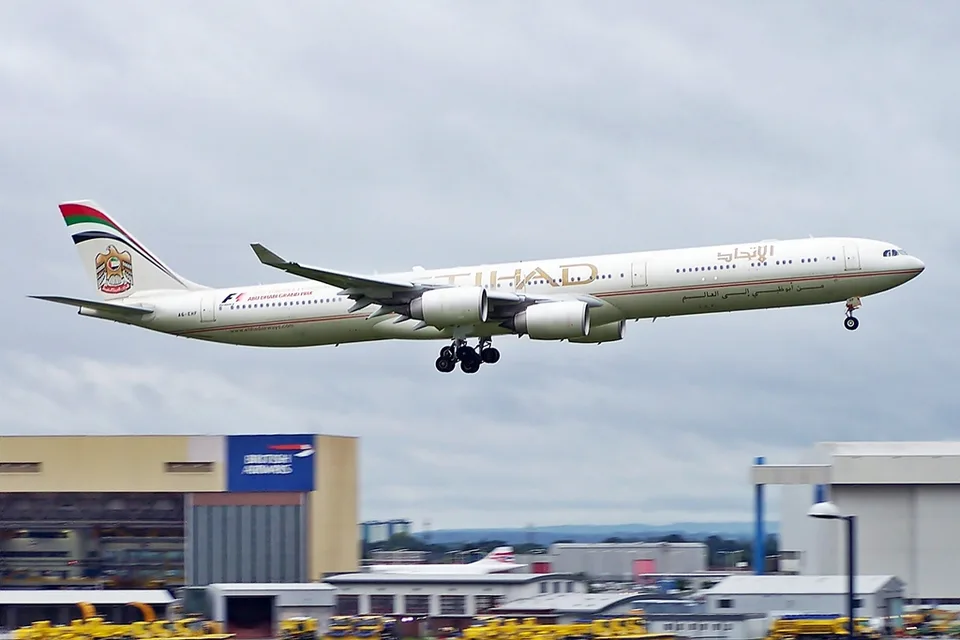
Ice crystals most probably obstructed two pitot probes over the Indian Ocean. The Etihad A340 crew diverted to Singapore and landed safely with 295 people aboard.
Original photograph used without cropping. Responsive WebP copies resized without cropping.
Geographic context
Abu Dhabi departure
Incident area in the Indian Ocean
Singapore Changi diversion
Melbourne planned destination
The incident position near the Colombo and Melbourne FIR boundary is estimated from Figure 13. The flight departed Abu Dhabi for Melbourne and diverted to Singapore. Basemap: Natural Earth, public domain.Read supporting evidence
At FL350, the captain and standby airspeed indications fluctuated while the first officer's indication remained steady. The autopilot, autothrust and flight directors disconnected, and the aircraft reverted to Alternate Law. Airspeed indications recovered, but the autopilots remained unavailable. The crew descended out of RVSM operations, diverted to Singapore, jettisoned about nine tonnes of fuel and landed without injury.
Read the full incident Follow what happened, from the flight to the investigation findings.
What investigators concluded
The AAIS found that intermittent obstruction of the left side pitot probes, most probably by ice crystals, caused the unreliable airspeed. An incorrect weather radar tilt setting and icing conditions outside the applicable certification and manufacturer envelopes contributed. Water entering through a disbanded Omega Seal caused the separate No. 2 engine vibration. The investigation found appropriate crew resource management during the incident and diversion.
1,572 words / about 8 minutes to read. Based on the investigation records cited below.
Cruise toward Melbourne
Etihad Airways flight ETD460 left Abu Dhabi at about 19:35 UTC on 2 February 2013 for Melbourne. The aircraft was Airbus A340-600 A6-EHF, carrying 278 passengers, four flight crew and 13 cabin crew. The captain was the pilot flying and the first officer was monitoring. Two relief pilots were available for the long flight. The aircraft was airworthy at dispatch, and the investigation found no pre-existing systems anomaly that contributed to the incident.
By about 00:49 UTC on 3 February, the flight was at FL350 on airway N640 between ELATI and PIPOV, crossing from the Colombo flight information region into the Melbourne region. Autopilot 1 and autothrust were engaged. The aircraft was flying through cirrocumulus cloud in instrument conditions with light turbulence. The weather radar showed few green returns. Its gain was set to automatic and its antenna tilt was being controlled manually at minus 0.8 degrees.
The dispatch weather chart showed isolated embedded cumulonimbus clouds reaching FL450 in the area. As the aircraft continued, turbulence increased and radar returns strengthened from mainly black through green to yellow. A small solid red area then appeared around the aircraft symbol. The captain's airspeed began to oscillate.
At 00:50:04 the captain's indicated airspeed dropped from 283 to 77 knots in two seconds, then rose again toward 270 knots. The other two indications were initially steady. At 00:50:10 the captain's reading fell again, and the standby speed also decreased. The first officer's indication continued to show a steady speed. At 00:50:12 the autopilot, autothrust and both flight directors disconnected automatically.
The flight controls changed from Normal Law to Alternate Law, removing some of the aircraft's flight envelope protections. The crew selected anti-icing and probe and window heating on. The captain's indication recovered, the flight directors returned, and by 00:50:22 the captain and standby displays had stabilized. The control system returned to Normal Law. The investigation found that the autopilot could have been re-engaged during this interval; the crew did not attempt it then.
At 00:51:02 the captain restored autothrust. Further fluctuations followed, first briefly on the captain's side and then on both the captain and standby displays. At 00:51:28 the controls reverted again to Alternate Law. NAV ADR DISAGREE and loss of protection messages appeared. The flight directors and autothrust disconnected again. The sequence of three airspeed disturbances extended over approximately one minute and 43 seconds.
Control transfer and attempts to restore the autopilot
The captain stabilized the aircraft at 00:51:46 and handed control to the first officer, whose instruments appeared to be functioning normally. Following the autopilot disconnection, the aircraft had climbed inadvertently 832 feet above FL350. The first officer descended back to the assigned level. Red SPD LIM flags appeared on the speed tapes; the lowest selectable speed and stall warning speed markings were lost.
After 00:51:48 the captain and standby readings recovered. The flight directors returned automatically, and autothrust was successfully re-engaged at 00:51:54. The first officer continued to fly manually. Neither autopilot could be restored. The captain selected air data reference 3 for his display. The crew began the air data checking procedure, but with all three speeds reading normally again, they did not carry it out.
The relief captain returned from rest to help. Using the quick reference handbook reset table, the crew reset flight control and flight management guidance computers. Maintenance control subsequently suggested further resets of data concentrator computers. These attempts did not restore an autopilot. The AAIS found that the crew were unaware that latched rejection of all three air data references prevented recovery: the abnormal and emergency procedures then in use omitted that information.
High frequency radio attempts to reach air traffic control were unsuccessful. The crew sent a PAN PAN message by controller pilot data link to Melbourne, reporting difficulty maintaining altitude because of aircraft performance, weather and turbulence. They also advised that reduced vertical separation minima capability had been lost. The crew reported a delay of about 20 minutes before the reply and clearance to divert arrived.
Maintenance control had received a high N1 vibration message for the No. 2 engine. The pilots checked the engine display and confirmed the vibration. The readings eventually reached 7.1 units. In coordination with maintenance control, the captain chose Singapore, where maintenance support was available. The combined circumstances included the unavailable autopilots, engine vibration, weather conditions and uncertainty about the weather radar's serviceability.
During the diversion the crew descended to FL290, leaving RVSM operations and maintaining visual conditions. The relief first officer took over the manual flying at that level. Before descending further, the crew obtained Jakarta ATC authorization and jettisoned approximately nine tonnes of fuel to bring the aircraft to its landing weight limit. At FL100 the captain took control and completed an uneventful ILS approach and landing on Singapore runway 02L. All 295 occupants survived without injury, and the aircraft was undamaged.
Why the indications recovered but the autopilot stayed unavailable
The A340 had three independent airspeed sensing systems. Each used a pitot probe and static pressure ports; the three pitot probes were electrically heated Goodrich 0851HL units. Air data were supplied to the flight guidance and flight control computers, which compared the different values and rejected readings that diverged beyond their monitoring thresholds.
The two computer systems used different thresholds. Flight guidance monitoring could reject an airspeed source after a deviation exceeding 20 knots for 450 milliseconds. Flight control comparison monitoring used a 16 knot difference confirmed for 10 seconds when three speeds were valid, reducing the confirmation time to one second when only two remained. These different monitoring paths affected which functions became available again after the readings recovered.
The recorded sequence explained the lasting loss of the autopilot. During the final disturbance, the captain's speed remained outside tolerance long enough for the flight control primary computers to latch rejection of that air data source. The standby speed then diverged from the first officer's speed. The computers rejected the remaining two references, leaving all three rejections latched for the rest of the flight and the controls in Alternate Law.
The flight guidance computers could accept recovered, consistent data again for autothrust and the flight directors. The autopilot depended additionally on the flight control computers, whose rejection remained latched. The AAIS found that these systems operated as designed. The first officer's airspeed had stayed steady, and there were no angle of attack anomalies or stall warnings. Associated changes in displayed altitude and temperature were inconsistent with the aircraft's physical motion and helped identify the false airspeed information.
The AAIS attributed the unreliable airspeed to intermittent obstruction of the left side pitot probes, most probably by accumulated ice crystals. Ground inspections and tests of the probes and air data systems found no faults. Probe heater testing was satisfactory, the post-flight record showed no probe heat computer failure, and normal airspeed and related readings continued during the ferry flight back to Abu Dhabi.
The weather radar also functioned correctly. The investigation found that its high tilt setting most probably scanned only the less reflective upper portion of the cell. Tilt and display range were not managed effectively enough to reveal the weather ahead, reducing the opportunity for avoidance. The aircraft encountered icing at a temperature and altitude outside the certification and manufacturer envelopes applicable to its probes. The incorrect radar tilt and those environmental conditions were the two contributing factors identified in the final conclusions.
The No. 2 engine had a separate icing mechanism. Examination found that its Omega Seal had disbanded, leaving a gap through which water could enter. Water or ice crystals passed through the spinner fairing and accumulated beneath the annulus fillers, creating an imbalance in the low speed rotor assembly. Engine anti-ice was apparently ineffective against that spinner fairing condition. The vibration diminished as the aircraft descended into warmer air and the ice fragmented and melted. It caused no engine damage. The AAIS found no causal link between the vibration and the unreliable airspeed.
Initial engine checks in Singapore included inspection of fan blades, annulus fillers and the fan case, a borescope examination and high power runs. Those checks produced no findings. The engine was subsequently removed for further examination, which revealed clearance between the spinner fairing and inlet cone, distorted and missing washers, and the loose Omega Seal.
All four pilots had received the required unreliable airspeed and dual air data fault training. The AAIS found appropriate crew resource management during the incident, descent and approach. It also identified missing information in the NAV ADR DISAGREE procedures about the lasting loss of the autopilot and the reduction of landing capability. Airbus supplied a procedure revision on 27 November 2013 that highlighted the autopilot limitation and the affected systems.
The cockpit voice recorder held only the last 120 minutes. Because the diversion took about three hours, the recording no longer contained the incident. Investigators obtained useful flight data recorder information and the operator's aircraft condition monitoring data, alongside crew accounts and maintenance evidence. The AAIS issued its final report on 13 September 2015.
Four recommendations followed. SR 41/2015 asked Etihad to strengthen initial and refresher training in manual weather radar techniques. SR 42/2015 asked EASA to consider requiring pitot probe icing qualification to the new CS-25 Amendment 16 standard for production aircraft and retrofits. SR 43/2015 asked the GCAA to consult recognized certification authorities about icing specifications, while SR 44/2015 called for weather radar training requirements for UAE operators. The report recorded the introduction of new environmental icing specifications on 12 March 2015 and ongoing certification work on new probes.
Follow the main stages, then open the evidence beneath each step.
1
Ice obstructs the left side probes
The captain and standby indications fluctuated while the first officer indication remained steady. The AAIS found ice crystal obstruction of the left side probes the most probable explanation.
The air data comparison and icing monitoring logic rejected inconsistent values, disconnecting automatic flight functions and changing the control law.
During the last disturbance all three air data references were rejected by the flight control primary computers. Alternate Law and the loss of autopilot availability continued to landing.
A simplified reading of the investigation findings. The sequence does not replace the full report or imply that every contributing factor is shown.
Sequence of events
All times are UTC. The flight departed Abu Dhabi on 2 February; the incident occurred after midnight on 3 February 2013. Expand an event to see its evidence.
2 February, about 19:35Departure from Abu Dhabi
ETD460 departed for Melbourne with 278 passengers and 17 crew. The captain was flying.
Further discrepancies caused rejection of all three air data references by the flight control computers. Alternate Law remained active for the rest of the flight.
The captain stabilized the aircraft and handed control to the first officer. The first officer corrected an 832 foot climb. Airspeed indications and autothrust recovered.
During the diversionManual flight toward Singapore
Attempts to restore an autopilot failed. The crew declared PAN PAN, coordinated with maintenance control, obtained diversion clearance and descended to FL290.
With Jakarta ATC authorization, the crew jettisoned about nine tonnes of fuel. The captain completed an ILS approach to runway 02L at Singapore. Nobody was injured.
Why could the pilots not re-engage the autopilot after the airspeed recovered?
The flight control primary computers had latched rejection of all three air data references. That rejection kept the aircraft in Alternate Law and prevented autopilot re-engagement for the remainder of the flight.
A gap left by the disbanded Omega Seal allowed water into the spinner assembly. It froze and accumulated under the annulus fillers, creating an imbalance. The vibration diminished as the ice melted during descent.
Was the incident captured on the cockpit voice recorder?
The recorder retained the last two hours of the flight. The diversion lasted about three hours, so the incident sequence had been overwritten by the time the aircraft landed in Singapore.
The AAIS concluded that accumulated ice crystals most probably caused the intermittent pitot obstruction. Post-flight checks found no probe or air data system fault.
The recorder retained the last two hours of the flight. The diversion lasted about three hours, so the incident sequence had been overwritten by the time the aircraft landed in Singapore.
The synopsis describes moderate to heavy turbulence. The recorder analysis gives normal accelerations from 0.72 to 1.25g and describes the turbulence as relatively light to medium.
Actions and recommendations are described at the dates of the cited records. A recommendation is not proof of implementation.
Procedure revision supplied in November 2013
Airbus updated the affected abnormal and emergency procedures to highlight the lasting loss of autopilot availability after flight control rejection of the air data, with references to inoperative systems.
SR 41/2015 addressed Etihad training; SR 44/2015 asked the GCAA to require optimum manual weather radar techniques in initial and refresher syllabi for regulated operators.
New environmental icing specifications were introduced in March 2015. The AAIS recommended that EASA consider their application to new and existing aircraft and that the GCAA consult certification authorities about the icing specifications.
These comparisons connect specific research topics. Shared circumstances do not establish identical causes. Evidence from both investigations is provided below.
Both investigations identified temporary airspeed disagreement associated with likely ice crystal obstruction and a change to Alternate Law. The Etihad crew recovered stable indications, corrected an altitude deviation and completed a manual diversion. The BEA found that Air France 447 entered a sustained stall after destabilizing control inputs and that the crew failed to diagnose the stall and recover.
Explore the records below for additional context. They open on the publisher's site and are not all included in our report search. Source reuse terms apply.
BEA findings on ice crystal obstruction, air data disagreement, alternate control law and the sustained stall.
Sources and transparency
UAE GCAA AAIS final report AIFN/0005/2013, dated 13 September 2015.
Source limitations
The cockpit voice recorder contained the last two hours of the flight; the incident occurred about three hours before landing. The investigation used flight data, maintenance records and crew information.
Unreliable Airspeed Indication, Etihad Airways Airbus A340-600 A6-EHF
UAE GCAA AAIS Serious Incident Final Report AIFN/0005/2013, dated 13 September 2015
Limited quotations for source-based commentary. Full report and illustrations are not republished. Wider reuse requires checking BEA terms. Source terms.
Kevin Murphy writes the incident accounts on AirlineIncidents.com, out of a long interest in aviation safety and the lessons each investigation leaves behind.
Prepared by
AirlineIncidents editorial desk
Report citation check
Independent expert review
Not completed
Citation checks compare supporting text with the indexed report pages. They do not constitute independent expert review. How these pages are prepared.
Revision history
: Published sourced incident account, timeline, photographs and investigation findings.