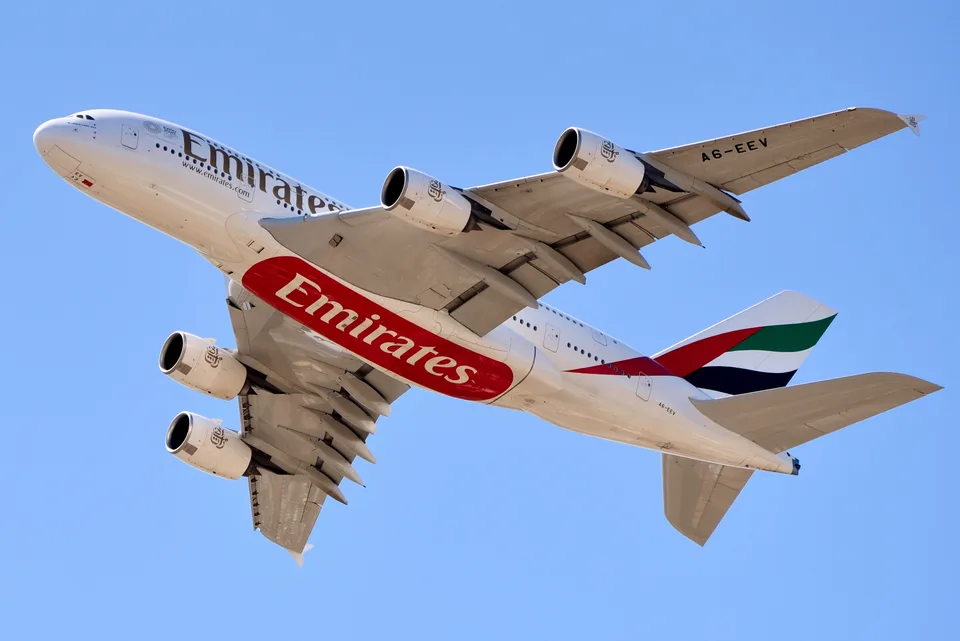
Original photograph unchanged. Responsive WebP copies resized without cropping.
Geographic context
Perth International Airport, departure
Severe turbulence southeast of Male, approximate
Dubai International Airport, destination
The report locates the encounter southeast of Male and about 35 nautical miles before AQAXA. The encounter marker is estimated from Figure 2; airport markers give geographic context. Basemap: Natural Earth, public domain.Read supporting evidence
At FL380 southeast of Male, EK421 encountered severe turbulence associated with developing tropical convection. Weak radar reflectivity and the display presentation gave no prominent indication of its turbulence potential. Unrestrained occupants struck cabin furnishings during abrupt vertical accelerations.
Read the full incident Follow what happened, from the flight to the investigation findings.
What investigators concluded
The GCAA identified developing tropical convection as the cause, with occupant restraint use and the short cabin preparation interval contributing to the injuries.
1,504 words / about 7 minutes to read. Based on the investigation records cited below.
Perth to Dubai
Emirates flight EK421 departed Perth at 1428 UTC on 4 December 2023 for Dubai. The Airbus A380-861, registered A6-EEV, carried 463 passengers, three pilots and 24 cabin crew. Seventy passengers occupied the upper deck and 393 were in the main cabin. The commander was flying from the left seat, the copilot was monitoring, and an augmenting captain occupied the third seat in the flight deck.
The pilots reviewed the operational flight plan, weather charts and weather applications before departure. Isolated convective activity was forecast near the Maldives. The commander assessed the conditions as typical for the route, and severe turbulence was not specifically highlighted in the briefing. The GCAA later found that flight preparation and briefing complied with Emirates' procedures and were consistent with the forecast information available at the time.
The aircraft initially cruised at FL340, then FL360. At 1911:17 it began a weather deviation in Melbourne flight information region. During this earlier part of the flight, the pilots used automatic radar monitoring and manual adjustments to examine weather. They climbed to FL380 at 1951 and subsequently resumed the planned route. The aircraft entered Colombo FIR at 2014 and Male FIR at 2029:06.
After entering Male FIR, the copilot went to rest and the augmenting captain took over the monitoring role in the right seat. The commander and augmenting captain watched isolated weather formations ahead and to the left. Moonlight helped them see clouds below, and the flight deck lights were dimmed to improve their outside view. They assessed the formations as lying beneath the aircraft's flight path.
The radar showed small green returns classified as off-path weather. The pilots changed the navigation display range while monitoring the developing picture. At FL380 the radar otherwise remained in automatic mode, apart from a brief gain adjustment earlier in the cruise. No additional assessment of the storms' vertical structure using the selectable radar functions was made during this segment.
The recorded range changes included the commander's reduction from 640 to 80 nautical miles at 2045:18. At 2101:03, the augmenting captain reduced his display from 160 to 80 nautical miles. Both displays were therefore set to 80 nautical miles when the commander activated the signs. The automatic elevation setting remained at 38,000 feet, with forward azimuth and level tilt settings.
With the flight smooth and the weather assessed as presenting no immediate threat, the augmenting captain left for a physiological break. A cabin crewmember occupied the flight deck jump seat in accordance with the operator's policy. The commander switched on the seat belt signs at about 2104:15 as a precaution. The report places this activation about 48 seconds before the severe encounter.
At about 2105 UTC, roughly 35 nautical miles before AQAXA waypoint, the A380 encountered turbulence at FL380. It was heading northwest at Mach 0.84. Flight data recorded a disturbed period extending from 2105:00 to 2105:50, with the strongest six seconds producing vertical accelerations from minus 0.5g to plus 2.16g. Vertical winds varied between an 11-knot downdraft and a 46-knot updraft.
The recorder data showed altitude varying between 38,195 and 37,515 feet during the encounter. Mach number ranged from 0.78 to 0.92, briefly exceeding the maximum operating Mach of 0.89 for less than one second. A master caution was associated with a loads-analysis message. The autopilot, flight directors and autothrust remained engaged. The GCAA found that the aircraft remained controllable throughout.
Inside the cabin, abrupt vertical movement lifted unrestrained occupants from their seats or feet and threw them against the ceiling or interior furnishings. The aft economy cabin, upper deck aft galley and bar lounge were particularly affected. Overhead bins, ceiling panels and passenger service units were cracked by impacts. Curtain rails in parts of the aft economy cabin and upper deck galley were also damaged.
When the signs illuminated, the economy cabin supervisor announced a turbulence warning and some cabin crew began securing the cabin. A juice and water service was nearly finished in economy. The purser was resting in a crew bunk, and eight cabin crewmembers were in the crew rest compartment. Some crew on the upper deck could not recall seeing the sign or hearing its activation chime.
Most cabin crew were standing in aisles, galleys or near lavatories, or were seated without their restraints fastened. The cabin securing process had only just started when the severe movement began. Among the 36 injured passengers, five were in lavatories and 31 were seated. Emirates' post-event analysis confirmed that 22 of the injured seated passengers had not been wearing seat belts.
The commander announced that cabin crew should take their seats after the turbulence began. Several crewmembers were able to secure themselves quickly. The augmenting captain, then in the first-class corridor, lay on the floor and wedged himself between seats. Four passengers and three cabin crewmembers sustained serious injuries. Another 32 passengers and 11 cabin crewmembers received minor injuries. There were no fatalities among the 490 occupants.
After the encounter, the crew assessed injuries and damage. Two doctors and two nurses, including an emergency room nurse, responded to an announcement requesting medical assistance. The copilot initially helped passengers and cabin crew, then returned to the flight deck and took over flying from the right seat. This allowed the commander to concentrate on the response and coordination.
The augmenting captain remained in the cabin, helped with the cleanup and care of injured people, and supplied updates to the commander. The purser coordinated the cabin response. The commander consulted the onboard medical professionals, ground medical support and the airline's network control centre. Injuries were assessed as non-life-threatening, and the decision was made to continue to Dubai.
The purser assigned available crew to the cabin doors for landing. Medical care took priority over several other pre-landing tasks, which could not be completed. The aircraft landed safely at Dubai at 0045:02 UTC on 5 December. Medical teams met the flight, and injured occupants were assessed at the airport clinic or local hospitals. Three seriously injured cabin crew were hospitalized, and one passenger required surgery.
The GCAA examined flight data, crew statements, the radar's operating characteristics and satellite imagery. Images showed a cloud formation developing during the two hours before the encounter. The forecast charts had indicated isolated embedded cumulonimbus clouds near the route, with tops extending above the aircraft's cruise altitude. The accident occurred southeast of Male in the tropical region near the Equator.
A6-EEV carried a Honeywell RDR-4000 radar. Its automatic presentation prioritizes weather within a vertical corridor around the projected flight path. At FL380, the relevant corridor extended from FL340 to FL420. Returns outside that corridor were displayed as off-path. Weakly reflective convection could receive less emphasis on the display even while its associated vertical motion extended to the aircraft's altitude.
Radar reflectivity depends on the size, composition and quantity of the particles ahead. The report explains that a water droplet is about five times as reflective as an ice particle of equal size. As liquid water decreases with height, a convective cloud can extend above its radar-detectable top. The radar's turbulence function operated over a forward range of up to 60 nautical miles and depended on sufficient precipitation movement within that volume.
The turbulence detection function uses movement within precipitation to identify wet turbulence. The GCAA found that insufficient hydrometeors were present to produce a turbulence alert. Engineering inspection confirmed that the radar was operating correctly. The investigation attributed the accident to severe turbulence associated with vertically developing tropical convection, whose weak reflectivity and radar presentation gave no prominent indication of the turbulence potential.
The final report, issued on 14 April 2026, identified two contributing factors: the presence of unrestrained passengers and cabin crew, and the short interval between sign activation and the encounter. That interval limited communication and cabin securing. The GCAA found no evidence of noncompliance with Emirates' documented procedures. It also found that the flight and cabin crew followed procedures for unanticipated moderate and severe turbulence during and after the event.
The aircraft underwent maintenance after arrival. Initial load analysis identified 15 structural areas for visual inspection. Checks covered the fuselage, wings, control surfaces, stabilizers, pylons and nacelles, with no issues identified in those inspections. Inspectors found a torn aft cargo net and five damaged ceiling light lenses in the holds. Further manufacturer assessment called for more detailed examination of the tail cone, horizontal stabilizer and elevators, including internal components.
Load analysis led to further manufacturer recommendations covering the wings, horizontal tailplane pivots and aft fuselage. Emirates implemented the resulting maintenance recommendations. The report also recorded a working group reviewing seat belt sign use, cabin securing, announcements and service levels, together with an upgraded LIDO mPilot application incorporating IATA Turbulence Aware.
Emirates changed the light-turbulence communication wording in its cabin manual from advisory to mandatory. The report recorded flight deck connectivity improvements, with A380 installation still in progress. Recommendation SR13/2026 asked Emirates to consider additional guidance and training on complementary radar functions during convective cruise operations. The GCAA identified this as an opportunity to improve situational awareness separately from the accident's causes.
The automatic presentation emphasized weather within the projected flight corridor. Insufficient precipitation particles were present for a turbulence alert.
A simplified reading of the investigation findings. The sequence does not replace the full report or imply that every contributing factor is shown.
Sequence of events
All times are UTC. The encounter occurred on 4 December 2023; landing at Dubai followed after midnight on 5 December. Expand an event to see its evidence.
Thirty-one injured passengers were seated, and Emirates confirmed that 22 of them were unbelted. Large vertical accelerations lifted unrestrained occupants into cabin fittings.
The GCAA found insufficient precipitation particles for Doppler turbulence detection. Weakly reflective tropical convection and the automatic radar presentation gave no prominent indication of the turbulence potential.
The GCAA could not determine conclusively whether the aircraft entered the top of a convective cloud. Satellite imagery lacked the detail needed to confirm its altitude.
The final report records a working group reviewing cabin practices, revised mandatory light-turbulence communication wording, and an upgraded weather application using IATA Turbulence Aware.
The GCAA recommended consideration of additional advice on complementary radar functions to improve situational awareness and strategic weather assessment during cruise.
These labels organise the evidence. They are not a ranking of causes. A shared label means a shared research topic, not an identical mechanism.
CauseSevere turbulence
Developing tropical convection produced severe turbulence with weak radar reflectivity and no prominent indication of the associated turbulence potential.
These comparisons connect specific research topics. Shared circumstances do not establish identical causes. Evidence from both investigations is provided below.
Both investigations documented unrestrained occupants striking cabin ceilings during sudden vertical accelerations. Qantas 72 involved erroneous angle-of-attack data and flight computer pitch-down commands. EK421 encountered convective turbulence. Both reports identify seat belt use as a factor in occupant injury severity.
Explore the records below for additional context. They open on the publisher's site and are not all included in our report search. Source reuse terms apply.
Kevin Murphy writes the incident accounts on AirlineIncidents.com, out of a long interest in aviation safety and the lessons each investigation leaves behind.
Prepared by
AirlineIncidents editorial desk
Report citation check
Independent expert review
Not completed
Citation checks compare supporting text with the indexed report pages. They do not constitute independent expert review. How these pages are prepared.
Revision history
: GCAA final findings identify tropical convection, weak radar reflectivity, occupant restraint use and the short cabin preparation interval.