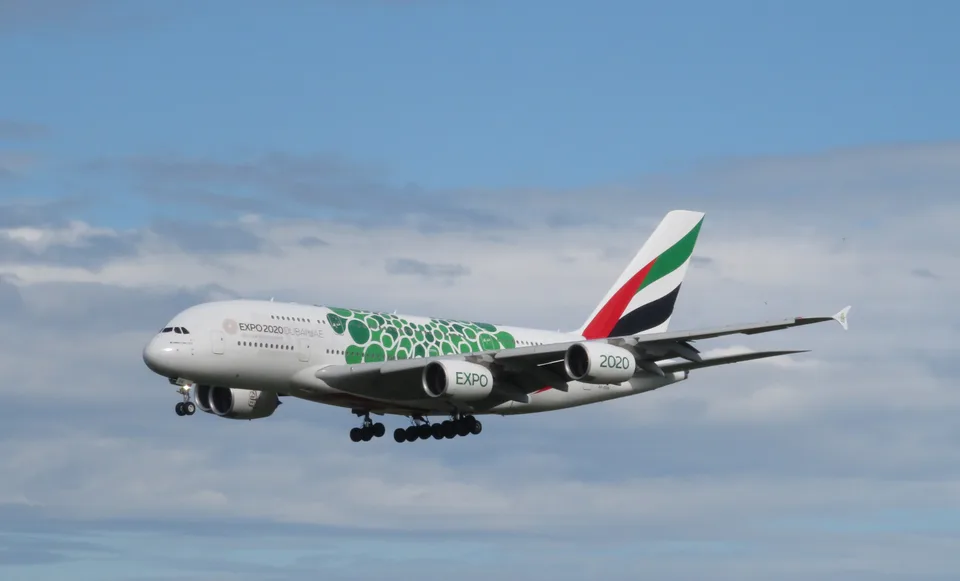
Clear air turbulence above Wyoming injured a passenger in an aft lavatory. The GCAA final report recommended more accessible handholds and turbulence instructions.
Original photograph unchanged. Responsive WebP copies resized without cropping.
Geographic context
Los Angeles departure
Turbulence above Trout Peak, approximate
Dubai destination and landing
Geographic markers show the departure, report-identified turbulence area above Trout Peak and Dubai destination. Positions are approximate. Basemap: Natural Earth, public domain.Read supporting evidence
UAE216 encountered turbulence while beginning a climb from flight level 330 to 350 above Trout Peak. A passenger was lifted into the air in an aft lavatory and sustained a serious ankle injury. The aircraft remained controllable and continued to Dubai.
Read the full incident Follow what happened, from the flight to the investigation findings.
What investigators concluded
The AAIS attributed the accident to clear air turbulence acceleration forces and the passenger's impact with lavatory furnishings. It listed inaccessible handholds and absent placarded instructions as contributing factors.
1,517 words / about 7 minutes to read. Based on the investigation records cited below.
Los Angeles to Dubai
Emirates flight UAE216 left Los Angeles at approximately 0032 UTC on 2 February 2020 for Dubai. The Airbus A380-861, registered A6-EON, carried 333 passengers and 28 crew: four flight crew and 24 cabin crew. Its planned route crossed the Rocky Mountains in Wyoming, within the Salt Lake City flight information region. The operational flight plan prepared by dispatch showed no significant weather for that region.
The commander was flying from the left seat. At 0038, as the aircraft climbed through flight level 100, he switched the seatbelt sign off. The aircraft was configured for 489 passengers, with first and business class on the upper deck and economy seating on the main deck. The passenger later injured during the flight was using a lavatory in the aft part of the main deck.
For the Wyoming sector, the flight crew had the weather radar and turbulence functions in automatic mode, with weather information selected for display. The commander used an 80 nautical mile navigation display range and the copilot used 160 nautical miles. The flight continued uneventfully toward waypoint KU84Q.
As the aircraft approached KU84Q, the crew heard other aircraft report light turbulence below flight level 290. The copilot checked the operational flight plan, which showed shear rates of zero or one between flight levels 330 and 350. Air traffic control had passed no turbulence reports to UAE216 for its own altitude or for flight level 350. The crew believed the planned route posed no turbulence threat.
The weather radar showed no precipitation. The crew described visibility of 10 kilometres and no clouds. The investigation confirmed that the Salt Lake City control centre had issued no significant meteorological information warning for the Wyoming area. The significant weather chart effective at 0000 UTC also showed no significant weather there.
The A380 carried a Honeywell RDR-4000 weather radar. Its turbulence function used the movement of precipitation to detect wet turbulence ahead of the aircraft. It scanned up to 40 nautical miles ahead, 20 nautical miles to either side and 5,000 feet above and below the aircraft. The function could not detect clear air or dry turbulence. Flight data later confirmed that it generated no turbulence alert before the encounter.
At about 0214, UAE216 was at flight level 330, with flight level 350 selected for a step climb. The selected speed was Mach 0.85 and the heading was 028 degrees. Autopilot 1, both flight directors and autothrust were engaged. All four thrust levers were in the climb detent. Four seconds before the turbulence began, the crew changed the longitudinal guidance mode from climb to vertical speed.
The encounter began at 0214:42 and lasted until 0216:36, approximately one hour and 42 minutes after departure. The aircraft was beyond KU84Q, above Trout Peak in the Absaroka Range of the Rocky Mountains. Recorded airspeed ranged from Mach 0.812 to 0.876. Vertical speed varied from a descent of 580 feet per minute to a climb of 1,400 feet per minute, while pitch stayed between 0.7 and 3.5 degrees nose up.
The recorded vertical acceleration ranged from positive 0.44 G to positive 1.63 G. Three seconds after the onset, the crew switched the seatbelt sign on and announced that cabin crew should sit down. Autopilot and autothrust stayed engaged. There were no cockpit audio or visual warnings, no excessive altitude loss and no exceedance of the maximum operating Mach number. The thrust levers stayed in the climb position throughout the encounter.
The recorder also captured changing wind components during the encounter. The tailwind component varied from 11 to 43 knots, while the left crosswind gust component ranged from 20 to 82 knots. Vertical gusts included a 14-knot downdraft and a 31-knot updraft. Before the encounter, recorded wind information had shown an average wind speed of 65 knots from 080 degrees, with both a tailwind component and a crosswind component from the right.
One passenger was injured in the lavatory beside the ML5 passenger door. The cabin crew recorded that she had been lifted into the air and twisted her ankle on coming back down. She was in severe pain and could not move her foot. Emirates subsequently told the investigation that she had sustained a fracture of the left ankle, classified as a serious injury. Investigators were unable to obtain her medical report.
The injury table recorded one seriously injured passenger and 360 uninjured occupants. There were no fatalities, minor injuries or reported crew injuries. The aircraft and its cabin sustained no reported damage. Medical attention was provided during the flight.
The flight crew contacted the operator's ground medical team to assess the passenger's condition. The commander decided to continue to Dubai because the injury was considered non-life-threatening and the aircraft systems had been unaffected. The rest of the flight and the landing at Dubai were uneventful.
The United States National Transportation Safety Board delegated the investigation to the UAE Air Accident Investigation Sector on 6 February 2020. The AAIS classified the occurrence as an accident because of the passenger's serious injury. Its inquiry covered the relevant flight operations, aircraft systems and cabin safety.
The NTSB represented the state where the occurrence took place, while the French BEA represented the state of aircraft design and manufacture. Both assigned accredited representatives. Airbus advisers assisted the BEA representative, and Emirates assigned a technical expert to help the investigator in charge. The AAIS led the inquiry as the authority of the operator and aircraft registry.
Investigators obtained the flight data recorder information and supplied it to Airbus for analysis. The manufacturer produced a summary of the recorded conditions and aircraft performance. The cockpit voice recorder held only the final two hours of the flight, so the encounter audio had been overwritten. The investigation was also unable to retrieve the air traffic control communications from before and after the turbulence.
The crew had initially assessed the turbulence as moderate and approaching the severe threshold, based on the aircraft's altitude, attitude and speed variations. The AAIS analysis of the recorded gravitational loads found that it momentarily reached severe intensity. The aircraft remained controllable and its systems and engines performed as designed. Investigators found no technical anomaly before the encounter.
The AAIS found that the flight had followed the operator's procedures and that the crew had used the available automation, weather radar and flight plan information appropriately. The flight and cabin crew held the required licences and medical certificates, met rest requirements and had completed recurrent training that included turbulence duties.
There was no aircraft close to UAE216's flight level, and the investigation excluded wake vortices as the source of the turbulence. With no active weather system over the Absaroka ridges, the AAIS considered mountain waves a possible explanation for the unanticipated clear air turbulence.
The operator's manual described mountain waves forming on the lee side of mountain ranges. These standing waves could extend 10,000 to 20,000 feet above the terrain and 200 to 300 nautical miles downwind. The manual instructed crews to remain alert to this hazard. Its seatbelt policy required the sign to be on when turbulence existed or was expected. The AAIS found that the crew reacted appropriately when this encounter began, including the immediate cabin instruction, turbulence report to air traffic control and consultation with medical support.
The operations manual also allowed the commander to require seatbelts at his discretion or under abnormal or emergency procedures. Whenever belts were required, passengers aged two or above had to use a safety belt or an approved child restraint. Annual flight and cabin crew training included theoretical and practical turbulence duties, while the manual described light, moderate and severe turbulence and the corresponding crew actions.
The lavatory occupied by the injured passenger had a single handhold that was readily reachable when seated on the toilet. Investigators examined the wider A380 lavatory arrangements. Accessible lavatories had several handholds at different heights. Other lavatories had either one or two, with a mixture of horizontal and vertical orientations.
The handles in these other lavatories were positioned within reach of a seated person. None had a handhold beside the sink, and in some arrangements a person using the sink had the handle behind their back. There were no placards telling occupants to use the available handles during turbulence.
The AAIS could not determine whether the handhold deficiencies contributed to this accident because it could not interview the injured passenger. It considered her description of being lifted into the air consistent with her probably being unable to secure herself using the single handle. Investigators called for handles that occupants could easily reach while seated, standing or using the sink.
The final report, issued on 10 September 2020, identified the cause as the acceleration forces imposed while the aircraft crossed clear air turbulence, resulting in an unsecured passenger forcefully striking furnishings in the lavatory. Its contributing factors were the absence of placarded instructions and inaccessible lavatory handholds.
Safety recommendation SR81/2020 asked Emirates to standardise and improve the accessibility of lavatory handholds and add placarded instructions for their use during turbulence. The recommendation addressed the means by which a lavatory occupant could secure themselves when an unexpected encounter began.
Why did the weather radar give no turbulence warning?
The radar detected wet turbulence through precipitation movement. Its turbulence function could not detect clear air or dry turbulence, and no alert preceded this encounter.
Recommendation SR81/2020 asked Emirates to standardise and improve lavatory handhold accessibility and add instructions for using the handholds during turbulence.
Matching dossiers for Mountain waves: No other dossier in this collection.
Read alongside
These comparisons connect specific research topics. Shared circumstances do not establish identical causes. Evidence from both investigations is provided below.
Medical events shaped the continuation decisions on both flights. UAE216 continued to Dubai after consultation with ground medical support about the injured passenger. On Etihad A6-EYN in 2015, the copilot became incapacitated and the commander returned to Abu Dhabi, with cabin crew and a doctor attending to the copilot.
Explore the records below for additional context. They open on the publisher's site and are not all included in our report search. Source reuse terms apply.
Kevin Murphy writes the incident accounts on AirlineIncidents.com, out of a long interest in aviation safety and the lessons each investigation leaves behind.
Prepared by
AirlineIncidents editorial desk
Report citation check
Independent expert review
Not completed
Citation checks compare supporting text with the indexed report pages. They do not constitute independent expert review. How these pages are prepared.
Revision history
: Published sourced incident account, timeline, photographs and investigation findings.