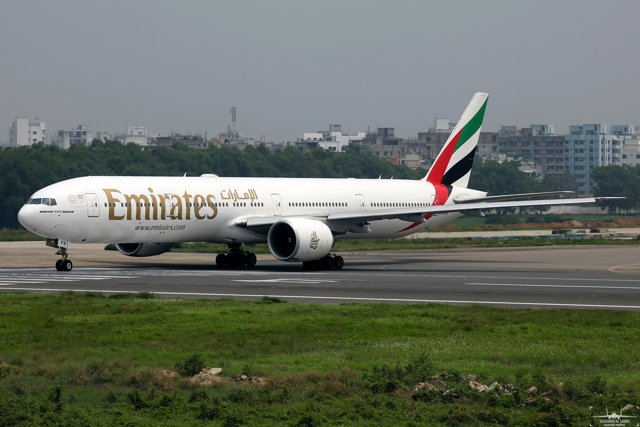
Seven occupants were injured when A6-EPN encountered severe turbulence during descent toward Beirut. A weather-message format mismatch delayed a warning to the crew.
Resized from 3000 by 2000 pixels and compressed as JPEG. The full frame is retained.
Geographic context
Dubai departure
Turbulence encounter in Nicosia FIR
Beirut destination
The turbulence position is the recorded location of the peak negative vertical load at 0804:41 UTC. Airport markers are approximate; the connecting lines show geographic context. Basemap: Natural Earth, public domain.Read supporting evidence
At about 0804 UTC, Emirates EK957 encountered moderate to severe turbulence in the Nicosia FIR while descending from FL360 toward Beirut. One passenger sustained a serious right foot fracture; two passengers and four cabin crewmembers sustained minor injuries. The Boeing 777 landed at Beirut at 0840 UTC.
Read the full incident Follow what happened, from the flight to the investigation findings.
What investigators concluded
The GCAA identified significant vertical forces from severe clear air turbulence as the cause of the accident: an unsecured passenger was lifted off her feet and struck cabin furnishings, fracturing her right foot. Jet stream and thunderstorm influences, missing critical SIGMET information in the cockpit, and a format mismatch that delayed the dispatch alert were contributory factors.
Three minutes of turbulence on the descent to Beirut
1,551 words / about 8 minutes to read. Based on the investigation records cited below.
A descent with weather ahead
Emirates EK957 left Dubai on 17 January 2021 for Beirut with 50 passengers, two pilots and 12 cabin crewmembers aboard Boeing 777-31HER A6-EPN. The aircraft departed at 0427 UTC. Before departure, the commander had warned the cabin crew that turbulence was possible during the descent. The significant weather chart in the operational flight plan forecast occasional embedded cumulonimbus clouds in the Nicosia and Beirut flight information regions, together with moderate turbulence that could occasionally become severe between FL380 and FL280.
The aircraft had been manufactured in June 2016 and was powered by two General Electric GE90-115B engines. It had 360 passenger seats across first, business and economy cabins. Its maintenance records were current, and investigators found no significant technical defects before the accident. Both pilots and the cabin crew had attended annual recurrent safety and emergency procedures training, including duties during turbulence. The aircraft carried flight data, cockpit voice and quick access recorders.
The pilots had downloaded their flight plan at 0146. Its briefing package contained no SIGMET, the messages used to warn aircraft of significant weather along a route. Larnaca meteorologists subsequently issued SIGMET 3 at 0515, forecasting occasional severe turbulence between FL260 and FL390 south of latitude 34 degrees 30 minutes north. The warning covered 0530 to 0930, including the period when EK957 would cross the Nicosia region. The flight crew remained unaware of that warning as they approached the area.
At 0758, the aircraft was at FL360 in the Cairo region, about 15 nautical miles from Nicosia airspace. The crew expected to deviate around cumulonimbus clouds ahead. Nicosia control offered a direct clearance to ZALKA instead of the planned waypoint PASOS. The pilots accepted a heading of 042 degrees, which they expected would avoid the clouds. The commander reported weather radar returns about 120 nautical miles straight ahead and another cell 50 nautical miles away to the left.
At 0800:21, while still at FL360, the flight crew switched on the seatbelt sign and instructed the cabin crew to secure the cabin for anticipated turbulence. Descent began 34 seconds later, at 0800:55. The warning came earlier than the usual descent threshold in the airline seatbelt policy. Cabin crewmembers began preparing equipment and passengers for arrival. The commander had not yet ordered them to take their own seats.
The airline procedures required pilots expecting turbulence to advise the cabin crew of the time available to secure the cabin, its expected severity and its expected duration. The cabin manager was responsible for ensuring passengers were secured and, when required, the cabin crew as well. The investigation considered it possible that knowledge of SIGMET 3 would have increased the urgency of seating everyone before descent began.
About three minutes into the descent, as the aircraft passed approximately 29,200 feet, turbulence began. The copilot immediately announced that cabin crew should take their seats. The commander described a rapid increase in turbulence, airspeed changes and violent jolts that made the instruments difficult to read. Several cabin crewmembers recalled severe turbulence starting less than a minute after the seating instruction. They were still securing the cabin and passengers, and several passengers remained out of their seats or unsecured.
The flight recorder timed significant turbulence from 0803:56 until 0806:56, during the descent from 29,200 to 22,200 feet. The first particularly energetic interval lasted from 0804:20 to 0805:08. At 0804:41, near 32.85685 degrees north and 33.85498 degrees east, the recorded vertical load factor reached minus 0.49 g. About one second later it reached plus 1.72 g. A further energetic interval followed from 0805:29 to 0805:46, with a peak positive vertical load factor of 1.71 g.
The negative vertical forces lifted unsecured occupants off their feet and into cabin furnishings. The passenger who sustained the serious injury was standing near the lavatory beside the left rear door L4, close to seat 37C. She suffered a fracture of her right foot. Another passenger was seated and sustained an impact to the knee. A passenger in the washroom beside door R4 suffered a bloody nose and a swollen, bruised leg.
Four cabin crewmembers sustained minor injuries. One was securing galley equipment beside door L2A when she was lifted into surrounding furnishings. Another was preparing the cabin near passenger seat row 24 and struck his knee against an armrest after being lifted repeatedly. A crewmember helping secure an infant and child at seat 38G was holding the child when turbulence lifted them upward, and her head struck the ceiling. A fourth crewmember, who had been directing passengers to sit down, could not secure himself at seat 47D and was lifted into the ceiling.
Five of the seven injured occupants were in the aft cabin, including the seriously injured passenger. After the aircraft passed approximately FL240, the pilots contacted the cabin manager to assess the injuries. The four injured cabin crewmembers were able to resume normal duties. The final injury table recorded one serious injury, six minor injuries and 57 uninjured people. All 64 occupants survived.
In the cockpit, the commander used speed intervention to reduce the selected speed toward 280 knots and intermittently extended the speedbrakes as airspeed increased. When vertical speed briefly exceeded 5,000 feet per minute, he selected vertical speed mode. At 0804:21, the copilot requested a deviation of 20 nautical miles to the right because of weather. The commander selected a heading of 070 degrees. The autopilot and autothrottle remained engaged throughout the turbulence, and aircraft control was maintained.
At 0807:45, the copilot told Nicosia control that the turbulence had reduced to light. Light turbulence continued for the remainder of the flight. EK957 landed uneventfully at Beirut at 0840, and ground medical services were contacted after landing. Engineers performed the required severe turbulence inspection and found no damage. The aircraft was released for service. The investigation found that its systems and engines had performed as designed and that its operating limitations had been respected.
Investigators obtained valid data from the flight data and quick access recorders and supplied them to Boeing for analysis. The cockpit voice recording of the occurrence had been overwritten. Nicosia control communications were available, including the request to deviate and the subsequent reports of turbulence intensity. The weather radar system could not record the weather displayed on the navigation screens, except during windshear events. The pilots described the absence of threatening radar returns during the descent.
Emirates dispatch used WSI Fusion to monitor significant weather near each flight path. The application read incoming SIGMET messages and generated advisories for dispatchers. For SIGMET 3, it extracted an altitude range shown as FL260 to FL260. The original message described turbulence between FL260 and FL390, using the word AND between the two levels. The internationally recognized format separated those levels with a slash. WSI Fusion stopped interpreting the altitude information at FL260 when it encountered the incompatible wording.
The warning had been issued while EK957 was cruising in the Jeddah region, about two hours and 43 minutes before it entered Nicosia airspace. The application generated its alert only at 0805, when the descending aircraft reached FL260. Dispatch transmitted an ACARS message at 0809. By then the aircraft had already passed through the main turbulence. The airline sterile cockpit policy held the message for display after landing. The investigation could not determine the arrival time entered in the flight management system and therefore could not calculate the message hold time.
The GCAA found that the airline safety management system had not identified the risk arising from incompatibility between SIGMET formats and the software interpreting them. Larnaca messages also differed from the standard template in the placement or omission of location information. The investigation identified the absence of critical SIGMET 3 information in the cockpit and the format mismatch that delayed the alert as contributory factors.
The weather analysis placed EK957 on the northern underside of a strong jet stream, with wind speeds changing vertically and horizontally as the aircraft descended. Boeing calculated a horizontal wind reduction of about 49 knots over roughly eight seconds. The aircraft also flew just above, or possibly through, thunderstorm tops. The GCAA concluded that jet stream and thunderstorm influences most likely produced the turbulent atmosphere and that the encounter was most likely associated with clear air turbulence. The aircraft weather radar required sufficient precipitation to detect turbulence and could not sense clear air turbulence.
A satellite image taken at 0800 showed lightning near the flight path, and the UAE National Center for Meteorology estimated cloud tops near FL300. Boeing also examined atmospheric soundings and model data. An index used to assess turbulence potential from wind shear placed the encounter in a region capable of strong turbulence, close to the jet stream. Modelled winds reached about 170 knots just south of and above the aircraft.
The final report, issued on 29 July 2021, identified the vertical forces from severe clear air turbulence as the cause of the serious passenger injury. It found the pilots' decisions appropriate to the information available and their actions consistent with operating procedures. Emirates advised that it would add the event to dispatcher recurrent training and assess the risk of SIGMET format incompatibility. The Cyprus meteorological office advised that it would inform forecasters, issue instructions and correct its operations manual. The GCAA recommended that ICAO engage EASA and meteorology specialists on standardizing SIGMET publication to avoid incompatibility with airline software.
Follow the main stages, then open the evidence beneath each step.
1
Descent through strong wind shear
The aircraft descended beneath the northern side of a jet stream near thunderstorm tops. The investigation associated the severe turbulence with the changing winds in that area.
WSI Fusion stopped interpreting the SIGMET altitude range at FL260 after encountering the word AND. It generated an alert only when the descending aircraft reached that level.
The seatbelt sign was on, but cabin crewmembers were still securing passengers and equipment when severe turbulence began. Several occupants remained unsecured.
Negative vertical loads lifted unsecured occupants into cabin furnishings. One passenger fractured her right foot, and six other occupants sustained minor injuries.
The pilots changed speed and vertical guidance selections and deviated right. The autopilot and autothrottle remained engaged, and the aircraft landed at Beirut.
A simplified reading of the investigation findings. The sequence does not replace the full report or imply that every contributing factor is shown.
Sequence of events
All event times are UTC. The flight recorders timed significant turbulence from 0803:56 to 0806:56 on 17 January 2021. Expand an event to see its evidence.
0146Flight plan downloaded
The briefing package forecast embedded cumulonimbus clouds and turbulence in Nicosia and Beirut airspace. It contained no SIGMET.
One passenger sustained a serious right foot fracture. Two passengers and four cabin crewmembers sustained minor injuries. Unsecured occupants were lifted into cabin furnishings; the seriously injured passenger had been standing near the lavatory beside door L4.
The recorder measured a vertical load factor of minus 0.49 g at 0804:41 UTC, followed about one second later by plus 1.72 g. The autopilot and autothrottle remained engaged, and the aircraft stayed controllable and below its maximum operating speed.
Why did the weather alert reach the crew after landing?
WSI Fusion interpreted the affected altitude as FL260 alone after stopping at the word AND in the SIGMET altitude range. It generated an alert at 0805, after turbulence had begun. Dispatch sent the ACARS message at 0809, and the sterile cockpit policy held its display until after landing.
The occurrence recording on the cockpit voice recorder had been overwritten. Valid flight data and quick access recorder data were available for analysis.
The GCAA concluded that jet stream and thunderstorm influences most likely produced the turbulence and that the encounter was most likely associated with clear air turbulence.
The GCAA found the pilots decisions appropriate to the available information. It considered it possible that access to SIGMET 3 would have increased the urgency of seating everyone before descent.
Actions and recommendations are described at the dates of the cited records. A recommendation is not proof of implementation.
Dispatcher training and risk assessment
Emirates advised the investigation that it would include EK957 in the next dispatcher recurrent training cycle and assess SIGMET format incompatibility and mitigations.
The Cyprus meteorological office advised that its actions would include informing forecasters, adding instructions to the continuity book and correcting its operations manual for SIGMET preparation.
The GCAA recommended that ICAO engage EASA and meteorology specialists to address standardized SIGMET publication and compatibility with airline software.
Matching dossiers for Unsecured occupants: No other dossier in this collection.
Read alongside
These comparisons connect specific research topics. Shared circumstances do not establish identical causes. Evidence from both investigations is provided below.
Both investigations describe injury risks when rapid vertical accelerations affect unsecured occupants. EK957 encountered severe turbulence during descent. Qantas 72 experienced computer-commanded pitch-downs after erroneous angle-of-attack data; the ATSB found substantially greater injury rates and severity among occupants who were standing or seated without a fastened seatbelt.
Explore the records below for additional context. They open on the publisher's site and are not all included in our report search. Source reuse terms apply.
Kevin Murphy writes the incident accounts on AirlineIncidents.com, out of a long interest in aviation safety and the lessons each investigation leaves behind.
Prepared by
AirlineIncidents editorial desk
Report citation check
Independent expert review
Not completed
Citation checks compare supporting text with the indexed report pages. They do not constitute independent expert review. How these pages are prepared.
Revision history
: GCAA final report AIFN/0002/2021 issued 29 July 2021.