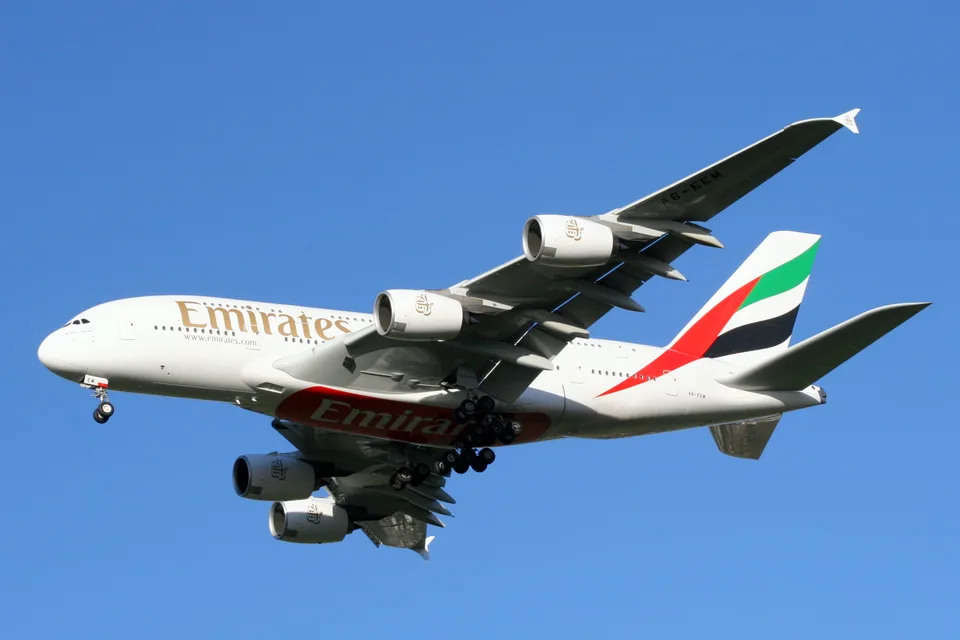
Original photograph retained in full. Responsive WebP copies resized without cropping.
Geographic context
Auckland Airport, departure
Bay of Bengal, approximate turbulence area
Dubai International Airport, destination
The turbulence area is marked approximately from the report weather chart. UAE449 was near IDASO, approximately 200 nautical miles east of Chennai. Auckland and Dubai mark the departure and destination airports. Basemap: Natural Earth, public domain.Read supporting evidence
UAE449 was cruising at FL400 about 13 hours after departure from Auckland when severe turbulence lifted occupants into cabin furnishings. The seat belt sign had been on for about five minutes, but cabin crew were unaware of it and cabin preparation had not been completed. The flight continued to Dubai after medical advice.
Read the full incident Follow what happened, from the flight to the investigation findings.
What investigators concluded
The AAIS attributed the accident to severe turbulence acceleration forces in clear air in an area affected by convective activity. Contributing factors involved route planning, weather information, radar use and communication needed to secure the cabin.
1,516 words / about 7 minutes to read. Based on the investigation records cited below.
A long flight toward monsoon weather
Emirates flight UAE449 left Auckland at 08:35 UTC on 10 July 2019 for a planned 17-hour flight to Dubai. The Airbus A380-861, registered A6-EEM, carried 378 passengers, four flight crew and 25 cabin crew. Seventy-eight passengers occupied the upper deck and 300 the main deck. Four pilots allowed the operating crew to alternate with an augmenting captain and copilot during the long flight.
Dispatch had produced the operational flight plan at 05:58. Its significant weather charts were effective from 18:00 and covered the planned route over the Bay of Bengal. The pilots discussed weather, alternate airports, fuel and rest arrangements before departure. They knew that monsoon conditions affected the bay, but considered the forecast compatible with their route. The Cabin Manager was briefed about expected turbulence along the flight.
The forecast package had been produced approximately sixteen hours before the aircraft approached IDASO. The AAIS identified the decreasing reliability of such forecasts over a long flight as a planning concern. It confirmed that the Indian meteorological office had issued no SIGMET warnings for the area. A later chart supplied to the investigation showed continuing convective activity with isolated embedded cumulonimbus clouds; that chart had not been available to the flight crew.
About an hour before the encounter, the augmenting pilots took over while the commander and the other copilot rested. The outgoing crew mentioned weather activity near waypoint IDASO and other aircraft requesting deviations. The augmenting copilot, seated on the right, became pilot flying. The aircraft continued along its planned route toward the Indian airspace over the bay.
Approaching the weather at night, the pilots dimmed the cockpit lights to observe lightning and cloud tops. They described the weather radar showing activity below or away from their track and believed that a clear area lay ahead. They continued without requesting updated weather information from air traffic control or flight dispatch. The radar weather and turbulence functions were operating in automatic mode, with weather selected for display.
At about 21:48, approximately 40 nautical miles before the encounter, the captain switched on the seat belt sign as a precaution. On the A380, that action illuminated the signs after five seconds of flashing and sounded a single low tone chime. The aircraft had no automatic passenger announcement tied to the switch. The captain did not call the Cabin Manager, and no announcement directed passengers back to their seats.
Fifteen cabin crew were on duty, while nine were resting. Thirteen of the on-duty crew were standing in the cabin, galleys or near lavatories. Cabin service was minimal and no serving trolleys were in the cabins. The on-duty crew did not recall noticing the sign or hearing its chime. The cabin readiness checks required after its activation were consequently not performed.
At 21:53:25, approximately 13 hours into the flight, the A380 encountered turbulence near IDASO, about 200 nautical miles east of Chennai. It was cruising at FL400 with a selected speed of Mach 0.84. The encounter lasted until 21:57:30, with the strongest turbulence concentrated in its first 20 seconds. The pilots described being jostled up and down and having to brace themselves despite wearing their belts.
Recorded data showed a tailwind component falling from 54 knots to 17 knots in five seconds, together with rapidly changing lateral gusts. A downdraft of about 3,000 feet per minute was followed by a similar updraft. Vertical acceleration varied between minus 0.35 G and plus 1.65 G. The abrupt wind changes increased the aircraft speed and briefly carried it beyond its maximum operating Mach number.
The copilot deployed the speed brakes and reduced the selected speed. Autopilot and autothrust remained engaged throughout, and the AAIS found that the crew correctly followed the overspeed prevention procedure. Automatic thrust adjustment and speed brake deployment could not fully prevent the brief exceedance. The flight recorder captured a three-second overspeed warning that the pilots did not notice. The aircraft remained controllable, and its load alleviation system operated to reduce wing loads.
In the first class cabin, the Cabin Manager and two colleagues tried to reach their jumpseats as the aircraft shook. Galley equipment fell to the floor. Once seated, the Cabin Manager made an announcement for passengers and crew to take their seats. He then used the intercom to advise the captain that the crew were seated and injuries were possible. In the business class aft galley, four crew were lifted into the ceiling and injured.
The final injury total was 27. Fourteen passengers were hurt, including one with a serious injury; thirteen cabin crew sustained minor injuries. The seriously injured passenger was in an aft main-deck washroom when she hit her head on the ceiling. She remained conscious and complained of neck pain. After arrival in Dubai, a hospital CT scan revealed a fracture to the right lateral mass of her first cervical vertebra.
Ten injured passengers were in economy and four in business class. Minor injuries included bruises and lacerations from contact with the cabin structure. Several aft main-deck ceiling panels near door L5 were damaged, as were panels in the upper-deck aft galley, and some ceiling exit signs detached. The four injured business class galley crew did not resume duties for the rest of the flight.
Seven of the nine cabin crew resting in the aft crew rest compartment suffered minor injuries when their heads struck its upper interior. All nine had their waist belts fastened loosely. The compartments had no handholds, and their hard plastic interior panels had no cushioning to protect against head impacts. The AAIS examined the risk of injuries both during turbulence and while entering or leaving the beds.
The investigators also reviewed handholds in lavatories, galleys, lounges and showers. In ordinary lavatories, handles were reachable from the toilet but there were none beside the washbasin. Most wet galley handles were above counter height, sometimes above the crew member's head, and their colour matched the surrounding structure. Dry galleys and workstations had no handholds. These arrangements limited opportunities to secure oneself during an unexpected encounter.
Among the fourteen injured passengers, two were in lavatories and twelve were seated. The operator confirmed that six seated injured passengers had been unbelted. The AAIS considered it most likely that the remaining six had also been unbelted. It found missed opportunities during the five minutes after the sign came on to prepare the cabin and reduce exposure to the turbulence.
The pilots initially regarded the turbulence as moderate, then classified it as severe after receiving cabin reports of injuries and damage. The resting commander contacted the operating captain and returned to the cockpit with the other copilot. The flight crew contacted the operator's ground medical team to assess the injured passengers and crew.
The commander decided to continue to Dubai because the injuries were assessed as non-life-threatening and the aircraft systems had not been affected. The rest of the flight and the landing were uneventful. Medical personnel attended the injured on arrival. All 407 occupants survived. The crew made a technical log entry for severe turbulence; the aircraft maintenance system also recorded that overspeed loads analysis was required.
The investigation downloaded the flight data recorder and used quick access recorder information to establish when the seat belt switch had moved to ON. Airbus analysed the recorded aircraft response and weather radar parameters. A recorded turbulence parameter indicated that magenta areas of wet turbulence had been displayed before the encounter, within the radar detection envelope ahead of the aircraft.
The pilots recalled using manual radar gain, but the recorded data showed that manual modes had not been selected during the five minutes immediately before the encounter. The AAIS found that the radar operated as designed. It concluded that the crew had not observed the magenta areas and had not used the manual modes effectively to assess the convective weather. The report called for clearer guidance on wet turbulence detection and additional cockpit alerting.
The AAIS attributed the accident to severe turbulence acceleration forces in clear air as the aircraft flew through an area affected by convective activity. Those forces caused unsecured passengers and cabin crew to strike furnishings. Its contributing factors included planning near forecast convective activity, failure to request updated weather information, limited radar use and the lack of communication to secure the cabin after the seat belt sign was switched on.
The Final Report, issued on 12 August 2020, recorded Emirates briefings and training concerning adverse weather, radar operation and flight crew communication with cabin crew. Emirates reported increasing the A380 seat belt chime volume on 19 September 2019. It also reported revising the seat belt announcement with fourteen additional languages from February 2020 and using an in-flight entertainment message about turbulence precautions.
The AAIS issued three final recommendations to Emirates. They addressed flight planning for locations affected by seasonal significant weather, more accessible and identifiable handholds in lavatories, galleys and showers, and measures to reduce head injuries in crew rest compartments. Three recommendations to Airbus addressed clearer manual guidance on wet turbulence detection, enhanced cockpit alerts when the radar detected it, and recording the precipitation information displayed to pilots so it could support training.
Follow the main stages, then open the evidence beneath each step.
1
Convective activity along the route
The planned route passed north of forecast convective weather over the Bay of Bengal. The pilots continued on course while observing lightning and off-path weather indications.
The captain switched on the seat belt sign about five minutes before the encounter, but did not call the Cabin Manager. Cabin crew did not notice the warning and continued their duties.
Passengers and crew hit furnishings and ceiling panels. A washroom passenger suffered a serious neck injury, and seven resting cabin crew struck the upper part of their bed compartments.
The captain switched on the sign about 40 nautical miles before the encounter. He did not call the Cabin Manager and no passenger announcement followed.
Switching on the signs made them flash for five seconds and sounded a single low tone chime. The A380 had no automatic passenger announcement linked to the switch, and the captain did not call the Cabin Manager.
The tailwind fell sharply. Automatic thrust reduction and speed brake deployment could not fully prevent the brief Mach limit exceedance. The autopilot and autothrust remained engaged and the aircraft remained controllable.
The investigation could not verify the locations of two injured passengers, one in business class and one in economy, or the lavatories in which they were injured.
Actions and recommendations are described at the dates of the cited records. A recommendation is not proof of implementation.
Changes reported by Emirates
The Final Report records an increase in the A380 seat belt chime volume on 19 September 2019, revised announcements from February 2020 and crew training on weather and communication.
These labels organise the evidence. They are not a ranking of causes. A shared label means a shared research topic, not an identical mechanism.
causeConvective weather and severe turbulence
The AAIS found that severe turbulence acceleration forces in clear air, in an area affected by convective activity, caused unsecured occupants to strike cabin furnishings.
contributing factorWeather assessment and radar use
The crew continued near forecast convective activity without requesting updated weather information. The displayed wet turbulence did not prompt full use of the radar manual modes.
contributing factorCabin preparation and communication
The flight crew did not notify the Cabin Manager after turning on the seat belt sign. Cabin crew remained unaware of its status and did not secure the cabin before the encounter.
Matching dossiers for Crew rest compartment injuries: No other dossier in this collection.
Read alongside
These comparisons connect specific research topics. Shared circumstances do not establish identical causes. Evidence from both investigations is provided below.
UAE449 and Qantas 72 both involved occupants striking cabin ceilings during abrupt vertical motion. UAE449 encountered convective turbulence. The ATSB found that Qantas 72 pitched down after erroneous angle of attack data interacted with a flight control computer design limitation. Its investigation found substantially greater injury rates and severity among occupants who were standing or seated without their belts fastened.
Explore the records below for additional context. They open on the publisher's site and are not all included in our report search. Source reuse terms apply.
Kevin Murphy writes the incident accounts on AirlineIncidents.com, out of a long interest in aviation safety and the lessons each investigation leaves behind.
Prepared by
AirlineIncidents editorial desk
Report citation check
Independent expert review
Not completed
Citation checks compare supporting text with the indexed report pages. They do not constitute independent expert review. How these pages are prepared.
Revision history
: The UAE GCAA Final Report was issued on 12 August 2020.