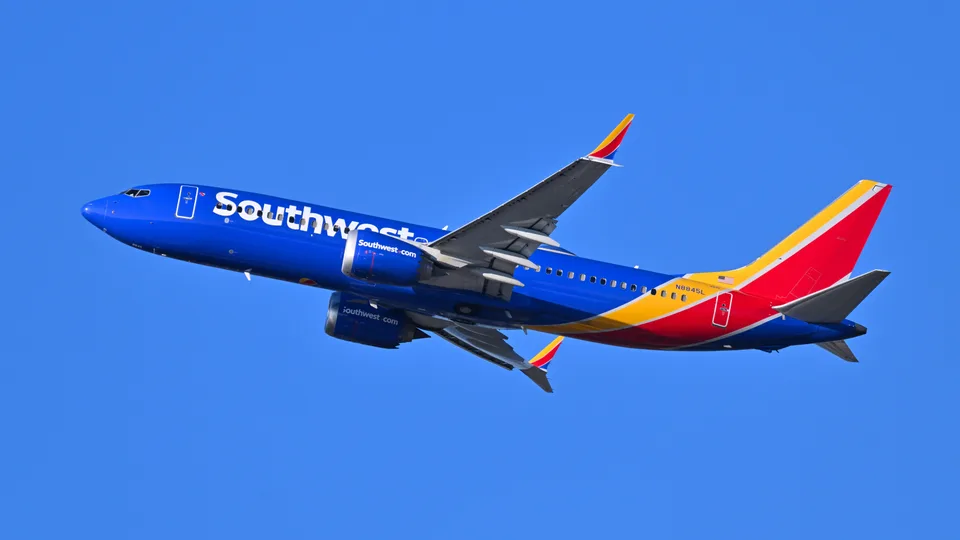
Original photograph retained. Responsive WebP copies resized without cropping.
Geographic context
Chicago Midway, departure
NTSB estimated encounter location near Providence
Boston Logan, destination
The encounter marker uses the NTSB estimated coordinates. Airport markers show the departure and destination locations schematically. Basemap: Natural Earth, public domain.Read supporting evidence
Southwest flight 2392 encountered unexpected moderate turbulence while descending through 14,000 feet toward Boston. Two flight attendants in the aft galley were thrown into the air and onto the floor. One suffered a fractured left foot. The flight continued to Boston, where medical personnel met it.
Read the full incident Follow what happened, from the flight to the investigation findings.
What investigators concluded
The NTSB determined that turbulence encountered during descent caused the serious injury to a flight attendant.
710 words / about 4 minutes to read. The official report for this event is short, so this account is shorter than most and covers only what the report documents.
The flight and its crew
Southwest Airlines flight 2392 was flying from Chicago Midway to Boston Logan on 15 April 2026. The Boeing 737-8, registered N8787K, was carrying 120 passengers and six crew members on a scheduled Part 121 service. The NTSB located the accident at Providence, Rhode Island, and recorded the time as 21:30 local. The aircraft was descending toward Boston when the turbulence encounter occurred.
The first officer was flying and the captain was monitoring. The captain had 22,889 hours of total flight experience, including 12,300 hours in the aircraft make and model. The first officer had 6,967 hours in total, including 2,401 hours in the make and model. Four flight attendants were working in the cabin.
The aircraft had been manufactured in 2022. Its airframe had accumulated 11,182 hours by the time of the accident. It was fitted with two CFM International LEAP-1B28 series turbofan engines and held a transport-category airworthiness certificate.
Before departure, the pilots examined their dispatch release and the weather forecasts. Those forecasts indicated turbulence during departure and two weather systems along the route. The pilots instructed the flight attendants to stay seated until the turbulence had subsided. About 20 minutes into the flight, the pilots and cabin crew discussed when cabin service could take place. They agreed that the attendants would be seated if the aircraft encountered turbulence.
As the pilots briefed the Boston approach, they saw that weather conditions had deteriorated. They prepared for a Category III instrument landing. That plan required the captain to take the controls from the first officer. Although their landing preparations had changed with the weather, the pilots did not expect turbulence during the descent into Boston.
While the aircraft was descending through 14,000 feet, it encountered unexpected moderate turbulence. The pilots recalled seeing nothing on the aircraft weather radar at that time. They tried to deviate from their course to avoid further turbulence. Light to moderate turbulence continued after their attempt to change course.
The flight attendants were preparing the cabin for landing when the encounter happened. Two were in the aft galley. The aircraft movement threw both into the air and then down onto the floor. A flight attendant from the forward cabin and a passenger came to their assistance. Together they helped both injured attendants into passenger seats in the last row. The forward attendant then occupied an aft jumpseat for landing.
The pilots requested emergency medical personnel to meet the aircraft at the gate. Flight 2392 continued to Boston and landed uneventfully. Both injured attendants from the aft galley were taken to hospital. One received treatment and was released. The other was diagnosed with a fracture of the left foot, the injury the NTSB classified as serious. The two remaining flight attendants reported minor injuries.
All 120 passengers were uninjured. The crew injury figures were one serious injury, three minor injuries and two people uninjured. With the passengers included, 122 of the 126 occupants escaped injury. Everyone survived. The aircraft sustained no damage, and the NTSB recorded no aircraft fire or explosion.
A National Weather Service convective SIGMET was valid for an area about 75 miles west of the encounter location. SkyPath, the crowdsourced tool used by pilots to track turbulence, had shown no turbulence near the flight. Flight 2392 subsequently recorded a moderate turbulence event in SkyPath. The pilots' recollection of the aircraft weather radar also described an empty display at the time of the encounter.
The NTSB examined weather observations from Rhode Island T.F. Green International Airport at Warwick. Its analysis placed that airport about four miles east of the turbulence encounter. The hourly airport weather report indicated that the cloud ceiling had fallen from 11,000 feet above ground level to about 9,500 feet. The factual information classified conditions at the accident site as instrument meteorological conditions and recorded the lighting condition as night.
The NTSB published its final report on 20 August 2026. It determined that the probable cause was the aircraft's encounter with turbulence during descent, resulting in a serious injury to a flight attendant. Its findings identified awareness of the condition and the effect on personnel as environmental issues. The injury sequence began while the attendants were preparing for landing and ended with two attendants needing help to reach passenger seats before arrival.
A simplified reading of the investigation findings. The sequence does not replace the full report or imply that every contributing factor is shown.
Sequence of events
The NTSB gives 21:30 local time for the encounter. Other stages follow the sequence described by the flight crew. Expand an event to see its evidence.
Before departureTurbulence appears in the forecasts
The pilots reviewed the dispatch release and weather forecasts, which indicated departure turbulence and two weather systems along the route. Flight attendants were told to remain seated until turbulence subsided.
21:30 local, descending through 14,000 feetUnexpected moderate turbulence
The aircraft encountered turbulence with nothing depicted on its weather radar. The pilots tried changing course, but light to moderate turbulence continued.
After arrival at BostonTwo attendants go to hospital
The aircraft landed uneventfully. One attendant was treated and released; the other had a fractured left foot. Two other attendants reported minor injuries.
Why were the pilots preparing to change who was flying?
Weather at Boston had deteriorated. The pilots prepared for a Category III instrument landing, which required the captain to take over from the first officer.
Where were the two flight attendants when they were thrown to the floor?
They were in the aft galley while the cabin crew prepared for landing. A forward flight attendant and a passenger helped them into the last row of passenger seats.
The pilots did not anticipate descent turbulence. They recalled no indication on the aircraft weather radar, and SkyPath showed no turbulence in the vicinity before the encounter.
Actions and recommendations are described at the dates of the cited records. A recommendation is not proof of implementation.
Medical assistance at Boston
Medical personnel met the aircraft. Two flight attendants went to hospital, where one was treated and released and the other was diagnosed with a fractured foot.
The pilots did not anticipate turbulence during descent. Their weather radar and SkyPath gave no indication of turbulence in the flight vicinity before the encounter.
Matching dossiers for Weather awareness: No other dossier in this collection.
Read alongside
These comparisons connect specific research topics. Shared circumstances do not establish identical causes. Evidence from both investigations is provided below.
JetBlue 1245 also encountered turbulence during descent while flight attendants were finishing arrival duties. An attendant suffered fractures to the pelvis and vertebrae. Southwest 2392 encountered moderate turbulence at 14,000 feet; JetBlue's pilots described a brief, sharp encounter in a cloud layer at 7,000 to 9,000 feet, and its aft attendants described severe turbulence. Both flights landed safely after requesting medical assistance.
Explore the records below for additional context. They open on the publisher's site and are not all included in our report search. Source reuse terms apply.
Kevin Murphy writes the incident accounts on AirlineIncidents.com, out of a long interest in aviation safety and the lessons each investigation leaves behind.
Prepared by
AirlineIncidents editorial desk
Report citation check
Independent expert review
Not completed
Citation checks compare supporting text with the indexed report pages. They do not constitute independent expert review. How these pages are prepared.
Revision history
: Final NTSB report DCA26LA185, published 20 August 2026.