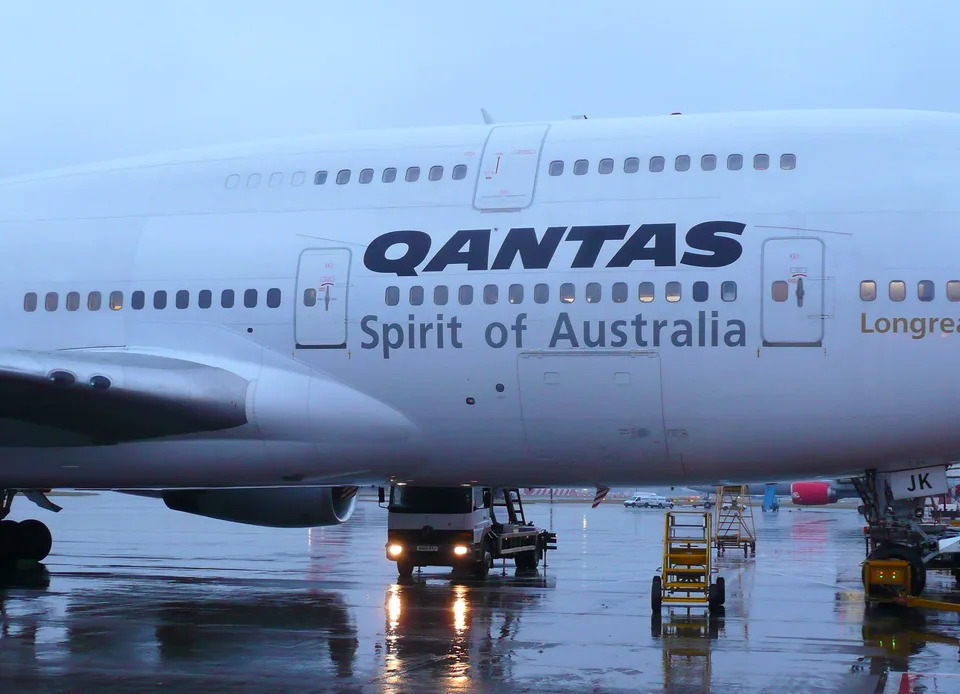
An oxygen cylinder burst through the fuselage over the South China Sea. The crew descended from 29,000 ft and diverted to Manila with all 369 occupants surviving.
Original photograph with no crop or retouching. Responsive WebP copies resized without cropping.
Geographic context
Hong Kong departure
Depressurisation over the South China Sea
Manila diversion and landing
The event marker is approximate, read from the report track plot. The aircraft diverted from its Hong Kong to Melbourne service to Manila. Basemap: Natural Earth, public domain.Read supporting evidence
A passenger oxygen cylinder ruptured beside the forward cargo hold, tearing open the fuselage and propelling the cylinder into the cabin. The pilots used oxygen, descended to 10,000 ft and diverted to Manila.
Read the full incident Follow what happened, from the flight to the investigation findings.
What investigators concluded
The ATSB identified cylinder rupture and the release of its pressurised contents as the contributing safety factors. It found that the flight crew managed the emergency appropriately and the cabin crew effectively supported passenger safety.
1,575 words / about 8 minutes to read. Based on the investigation records cited below.
A rupture above the South China Sea
Qantas flight 30 left Hong Kong for Melbourne at 09:22 local time on 25 July 2008. The Boeing 747-438, VH-OJK, carried 350 passengers, including four infants, with 16 cabin crew and three pilots. Its departure and climb were normal. By 09:42 it was established at 29,000 ft. The first officer was flying with the autopilot engaged, the captain was beside him, and the second officer was in the forward crew rest position. Cabin crew were carrying out passenger service as the aircraft crossed the South China Sea.
At 10:17, about 55 minutes after takeoff, the pilots heard a loud bang and felt an airframe jolt. The autopilot disconnected, and the first officer took manual control. Warnings appeared for cabin altitude and the second main cabin door on the right, known as R2. The second officer returned to the flight deck. All three pilots put on oxygen masks and carried out the cabin altitude emergency checklist. The aircraft was about 475 km north-west of Manila. In the cabin, crew felt wind, saw mist and light debris, and watched oxygen masks drop from overhead units.
The crew reduced engine thrust and extended the speed brakes about 20 seconds after the rupture. They declared a MAYDAY to Manila controllers and began an emergency descent roughly 38 seconds after the event. Cabin pressure had fallen from approximately 12.5 to 5.25 pounds per square inch absolute in 20 to 25 seconds. That minimum pressure corresponded to a cabin altitude of about 25,900 ft. The aircraft reached 10,000 ft approximately six and a half minutes after the rupture, bringing its occupants to an altitude where general use of supplemental oxygen could end.
Manila offered radar assistance, emergency services, ground support and enough runway for a landing with degraded anti-skid braking. The crew selected it for the diversion and jettisoned excess fuel to bring the landing weight within limits. They faced numerous system messages, including failures involving the left flight management computer, left VOR navigation receiver and all three instrument landing systems. They remained in visual conditions. The captain took over the flying and landed on runway 06 at 03:11:56 UTC, using full reverse thrust and minimal braking. Emergency services inspected the stopped aircraft before it was towed to the terminal for passengers to leave by an airbridge.
Inspection in Manila revealed that the fairing ahead of the right wing root had separated. Beneath it, the fuselage skin had an inverted T-shaped rupture. Its damaged area was estimated at 1.74 square metres, with cargo protruding through the opening. Fractures showed ductile tearing, and investigators found no pre-existing cracking or corrosion in the damaged skin. The fourth oxygen cylinder in the bank along the right side of the forward hold was missing. An outward fold in the skin matched the shape of the cylinders installed beside it.
Damage above that position showed that the cylinder had been propelled upward. It punctured the cabin floor, struck the R2 door frame and handle, and hit the overhead panels and storage area. Green paint marks, valve fragments and circular damage helped establish its path. The impact rotated the internal door handle about 120 degrees and broke its shaft. The ATSB found that the door remained secure because of its plug design and the way the damaged mechanism limited unlocking. The cylinder's upward movement also severed both of the first officer's aileron control cables. The duplicated flight control system allowed continued control of the aircraft.
The passenger oxygen installation used 13 high-pressure steel cylinders. Seven were along the right side of the forward hold and six were above it. The pilots had a separate oxygen system, and portable equipment was distributed through the cabin. When cabin altitude increased, mechanical flow control units automatically supplied the passenger system. An initial pressure surge opened the overhead compartments. Each user then had to pull a mask down to release its actuating pin and start oxygen flowing. The flow rate changed with cabin altitude as the aircraft descended.
The rupture damaged oxygen plumbing and electrical wiring near the cylinder. Investigators counted 85 wires that had been severed or partly cut. Their loss impaired monitoring and some manual controls, while the mechanical automatic activation and flow regulation continued to operate. The ATSB calculated that the remaining 12 cylinders could supply all activated masks for more than 36 minutes, allowing for leakage from the fractured line at the highest recorded cabin altitude. Reducing oxygen demand during descent would extend that estimate. Several overhead units failed to release their masks, however, and some passengers needed direct assistance to reach or activate an oxygen supply.
The automatic recorded announcement intended to tell passengers to sit down and use oxygen failed. Cabin crew shouted instructions or used hand signals while also trying to keep their own masks fitted. Some passengers needed to be told to pull their masks firmly downward. Others needed help securing them, or keeping masks on infants and children. Two crew members moved to assist passengers before the pilots cleared them to resume duties. The ATSB found that this exposed them to possible injury or incapacitation. Some crew had also returned to a crew seat instead of taking the nearest available oxygen mask.
After the aircraft reached 10,000 ft, the pilots instructed cabin crew to carry out follow-up duties. They used portable oxygen while checking passengers and preparing for landing. Two crew members were temporarily unable to perform those duties, one feeling unwell and another experiencing psychological distress, but both recovered before the approach. The report's injury table recorded no injuries among the 369 occupants. Subsequent passenger survey responses included ear pain, hearing problems, anxiety and other adverse effects. The survey also exposed confusion about mask operation: many passengers expected the reservoir bag to inflate, although oxygen could flow while the bag remained uninflated. Loss of elasticity in straps forced many to hold masks against their faces.
A search of the cabin, hold and surrounding spaces recovered parts of the cylinder valve but none of the cylinder body. The ATSB considered it most likely that the cylinder had left the aircraft during the initial depressurisation. The impact path indicated failure through the lower dome or around the lower circumference, releasing gas downward and driving the cylinder upward. The recovered valve's burst disk was intact. Examination of the valve and surrounding structures found no evidence of a fire or combustion event. Tests for explosive residues in the hold and cabin were negative.
Maintenance records identified the failed cylinder as serial number 535657. It had passed its fifth hydrostatic test on 26 May 2008 and was installed in the number-four position on 14 June. Investigators examined 20 similar cylinders, including five from its production batch and the 12 remaining aboard VH-OJK. The programme included internal and external inspection, material testing, pressure tests, repeated pressurisation, artificially machined flaws and exposure of cylinder material to maintenance chemicals. Three exemplar cylinders exceeded the specified minimum rupture pressure. One completed 10,000 pressure cycles before further expansion and rupture testing. The work demonstrated a robust, damage-tolerant design.
The flight data recorder supplied a continuous record from engine start in Hong Kong to engine shutdown on the Manila runway. It held approximately 300 operational and monitoring parameters over a 25-hour period. Investigators used those data to reconstruct the descent and assess the loads on the damaged aircraft. Recorded airspeed, bank angle and vertical acceleration during the diversion were within the range expected in normal operation and comparable with the preceding flights. The data also showed no unusual turbulence leading up to the rupture.
The cockpit voice recorder continued recording while the aircraft was towed and remained at the gate. By the time it was powered down, its two-hour recording had overwritten the rupture and emergency descent. The oldest surviving audio began while the aircraft was already at 10,000 ft. A separate quick-access recorder held more parameters, but had entered its programmed sleep mode during stable cruise about five minutes before the event. It resumed recording about four seconds after the depressurisation. The ATSB combined the available recordings with crew interviews, damage examinations and passenger survey responses.
The ATSB evaluated five broad possibilities: a manufacturing flaw, damage before the last overhaul, damage during that overhaul, damage afterward, or damage during the accident flight. The unusual failure direction suggested a defect or weakening mechanism, but the missing cylinder prevented direct examination of the failure surface. The ATSB could not determine which factor or factors caused the cylinder to fail. It found no evidence linking the failure to maintenance or handling, and no evidence of an increased failure risk in other cylinders from the same batch. The final report, issued in November 2010, identified the rupture and the resulting release of pressurised oxygen as the verifiable contributing safety factors.
Safety action addressed the difficulties encountered in the cabin and the oversight of cylinder maintenance. Qantas changed procedures so the pilots would make a direct announcement if the automatic recording failed, and revised passenger briefings about pulling down masks and oxygen flowing with an uninflated bag. Training facilities received appropriate drop-down mask assemblies, and training covered emergency descent profiles. The operator reported a workshop equipment and staff qualification programme, and had completed fleet oxygen installation inspections by 1 August 2008. The ATSB issued advisory notices on passenger instructions, cylinder maintenance practice and independent accreditation of testing facilities. It found the flight crew's emergency response compliant and well managed, and the cabin crew's overall response effective.
A simplified reading of the investigation findings. The sequence does not replace the full report or imply that every contributing factor is shown.
Sequence of events
Times are UTC unless identified as local. Hong Kong and Manila local time was UTC plus eight hours. Recorder times follow Table 1 of the ATSB final report. Expand an event to see its evidence.
01:22:12 UTCDeparture from Hong Kong
The 747 took off for Melbourne with 350 passengers and 19 crew.
The ATSB calculated more than 36 minutes for all activated masks at the maximum cabin altitude, including leakage through the fractured line. Demand fell as the aircraft descended.
The damage path was consistent with failure through the lower dome or around the lower circumference. Gas escaping downward propelled the cylinder through the floor and into the R2 door area.
The briefings inadequately explained that oxygen could flow while the bag remained uninflated. The operator revised them to cover firm downward activation of the mask and oxygen flow with an uninflated bag.
Actions and recommendations are described at the dates of the cited records. A recommendation is not proof of implementation.
Passenger briefings and announcements
The final report recorded revised briefings on mask activation and uninflated bags, plus a direct pilot announcement when the automatic recording failed.
The operator reported revised depressurisation training, suitable drop-down masks at training facilities and improved instruction about emergency descent profiles.
Fleet oxygen installation inspections were completed by 1 August 2008. The report also recorded a workshop equipment and staff qualification programme, and ATSB advice to maintain independent external accreditation.
These comparisons connect specific research topics. Shared circumstances do not establish identical causes. Evidence from both investigations is provided below.
Both flights suffered rapid cabin depressurisation after a component failure damaged the pressure hull. Qantas 30 involved an oxygen cylinder bursting from inside the fuselage. On Southwest 1380, a separated engine fan cowl component struck the fuselage near a cabin window, causing window loss and one passenger fatality.
Explore the records below for additional context. They open on the publisher's site and are not all included in our report search. Source reuse terms apply.
Commonwealth of Australia 2010. Report linked for investigation evidence; third-party material carries separate rights. Source terms.
Left Engine Failure and Subsequent Depressurization: Southwest Airlines Flight 1380, Boeing 737-7H4, N772SW, Philadelphia, Pennsylvania, April 17, 2018
National Transportation Safety Board NTSB/AAR-19/03, adopted 19 November 2019
US federal investigation report, attributed to the NTSB. Limited excerpts for commentary; third-party material and illustrations excluded. No NTSB endorsement. Source terms.
Kevin Murphy writes the incident accounts on AirlineIncidents.com, out of a long interest in aviation safety and the lessons each investigation leaves behind.
Prepared by
AirlineIncidents editorial desk
Report citation check
Independent expert review
Not completed
Citation checks compare supporting text with the indexed report pages. They do not constitute independent expert review. How these pages are prepared.
Revision history
: Published sourced incident account, timeline, photographs and investigation findings.