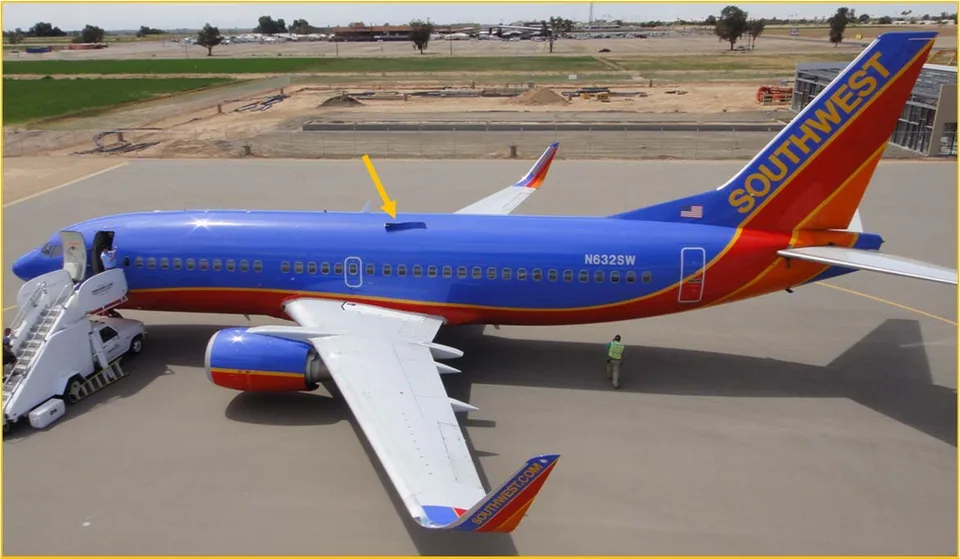
Photograph extracted from the report with its original arrow and border. Responsive WebP copies resized without cropping.
Geographic context
Phoenix Sky Harbor, departure
Yuma area, decompression and diversion
Sacramento International, intended destination
Approximate geographic markers show the departure, the Yuma area and the intended destination. The aircraft landed at Yuma International Airport. The brief identifies Yuma as the accident location and gives no coordinates for the decompression. Basemap: Natural Earth, public domain.Read supporting evidence
Southwest Flight 812 lost cabin pressure while climbing through flight level 340 on a scheduled passenger flight from Phoenix to Sacramento. A section of skin above the left wing fractured and flapped outward. The pilots descended to 11,000 feet within five minutes, then diverted to Yuma. All 122 occupants survived; a flight attendant and an off-duty airline employee passenger sustained minor injuries after losing consciousness.
Read the full incident Follow what happened, from the flight to the investigation findings.
What investigators concluded
The NTSB found that improper installation of the crown skin panel at the S-4L lap joint during manufacture caused multiple site fatigue cracking and eventual failure of the lower skin panel. The flight crew response was timely and effective. The flight attendant's incorrect assessment of his time of useful consciousness contributed to the injuries by delaying his use of oxygen.
Southwest 812: the fuselage joint that opened in flight
1,589 words / about 8 minutes to read. Based on the investigation records cited below.
A normal climb becomes an emergency
On 1 April 2011, Southwest Airlines Flight 812 departed Phoenix Sky Harbor International Airport for Sacramento International Airport with 117 passengers and five crewmembers. The Boeing 737-3H4, registered N632SW, was operating a scheduled domestic passenger service. Its takeoff and initial climb were normal. At about 15:58 mountain standard time, while climbing through flight level 340, the aircraft suffered a rapid loss of cabin pressure. A section of fuselage skin above the left wing had fractured and opened outward.
The cockpit area microphone recorded an unidentified sound at 15:58:05. About two seconds later, the captain announced the loss of cabin pressurization and called for oxygen masks. Increased wind noise followed on the cockpit recording. The captain declared an emergency to air traffic control and requested a lower altitude. Controllers issued descent clearances, and the flight crew brought the aircraft down to 11,000 feet within five minutes. The cabin oxygen masks deployed during the emergency.
At about 16:05, cabin crewmembers began reporting the damage and injuries to the pilots. Their initial description included a two-foot hole in the fuselage and a flight attendant with a broken nose. The aircraft received clearance to descend further, to 9,000 feet. The captain requested radar vectors to the nearest suitable airport, Yuma International. At about 16:29, Flight 812 landed on runway 21R without further incident. Passengers left by airstairs. The NTSB later found the flight crew response timely and effective.
Both flight recorders were recovered in usable condition. The cockpit voice recorder held two hours of digital audio, which the NTSB described as good to excellent. Its laboratory prepared an audio summary. The flight data recorder was also in good condition and its data were recovered normally. Investigators established the timing by matching events common to the cockpit recording and flight data. The aircraft also recorded time as a flight data parameter, allowing the recordings to be aligned with mountain standard time.
A flight attendant lost consciousness while preparing either to call the pilots on the interphone or to make a passenger announcement. He fell against the forward partition, cutting and fracturing his nose. An off-duty airline employee travelling as a passenger tried to assist him, also lost consciousness, and sustained a cut above his eye in the fall. Both regained consciousness during the descent. These were the two minor injuries recorded by the investigation; all 122 people aboard survived.
The flight attendant regarded communication with the pilots and getting passengers onto oxygen as urgent tasks. He attempted to act before obtaining oxygen himself. Southwest's initial and recurrent training instructed flight attendants to take oxygen from the nearest mask immediately and then secure themselves. Investigators found that the training materials consistently gave that order. They concluded that his attempt to communicate before taking oxygen likely reflected an incorrect assessment of his time of useful consciousness. Inspection found all passenger mask doors open and activation indications on the passenger and flight attendant oxygen generators.
After landing, the opening measured about 60 inches long and eight inches wide. The skin remained attached at its lower edge and had bent outward. Its upper fracture ran through the lower rivet row of the lap joint at stringer S-4L. The damaged skin lay between body stations 663 and 727, above the left wing. Abrasion below the forward edge matched the shape of the opened panel. During repairs, two cracked stringer clips were also found along S-4L.
Investigators removed the damaged area for examination at the NTSB materials laboratory. The longitudinal fracture ran from body station 666 to 725 and crossed 58 consecutive rivet holes at approximately one-inch intervals. The joint joined overlapping skin assemblies with three rows of rivets. A doubler was bonded to the upper skin, and sealant lay between that assembly and the lower skin. The middle rivet row also attached the stringer. The laboratory examined the fracture surfaces and the concealed contact surfaces between the overlapping parts.
Microscopic examination found fatigue features originating at 54 of the 58 rivet holes crossed by the fracture. The cracks began on the outer surface of the lower skin, which the overlapping joint concealed from both interior and exterior view. At nine adjoining holes, numbered 81 to 89, fatigue cracking had penetrated the entire skin thickness. The two longest cracks extended forward and aft from hole 85. They measured 0.55 and 0.60 inch respectively. Between the fatigue regions, the rough fracture surfaces showed where the remaining material separated under overload.
The investigators also found signs that the joint had been moving and deteriorating over an extended period. Contact between the lower skin and doubler had produced rubbing damage, known as fretting, and exposed areas of bare metal. Green primer and blue exterior paint lay on the sealant surface inside the joint. The upper fuselage had originally been painted tan and was repainted blue in January 2011. The paint evidence showed that the sealant had broken down before the blue finish was applied.
Fatigue striations provided an estimate of how long the cracking had grown. The NTSB laboratory examined the longest crack behind hole 85, and Boeing examined smaller crack regions. Their calculated growth rates reasonably agreed. The longest crack represented about 38,261 cycles. N632SW had accumulated 39,786 cycles and 48,748 flight hours by the accident. From this evidence, the NTSB concluded that cracking at hole 85 began approximately when the aircraft entered service. Tests of the skins, doubler and rivets found that their material properties met Boeing specifications.
The aircraft was manufactured in May 1996 and delivered new to Southwest the following month. Its fuselage sections were built in Wichita and shipped by rail to Renton for final assembly. The sections left Wichita on 1 April 1996 and arrived at Renton on 8 April. Drilling and riveting at the lap joints were manual operations. Some work near the joint between the forward and aft sections was deliberately left for Renton to complete, so the crown panel installation involved work at both factories.
Examination of the failed joint revealed numerous installation discrepancies. Ten lower-row rivets were oversized. Other rivets were under driven, had unusual finishes, or had expanded shanks near their tails. Many holes in the lower skin were oval or resembled a figure eight from double drilling. Most lower-row holes were offset from the corresponding holes in the upper skin and doubler. There were burrs, sealant deposits and gaps around some rivet tails. The NTSB found that this hole quality fell outside Boeing specifications and standard manufacturing practice.
Panel markings helped reconstruct the production history. Surrounding panels carried manufacturing dates from January and February 1996 and Wichita inspection stamps. The crown panel above the fracture carried a March 1996 coating stamp and lacked an inspection stamp. Southwest's records showed no major repairs or alterations to the affected skin panels. The NTSB concluded that the crown panel had been replaced during manufacture. The completed production records were no longer available under the retention arrangements then in force.
Boeing's quality assurance arrangements called for inspections after drilling and after the skins were separated to remove burrs. A quality assurance stamp was required before sealing and installing fasteners, followed by acceptance of the installed fasteners and other components. Factory rework followed the same inspection steps as normal production. At the time N632SW was built, Boeing's policy kept manufacturing records for the current production year and six previous years. There was then no regulatory requirement governing their retention. The accident occurred fifteen years after the fuselage sections left Wichita.
The physical evidence indicated that the crown and upper left fuselage panel were misaligned when the S-4L joint was drilled. Many installed rivets failed to fill the holes in the lower skin completely, greatly reducing the panel's fatigue life. Pressurization loads initiated a crack at hole 85 almost immediately after manufacture. Cracks subsequently began at adjacent holes and grew with repeated pressurization. Small cracks eventually linked into a longer damaged region, the process known as multiple site damage.
On Flight 812, the accumulated cracking reached a critical length. The remaining strength of the skin could no longer carry the loads, and the panel flapped open. The NTSB identified improper installation of the crown skin panel during manufacture as the probable cause. It found that crew actions had not affected the structural separation. The flight attendant's delayed use of oxygen contributed to the injuries. Inspections of other affected aircraft found small fatigue cracks, but none had the extensive cracking and double-drilled holes seen on N632SW. The NTSB considered a systemic quality assurance error at the two factories unlikely.
Inspections and oxygen guidance after the accident
Boeing issued an alert service bulletin on 4 April 2011 for aircraft with line numbers 2553 through 3132. It called for eddy current inspection of the lower fastener rows at the left and right S-4 lap joints. Aircraft with at least 35,000 cycles were to receive their initial inspection within five days. The bulletin specified repeat intervals of no more than 500 flight cycles. The FAA issued an immediately effective emergency airworthiness directive the following day requiring the inspections. Boeing also increased its manufacturing record retention requirement to ten years in April 2011.
The brief also examined the FAA's guidance on useful consciousness after decompression. The NTSB had sought revisions through an earlier safety recommendation, expressing concern that published time estimates overstated the time available to perform realistic tasks. After reviewing revised FAA guidance issued in March 2013, it concluded that those concerns remained unresolved and closed the recommendation with an unacceptable-action classification on 18 September 2013. The Board adopted the final Flight 812 accident brief six days later.
The cockpit area microphone recorded an unidentified sound. About two seconds later, the captain announced a loss of pressurization and called for oxygen masks.
Were the cracks visible from the cabin or outside?
The fatigue cracks began on a lower skin surface concealed inside the lap joint. The NTSB found that the fatigue fracture area was invisible from both the exterior and interior.
The crown panel markings indicated replacement during manufacture. The NTSB could not determine whether that work occurred at Wichita or Renton, why it was done, or how the deficient work passed the quality assurance process.
Inspections found one to five small fatigue cracks in other affected aircraft. Those aircraft lacked the extensive cracking and double-drilled holes found on N632SW.
Actions and recommendations are described at the dates of the cited records. A recommendation is not proof of implementation.
April 2011 lap joint inspections
Boeing issued alert service bulletin 737-53A1319 on 4 April 2011, and the FAA required the inspections on 5 April. The bulletin called for recurring inspections at intervals of no more than 500 cycles.
On 18 September 2013, the NTSB closed Safety Recommendation A-00-109 as unacceptable action after finding that revised FAA guidance failed to address its concerns about useful consciousness after decompression.
Matching dossiers for Emergency oxygen: No other dossier in this collection.
Read alongside
These comparisons connect specific research topics. Shared circumstances do not establish identical causes. Evidence from both investigations is provided below.
Both investigations examined fatigue damage in Boeing 737 fuselage lap joints. For Aloha 243, the NTSB found that the maintenance programme failed to detect significant disbonding and fatigue damage at S-10L; contributing factors included supervision, oversight and early joint bonding difficulties. Southwest 812 involved improper installation at S-4L during manufacture, with misdrilled holes and incompletely filled rivet holes reducing fatigue life.
Explore the records below for additional context. They open on the publisher's site and are not all included in our report search. Source reuse terms apply.
The completed NTSB investigation covers the flight sequence, cabin injuries, fracture examination, manufacturing findings and inspection response.
Sources and transparency
The NTSB completed its investigation and adopted accident brief NTSB/AAB-13/02 on 24 September 2013.
Source limitations
The fatigue striation count yielded an estimated 38,261 growth cycles for the longest examined crack, compared with 39,786 cycles accumulated by the aircraft.
Southwest Airlines Flight 812, Boeing 737-3H4 N632SW, Yuma, Arizona, 1 April 2011
National Transportation Safety Board Final accident brief NTSB/AAB-13/02, adopted 24 September 2013
Kevin Murphy writes the incident accounts on AirlineIncidents.com, out of a long interest in aviation safety and the lessons each investigation leaves behind.
Prepared by
AirlineIncidents editorial desk
Report citation check
Independent expert review
Not completed
Citation checks compare supporting text with the indexed report pages. They do not constitute independent expert review. How these pages are prepared.
Revision history
: NTSB final accident brief adopted 24 September 2013.