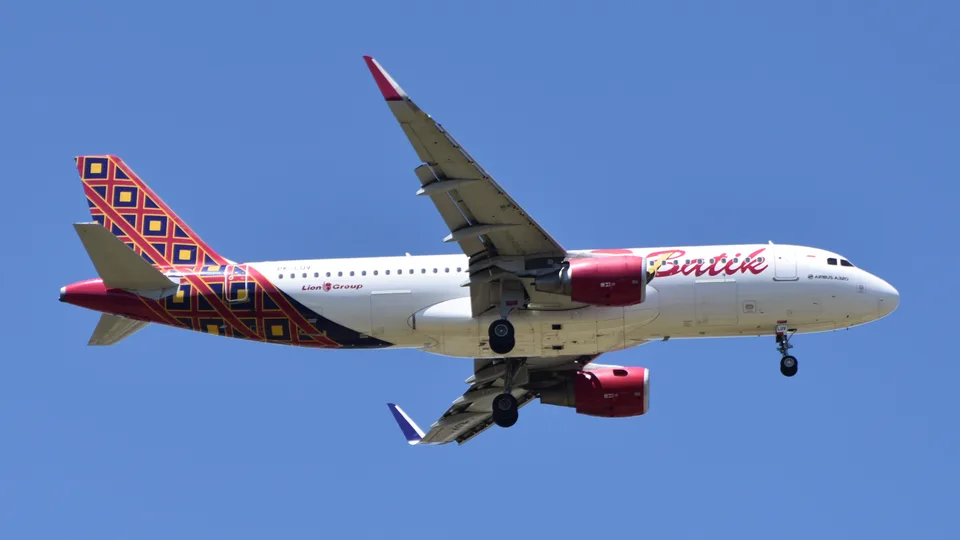
Original photograph unchanged. Responsive WebP copies resized without cropping.
Geographic context
Kendari Halu Oleo Airport
About 125 NM east of KURUS
Jakarta Soekarno-Hatta Airport
The flight returned from Kendari to Jakarta. At the last first officer readback it was about 125 NM east of KURUS. Positions are approximate geographic markers. Basemap: Natural Earth, public domain.Read supporting evidence
Batik Air 6723 was returning from Kendari to Jakarta with 153 passengers and six crew. The captain rested in the cockpit while the first officer flew and monitored the aircraft. The first officer then fell asleep. The autopilot continued on a selected heading of 250 degrees until the captain woke about 28 minutes after the last first officer transmission. The flight landed at Jakarta with no injuries or aircraft damage.
Read the full incident Follow what happened, from the flight to the investigation findings.
What investigators concluded
KNKT identified inadequate detailed fatigue management guidance, the decision to fly while fatigued together with altered circadian rhythms, and missing detailed cockpit check procedures as contributing factors.
1,534 words / about 7 minutes to read. Based on the investigation records cited below.
An early start after insufficient sleep
Batik Air's crew reported for an early morning journey from Jakarta to Kendari and back on 25 January 2024. The aircraft was Airbus A320 PK-LUV, operated by two pilots and four flight attendants. The first departure was scheduled for 02:55 Jakarta local time, with duty reporting required 90 minutes earlier. During preparation, the first officer told the captain that he had not obtained adequate rest. The captain flew the outbound sector and the first officer monitored.
Both pilots had been free of flying duties for substantial periods before this assignment. The captain's rest period was 35 hours and the first officer's was 53 hours. KNKT found that their scheduled days off and minimum rest periods complied with the applicable requirements. Their actual sleep was limited. On the day before the flight, the captain carried out normal daytime activities and went to bed at about 20:00. He woke at about 22:00 and later drove himself to the airport.
The first officer had spent his day off and standby day moving house. He also helped his wife care for their one-month-old twins. He attempted to sleep at about 19:00 before the duty, but woke repeatedly to help with the babies. He considered the quality of that sleep poor. Before duty he neither notified the chief pilot or deputy of his fatigue nor completed the IM SAFE personal checklist. KNKT found that he lacked the knowledge needed to make that assessment using the checklist.
The aircraft left Jakarta at 03:14 local time during darkness. It cruised at 35,000 feet. The captain offered the first officer a rest, and the first officer slept in the cockpit for about 30 minutes. The captain assumed the monitoring duties as well as flying the aircraft during that period. The first officer woke before descent. On approach to Kendari, controllers advised that the weather was below the instrument landing minimum and the airport remained closed. The aircraft held for about 30 minutes before landing on Runway 26.
During the turnaround the pilots ate instant noodles in the cockpit as passengers disembarked and the return passengers boarded. Flight BTK6723 carried 153 passengers back towards Jakarta. The first officer now flew the aircraft and the captain monitored. The return flight departed at about 00:05 UTC. Flight attendants checked the cabin and began serving a light meal after the seat belt sign was switched off. One brought snacks to the pilots. The flight climbed towards its planned cruising altitude of 36,000 feet.
At 00:37 UTC the A320 reached its cruising altitude. Both pilots removed their headsets and increased the cockpit loudspeaker volume. The captain asked to rest and the first officer agreed. The captain then fell asleep. The first officer took over the monitoring role while continuing to fly the aircraft. KNKT later found that the loudspeaker volume was sufficient for the pilots to hear air traffic control transmissions.
At 01:04 a flight attendant called the cockpit by interphone to ask whether the pilots needed anything. The first officer said that the captain was sleeping and that they needed nothing. At 01:22 the captain woke and asked whether the first officer wanted to rest. The first officer declined. After a conversation lasting about 30 seconds, the captain went back to sleep, leaving the first officer performing both roles again.
Weather avoidance required changes to the flight's direction. At about 01:24 the first officer requested a heading of 275 degrees, which Makassar Area Control Center approved. At 01:29 he called the cabin to ask about the passengers after experiencing turbulence. The flight attendant said the passengers were fine. At about 01:34 he reported a heading of 250 degrees. Makassar instructed him to report when clear of the weather.
The heading remains selected as the calls go unanswered
The autopilot had been navigating along the assigned airways in NAV mode. For weather avoidance, its directional control was changed to HDG mode. In this mode it followed the heading selected by the pilot. The recorded sequence showed a change from NAV to HDG at 01:23:49. Later selections included 250 degrees, a brief change to 255 degrees, and another selection of 250 degrees at 01:41:17.
Makassar transferred the flight to Jakarta Area Control Center. At about 01:43 the first officer contacted Jakarta and received instructions to follow the KURUS 2G arrival and report when clear of the weather. The aircraft was about 125 nautical miles east of waypoint KURUS, still flying the weather avoidance heading. The first officer acknowledged the instruction and inadvertently fell asleep shortly afterwards. The captain was already asleep, and the autopilot continued along the selected heading of 250 degrees.
At about 01:56 Jakarta asked how much longer the aircraft needed to maintain that heading. Neither pilot answered. Controllers continued trying to reach the flight and asked other aircraft to call it. KNKT's findings record fourteen Jakarta calls over the following thirteen minutes, together with attempts by pilots from two other aircraft. The calls received no reply because both pilots were sleeping.
The captain wakes and the flight returns towards Jakarta
At about 02:11 the captain woke and recognised that the aircraft was off its intended flight path. He saw the first officer asleep and woke him. The interval from the last first officer transmission was about 28 minutes. Around the same time the captain answered calls from another aircraft and Jakarta control. He told Jakarta that the aircraft had experienced a radio communication problem and that the problem had been resolved.
The recorded heading selection changed to 304 degrees at 02:11:58, followed by a radio transmission at 02:12:03. The aircraft continued to Jakarta and landed uneventfully. None of the 159 occupants was injured and the A320 was undamaged. Examination after the flight found the radio communication system operating normally. KNKT also found no records or reports of an aircraft system malfunction before departure.
For the investigation, the operator supplied downloaded quick access recorder data containing 1,025 parameters from about 49 hours of operation across 24 flights, including this sector. The cockpit voice recorder held two hours and four minutes of good quality audio. It captured cockpit conversations and radio communications with controllers. Investigators used the recordings to examine heading selections, the transfer between control centres and the attempts to regain contact with the aircraft.
KNKT examined the sleep histories, the airline's manuals and the checks used before duty. Both pilots had passed medical screening that measured blood pressure and tested for alcohol. The airline also required pilots to assess their fitness using an IM SAFE checklist. Investigators found no detailed guidance for assessing each impairment category. They concluded that the checklist and medical examinations were ineffective in identifying these pilots' fatigue.
The investigation linked inadequate sleep and altered circadian rhythms to the pilots' reduced ability to stay awake. The duty began at night and continued into the morning, requiring work during hours when the pilots would normally have been asleep. KNKT concluded that both pilots were fatigued before duty and should have declined the assignment. It found no fatigue reports submitted by either pilot before or after the occurrence.
The Indonesian aviation authority's fatigue guidance required pilots to obtain enough sleep, plan it ahead of duty and report fatigue. It described an average requirement of about eight hours of sleep per day, while recognising individual differences. Batik Air's manual required pilots to avoid duty when fatigued and notify their chief pilot. Investigators could find no detailed airline guidance on recommended sleep quantity or advance sleep planning. KNKT concluded that fatigue management had been implemented improperly, with pilots most likely treating sleep during flight as a common response to insufficient rest before duty.
The cabin procedures required a cockpit check every 30 minutes but did not explain how to perform it or identify who was responsible. The flight attendant treated the first officer's interphone call about turbulence as a cockpit check. That conversation occurred 42 minutes before the captain woke and discovered the first officer asleep. KNKT concluded that the missing procedural detail led to ineffective cockpit checks and prevented detection of the first officer falling asleep.
KNKT's final report identified three contributing factors. Inadequate detailed guidance on fatigue management most likely led to poor use of scheduled rest and attempts to manage fatigue by sleeping during flight. The decision to fly while fatigued, together with altered circadian rhythms, reduced the pilots' ability to remain awake. Missing detailed cockpit check procedures prevented the inadvertent sleep from being detected.
Batik Air issued a safety notice on 7 February 2024 reminding pilots and flight attendants about cockpit checks, communication and adequate rest before early starts. A notice on 12 February addressed personal fitness, sleep quality, circadian rhythms and review of the IM SAFE checklist during the preflight briefing. After preliminary recommendations, the airline revised its operations manual with detailed checklist guidance and instructions for crew members to report when unfit for duty.
The airline also revised its emergency procedures to require periodic cockpit checks at intervals of no more than 30 minutes. Notices, internal campaigns and monthly sharing sessions supported the changes. KNKT acknowledged these actions and issued a further recommendation in its final report: Batik Air should develop and implement fatigue management that specifies recommended sleep quantities and requires pilots to plan their sleep ahead of duty. The final report is dated 8 January 2025.
How long did the flight go without a pilot response?
KNKT places the captain waking about 28 minutes after the last first officer transmission. The first officer fell asleep shortly after that transmission.
The airline added detailed procedures requiring cockpit checks no more than 30 minutes apart, supported by notices, campaigns and monthly crew sessions.
These comparisons connect specific research topics. Shared circumstances do not establish identical causes. Evidence from both investigations is provided below.
Fatigue and disrupted body clocks feature in both investigations. KNKT found that insufficient sleep and altered circadian rhythms reduced the Batik Air pilots' ability to stay awake during cruise. For Air Canada 759, the NTSB found fatigue from continued wakefulness and circadian disruption likely contributed to misidentifying a taxiway as the landing runway and delaying the go-around.
Explore the records below for additional context. They open on the publisher's site and are not all included in our report search. Source reuse terms apply.
Kevin Murphy writes the incident accounts on AirlineIncidents.com, out of a long interest in aviation safety and the lessons each investigation leaves behind.
Prepared by
AirlineIncidents editorial desk
Report citation check
Independent expert review
Not completed
Citation checks compare supporting text with the indexed report pages. They do not constitute independent expert review. How these pages are prepared.
Revision history
: Final KNKT findings and the safety actions documented in January 2025.