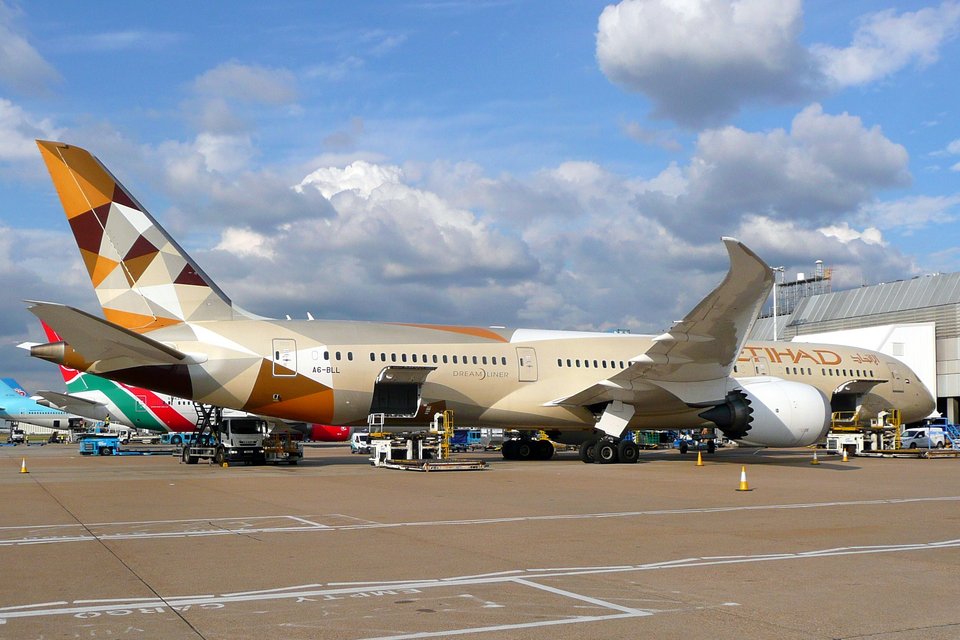
Resized and recompressed from the original photograph. Full frame retained.
Geographic context
Abu Dhabi International Airport, runway 13R/31L midpoint
King Abdulaziz International Airport, Jeddah, intended destination
ETD2333 was scheduled from Abu Dhabi to Jeddah. Abu Dhabi coordinates identify the runway midpoint given in the summary. The Jeddah airport marker is approximate. Basemap: Natural Earth, public domain.Read supporting evidence
Etihad flight ETD2333 was departing for Jeddah while a calibration aircraft operated toward the parallel runway in the opposite direction. Aerodrome Controller South issued takeoff clearance, then attempted to cancel it using an incorrect callsign. The crew rejected the takeoff after the fourth call used the correct callsign. The aircraft stopped on runway 31L and subsequently taxied clear.
Read the full incident Follow what happened, from the flight to the investigation findings.
What investigators concluded
AAIS attributed the high energy rejected takeoff to the controller's stop instruction after an earlier takeoff clearance that did not comply with published procedures. Contributing factors were the missing coordination with Aerodrome Controller North, the incorrect callsign and nonstandard cancellation phraseology, and prolonged transmissions during a critical instruction.
1,500 words / about 7 minutes to read. Based on the investigation records cited below.
A departure during runway calibration
On 28 September 2021, Etihad Airways prepared Boeing 787-9 A6-BLL for passenger flight ETD2333 from Abu Dhabi International Airport to King Abdulaziz International Airport in Jeddah. There were 224 passengers, two pilots and nine cabin crew aboard. The commander was flying and the copilot was monitoring. Taxi began at 0758:22 UTC, or 1158:22 local time.
Flight calibration was taking place at the airport. The airport had two parallel asphalt runways, with their centerlines 2,000 meters apart. Runway 31L had a landing distance available of 4,106 meters. A calibration aircraft using the callsign VOR05 was operating toward runway 13L on the parallel runway, opposite to the direction used by departures from runway 31L.
The weather was normal. Aircraft technical records showed no defects before the incident and no post-flight maintenance fault messages. Both pilots had completed the required training and stated that they were rested and fit for duty.
A shift change took place during the calibration operation. Aerodrome Controller North took over at 0755 and told Approach that the calibration activity would shift to runway 13L and would be managed by North. The two aerodrome positions were staffed by qualified controllers who held management or specialist roles and routinely performed administrative duties. They had been assigned operational duties that day to support the shift controllers.
At 0757:23, North asked South to hold all departures because of the calibration activity. South requested release for departing aircraft, but North declined. A military aircraft, UAF2299, was lining up on runway 31L. At 0800:33, North released that aircraft once its separation from VOR05 was sufficient.
At 0803:00, ETD2333 reported ready for takeoff while taxiing toward Echo 15. South instructed the crew to hold short of runway 31L. Twenty seconds later, South asked Approach to release ETD2333 and mentioned the preceding military departure. Approach replied that release was unnecessary because that military flight was operating under visual flight rules within the airport control zone.
At 0803:42, South told ETD2333 to line up and wait on runway 31L. At 0804:25, the controller checked whether the crew was ready to depart, and the crew confirmed. A commercial arrival was approaching runway 31L, while VOR05 was established on final for runway 13L at about 6.5 nautical miles.
South issued takeoff clearance at 0804:30. The transmission included wind information, information about the departing military aircraft and information about the commercial arrival. During the issuance of clearance, North called South to stop it. The military flight also called South at 0804:54 while approaching Khalifa City South; South did not acknowledge that call.
At 0805:05, South instructed the crew to cancel takeoff clearance and vacate at Echo 14, addressing the aircraft as UAF2333. This combined the military callsign letters with ETD2333's flight number. The incorrect callsign went unnoticed and the crew gave no readback. ETD2333 commenced its takeoff roll while the controller repeated cancellation instructions using the wrong callsign.
At 0805:17, South again tried to attract the crew's attention using the Uniforce callsign and asked whether they had copied the instructions. The crew continued rolling. South was also transmitting traffic information to the commercial arrival, RBDN922, and to VOR05. At 0805:32, RBDN922 reported four miles from runway 31L.
At 0805:38, the controller called for the fourth time and used the correct callsign: Etihad two three three three stop. The crew read the instruction back correctly. The aircraft was passing abeam Echo 13, and the crew executed a rejected takeoff at 127 knots ground speed.
The combined airborne recorder provided both cockpit voice and flight data recordings. Investigators examined those recordings and the air traffic control transcript, synchronizing the time references. Flight data showed the brake pedal being pushed at 0805:41 for 20 seconds, with 1,200 psi of pressure. The speed brake handle moved to 35 degrees. The aircraft stopped at 0806:01.
At 0805:47, South had instructed ETD2333 to vacate through Echo 8 and continue via Echo 6. South also instructed RBDN922 to go around and follow the standard missed approach procedure. At 0806:00, the arriving crew confirmed that they were established on the instrument landing system and reported three miles from the runway threshold.
The Etihad crew advised that they intended to stay on the runway to check whether brake temperature was within limits. At 0806:35, they reported ready to taxi and asked why takeoff had been cancelled. South explained that a VFR calibration flight was operating toward the north runway in the opposite direction. A6-BLL safely vacated at 0807:18 after the crew confirmed that no aircraft systems showed abnormalities or malfunctions.
AAIS found a lack of coordination between the north and south controllers. North had released the military departure and said the calibration aircraft was proceeding west, but had supplied no further information about its intentions or profile. South was simultaneously managing departures and an arrival on runway 31L while calibration traffic approached the parallel runway in the opposite direction.
The investigation linked the incorrect callsign to South mixing the military flight's letters with ETD2333's numbers during the simultaneous events. It also identified nonstandard phraseology and prolonged traffic information. South believed the cancellation had been heard and proceeded to instruct the crew to vacate.
The recordings contained clipping consistent with a simultaneous or double transmission. Investigators could not identify its source. AAIS described a 16-second transmission in which South amended an ongoing instruction after North intervened. The subsequent calls using the incorrect callsign may have caused the crew to ignore the cancellation and continue accelerating.
The calibration notice covered 26, 28 and 30 September, between 0600 and 1100 UTC. It warned operators to expect possible delays and prohibited training flights. Its period included the morning of the incident. The notice identified the activity and the available operating window; detailed controller procedures were contained in the air traffic services manuals and supplementary instructions.
The flight calibration procedures limited the operation to visual flight rules. Tower was to tell Approach as soon as the calibration aircraft started up, and close coordination was required throughout. Calibration had priority over scheduled traffic, and controllers were encouraged to allow a profile to continue unless a safety interruption was necessary. Other airport operations were to use the other available runway.
Where a runway remained active for regular traffic during calibration, the manual required separation intended to prevent wake turbulence, with distance depending on aircraft weight. Controllers were to provide the services applicable to Class D airspace. Airport operating procedures also required other arrivals to remain outside 10 nautical miles of the active runway when exclusive calibration use was impossible.
The report examined Temporary Instruction 279/21, which described arrangements for 26 September from 0600 to 1100 UTC. It allocated the south runway to calibration and other traffic to the north runway, required control positions to remain staffed and open, and provided for office staff to assist the roster. It also required other aircraft to remain clear when the calibration aircraft flew arcs across the instrument landing system localizer.
AAIS compared the temporary instructions with the operating manual. The manual prohibited opposite-direction arrivals and departures except for aircraft emergency movements. Investigators found that the controllers had departed from its requirements when clearing the military VFR flight. They also found that the later clearance issued to ETD2333 lacked the required coordination with North and Approach.
A notice to airmen warned that flight calibration was in progress and that traffic could expect delays. The air navigation service provider had assessed four hazards on 19 May 2021 and concluded that the mitigated risk was acceptable. The operating manual required close coordination between radar and tower, gave calibration priority over scheduled traffic and required the calibration team to receive separation information.
Supplementary instructions prohibited opposite departures during a calibration profile until the calibration aircraft had gone around and was clear of departing traffic. AAIS found that the temporary instructions lacked specific arrangements for arrivals and departures during calibration in the opposite direction. They also lacked specific procedures for issuing clearances between Tower and Approach.
The completed investigation concluded that South's stop instruction led to the high energy rejection after an earlier clearance that failed to comply with published procedures. Its contributing factors were the missing coordination with North, the wrong callsign and nonstandard cancellation phraseology, and prolonged transmissions during a critical instruction. Findings also identified insufficient separation and spacing procedures and the omission of existing separation criteria from temporary instructions.
Both controllers received two days of internal training to address deficiencies identified in the internal investigation. South's performance was to be monitored for three months, with six random tape reviews. After remedial training and GCAA approval, South was reinstated as an operational controller.
The internal investigation recommended improvements to calibration procedures, briefings for controllers and the supervisor, a safety bulletin carrying the lessons learned, and inclusion of calibration operations in annual controller assessments. AAIS reviewed the actions, which resulted in updates to the air traffic services and airport operations manuals. It considered them sufficient and issued no further safety recommendations. AAIS issued the completed Serious Incident Summary Report on 27 October 2022.
A simplified reading of the investigation findings. The sequence does not replace the full report or imply that every contributing factor is shown.
Sequence of events
All sequence times are UTC. UAE local time was UTC plus four hours. The recorded stopping time was 0806:01 UTC. Expand an event to see its evidence.
0755North controller takes over
A shift change occurred during calibration operations. Aerodrome Controller North took over at 0755 and advised Approach that calibration would shift to runway 13L.
South called UAF2333 to cancel takeoff clearance and vacate via Echo 14. The crew began the takeoff roll and continued through repeated calls using that callsign.
Why did ETD2333 continue rolling after the cancellation calls?
The controller repeatedly used UAF2333 while trying to stop ETD2333. The crew continued rolling and acknowledged the fourth call, which used the correct Etihad callsign. AAIS identified the incorrect callsign and nonstandard cancellation phraseology as contributing factors.
Ground speed reached 127 knots. The brake pedal was pushed at 0805:41 for 20 seconds at 1,200 psi, and the speed brake handle moved to 35 degrees. The recorded stopping time was 0806:01 UTC.
What follow-up was planned for the south controller?
The controller received remedial training and was reinstated after GCAA approval. The planned follow-up comprised three months of performance monitoring and six random tape reviews.
AAIS limited the investigation to events leading up to the occurrence and undertook no detailed analysis of non-contributing factors. The completed summary includes conclusions and contributing factors.
Investigators examined the combined voice and flight data recordings and the ATC transcript. The summary includes selected radio calls and recorder findings; a full cockpit voice transcript is absent.
The history places the stop abeam Echo 10, approximately 1,850 meters from the runway threshold. The analysis gives approximately 1,850 feet. The two passages contain different units.
The summary lists 224 passengers and 11 crew and records the aircraft safely vacating the runway. It provides no injury table, survivor total, takeoff decision speed or detailed minimum separation calculation.
The internal investigation led to updates of ATSOM and the OMAA Operations Manual. AAIS judged the safety actions sufficient and issued no further recommendations.
The internal investigation recommended controller and supervisor briefings, a safety bulletin with lessons learned, and calibration operations in annual assessments.
AAIS found insufficient procedures for separation and spacing when calibration flights operated opposite to arriving and departing traffic. Existing separation criteria had not been incorporated in the temporary instructions.
These comparisons connect specific research topics. Shared circumstances do not establish identical causes. Evidence from both investigations is provided below.
Both incidents involved airline crews discontinuing a runway operation amid other aircraft traffic. At Abu Dhabi, ETD2333 rejected takeoff after a stop call used the correct callsign; AAIS identified controller coordination and communication factors. At San Francisco, Air Canada 759 initiated a low-altitude go-around after lining up with a taxiway occupied by departing aircraft. The NTSB found that the maneuver prevented a collision. The Abu Dhabi event concerned a departure clearance during calibration; the San Francisco event concerned approach alignment.
Explore the records below for additional context. They open on the publisher's site and are not all included in our report search. Source reuse terms apply.
Completed investigation summary issued 27 October 2022, with flight history, recorder findings, conclusions, contributing factors and safety actions.
Sources and transparency
GCAA AAIS issued its completed Serious Incident Summary Report on 27 October 2022.
Source limitations
The investigation was limited to events leading to the occurrence. The summary contains no full CVR transcript, detailed separation reconstruction, injury table or aircraft takeoff decision speed.
High Energy Rejected Takeoff, Etihad Airways Boeing 787-9 A6-BLL, 28 September 2021
UAE GCAA Air Accident Investigation Sector Final investigation summary report AIFN/0012/2021, issued 27 October 2022
Kevin Murphy writes the incident accounts on AirlineIncidents.com, out of a long interest in aviation safety and the lessons each investigation leaves behind.
Prepared by
AirlineIncidents editorial desk
Report citation check
Independent expert review
Not completed
Citation checks compare supporting text with the indexed report pages. They do not constitute independent expert review. How these pages are prepared.
Revision history
: Published sourced incident account, timeline, photographs and investigation findings.