LEVEL 3 Final report

Based on the investigation authority's final report.

Date
Show source
Occurrence
Nose gear tyre tread separation and rejected takeoff
Location
Runway 12R, Dubai International Airport, UAE
Show source
Nose Gear Tire Tread Separation on Takeoff1.1 History of the flight | Printed page 1 | PDF page 10Find this passage in evidence search
Operator
Emirates
Show source
Flight
EK211
Show source
Aircraft
Boeing 777 - 200LR
Show source
Nose Gear Tire Tread Separation on Takeoff1.6 Aircraft information | Printed page 3 | PDF page 12Find this passage in evidence search
Registration
A6-EWC
Show source
Route
Dubai to Houston, United States
Show source
Nose Gear Tire Tread Separation on Takeoff1.1 History of the flight | Printed page 1 | PDF page 10Find this passage in evidence search
People aboard
287: 269 passengers, 4 flight crew and 14 cabin crew
Show source
Nose Gear Tire Tread Separation on Takeoff1.2 Injuries to persons, Table 1 | Printed page 2 | PDF page 11Find this passage in evidence search
Fatalities
0
Show source
Nose Gear Tire Tread Separation on Takeoff1.2 Injuries to persons, Table 1 | Printed page 2 | PDF page 11Find this passage in evidence search
Survivors
287, all occupants
Show source
Nose Gear Tire Tread Separation on Takeoff1.2 Injuries to persons, Table 1 | Printed page 2 | PDF page 11Find this passage in evidence search
Topics
Right nose tyre tread separation, Foreign object damage, Coordinated rejected takeoff, Brake heating and main gear damage

This photograph is cropped for the banner. See the full photograph, credit, licence and what it shows.

Photographs and geographic context

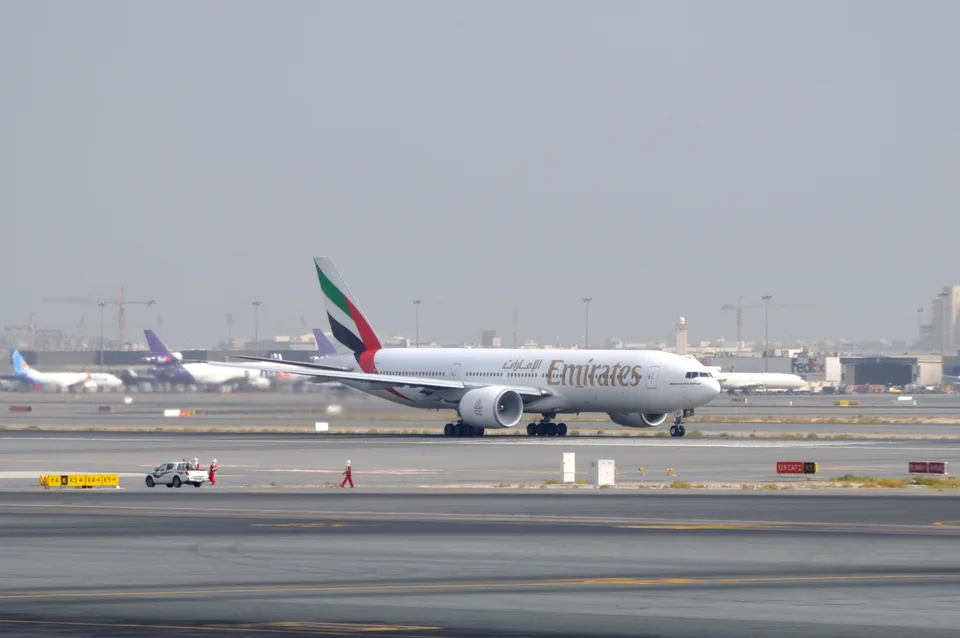
Emirates Boeing 777 A6-EWC at Dubai International Airport.

A6-EWC at Dubai International Airport in August 2009.

Photo: Simisa, CC BY-SA 3.0

Image info

The incident aircraft, photographed on 16 August 2009, before the incident.

Image source

Original photograph unchanged. Responsive WebP copies resized without cropping.

Geographic context

Geographical orientation for Emirates A6-EWC nose gear tyreDubai International Airport, departure and rejected takeoff; Houston, planned destination. Approximate airport and destination city markers. EK211 stopped on runway 12R at Dubai.12NORTH UP / SCHEMATIC / NOT A RECORDED FLIGHT TRACK
  1. Dubai International Airport, departure and rejected takeoff
  2. Houston, planned destination
Approximate airport and destination city markers. EK211 stopped on runway 12R at Dubai. Basemap: Natural Earth, public domain.
Read supporting evidence
Nose Gear Tire Tread Separation on Takeoff1.1 History of the flight | Printed page 1 | PDF page 10Find this passage in evidence search

What happened

The right nose wheel tyre tread separated during the takeoff roll. Debris struck the forward fuselage, producing bangs and vibration that led the commander to judge the aircraft unsafe to fly. The crew stopped below V1. Brake heating deflated the main gear tyres, and passengers left by steps.

Read the full incident Follow what happened, from the flight to the investigation findings.

What investigators concluded

The AAIS identified right nose wheel tyre tread separation as the cause and damage from foreign object debris as a contributing factor. It found the rejected takeoff coordinated and performed in accordance with Emirates procedures.

Evidence behind this explanation
Nose Gear Tire Tread Separation on Takeoff1.1 History of the flight | Printed page 1 | PDF page 10Find this passage in evidence search
Nose Gear Tire Tread Separation on Takeoff2.2 Decision to reject | Printed page 18 | PDF page 27Find this passage in evidence search
Nose Gear Tire Tread Separation on Takeoff3.3 and 3.4 Causes and contributing factors | Printed page 19 | PDF page 28Find this passage in evidence search

The takeoff rejection and tyre investigation

1,509 words / about 7 minutes to read. Based on the investigation records cited below.

Departure from Dubai

Emirates flight EK211 was preparing to depart Dubai International Airport for Houston on 8 August 2010. The Boeing 777-200LR, registered A6-EWC, carried 269 passengers, four flight crewmembers and fourteen cabin crewmembers. The commander was the pilot flying. The aircraft used the full length of runway 12R, and its takeoff mass was 5,767 kilograms below the maximum certified takeoff mass. The crew had correctly calculated a V1 decision speed of 178 knots.

The aircraft had been manufactured in November 2007 and had undergone its latest A maintenance check on 16 July 2010. Investigators found that it was airworthy when dispatched. They also found the flight crewmembers licensed, medically fit, qualified and adequately rested. Weather and navigation aids were excluded as factors. Communications between the aircraft and Dubai air traffic control were good, as were communications between the flight deck and cabin.

The recorder timeline placed the aircraft on the runway at 05:55:18 UTC. The thrust levers were advanced at 05:55:34, engine thrust stabilised at 55% N1, and takeoff thrust reached 100% N1 at 05:55:43. Computed airspeed reached 80 knots at 05:56:00 and 100 knots five seconds later. The flight history described the occurrence time as approximately 05:57.

Sources for this section
Nose Gear Tire Tread Separation on Takeoff1.1 History of the flight | Printed page 1 | PDF page 10Find this passage in evidence search
Nose Gear Tire Tread Separation on Takeoff1.2 Injuries to persons | Printed page 2 | PDF page 11Find this passage in evidence search
Nose Gear Tire Tread Separation on Takeoff1.6 Aircraft information | Printed page 3 | PDF page 12Find this passage in evidence search
Nose Gear Tire Tread Separation on Takeoff1.7 Meteorological information | Printed page 4 | PDF page 13Find this passage in evidence search
Nose Gear Tire Tread Separation on TakeoffTable 6, recorder timeline | Printed page 6 | PDF page 15Find this passage in evidence search

Tread debris and the decision to stop

At approximately 170 knots, the crew heard a loud bang. Tyre debris flew up in front of the aircraft and significant vibration came from the nose gear. The right nose wheel tyre had shed its tread, and pieces struck the underside of the forward fuselage. The impacts produced loud bangs in the cockpit. The commander judged that the aircraft was unsafe or unable to fly and rejected the takeoff before V1.

The recorders captured a vertical acceleration spike of 1.539G at 05:56:24. Two seconds later the forward thrust levers began moving from takeoff thrust to the closed position, a movement completed within one second. The speedbrake lever moved up at 05:56:27. The aircraft continued accelerating briefly after the stopping actions began, reaching a maximum computed airspeed of 176 knots. Its recorded groundspeed at that point was 183 knots.

Maximum reverse thrust was selected at 05:56:30, when the ground spoilers also extended. Maximum reverse thrust was established four seconds later. At 05:56:41 computed airspeed had fallen to 60 knots and the reverse thrust levers moved towards reverse idle. The aircraft stopped on the runway centreline at 05:56:50, approximately 1,216 metres before the runway end. The report treated its calculated runway distances as approximate.

Sources for this section
Nose Gear Tire Tread Separation on Takeoff1.1 History of the flight | Printed page 1 | PDF page 10Find this passage in evidence search
Nose Gear Tire Tread Separation on Takeoff2.1 Foreign object debris | Printed page 16 | PDF page 25Find this passage in evidence search
Nose Gear Tire Tread Separation on TakeoffTable 6, recorder timeline | Printed page 6 | PDF page 15Find this passage in evidence search
Nose Gear Tire Tread Separation on Takeoff2.2 Decision to reject | Printed page 18 | PDF page 27Find this passage in evidence search

Brake heating and disembarkation

After stopping, the crew notified air traffic control and the airport fire service attended. The commander alerted the cabin crew. The high energy rejection heated the brakes and triggered a brake temperature warning on the engine indication and crew alerting system. The recorder timeline put the indication and the first main gear tyre deflation through a fuse plug at 06:00:39. The main gear tyres deflated following the stop.

The crew kept the aircraft stationary, started the auxiliary power unit and shut down the engines. Firefighters reported smoke from the main gear area and cooled the brakes with water. Investigators found no indication of fire. The commander told passengers over the public address system that a tyre failure had caused the takeoff rejection and that they would leave using steps. All passengers had disembarked within 25 minutes of the event.

All 287 occupants were uninjured. Damage included dents and impact marks on the lower fuselage behind the nose gear, rubber marks ahead of the nose gear bay and destruction of a nose gear landing light. All main gear axles required replacement because of the deceleration forces and heating of the brake assemblies during and after the stop. There was no damage to property or the environment.

Sources for this section
Nose Gear Tire Tread Separation on Takeoff1.1 History of the flight | Printed page 1 | PDF page 10Find this passage in evidence search
Nose Gear Tire Tread Separation on TakeoffTable 6, recorder timeline | Printed page 6 | PDF page 15Find this passage in evidence search
Nose Gear Tire Tread Separation on Takeoff1.2 and 1.3 Injuries and damage | Printed page 2 | PDF page 11Find this passage in evidence search

Recorded evidence

A6-EWC carried a flight data recorder, cockpit voice recorder and quick access recorder. The quick access recorder served the operator's monitoring of flight data and aircraft systems, recording most flight data recorder parameters as well as additional parameters selected by the operator. The flight data recorder received parameters through the digital flight data acquisition function, which converted the incoming information into digital form before passing it to the recorder.

The cockpit voice recorder operated continuously while the aircraft electrical system was powered and its circuit breaker was closed. It recorded the most recent 120 minutes of cockpit audio and was deactivated after the incident. The AAIS downloaded both the flight data recorder and cockpit voice recorder at its laboratory in Abu Dhabi. Both contained usable data. Investigators used the onboard recordings to construct the timed sequence of thrust changes, speedbrake movement, speed, stopping and subsequent tyre deflation. The timeline listed an accelerate stop distance available of 4,570 metres for runway 12R.

Sources for this section
Nose Gear Tire Tread Separation on Takeoff1.11 Flight recorders | Printed page 5 | PDF page 14Find this passage in evidence search
Nose Gear Tire Tread Separation on TakeoffTable 6, recorder timeline | Printed page 6 | PDF page 15Find this passage in evidence search

What the tyre examination found

The failed right nose wheel tyre was a Bridgestone radial tyre manufactured in December 2007. It had received its first retread in January 2010 and had completed 54 landings at the time of the incident. The report recorded an inflation pressure of 229 psi and approximately 6.5 mm of remaining skid depth. Investigators sent the failed tyre for laboratory examination.

The outboard sidewall appeared normal. On the inboard side, examiners found seven large bulges around the upper sidewall and shoulder. Most of the tread crown had detached from the casing, while the outboard shoulder rib remained firmly attached. The separation ran along the upper surface of the first belt ply and the original rubber beneath the tread. The pattern of detachment indicated good adhesion.

Airport personnel recovered approximately half of the detached tread. A recovered section had a large notch, 46 mm long and 17 mm wide, in the centre rib. Directly beneath this notch, the rubber showed a smooth separated surface and blue discolouration. The laboratory attributed these features to heat generated by internal friction. It found no separation or structural anomaly within the casing plies and concluded that impact with a blunt foreign object had caused the tread separation.

Sources for this section
Nose Gear Tire Tread Separation on Takeoff1.6.2 Tyre information | Printed page 4 | PDF page 13Find this passage in evidence search
Nose Gear Tire Tread Separation on Takeoff1.16.1 Tyre inspection | Printed page 7 | PDF page 16Find this passage in evidence search
Nose Gear Tire Tread Separation on Takeoff1.16.1 Tyre inspection | Printed page 8 | PDF page 17Find this passage in evidence search
Nose Gear Tire Tread Separation on Takeoff1.16.1 Tyre inspection | Printed page 9 | PDF page 18Find this passage in evidence search
Nose Gear Tire Tread Separation on Takeoff1.16.1 Tyre inspection | Printed page 10 | PDF page 19Find this passage in evidence search

Foreign object damage and its limits

The AAIS concluded that the tyre had probably rolled over an object without sharp edges or corners. The impact made a deep indentation and damaged the tyre, leading to the tread separation during takeoff. The foreign object was never recovered. Investigators could not determine where or when the contact occurred: possible locations included the taxi route and runway, and contact on an earlier occasion also remained possible.

The final findings identified tread separation of the right nose wheel tyre as the cause of the incident and foreign object damage as a contributing factor. The investigators examined the wider debris hazard through the UAE reporting database. They explained that mandatory reporting covered Category A debris likely to damage aircraft on runways or runway shoulders, while reports from other categories were optional. The database therefore mainly reflected mandatory reports.

Dubai already had a debris prevention programme when the incident occurred. The airport strengthened it afterwards, with training, inspections, maintenance and debris reduction measures. At national level, the UAE National Runway Safety Team was established in November 2012. Its safety plan for 2014 to 2016 included foreign object debris prevention among the areas selected for further work.

Sources for this section
Nose Gear Tire Tread Separation on Takeoff2.1 Foreign object debris | Printed page 16 | PDF page 25Find this passage in evidence search
Nose Gear Tire Tread Separation on Takeoff3.3 and 3.4 Causes and contributing factors | Printed page 19 | PDF page 28Find this passage in evidence search
Nose Gear Tire Tread Separation on Takeoff1.17.2 Aerodrome operator | Printed page 12 | PDF page 21Find this passage in evidence search

The crew response and safety recommendations

Emirates procedures gave the commander responsibility for deciding on and performing a rejected takeoff. Between 80 knots and V1, the listed reasons included an engine failure, fire or fire warning, predictive windshear warning, or an aircraft judged unsafe or unable to fly. The AAIS found that both pilots coordinated their actions and completed the rejection in accordance with the operator's procedures.

The investigation considered the risks of rejecting at high speed. The nose wheels provided no braking, the second nose tyre remained intact and the tyre that lost its tread stayed inflated. However, the detached tread striking the fuselage created the noises that led the commander to stop. The report also described how the high energy rejection generated temperatures capable of causing additional tyre failures.

The GCAA issued two recommendations. SR 39/2015 called for consideration of an enhanced UAE debris prevention programme. SR 40/2015 called for effective debris programmes at all UAE aerodromes. The final findings said the national prevention provision had been developed but was still awaiting full deployment and implementation.

The airport described a three tier inspection system, including inspections by senior management every six months and participation by its safety action group. Cleaning arrangements covered ground support equipment roads as well as runways, taxiways and aprons. A February 2015 update reported weekly runway cleaning and twice daily cleaning of taxiway crossings. Staff also cleaned critical areas manually, with cleaning personnel positioned in baggage handling areas and on aprons.

Training and campaigns involved airport stakeholders as well as airside controllers. Debris prevention formed part of annual development training and competency assessments. Stakeholders organised walks to collect debris and raise awareness, while runway debris was monitored as a key performance indicator at safety meetings. The airport also reported directions to construction contractors covering debris bins, sweepers and inspections.

Dubai Airports reported expanded inspections, cleaning of runways, taxiways and aprons, stakeholder debris walks and training. It also reported purchase and installation of the iFerret detection system, with operation expected in the first quarter of 2016. These actions and plans were recorded in the AAIS final report dated 23 July 2015.

Sources for this section
Nose Gear Tire Tread Separation on Takeoff1.18.6 Rejected takeoff procedures | Printed page 15 | PDF page 24Find this passage in evidence search
Nose Gear Tire Tread Separation on Takeoff1.18.6 Rejected takeoff procedures | Printed page 16 | PDF page 25Find this passage in evidence search
Nose Gear Tire Tread Separation on Takeoff2.2 Decision to reject | Printed page 18 | PDF page 27Find this passage in evidence search

Return to the short summary / Source status and limitations

How the sequence developed

Follow the main stages, then open the evidence beneath each step.

  1. Blunt object damage

    A blunt object left a deep notch in the tread; laboratory examination linked the impact to the separation.

    Read supporting evidence
    Nose Gear Tire Tread Separation on Takeoff1.16.1 Tyre inspection | Printed page 10 | PDF page 19Find this passage in evidence search
  2. Tread strikes the fuselage

    The tread separated and struck the forward fuselage, creating loud bangs.

    Read supporting evidence
    Nose Gear Tire Tread Separation on Takeoff2.1 Foreign object debris | Printed page 16 | PDF page 25Find this passage in evidence search
  3. High speed stop

    The commander rejected below V1; the crew stopped on the runway with approximately 1,216 metres remaining.

    Read supporting evidence
    Nose Gear Tire Tread Separation on Takeoff2.2 Decision to reject | Printed page 18 | PDF page 27Find this passage in evidence search
  4. Heat after rejection

    Brake heating led to main gear tyre deflation. Firefighters cooled the brakes and passengers left by steps.

    Read supporting evidence
    Nose Gear Tire Tread Separation on Takeoff1.1 History of the flight | Printed page 1 | PDF page 10Find this passage in evidence search

A simplified reading of the investigation findings. The sequence does not replace the full report or imply that every contributing factor is shown.

Sequence of events

Times are UTC, four hours behind UAE local time. The recorder table places the stop at 05:56:50; the flight history rounds the event to 05:57. Runway distances in the table are approximate. Expand an event to see its evidence.

  1. 05:55:18Lined up

    A6-EWC lined up on runway 12R for departure to Houston.

    Nose Gear Tire Tread Separation on TakeoffTable 6, recorder timeline | Printed page 6 | PDF page 15Find this passage in evidence search
  2. 05:55:43Takeoff thrust

    Takeoff thrust reached 100% N1.

    Nose Gear Tire Tread Separation on TakeoffTable 6, recorder timeline | Printed page 6 | PDF page 15Find this passage in evidence search
  3. About 170 knotsBang and vibration

    The crew heard a bang, saw tyre debris and felt significant nose gear vibration.

    Nose Gear Tire Tread Separation on Takeoff1.1 History of the flight | Printed page 1 | PDF page 10Find this passage in evidence search
  4. 05:56:24Acceleration spike

    The recorders captured a vertical acceleration spike of 1.539G.

    Nose Gear Tire Tread Separation on TakeoffTable 6, recorder timeline | Printed page 6 | PDF page 15Find this passage in evidence search
  5. 05:56:26Thrust reduced

    The forward thrust levers moved from takeoff to closed, completing the movement within one second.

    Nose Gear Tire Tread Separation on TakeoffTable 6, recorder timeline | Printed page 6 | PDF page 15Find this passage in evidence search
  6. 05:56:27Peak airspeed

    Maximum recorded computed airspeed was 176 knots, below the 178 knot V1.

    Nose Gear Tire Tread Separation on TakeoffTable 6, recorder timeline | Printed page 6 | PDF page 15Find this passage in evidence search
    Nose Gear Tire Tread Separation on Takeoff1.1 History of the flight | Printed page 1 | PDF page 10Find this passage in evidence search
  7. 05:56:30Reverse and spoilers

    Reverse thrust was selected to maximum and the ground spoilers extended.

    Nose Gear Tire Tread Separation on TakeoffTable 6, recorder timeline | Printed page 6 | PDF page 15Find this passage in evidence search
  8. 05:56:50Stopped on the runway

    The aircraft stopped with approximately 1,216 metres remaining.

    Nose Gear Tire Tread Separation on TakeoffTable 6, recorder timeline | Printed page 6 | PDF page 15Find this passage in evidence search
  9. 06:00:39Brake heating

    A brake temperature indication appeared and the first main gear tyre deflated through a fuse plug.

    Nose Gear Tire Tread Separation on TakeoffTable 6, recorder timeline | Printed page 6 | PDF page 15Find this passage in evidence search
  10. Within 25 minutesPassengers disembarked

    All passengers left by steps, with no injuries reported.

    Nose Gear Tire Tread Separation on Takeoff1.1 History of the flight | Printed page 1 | PDF page 10Find this passage in evidence search
    Nose Gear Tire Tread Separation on Takeoff1.2 Injuries to persons | Printed page 2 | PDF page 11Find this passage in evidence search

Search the report evidence

Search extracted report prose, with original page references. Short results link to the full document.

Questions readers ask

What physical evidence linked the failure to a foreign object?

Recovered tread contained a 46 mm by 17 mm notch. The corresponding inner surface showed separation and heat discolouration, and the laboratory attributed the failure to impact with a blunt object.

Nose Gear Tire Tread Separation on Takeoff1.16.1 Tyre inspection | Printed page 9 | PDF page 18Find this passage in evidence search
Nose Gear Tire Tread Separation on Takeoff1.16.1 Tyre inspection | Printed page 10 | PDF page 19Find this passage in evidence search
How fast did the aircraft travel during the rejection?

Computed airspeed peaked at 176 knots, below the correctly calculated V1 of 178 knots. The aircraft stopped approximately 1,216 metres before the runway end.

Nose Gear Tire Tread Separation on Takeoff2.2 Decision to reject | Printed page 18 | PDF page 27Find this passage in evidence search
Nose Gear Tire Tread Separation on TakeoffTable 6, recorder timeline | Printed page 6 | PDF page 15Find this passage in evidence search
Nose Gear Tire Tread Separation on Takeoff1.1 History of the flight | Printed page 1 | PDF page 10Find this passage in evidence search
What additional debris detection equipment was planned?

Dubai Airports reported purchase and installation of iFerret, with operation expected in the first quarter of 2016. The final report also described expanded inspections, cleaning and training.

Nose Gear Tire Tread Separation on TakeoffAppendix B, safety actions | Printed page 22 | PDF page 31Find this passage in evidence search
Nose Gear Tire Tread Separation on TakeoffAppendix B, inspections and cleaning | Printed page 23 | PDF page 32Find this passage in evidence search

What the evidence can and cannot establish

Safety follow-up

Actions and recommendations are described at the dates of the cited records. A recommendation is not proof of implementation.

Classifications, with reasons

These labels organise the evidence. They are not a ranking of causes. A shared label means a shared research topic, not an identical mechanism.

CauseRight nose tyre tread separation

The tread detached during the takeoff roll.

Contributing factorForeign object damage

The tyre had sustained foreign object damage before its tread separated.

Nose Gear Tire Tread Separation on Takeoff3.4 Contributing factors | Printed page 19 | PDF page 28Find this passage in evidence search
Crew responseCoordinated rejected takeoff

The crew initiated the rejection below V1 and followed Emirates standard operating procedures.

Nose Gear Tire Tread Separation on Takeoff2.2 Decision to reject | Printed page 18 | PDF page 27Find this passage in evidence search
ConsequenceBrake heating and main gear damage

The high energy stop heated the brake assemblies; the main gear tyres deflated and all main gear axles required replacement.

Nose Gear Tire Tread Separation on Takeoff1.3 Damage to aircraft | Printed page 2 | PDF page 11Find this passage in evidence search

Read alongside

These comparisons connect specific research topics. Shared circumstances do not establish identical causes. Evidence from both investigations is provided below.

Air France Flight 4590

Both investigations traced a takeoff sequence to tyre damage from foreign objects. A6-EWC shed a nose tyre tread and stopped on the runway. In Air France 4590, tyre debris damaged a fuel tank; leaking fuel ignited and the aircraft lost thrust. The BEA identified a part lost by a preceding aircraft, while the object that damaged A6-EWC was not recovered.

Read supporting evidence
Nose Gear Tire Tread Separation on Takeoff2.1 Foreign object debris | Printed page 16 | PDF page 25Find this passage in evidence search
Nose Gear Tire Tread Separation on Takeoff2.2 Decision to reject | Printed page 18 | PDF page 27Find this passage in evidence search
Final report: Concorde F-BTSC, 25 July 20003.2 Probable causes | Printed page 176 | PDF page 176Find this passage in evidence search

Further investigation records

Explore the records below for additional context. They open on the publisher's site and are not all included in our report search. Source reuse terms apply.

Sources and transparency

The GCAA AAIS issued final report AIFN/0012/2010 on 23 July 2015.

Source limitations

The foreign object was not recovered. Investigators could not determine where or when the tyre struck it.

Nose Gear Tire Tread Separation on Takeoff

UAE GCAA Air Accident Investigation Sector
Final report AIFN/0012/2010, dated 23 July 2015

Official report PDF, hosted by gcaa.gov.ae

Open source document

36 PDF pages.

GCAA publication; original narrative with short supporting extracts. Report photographs carry separate rights.

Read the extraction, classification and review methodology.

Suggest a correction to this dossier

Editorial record

Kevin Murphy writes the incident accounts on AirlineIncidents.com, out of a long interest in aviation safety and the lessons each investigation leaves behind.

Prepared by
AirlineIncidents editorial desk
Report citation check
Independent expert review
Not completed

Citation checks compare supporting text with the indexed report pages. They do not constitute independent expert review. How these pages are prepared.

Revision history

: GCAA AAIS final investigation report dated 23 July 2015.
Source-based corrections are reviewed before changes appear here. Suggest a correction to this dossier.

Cite or link to this page

Quoting this account or linking to it? Please use the page address below, and credit the investigation report it is built from.

Credit line

AirlineIncidents.com. Emirates A6-EWC accident account. Published 30 October 2026. https://airlineincidents.com/incidents/emirates-a6-ewc-2010/

HTML link

<a href="https://airlineincidents.com/incidents/emirates-a6-ewc-2010/">Emirates A6-EWC accident account (AirlineIncidents.com)</a>

Select a box to copy it. Spotted something wrong? Send a correction.