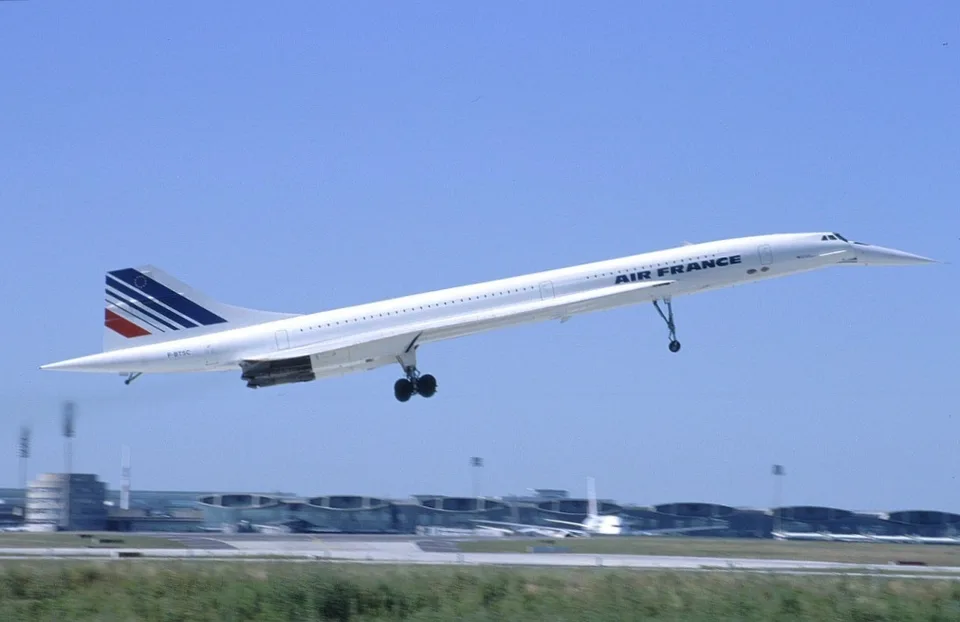
Responsive versions resized and recompressed; no content changes. Derivatives retain CC BY-SA 4.0. Responsive WebP copies resized without cropping.
Geographic context
Paris Charles de Gaulle
New York intended destination
Approximate airport markers for the intended route, not an accident flight track or navigation chart. Basemap: Natural Earth, public domain.Read supporting evidence
During takeoff from Paris, a tyre was cut by a strip lost from an earlier aircraft. Fuel escaped from the left wing and ignited. The Concorde could not sustain flight and struck a hotel in Gonesse.
Read the full incident Follow what happened, from the flight to the investigation findings.
What investigators concluded
BEA identified the tyre destruction, tank rupture and ignition sequence as causes. The precise rupture and ignition mechanisms were subjects of formal UK comments, with BEA retaining its conclusions.
A tyre failure, a fuel leak and a disputed mechanism
1,623 words / about 8 minutes to read. Based on the investigation records cited below.
A charter departure from Paris
Air France flight 4590 was a charter from Paris Charles de Gaulle to New York on 25 July 2000. The Concorde, registered F-BTSC, carried one hundred passengers and nine crew members, including three flight crew. The captain was pilot flying and the first officer was pilot not flying. BEA reconstructed the short flight using recorder information, radio communications, wreckage, runway debris and technical testing. This account follows the official English final report and uses UTC for its recorded times. It also includes the formal UK comments printed at the end of that report.
The crew requested the full length of runway 26 right. Start-up clearance came at 14:07:22 and taxi clearance at 14:34:38. The controller cleared the aircraft to line up at 14:40:02 and to take off at 14:42:17. The selected takeoff speeds included a decision speed of 150 knots and a rotation speed of 198 knots. These details establish the operational setting without suggesting that an ordinary clearance could itself have detected the dangerous object on the runway. The investigation subsequently identified the object through physical evidence.
At 14:42:31, the captain commenced takeoff. The first officer called one hundred knots at 14:42:54.6 and the decision speed nine seconds later. A few seconds after that, the tyre on wheel 2 of the left main landing gear was destroyed. The report places the initiating damage after the decision-speed call. That chronology matters when describing the short time available before rotation and the subsequent fire. It should not be replaced with an unsupported assumption that the crew had received an earlier warning and could simply have avoided the event.
The investigation found that a metallic strip on the runway had cut the tyre. It came from the thrust reverser cowl door of engine 3 on a DC-10 that had departed five minutes earlier. BEA found that the strip installed during maintenance in Houston had neither been manufactured nor installed in accordance with the manufacturer's procedures. A 4.5 kilogram piece of tyre was recovered near the strip, together with other tyre fragments and light aircraft pieces. This sequence links a maintenance-related object on the runway to the damage suffered by a different departing aircraft.
A large piece from the underside of fuel tank 5 was also recovered on the runway. BEA described it as having been torn from the inside towards the outside, without visible impact marks on that piece. Another piece found at the accident site had a small puncture. The report therefore investigated more than a simple picture of a fragment punching a single hole through the tank. It used tests and modelling to study how impact energy could be transmitted through tank skin and fuel and cause a larger structural failure.
In its probable-cause statement, BEA described a complex transmission of energy from a tyre-piece impact at another point on the tank, involving tank-skin deformation and fuel movement. It allowed possible contributions from smaller impacts or a hydrodynamic pressure surge. Those qualifications are retained here. The report established the tyre failure and subsequent fuel release much more firmly than every detail of the internal failure process. The UK accredited representative's comments expressly challenged which model should receive precedence, an issue discussed separately below rather than silently merged into BEA's conclusion.
A severe fire developed beneath the left wing. Engines 1 and 2 experienced losses of thrust, with the initial loss more severe on engine 2. At 14:43:13, as rotation began, the controller told the crew that flames were visible behind the aircraft. The first officer acknowledged the warning and the flight engineer announced the engine 2 failure. The recorded data also showed a transient loss on engine 1 which was not announced by the crew. This distinction separates what investigators could reconstruct afterwards from the information explicitly recorded as recognised in the cockpit.
The engine fire alarm sounded at about 14:43:22. The flight engineer announced the shutdown of engine 2 and the captain called for the engine-fire procedure. The engine 2 fire handle was pulled a few seconds later and the warning stopped. The first officer drew attention to the airspeed, then approximately 200 knots. At 14:43:30 the captain called for gear retraction, while the controller again confirmed large flames. The aircraft was airborne with major fire damage and diminished thrust, not merely coping with an isolated tyre defect after an otherwise normal takeoff.
The gear did not retract. At 14:43:56 the first officer commented on that condition and made further airspeed calls. BEA later concluded that the inability to retract the landing gear probably helped retain and stabilise the flame during the flight. The wording probably reflects the report's confidence rather than a proven measurement of every aerodynamic effect. The gear condition also forms part of the reconstruction of why the aircraft could not gain the performance needed to continue safely. It is a contributing circumstance within the fire sequence, not a replacement for the initiating runway-object finding.
At 14:43:59, ground-proximity warnings sounded and the first officer told control that the crew were trying for Le Bourget aerodrome. Recorded parameters then indicated another loss of power on engine 1. A few seconds later, the Concorde struck a hotel at La Patte d'Oie in Gonesse. The aircraft and hotel were destroyed. All one hundred passengers and nine crew died, together with four people on the ground. The injury table records six others in its slight-or-none category. It does not establish six serious injuries, and this account does not convert that category into one.
BEA's findings describe the later severe loss of engine 1 thrust, high angle of attack and roll, and structural damage sustained in flight from the fire. The report also concluded that even normally operating engines would not have prevented the eventual loss of an aircraft with that significant structural damage. This is an investigation finding about the damage sustained, rather than a claim that performance and engine response were irrelevant during the earlier seconds. The account keeps the sequence of tyre damage, fuel release, fire, thrust loss and impact together.
Other conditions examined by the investigation require equally careful treatment. The left main-gear bogie spacer had not been reinstalled during recent maintenance, but BEA explicitly found that this omission did not contribute to the accident. Its recalculation placed actual takeoff weight about one tonne above the maximum and described the performance effect as negligible. Reporting these findings avoids promoting an identified maintenance omission or a numerical exceedance into an alternative cause when the final investigation did not support that interpretation. Technical significance comes from the report's analysis, not simply from whether a condition sounds abnormal.
The UK accredited representative and advisers agreed that tyre rupture was followed by tank damage and massive fuel release. They emphasised the lack of recovered material from much of tank 5's underside. In their view, the non-penetrating tyre-impact model reasonably represented the general physics but could not be fully substantiated. A more limited study also showed that a penetrating projectile could produce structural damage. They said neither scenario could be given precedence from the available underside evidence and that a combination was possible. BEA disputed that interpretation and retained its tank-rupture analysis.
The ignition discussion also contains a formal difference of view. The UK comments noted that ignition preceded the first engine surge, excluding that surge as the initial ignition source. They described testing which repeatedly produced rapid ignition from electrical arcing in the main-gear bay, while forward propagation from the engine reheat area remained theoretical in their assessment. They therefore favoured damaged wheel-brake fan power-supply cables as the most probable source. The relevant cables were not identified in the wreckage, so their actual damage and arcing could not be directly established.
BEA acknowledged divergence between experts and retained electrical arcing or contact with hot engine parts followed by forward flame propagation in its conclusions. Its response said safety could benefit from considering the different possibilities. This draft does not settle that technical disagreement by choosing whichever statement is simpler to narrate. It attributes the lead investigation's conclusion and the UK preference separately, with page-level references to both. The existence of an unresolved ignition detail does not erase the established runway-object, tyre-failure, fuel-release and fire sequence.
The report records measures defined for return to service, including flexible tank linings, reinforced electrical harnesses in main-gear bays, inhibition of brake-fan power in critical phases, Michelin NZG tyres and changes to the anti-skid computer. It also lists water-deflector changes, a ban on volatile fuels and increased minimum go-around fuel. These are report-era measures. Describing them does not claim that a present operator has implemented a particular action or that a later regulatory programme has been independently checked during preparation of this draft.
BEA recommended stronger analysis of in-service events, consistency between Air France emergency procedures and the flight manual, improved recorder sampling and an operational and maintenance audit. Its wider recommendations addressed tyre certification, tank damage and fuel-leak ignition, runway debris prevention and the feasibility of automatic detection. The accident thus generated proposals beyond a single component replacement. The report connected a dangerous runway object with maintenance practice, tyre vulnerability, fuel-tank response and the ability of airports to find debris before another aircraft encountered it.
The final account rests on the official investigation rather than later litigation or an inferred cockpit drama. It states the fatal outcome plainly, preserves the exact scope of excluded and negligible factors, and retains the UK comments beside BEA's responses. The central lesson described by the report is a chain of interacting physical hazards: a small foreign object led to tyre destruction, tank damage and a major fire. The uncertainty concerns parts of that physical mechanism. It must be visible without being exaggerated into uncertainty about every established event in the short flight.
Matching dossiers for Mechanism disagreement: No other dossier in this collection.
Read alongside
These comparisons connect specific research topics. Shared circumstances do not establish identical causes. Evidence from both investigations is provided below.
Concorde and Air France 447 demonstrate why findings must distinguish an initiating event from the subsequent aircraft response. Concorde involved external tyre damage, a fuel leak and fire; AF447 involved unreliable airspeed indications and a loss of control. The mechanisms are different.
Explore the records below for additional context. They open on the publisher's site and are not all included in our report search. Source reuse terms apply.
Official English final report, January 2002, including UK accredited representative comments and BEA responses
Sources and transparency
Checked against cached official report pages and specified official comments. No independent expert review.
Source limitations
BEA conclusions are attributed. UK comments dispute the preference between tank-rupture mechanisms and favour electrical arcing as ignition; those disagreements are retained.
Final report: Concorde F-BTSC, 25 July 2000
BEA Official English final report, January 2002, including UK accredited representative comments and BEA responses
Private evidence cache. Only short attributed quotations in original commentary; full report and third-party illustrations are not redistributed. Source terms / provenance.
Final Report: Accident on 1st June 2009 to the Airbus A330-203 registered F-GZCP operated by Air France flight AF 447
Bureau d'Enquetes et d'Analyses (BEA) English final report, 5 July 2012
Limited quotations for source-based commentary. Full report and illustrations are not republished. Wider reuse requires checking BEA terms. Source terms / provenance.
Kevin Murphy writes the incident accounts on AirlineIncidents.com, out of a long interest in aviation safety and the lessons each investigation leaves behind.
Prepared by
AirlineIncidents editorial desk
Report citation check
Independent expert review
Not completed
Citation checks compare supporting text with the indexed report pages. They do not constitute independent expert review. How these pages are prepared.
Revision history
: Private landmark Wave 1 original account; final report and specified comments cited.