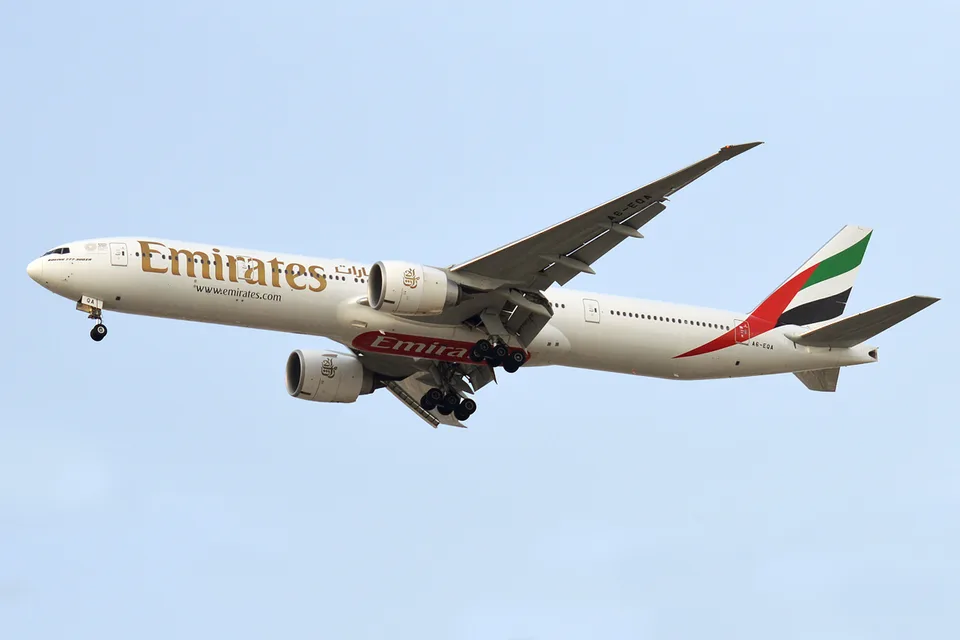
EK524 began a takeoff without clearance while another Emirates 777 crossed runway 30R. The crew rejected the takeoff after the tower ordered them to stop.
Original photograph unchanged. Responsive WebP copies resized without cropping.
Geographic context
Dubai International Airport, runway 30R incident
Hyderabad, EK524 destination
Bengaluru, EK568 destination
Both flights departed from Dubai for destinations in India. Airport positions are approximate geographic markers. Basemap: Natural Earth, public domain.Read supporting evidence
At Dubai, EK524 received permission to line up on runway 30R and continued into a rolling takeoff. EK568 had been cleared to cross the same runway at Mike 5A. The tower detected EK524 accelerating and instructed its crew to stop. EK524 came to rest abeam Mike 9, 1,000 metres short of Mike 5A.
Read the full incident Follow what happened, from the flight to the investigation findings.
What investigators concluded
The AAIS found that EK524 crew members mistook departure-readiness and line-up instructions for takeoff clearance. Checklist work reduced radio monitoring, and distance, construction work and darkness hindered their view of EK568. AIRN had issued no takeoff clearance.
The clearance misunderstanding and rejected takeoff
1,602 words / about 8 minutes to read. Based on the investigation records cited below.
Two departures during taxiway works
On 9 January 2022, Emirates EK524 was preparing to fly from Dubai to Hyderabad with 187 people aboard. Its Boeing 777-31H(ER), A6-EQA, carried 173 passengers, two pilots and 12 cabin crew. The copilot was flying and the commander was monitoring. Another Emirates Boeing 777, A6-EBY, was operating EK568 to Bengaluru with 311 people aboard. That aircraft also had its copilot flying and its commander monitoring.
Construction had closed a substantial part of taxiway Mike. With runway 30R in use for departures, aircraft taxiing out had to cross either that runway or the parallel arrival runway, 30L, according to their route. EK524 was routed along Zulu and Zulu 16 to Kilo 12, across runway 30L and then to Mike 15A for runway 30R. The two flights would reach the departure runway at different positions.
The weather was clear, with visibility above 10 kilometres and no cloud. The AAIS found that weather did not contribute to the incident. It found EK524 airworthy, with no defect or malfunction contributing to the event. Both crews were qualified, and the EK524 pilots said they were rested and fit for duty. The investigation concentrated on the sequence of clearances, crew perceptions and runway movements.
Before EK524 reached runway 30R, its crew had a confused exchange with the Air South controller at the crossing of runway 30L. After an arriving SpiceJet Boeing 737 landed, the stop bar lights went out and EK524 began moving at 18:00:07. At 18:00:14, the controller instructed it to hold position and the stop bar lights turned red. The crew did not respond to that first instruction. They acknowledged a repeated instruction five seconds later.
The commander thought the aircraft nose might have passed the stop bar. The pilots used the ground manoeuvring camera to check their position and confirmed that the nose landing gear remained behind it. Ground movement radar also confirmed the position. During the exchange, the controller referred to a possible system fault. Investigators established from his statement that he had selected the stop bar manually.
At 18:00:58, Air South cleared EK524 to cross runway 30L behind an arriving Airbus A330, and the crew correctly read back the instruction. Later, the controller asked if they were ready for departure and cleared them toward Mike 15A. The commander understood the readiness question as readiness for takeoff. The AAIS found that the runway crossing sequence and this question created a sense of urgency and contributed to the crew assumption that takeoff had been authorized.
Air South transferred EK524 to Air North on 118.75 MHz. At 18:02:46, the commander called the new controller and received an instruction to line up on runway 30R. He correctly read it back. Surface radar showed EK524 passing holding point Mike 15A at 18:03:08 and continuing onto the runway. The commander turned on the landing lights.
The takeoff clearance was being withheld because a landing aircraft was approaching runway 30L. EK524 departure from Mike 15A required dependent runway operations, which linked the departure clearance to the progress of traffic on the arrival runway. The summary records that the approaching aircraft was 2.5 nautical miles from the runway 30L threshold. Air North had authorized EK524 to enter and line up, with its departure still subject to the arriving traffic.
At 18:03:35, EK568 called Air North from Mike 5A, holding short of runway 30R. The controller cleared it to cross, expedite and continue toward holding point November 9. EK568 read back the instruction and began crossing. Eight seconds after that call, surface radar showed EK524 lined up and moving at 11 knots ground speed.
Before initiating takeoff, the EK524 commander asked the copilot whether clearance had been received. The copilot confirmed it, and the aircraft continued into a rolling takeoff. Investigators found that both pilots assumed a takeoff clearance had been given. The radio record showed a line-up instruction and its correct readback; no takeoff clearance had been issued.
The flight history records the controller detecting EK524 accelerating at 97 knots ground speed at 18:04:04. He immediately instructed its crew to hold position. They did not answer. At 18:04:10, he repeated the call with an instruction to stop immediately. The pilots began stopping the aircraft, again without acknowledging the transmission.
EK524 reached a maximum recorded ground speed of 125 knots. It stopped at 18:04:26 abeam taxiway Mike 9, about 1,000 metres short of the crossing point at Mike 5A. The controller then told the crew that they had received no takeoff clearance. After the stop, the pilots asked for confirmation that they had not been cleared, and the controller confirmed this.
The AAIS classified the incursion as Category B, a category involving decreasing separation and significant potential for collision requiring a time-critical response. EK568 had been crossing under an ATC clearance while EK524 accelerated toward it. The high-speed rejected takeoff ended the immediate conflict. The summary records no damage to EK524 or property.
The EK524 crew had not heard the exchange clearing EK568 to cross. They were occupied with the before-takeoff checklist, preparations to initiate takeoff and announcements. The investigation found that these activities interfered with monitoring the frequency. Air North had given them no prior warning of the aircraft crossing ahead.
Visual detection was also difficult. The distance from EK524 to the crossing point at Mike 5A was approximately 2,000 metres. Ongoing works obstructed visibility along taxiway Mike, and it was night. The crew said the runway appeared clear when they entered it. The AAIS identified the distance, construction and darkness among the causes that hindered their ability to see EK568.
The Air North controller told investigators he was managing several tasks when he issued EK568 crossing clearance. He was on his second night shift after five days of duty and said he was fit for work. He was relieved from duty immediately after the incident under the applicable civil aviation requirements.
The investigation examined the line-up wording. The applicable local procedures permitted the instruction to line up and did not require the controller to add the words and wait. It also found that Air North had not followed the manual conditional-clearance procedures when coordinating EK524 line-up with the other aircraft crossing. The commander switching on the landing lights provided no effective warning to EK568 or the controller that EK524 was about to start its takeoff roll.
Inspection, continuation and lost voice recordings
A controller handover began at 18:06:23. It included traffic information but omitted specific information about the rejected takeoff. EK524 left the runway at 18:07:06 via November 4 to taxiway Papa, and the handover ended shortly afterward. Ground Movement Planner requested a runway inspection at 18:10:33; it was completed at 18:19:13 and found no foreign debris or contamination.
EK524 remained on the taxiway for 15 minutes while its crew evaluated the event with maintenance control. The crew subsequently reported ready to taxi and rejoined the departure sequence. The aircraft took off at 18:34:15. The summary says that both aircraft continued their scheduled flights. It provides the occupants aboard each flight but no separate injury or survivor table.
Both aircraft carried flight data, cockpit voice and quick access recorders. Their recorders were removed after return to base and downloaded at the Abu Dhabi Flight Recorder Laboratory. By then, the cockpit voice recordings of the occurrence had been overwritten. The flight data recordings remained relevant, and investigators considered the rejected-takeoff data credible. The GCAA issued its Final Summary Report on 20 February 2024, limiting the investigation scope to events leading to the occurrence and excluding in-depth analysis of non-contributing factors.
Recommendations for cockpit work and runway protection
The AAIS recommended that Emirates address the risks of before-takeoff activities through crew resource management. Recommendation SR01/2024 called for mitigation of checklist work that reduced awareness of radio traffic, including dividing tasks between the pilot flying and pilot monitoring. The report records that Emirates arranged discussions with the air navigation service provider about line-up phraseology and was reviewing its management pilot on duty procedures for assessing flight continuation after a safety event.
The investigation also found conflicting runway inspection guidance in different parts of the air traffic services manual. One provision allowed an exception for rejected takeoffs caused by non-mechanical reasons, while another warned that a rejection above 80 knots could damage landing gear or brakes. Recommendation SR02/2024 asked Dubai Air Navigation Services to remove these inconsistencies.
The inspection rules specified the area to be checked after an interrupted departure. If an aircraft had become airborne, the entire runway required inspection. If it remained on the ground, the section from the departure point to the exit used after the rejection required inspection. The AAIS found that conflicting instructions could confuse controllers and airport staff about when that inspection was necessary, allowing foreign objects to remain undetected.
The autonomous warning systems described in the report use surveillance to detect runway occupancy and activate red warning lights. Entrance lights warn an approaching aircraft that entering or crossing is unsafe. Takeoff hold lights warn an aircraft waiting at the runway threshold that another aircraft or vehicle has entered or crossed ahead. These alerts operate independently of normal ATC instructions. The AAIS identified no systemic deficiencies or organizational factors in this investigation.
Recommendation SR03/2024 asked Dubai Airports to begin a safety case study with the GCAA, the air navigation service provider and Emirates on improving ground alerts for runway incursions. The report describes autonomous runway warning systems that detect occupancy and provide direct warnings to pilots and controllers. Emirates was discussing the benefits and feasibility of such a system with the airport. The AAIS said it had not conducted a trend analysis of takeoffs without clearance; its recommendation addressed the severity of the possible consequences and an additional ground warning defense.
Air South instructed EK524 to hold position. The crew confirmed the repeated instruction at 18:00:19; the aircraft stopped with its nose gear behind the stop bar.
The controller detected EK524 accelerating at 97 knots ground speed, first instructed it to hold position and then ordered an immediate stop. The crew began stopping without acknowledging the calls.
The detailed flight history records a maximum ground speed of 125 knots. EK524 stopped at 18:04:26 abeam Mike 9, 1,000 metres short of the Mike 5A crossing point.
Both aircraft had cockpit voice recorders, but the occurrence recordings were overwritten when the flights continued. The recorders were removed after return to base. The flight data recorder information was available and the rejected-takeoff data was credible.
Recommendation SR01/2024 asked Emirates to address the risks of before-takeoff activities through crew resource management, including dividing checklist tasks between the pilots to improve situational awareness.
The published final document is a summary. It omits a complete ATC transcript, detailed FDR parameter tables, an injury and survivor table, and a CVR transcript. The AAIS limited its work to the events leading to the occurrence and did no in-depth analysis of non-contributing factors.
Emirates had arranged phraseology meetings, was coordinating discussions about autonomous runway warnings and was reviewing management pilot on duty procedures for flight-continuation decisions.
Air North gave a line-up instruction and later cleared EK568 to cross the runway. The report found that its conditional-clearance procedures had not been followed.
Matching dossiers for Visual detection: No other dossier in this collection.
Read alongside
These comparisons connect specific research topics. Shared circumstances do not establish identical causes. Evidence from both investigations is provided below.
Both investigations examined crews continuing toward occupied airport surfaces while believing their operation was authorized. At Dubai, EK524 mistook a line-up instruction for takeoff clearance as EK568 crossed runway 30R. At San Francisco, Air Canada 759 mistook taxiway C for its cleared landing runway; the NTSB identified expectation bias among the contributing factors. Each investigation recommended additional ground or cockpit alerts against collision risk.
Explore the records below for additional context. They open on the publisher's site and are not all included in our report search. Source reuse terms apply.
Official findings, event chronology, recorder information and recommendations for the Dubai runway incursion.
Sources and transparency
GCAA AAIS Final Summary Report AIFN/0001/2022, issued 20 February 2024.
Source limitations
The GCAA published a Final Summary Report. It contains no complete ATC transcript, CVR transcript, detailed FDR parameter tables, or injury and survivor table. The investigation covered the events leading to the occurrence and excluded in-depth analysis of non-contributing factors.
Runway Incursion: Emirates A6-EQA and A6-EBY, Dubai, 9 January 2022
UAE GCAA Air Accident Investigation Sector Final Summary Report AIFN/0001/2022, issued 20 February 2024
Kevin Murphy writes the incident accounts on AirlineIncidents.com, out of a long interest in aviation safety and the lessons each investigation leaves behind.
Prepared by
AirlineIncidents editorial desk
Report citation check
Independent expert review
Not completed
Citation checks compare supporting text with the indexed report pages. They do not constitute independent expert review. How these pages are prepared.
Revision history
: GCAA AAIS issued Final Summary Report AIFN/0001/2022 on 20 February 2024.