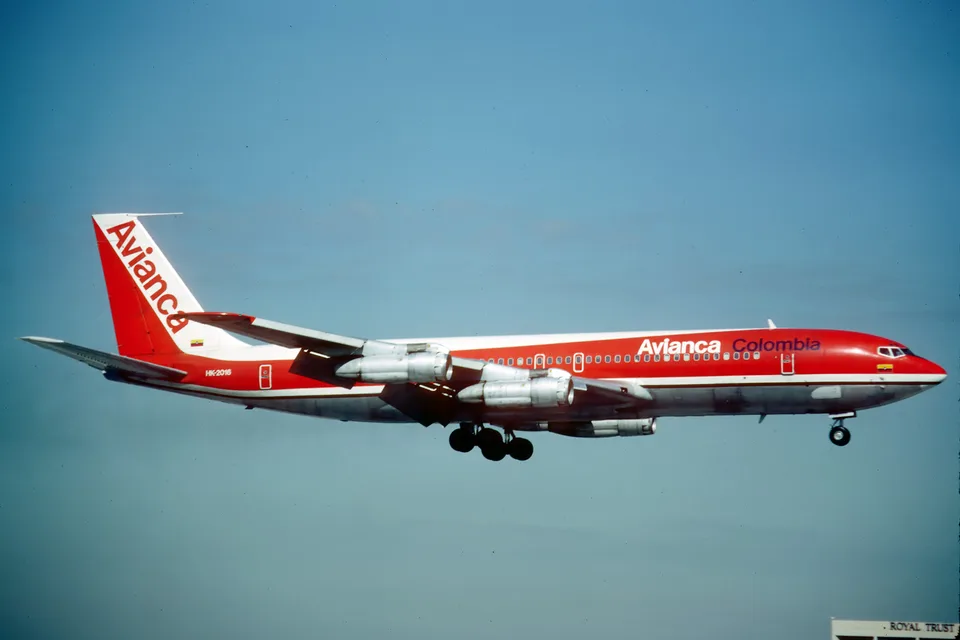
After three holds and a missed approach to New York JFK, Avianca 52 exhausted its fuel and crashed at Cove Neck. Seventy-three of the 158 people aboard died.
Original photograph unchanged. Responsive WebP copies resized without cropping.
Geographic context
Medellin departure, approximate airport location
New York JFK, intended destination
Cove Neck accident area, approximate
Approximate geographic markers show the departure, intended destination and accident area. Basemap: Natural Earth, public domain.Read supporting evidence
Avianca 52 spent 77 minutes in three holding patterns as poor weather and traffic delayed arrivals at JFK. Its crew reported a dwindling fuel supply and inability to reach Boston. After an unsuccessful landing approach, all four engines lost power from fuel exhaustion while the aircraft was being vectored back to the airport.
Read the full incident Follow what happened, from the flight to the investigation findings.
What investigators concluded
The NTSB found inadequate fuel management and failure to communicate an emergency fuel situation to be the probable cause. Dispatch support, FAA traffic flow management and fuel terminology contributed. Windshear, fatigue and stress contributed to the failed first approach.
1,733 words / about 8 minutes to read. Based on the investigation records cited below.
Departure with an unsuitable alternate
Avianca flight 052 began in Bogota on 25 January 1990 and stopped near Medellin before continuing to New York. The Boeing 707-321B, registered HK-2016, was refueled at Jose Maria Cordova Airport. The captain, first officer and flight engineer remained aboard for the onward sector, which departed at 15:08. The scheduled international passenger flight carried 158 people, comprising 149 passengers, including infants, and nine crew. Its planned destination was John F. Kennedy International Airport, with Boston Logan listed as the alternate.
The preparation for that sector contained weaknesses that investigators later traced through the flight plan and dispatch records. Weather information supplied at Medellin was nine to ten hours old. Both that information and the current forecasts put the planned alternates below the required weather minima at the expected arrival time. Syracuse and Buffalo were forecast to meet alternate requirements, but they were absent from the documents given to the crew. Avianca personnel said Boston appeared in a computer-generated plan used for flights to JFK regardless of the forecast.
The plan also used outdated upper air data and understated the aircraft's departure weight by more than 4,000 pounds. It included 28 minutes of reserve fuel corresponding to ten percent of the planned en route time. The NTSB found that the reserve planning failed to anticipate extensive weather and traffic delays at the destination or alternate. It also found that the aircraft had sufficient fuel to complete the flight safely. Subsequent decisions about holding, diversion and emergency handling determined how that fuel was used.
The aircraft flew north along the United States East Coast toward a congested New York arrival system. Controllers first placed it in holding over Norfolk from 19:04 until 19:23. A second hold at BOTON, near Atlantic City, lasted from 19:43 to 20:12. At 20:18 the flight entered a third hold at CAMRN, south of JFK, and remained there until 20:47. Together, the three holds consumed 77 minutes. During the CAMRN hold, the aircraft descended from 14,000 feet to 11,000 feet.
The NTSB found no record of the crew obtaining updated destination or alternate weather during the flight. Avianca's operations policy called for the captain and dispatcher to communicate when conditions or events differed from the release. The aircraft could have contacted dispatch by high frequency radio or through the airline's contracted service in Miami. The flight continued through the delays without that exchange of operational information.
While holding at CAMRN, the crew received successive expect-further-clearance times. When a revised estimate extended to 21:05, the first officer requested priority. At 20:46 he told New York Center that the aircraft could hold about five more minutes. He subsequently said that Boston could no longer be reached because the fuel was running out. The NTSB concluded that the crew had already exhausted the reserve needed to reach the alternate when it requested priority. The remaining fuel state was also critical for landing at JFK.
The controller assisting with the handoff heard the request for priority and the five-minute holding limit. He did not hear the subsequent statement that the aircraft could no longer reach Boston. When he telephoned New York approach control, he passed on the holding limit. The receiving controller was unaware of a fuel problem or request for special handling and gave the flight ordinary approach vectors, including a full turn for spacing.
The Board found that the pilots believed they had conveyed their critical fuel situation. The Center controllers believed they had met the request by releasing the flight from holding toward JFK. They understood the five-minute limit as the point at which the aircraft would need to proceed to its alternate. Inside the cockpit, the flight engineer and captain discussed their belief that controllers knew their condition and were providing priority service. The crew continued toward the approach with that understanding.
On the first instrument approach, Avianca 52 encountered a strong headwind that diminished as it descended. The NTSB reconstructed winds of 60 knots or more at 1,000 feet, about 50 knots at 500 feet and about 20 knots at the surface. That changing wind required continuing adjustments of pitch and thrust to hold the glideslope. The captain established a descent rate suited to much lighter headwinds, and the aircraft moved below the required descent path.
The captain also selected large flap settings prohibited by the operations manual for an aircraft fitted with its engine noise reduction equipment. The Board found that using the permitted settings would have reduced drag and helped conserve fuel. Radar data and cockpit comments showed repeated deviations around the glideslope. Increasingly large corrections in pitch and thrust failed to produce a stable descent. The aircraft was well below the glideslope when the captain initiated the missed approach at about 21:23.
Maintenance records showed recurring autopilot difficulties, and the preceding captain had encountered a flight director problem in approach mode. The NTSB believed the aircraft might have been flown manually from Medellin and that the landing approach used raw glideslope indications. It attributed the captain's difficulty maintaining the approach path to windshear, fatigue after the long flight and stress from the remaining fuel. The cockpit recording also showed repeated requests for instructions or configuration information to be repeated as the workload increased.
After discontinuing the approach, the captain directed the first officer to tell air traffic control that the aircraft was in an emergency. The first officer acknowledged the tower's heading and altitude instructions and added that fuel was running out. He assured the captain that he had passed the warning. The tower handed the flight to approach control without forwarding its fuel statement. On contacting approach, the first officer again reported the dwindling fuel supply.
The aircraft turned onto another downwind leg. At about 21:26 the approach controller asked whether a routing approximately 15 miles northeast followed by a turn back toward the approach was acceptable with the aircraft's fuel. The first officer replied tentatively that it was. The crew later asked for the final approach and received another vector. The Board found that these transmissions failed to make the emergency clear to the controllers, who continued sequencing the aircraft for another landing attempt.
At 21:32 the flight engineer reported flameouts of engines four and three. The first officer told the controller that two engines had been lost and again requested priority. The controller issued a turn and a clearance for the instrument approach to runway 22 left. Power was ultimately lost from all four engines. The cockpit voice recording ended at 21:33:24. At about 21:34 the aircraft struck a hillside in a wooded residential area at Cove Neck, on the north shore of Long Island. The forward fuselage also struck a house's wooden deck. There was no fire.
The crash killed all three cockpit crew, five cabin crew and 65 passengers, including one infant. Eighty-one occupants suffered serious injuries and four suffered minor injuries. All 85 survivors were injured. The NTSB attributed the serious and fatal injuries to blunt force trauma during the severe vertical and longitudinal deceleration of the impact sequence.
The surviving flight attendant told investigators that the cockpit had given the cabin no warning of the fuel shortage, engine losses or impending emergency landing. Passengers consequently received no additional instruction to brace before impact. The Board found that a warning and brace positions might have reduced the severity of some injuries. It also identified missing evacuation slide attachment hardware and the absence of shoulder harnesses at the captain's and first officer's seats.
Local police, fire and rescue services responded to the hillside. The report counted approximately 91 responding vehicles from 37 fire and rescue companies. A single narrow residential access road became congested as vehicles tried to reach the wreckage and transport injured people out. Nassau County Police Department helicopters evacuated many of the injured. The NTSB judged the local response timely and effective and concluded that the helicopter operations probably saved lives.
Investigators found no engine or fuel system malfunction capable of causing premature fuel exhaustion. The Board adopted its final report on 30 April 1991. It identified the probable cause as the crew's inadequate management of the fuel load and failure to communicate an emergency fuel situation before exhaustion. It listed failure to obtain operational dispatch assistance, inadequate FAA traffic flow management and the lack of standardized understandable fuel terminology as contributing factors. Windshear, fatigue and stress contributed to the unsuccessful first approach.
The analysis of traffic flow found that the FAA did not react adequately as actual weather conditions reduced the airport's capacity and missed approaches added to the traffic. Overseas flights were already airborne when restrictions were imposed on departures. The Board found the individual controllers' handling proper in light of the information they received, while identifying opportunities to clarify the flight's ambiguous warnings. Jim Burnett supported the probable cause and recommendations but voted against adoption because he considered the treatment of air traffic control shortcomings inadequate. His statement cited failures to supply delay and windshear information and to pass the fuel warning between controllers.
Christopher Hart partly dissented from the probable cause. He argued that existing Mayday and Emergency terminology could have communicated the danger and that the pilots failed to use it. Colombia's aviation authority also submitted comments, reproduced in Appendix F. It called for inadequate handling of the flight itself to be added to the contributing factors and criticized the acceptance of the handoff, subsequent delay and missing approach information. It also sought better presentation of anticipated delays and active flight following for international arrivals.
Recommendations on fuel, dispatch and communications
The recommendations addressed both the fuel decisions and the systems supporting them. The NTSB asked the FAA and the International Civil Aviation Organization to develop a clearly understood glossary for minimum and emergency fuel communications. It requested flight manual criteria identifying minimum fuel values, the point at which landing should no longer be delayed and the circumstances requiring emergency handling. Other recommendations covered traffic management review and broadcasts giving pilots early notice of potential delays.
For Colombia's aviation authority, the Board recommended renewed emphasis on the shared responsibility of crews and dispatchers to exchange changing operational information. It also called for Avianca to incorporate cockpit resource management and line oriented flight training. Earlier urgent recommendations had called for familiarity with United States operating phraseology and for controllers to clarify ambiguous transmissions suggesting an emergency. The report recorded those urgent recommendations as closed with acceptable action on 22 June 1990.
The crew believed the fuel warning had secured priority. The receiving approach controller knew only of a holding limit and continued approach sequencing.
A simplified reading of the investigation findings. The sequence does not replace the full report or imply that every contributing factor is shown.
Sequence of events
Times are eastern standard time in the 24-hour clock. The report identifies cockpit voice recorder times where used. Expand an event to see its evidence.
15:08Departure from Medellin
The refueled aircraft departed for JFK with the same cockpit crew that had flown from Bogota.
The aircraft was below the glideslope. The captain initiated a go-around and directed the first officer to tell controllers that there was an emergency.
The NTSB found that fuel exhaustion caused the loss of engine power while the aircraft maneuvered for a second approach. Examination found no engine or fuel system malfunction that could have caused premature exhaustion.
Why did the priority request fail to secure emergency handling?
The crew had already used the fuel needed to reach its alternate when it requested priority. Controllers understood the request as a need to leave holding within five minutes. The fuel emergency was not clearly communicated through the subsequent radio calls and controller handoffs.
How did windshear affect the first landing attempt?
The headwind weakened sharply as the aircraft descended. The captain made large corrections and failed to stabilize the descent along the glideslope. The NTSB attributed the failed approach to windshear, fatigue and stress.
The NTSB believed that the flight from Medellin might have been flown manually because of recurring autopilot problems. It linked possible prolonged manual flying with fatigue.
Investigators could not establish every passenger's seat position because few seats had been assigned and passengers had moved to sit with family and friends.
Disagreement over controller services and terminology
Jim Burnett criticized the report's treatment of controller shortcomings. Christopher Hart disagreed with the finding that fuel terminology lacked adequate standardization. Colombia's aviation authority requested stronger findings on the handling of the flight.
Recommendations A-91-37 and A-91-38 addressed the exchange of operational information between crews and dispatchers and Avianca's cockpit resource management and line oriented flight training.
The report recorded recommendations A-90-9 through A-90-11 as closed with acceptable action on 22 June 1990. They addressed operating phraseology and clarification of ambiguous emergency transmissions.
The captain instructed the first officer to report an emergency. The first officer transmitted that fuel was running out and assured the captain that the warning had been given.
These comparisons connect specific research topics. Shared circumstances do not establish identical causes. Evidence from both investigations is provided below.
Both investigations found fuel exhaustion and failures to communicate the urgency of the fuel state. United Airlines 173 delayed near Portland while its captain focused on a landing gear malfunction and emergency landing preparations. Avianca 52 encountered weather and traffic holds, followed by a missed approach; the NTSB identified dispatch support, traffic flow and communications with controllers among the contributing factors.
Explore the records below for additional context. They open on the publisher's site and are not all included in our report search. Source reuse terms apply.
NTSB staff material is in the public domain; separately credited material retains its applicable rights. Accurate reuse with source acknowledgment; third-party material requires its own permission.
United Airlines, Inc., McDonnell-Douglas DC-8-61, N8082U, Portland, Oregon, December 28, 1978
National Transportation Safety Board Final report AAR-79/07, adopted 7 June 1979, with errata.
Kevin Murphy writes the incident accounts on AirlineIncidents.com, out of a long interest in aviation safety and the lessons each investigation leaves behind.
Prepared by
AirlineIncidents editorial desk
Report citation check
Independent expert review
Not completed
Citation checks compare supporting text with the indexed report pages. They do not constitute independent expert review. How these pages are prepared.
Revision history
: Final NTSB findings, recommendations and appended dissenting comments.