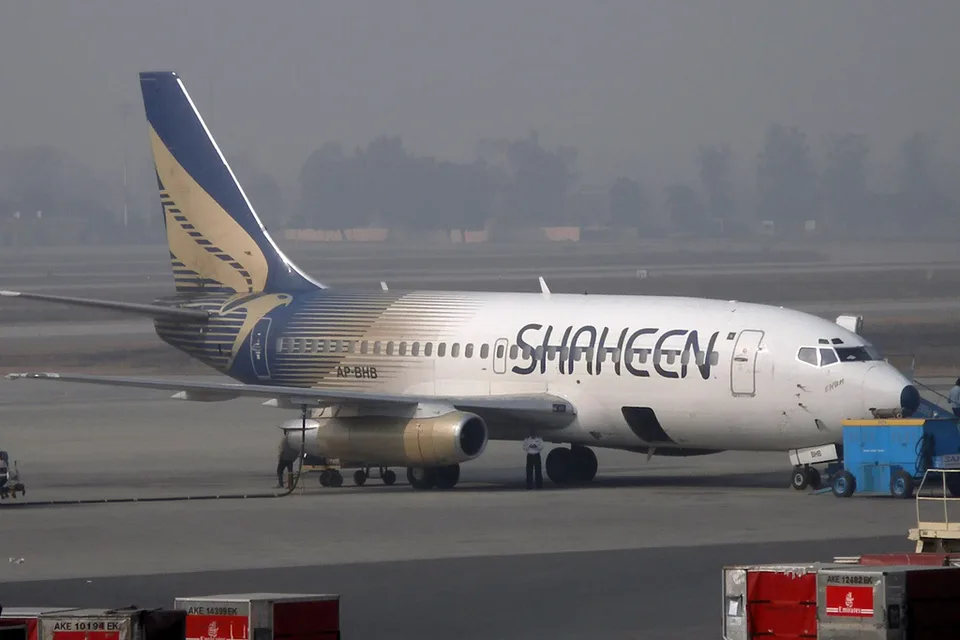
Original photograph unchanged. Responsive WebP copies resized without cropping.
Geographic context
Sharjah International Airport
Bacha Khan International Airport
SAI791 departed Sharjah for Bacha Khan International Airport in Pakistan. Markers show approximate airport locations. Basemap: Natural Earth, public domain.Read supporting evidence
Flight SAI791 was cleared to depart from runway 30 but turned onto the parallel taxiway during a night departure. The controller recognized the error during the takeoff roll and allowed the aircraft to continue because its speed was unknown and the taxiway was clear. It landed safely at Bacha Khan International Airport.
Read the full incident Follow what happened, from the flight to the investigation findings.
What investigators concluded
The AAIS found that the crew most probably gave insufficient attention to the taxi route, lighting and signs, misunderstood the control instructions and failed to identify the taxiway alignment. Early clearance, repeated requests to expedite, operating procedures, airport visual cues and loss of visual monitoring contributed.
1,579 words / about 8 minutes to read. Based on the investigation records cited below.
The route to runway 30
Shaheen Air International flight SAI791 was preparing to return from Sharjah to Bacha Khan International Airport in Pakistan in the early hours of 24 September 2015. Boeing 737-400 AP-BJR carried 148 passengers, two operating pilots, an observer pilot and five cabin crew. The same cockpit crew had arrived at Sharjah at 01:30 after a flight of about three and a half hours. The turnaround lasted approximately an hour. The commander flew the aircraft from the left seat; the copilot monitored the flight and handled the radio.
Visibility was normal, traffic was light and the taxiway lights, signs and stop bars were serviceable. One controller handled both Ground and Tower functions, with a supervisor also on duty. At 02:33:26 the copilot requested taxi clearance and the full runway length. The clearance specified Alpha, Alpha 20 and holding point Bravo 20 for runway 30. The copilot read back a route to the runway holding point but omitted Bravo 20. The controller allowed the omission to pass.
The aircraft started moving at 02:34:04 and joined Alpha about a minute later. Its average speed along the taxiway was approximately ten knots. At 02:37:54 the controller instructed the crew to switch to Tower frequency. When the copilot called, the controller again specified holding short at Bravo 20. The response referred to holding short of runway 30 and again omitted the taxiway holding point.
At 02:38:49, while the aircraft was turning towards Alpha 20, the controller cleared it for takeoff from runway 30 via Bravo 20 and asked for departure without delay. The Boeing was still about 200 metres from the runway holding point and 360 metres from entering the runway. Once more the copilot repeated the runway clearance without mentioning Bravo 20. An Airbus A320 was approaching runway 30 on a seven nautical mile final, and the controller was trying to expedite SAI791 ahead of it.
As the Boeing slowed, the controller asked the crew to keep its speed up until clear of the runway. The copilot requested a repetition. At 02:39:12 the controller repeated the takeoff clearance and the request to depart without delay. The aircraft had passed the unlit intermediate stop bar on Alpha 20 and was moving at seven knots. Four seconds later it began turning left along green lead-on lights towards Bravo. Continuing along Alpha 20 would have taken it towards the runway holding point.
At 02:39:28 the aircraft was entering Bravo when the controller again asked the crew to expedite because of arriving traffic. The copilot acknowledged. The crew subsequently said they had understood their route as Alpha, Alpha 20 and the runway 30 holding point. They did not remember Bravo 20 being included. The commander said he felt no pressure from air traffic control to depart, while the AAIS analysis identified the repeated expedited instructions as a possible influence on the wrong turn.
Both thrust levers were advanced at 02:39:30. The flight data placed the aircraft aligned on Bravo at 02:39:40, travelling at 16 knots. By 02:39:52 takeoff thrust was set and ground speed had reached 69 knots near the Alpha 18 intersection. The crew continued the rolling takeoff. All three pilots later said they had been certain the aircraft was on runway 30. No one recognized the green taxiway centreline lighting as a warning that the surface was wrong.
The controller had lost sight of the Boeing during its movement from Alpha 20 towards Bravo. The tower window framing obstructed the view of that area, about a kilometre away. The AAIS calculated that visual contact was lost for approximately 36 to 39 seconds. When the controller regained sight near Alpha 18, the aircraft was approaching 80 knots. At first the controller thought it was on the runway, then recognized its lights on the parallel taxiway.
The supervisor also saw the aircraft on Bravo. Together they decided to let the takeoff continue because they could not determine its speed and there were no vehicles or obstructions in its path. The aircraft passed the Bravo 14 intersection at approximately 128 knots. It became airborne at 02:40:25. At 02:41:15 the copilot advised that the crew was switching to Dubai control. The controller acknowledged without discussing the taxiway departure. SAI791 continued to an uneventful landing, with no injuries or aircraft damage.
The AAIS was notified four days after the occurrence. Shaheen Air informed the flight crew five days after the flight. By then the cockpit voice recording would have been overwritten, and investigators did not request it. Pakistan investigators interviewed the pilots on behalf of the AAIS, and the crew answered an AAIS questionnaire. The operator supplied the digital flight data, while Sharjah supplied the radio communications.
The position information in the flight recorder was derived data and was too inaccurate to plot the taxi route. Investigators instead synchronized the radio transmissions with recorded headings, ground speeds and aircraft movement. Their reconstruction confirmed the departure from Bravo. The final report included the sequence in Appendix A. The AAIS could not determine why the crew failed to regain awareness of the wrong alignment despite the significant differences between taxiway and runway lighting.
Sharjah had opened its new runway in October 2014 and converted the previous runway to taxiway Bravo, 250 metres from the new runway centreline. Bravo was published as 25 metres wide between its yellow edge lines, but the intersection with Alpha 20 was 45 metres wide. Faint former threshold markings and other traces of the old runway remained visible. The green lights curving onto Bravo were brighter and a different shade from the other taxiway centreline lights.
The AAIS considered that the width could have reinforced the crew's belief that Bravo was the runway. Their preceding departure airport, Sialkot, had a single 45 metre runway. At Sharjah, white runway edge and centreline lights would have become visible on the correct alignment. The Boeing had no runway awareness advisory system. Its operator procedures required checks for conflicting traffic before runway entry, but contained no requirement for a verbal, positive identification of the departure runway.
The final findings recorded that the pilots were licensed, medically qualified and adequately rested. The operator had not assessed the risks arising from Sharjah's new runway layout, and had not defined the third pilot's cockpit duties. The controller had failed to correct three readback omissions. The AAIS identified similar numerical taxiway and runway designations, the early takeoff clearance, requests to expedite, brighter lead-on lights and the loss of visual watch among the contributing factors. Its cause finding was that the crew most probably gave insufficient attention to the route, lighting and signs, misunderstood the instructions and failed to identify the taxiway alignment.
The stop bars on Bravo were unlit during the incident. Investigators could not verify the switch setting of the runway holding-point stop bar, but their analysis considered it most likely off after the takeoff clearance. The airport had neither surface movement radar nor a runway incursion monitoring and conflict alerting system. The report identified the potential for catastrophic consequences had equipment occupied the taxiway.
The combined Ground and Tower role left one controller responsible for radio calls, surface movements and arriving traffic. Sharjah controllers were trained for both functions, and combining the positions was an established practice. The operations manual referred to the arrangement in its seating plan but did not otherwise describe the combined responsibility. The AAIS considered that the arrangement could have influenced decision making and recommended an assessment of its risks, supported by procedures.
The airport surface itself offered limited position references at night. At the distant ends of Alpha and Bravo, stop bars were difficult to see from the tower and the green centreline lights faded with distance. The tower had no cameras or monitors to cover obscured areas. A renovation had been planned following GCAA audit findings dating from 2011. The AAIS recommended addressing the visual-control-room limitations and reassessing the need for surface movement radar to improve monitoring.
The report also examined separation from the arriving A320. Its calculation indicated that following the correct taxi route would have brought SAI791 towards the runway as the arrival closed in. The controller would then have needed to reassess whether the arriving aircraft should go around. This analysis formed part of the examination of the expedited departure instructions and the demands of supervising both flights.
A further night-time wrong turn onto Bravo occurred in April 2016. On that occasion the controller questioned the aircraft position and instructed the crew to stop. Sharjah Air Traffic Services then directed controllers to illuminate the appropriate Bravo stop bar and withhold takeoff clearance until an aircraft had passed Bravo and could no longer mistake it for the runway.
The final report issued on 13 April 2017 called for stronger safeguards across the operator, airport and air traffic services. Recommendations to Shaheen covered airport diagram use during taxi, reduced cockpit tasks, accurate readbacks, positive runway verification by all crew, improved communication, defined observer duties and an evaluation of runway awareness equipment. Recommendations to air traffic services covered phraseology, stop bars, visual monitoring, the combined controller role and immediate incident notification.
The Sharjah Department of Civil Aviation was asked to reassess taxiway names, green lead-on lights, old runway markings, Bravo width and possible hot spots. Further recommendations addressed tower visibility, surface movement radar and the accuracy of airport manuals, charts and operational approvals. The GCAA was asked to circulate the report to runway safety teams and monitor implementation by Sharjah Air Traffic Services and the Department of Civil Aviation.
The crew followed brighter green lead-on lights onto the former runway. The AAIS identified the lights and possible influence of the taxiway width as contributing factors.
The tower structure obscured the critical area. The controller regained sight as the aircraft approached 80 knots and then recognized the taxiway departure.
During the takeoff rollControllers recognize the wrong surface
The controller and supervisor saw the aircraft on Bravo and decided to let it continue. They could not determine its speed and saw no vehicles or obstructions ahead.
Why did the controller allow the takeoff to continue?
The controller could not determine the aircraft speed and taxiway Bravo was clear of vehicles and obstructions. The controller and supervisor decided to let the departure continue.
The cockpit voice recording would have been overwritten before the AAIS was notified. The investigation could not confirm whether the pilots discussed their position or were distracted before takeoff.
The runway holding-point stop-bar switch position could not be verified. The AAIS analysis considered the lights most likely off because an expedited takeoff clearance had been issued.
Actions and recommendations are described at the dates of the cited records. A recommendation is not proof of implementation.
Stop bars and clearance timing
After another Bravo alignment error in April 2016, air traffic services required use of the Bravo stop bars and delayed clearance until an aircraft had passed the taxiway.
SR11/2017 to SR16/2017 addressed taxi procedures and training, accurate readbacks, positive runway verification, crew communication, runway awareness equipment and the duties of a third pilot.
SR17/2017 to SR20/2017 addressed standard phraseology, readbacks, stop bars, visual watch, combined Ground and Tower duties and immediate notification to investigators, crew and operator.
The airport recommendations covered notification, taxiway designations and lights, hot spots, old runway markings, tower visibility, radar and airport documentation. SR33/2017 and SR34/2017 asked the GCAA to distribute the report and monitor implementation.
Matching dossiers for Crew procedures: No other dossier in this collection.
Read alongside
These comparisons connect specific research topics. Shared circumstances do not establish identical causes. Evidence from both investigations is provided below.
Both investigations identified failures to verify the departure surface before takeoff. At Sharjah, the crew departed a parallel taxiway and landed safely. For Comair 5191, the NTSB found that the crew failed to use available location cues and crosscheck the runway before its attempted departure from the wrong runway.
Explore the records below for additional context. They open on the publisher's site and are not all included in our report search. Source reuse terms apply.
Kevin Murphy writes the incident accounts on AirlineIncidents.com, out of a long interest in aviation safety and the lessons each investigation leaves behind.
Prepared by
AirlineIncidents editorial desk
Report citation check
Independent expert review
Not completed
Citation checks compare supporting text with the indexed report pages. They do not constitute independent expert review. How these pages are prepared.
Revision history
: AAIS final investigation completed; report issued on 13 April 2017.