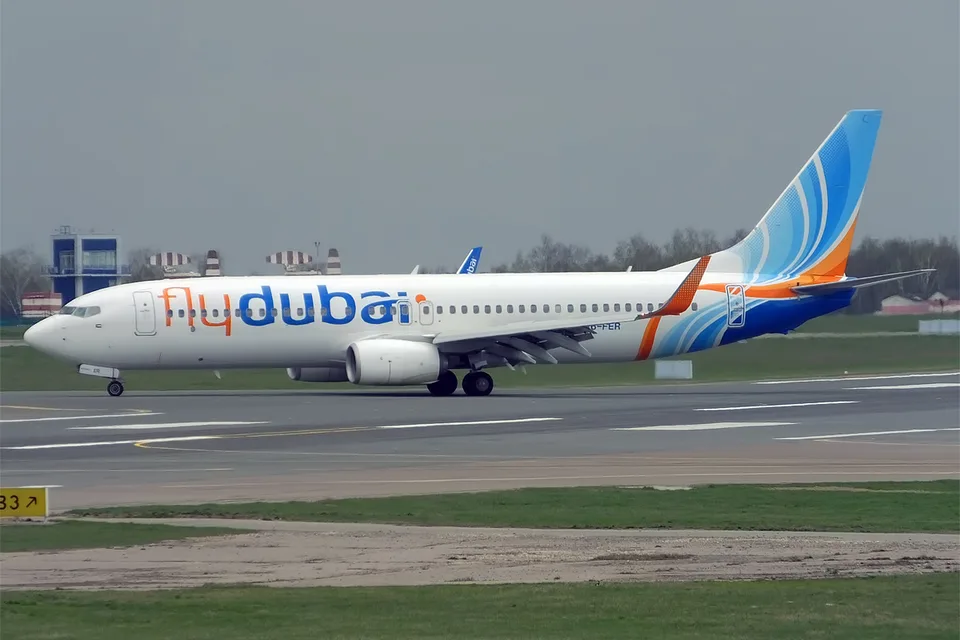
At Dubai, a taxiing flydubai Boeing 737 struck the tail of a Gulf Air A321 holding short of the runway. AAIS identified clearance, positioning and coordination failures.
Original photograph downloaded at 1200 by 800 pixels. Responsive WebP copies resized without cropping.
Geographic context
Dubai International Airport, collision airport
Manas International Airport, FDM1461 destination
Bahrain International Airport, GFA513 destination
Approximate airport reference markers. The collision occurred on taxiway Mike beside Mike 10 Alpha at Dubai. The summary names the airports and supplies no geographic coordinates. Basemap: Natural Earth, public domain.Read supporting evidence
As flydubai flight FDM1461 taxied toward Mike 13, its left wingtip struck Gulf Air flight GFA513 at Mike 10 Alpha. The Airbus had stopped sufficiently far short of its stop bar for its tail to project into the Boeing's path. The Boeing crew slowed but continued behind it. Neither Ground nor Tower instructed the Boeing to stop.
Read the full incident Follow what happened, from the flight to the investigation findings.
What investigators concluded
AAIS identified three causes: the absence of an ATC stop instruction, the Gulf Air A321's position more than 20.61 metres short of its stop bar, and the flydubai crew's misjudgment of lateral clearance. Nighttime visual limitations, controller coordination, mutual expectations and inconsistent publication of taxi restrictions contributed.
1,517 words / about 7 minutes to read. Based on the investigation records cited below.
Two passenger flights preparing to depart
On 21 July 2021, flydubai Boeing 737-800 A6-FER was preparing for night flight FDM1461 from Dubai International Airport to Manas International Airport in Kyrgyzstan. It carried 116 passengers, two pilots and six cabin crew. Gulf Air Airbus A321-200 A9C-NC was preparing for flight GFA513 from Dubai to Bahrain, with 109 passengers, two pilots and five cabin crew. Both aircraft were airworthy. AAIS found the crews appropriately licensed, medically fit and sufficiently rested.
The flydubai crew reported aboard 42 minutes before departure time. Changes to the load sheet delayed the flight by about 47 minutes. At 19:34:32 UTC, Gulf Air requested taxi clearance from stand Charlie 54. Ground initially directed it through Lima 1 onto Mike to hold at Mike Charlie. After a request from the crew, the controller approved a route through Zulu and Lima 1. At 19:37:40, flydubai requested taxi from stand Charlie 22 and received clearance through Mike 1 onto Mike, also initially to hold at Mike Charlie.
Ground later instructed Gulf Air to continue to holding point Mike 13 behind another flydubai Boeing 737. At 19:39:53, the Gulf Air crew advised that it would be ready for departure at Mike 10 Alpha, and Ground agreed to the change. While taking a telephone call about inbound traffic, Ground cleared FDM1461 onward to Mike 13 at 19:40:21. The aircraft now had different intended departure points along the same taxiway.
At 19:41:07, Ground told Gulf Air to monitor Tower on 118.75 MHz. Six seconds later, Ground gave flydubai a similar instruction. The Boeing crew received no instruction to stop before drawing abeam Mike 10 Alpha if the Airbus remained there. Both crews read back the frequency correctly.
At 19:42:57, Gulf Air turned left toward Mike 10 Alpha. The Boeing was about 650 metres away. When the Airbus stopped at the holding point, the Boeing was about 500 metres away. FDR data showed that flydubai had been taxiing at 27 knots and slowed to 12 knots before the collision. Its operating manual described normal taxi speed as approximately 20 knots, adjusted for conditions, with up to 30 knots acceptable on long straight routes.
At 19:43:58, the Boeing's left wingtip contacted the Airbus tail. The flydubai commander later told investigators that the crew had checked wing clearance and believed there was enough room. AAIS could not confirm this statement because the cockpit voice recorder had been overwritten.
Gulf Air first established communication with Tower at 19:44:15. When the controller asked whether it was ready for departure, the crew reported the impact and requested a return to the gate. Tower contacted flydubai at 19:44:42, and its crew confirmed the collision. Tower informed the Duty Manager and called airport fire services. The summary records minor damage to the Boeing wingtip and Airbus tail.
Investigators examined the space between the runway holding point and the taxiway. Mike 10 Alpha's stop bar lay about 83 metres north of the Mike centreline. The Airbus was 44.51 metres long. For the collision reconstruction, AAIS used a Boeing wingspan of 35.76 metres, placing its left wingtip about 17.88 metres from the centreline. The calculation assumed that the Boeing followed the centreline, as its crew reported.
AAIS could not establish the Airbus's exact stopping position from direct observations. Using the dimensions and the contact geometry, it estimated that the nose had stopped more than 20.61 metres short of the stop bar. That position left the tail partly obstructing taxiway Mike and within the Boeing wingtip's path. A footnote qualifies the estimate: it excludes the Boeing's inboard wing contact point and the sweep of the Airbus vertical stabilizer.
The investigation also examined the Airbus pilots' forward view. Their eye reference position was about 4.56 metres above ground. Objects became visible about 12.55 metres ahead of that position, corresponding to roughly 10.14 metres ahead of the nose. At the estimated stopping position, the stop bar was about 10.47 metres beyond the beginning of that visible area. The crew reported that airfield signs and lights were clearly visible and believed they had stopped appropriately.
AAIS found that nighttime visual illusions and glare probably affected the Gulf Air crew's distance judgment. The ground movement radar displayed the aircraft at the holding point, but its design could not establish the exact positions of the nose and tail.
The sightline calculation assumed correctly adjusted seats, with the pilots' eyes at the reference position. AAIS noted that neither an ICAO standard nor the Airbus operator's procedures specified a minimum stopping distance beyond the requirement to remain before the stop bar.
The airport's weather report gave visibility exceeding ten kilometres, with no significant change. Wind was from 240 degrees at eight knots, temperature was 37 degrees Celsius, and runway 30R was in use. AAIS nevertheless identified specific visual difficulties in assessing the clearance between the two aircraft at night.
From the Boeing commander's left seat, the oblique view toward the wingtip was restricted by the cockpit structure, sidewall, window framing and seat or headrest configuration. The investigation's table described the view directly left as partial and the left-rear view as severely limited. Its findings state that the wingtip was still visible, but judging lateral separation was difficult.
The Boeing's runway turnoff lights provided limited sideways illumination. They were integrated with the fixed landing light assembly near the wing root and projected forward and outward. As the Boeing approached abeam the Airbus, the tail moved outside the illuminated area. The crew relied on ambient taxiway lighting and the Airbus's white tail position light. AAIS identified the combination of restricted oblique visibility, limited lateral lighting and low ambient light as a contributor to the collision.
The flydubai commander wore corrective glasses as required by the medical certificate. Investigators found no indication of a visual acuity deficiency beyond the usual limitations of a low-light environment. They considered the collision more likely to involve perceptual misjudgment in the prevailing visual conditions. The Boeing's reduction in speed suggested concern about clearance, but its crew continued without asking ATC for clarification or holding before passing the Airbus.
Different expectations between Ground, Tower and the crew
Ground expected Gulf Air to enter the runway before flydubai reached Mike 10 Alpha. If the Airbus remained there, Ground expected the obstruction to be obvious and the Boeing crew to stop. The flydubai crew believed there was enough room behind the Airbus and expected ATC to intervene if separation became unsafe. AAIS found that these mutual assumptions weakened situational awareness and conflict recognition.
The instruction to monitor Tower also affected the sequence. AAIS found that an instruction to contact Tower would have established an active handover and immediate two-way communication. Gulf Air instead remained on the frequency without directly reporting readiness for runway entry. Its first exchange with Tower came after the collision.
Ground had changed Gulf Air's departure point on the electronic flight progress strips to Mike 10 Alpha, but had not coordinated the intersection departure with Tower. Tower expected a full-length departure and missed the revised entry on the strips. The controller briefly looked away as Gulf Air reached the holding point and remained unaware of its position and readiness. Only the two aircraft were awaiting departure; no other outbound traffic was holding or taxiing.
Local ATC procedures already prohibited taxiing or holding behind aircraft at designated holding points, including Mike 10 Alpha. That restriction was absent from the AIP and the navigation charts available to the flydubai crew. AAIS found that the resulting gap in the operator's guidance removed a safety defence. Its causes combined the missing ATC stop instruction, the Airbus stopping position and the Boeing crew's clearance misjudgment.
The investigation was initially concluded in December 2022 and later reopened when new evidence emerged. AAIS published Summary Report AIFN/0009/2021 on 25 November 2025 after reviewing safety issues and developing recommendations. The publication presents the investigation's factual information, analysis, causes, contributing factors and safety follow-up.
The summary records immediate measures by Dubai Air Navigation Services, known as dans. These included a unit safety bulletin and focused briefings on taxi clearance hazards and controller-pilot coordination. The GCAA amended the UAE AIP to prohibit aircraft on Mike and November from taxiing or holding behind another aircraft at a runway holding point, with later refinements based on operational demand. The regulator also checked the integration of restrictions into local procedures, training and operator briefing material. flydubai updated its procedures after the AIP amendment and continued revising them as the requirements evolved.
Five recommendations accompanied the published findings. SR13/2025 asked dans to reinforce compliance with established Dubai taxi restrictions. SR14/2025 addressed standard handover phraseology and the use of contact when a two-way exchange with Tower was expected. SR15/2025 called for a review of ground movement radar accuracy, particularly the detection of aircraft holding short of stop bars, and improvements where limitations existed.
SR16/2025 asked flydubai to reinforce the importance of confirming taxi clearance near stationary aircraft when visibility or wingtip clearance was uncertain. SR17/2025 asked Dubai Airports to formalize amendments in the Aerodrome Manual, submit them for AIP inclusion and ensure their reflection on aerodrome charts. Together, these recommendations addressed controller instructions, aircraft positioning information, pilot clearance decisions and the distribution of operating restrictions.
A simplified reading of the investigation findings. The sequence does not replace the full report or imply that every contributing factor is shown.
Sequence of events
Times are UTC, as used in the GCAA summary. UAE local time was UTC plus four hours. Contact occurred at 19:43:58 UTC on 21 July 2021. Expand an event to see its evidence.
19:34:32Gulf Air requests taxi
GFA513 requested clearance from stand Charlie 54. Its route was subsequently changed to Zulu and Lima 1.
Gulf Air first contacted Tower and requested a return to the gate. Tower then contacted flydubai, whose crew confirmed the collision. Tower called airport fire services.
AAIS estimated that the A321 stopped more than 20.61 metres short of the stop bar at Mike 10 Alpha, leaving its tail partly across taxiway Mike. The estimate used aircraft dimensions and the Boeing crew's statement that they followed the centreline.
Ground updated the electronic strips but did not coordinate the revised intersection departure with Tower. Tower expected a full-length departure and briefly looked away as GFA513 reached its holding point.
The flydubai cockpit voice recorder had been overwritten. AAIS could not confirm the commander's statement that the crew checked wing clearance before passing the Airbus.
AAIS could not determine the exact Airbus stopping position from direct observational evidence. Its estimate used aircraft dimensions, collision geometry and the Boeing crew's centreline statement; it excluded the inboard contact point and tail sweep.
This is a published summary report. It contains no casualty table, survivor total, complete cockpit transcript, full flight recorder dataset or exact surveyed stopping position. Its investigation scope excludes detailed analysis of non-contributing factors.
By publication in November 2025, the GCAA reported AIP amendments and checks on their integration into procedures and training. flydubai had updated its procedures in response.
SR16/2025 sought stronger pilot clearance confirmation near stationary aircraft. SR17/2025 sought consistent restrictions in the Aerodrome Manual, AIP and charts.
Matching dossiers for Procedural coordination: No other dossier in this collection.
Read alongside
These comparisons connect specific research topics. Shared circumstances do not establish identical causes. Evidence from both investigations is provided below.
Both investigations identified expectations that weakened recognition of an airport conflict. At Dubai, Ground and the Boeing crew each expected the other to ensure separation, while Tower expected a different departure position. In the Air Canada 759 taxiway overflight at San Francisco, the NTSB identified expectation bias among factors contributing to the crew's misidentification of taxiway C as the landing runway. Dubai involved aircraft taxiing before departure; Air Canada 759 involved an approaching aircraft aligned over a taxiway.
Explore the records below for additional context. They open on the publisher's site and are not all included in our report search. Source reuse terms apply.
Published summary issued 25 November 2025, covering the collision, findings, safety actions and five recommendations.
Sources and transparency
GCAA AAIS published its investigation summary on 25 November 2025, including causes, contributing factors, safety actions and five recommendations.
Source limitations
This is a published summary report. It contains no casualty table, survivor total, complete cockpit transcript, full flight recorder dataset or exact surveyed stopping position. Its investigation scope excludes detailed analysis of non-contributing factors.
Ground Collision: flydubai A6-FER and Gulf Air A9C-NC
UAE GCAA AAIS Final investigation summary report AIFN/0009/2021, issued 25 November 2025
Kevin Murphy writes the incident accounts on AirlineIncidents.com, out of a long interest in aviation safety and the lessons each investigation leaves behind.
Prepared by
AirlineIncidents editorial desk
Report citation check
Independent expert review
Not completed
Citation checks compare supporting text with the indexed report pages. They do not constitute independent expert review. How these pages are prepared.
Revision history
: Published sourced incident account, timeline, photographs and investigation findings.
Quoting this account or linking to it? Please use the page address below, and credit the investigation report it is built from.
Credit line
AirlineIncidents.com. flydubai A6-FER and Gulf Air A9C-NC accident account. Published 31 October 2026. https://airlineincidents.com/incidents/flydubai-a6-fer-gulf-air-a9c-nc-2021/
HTML link
<a href="https://airlineincidents.com/incidents/flydubai-a6-fer-gulf-air-a9c-nc-2021/">flydubai A6-FER and Gulf Air A9C-NC accident account (AirlineIncidents.com)</a>
Select a box to copy it. Spotted something wrong? Send a correction.