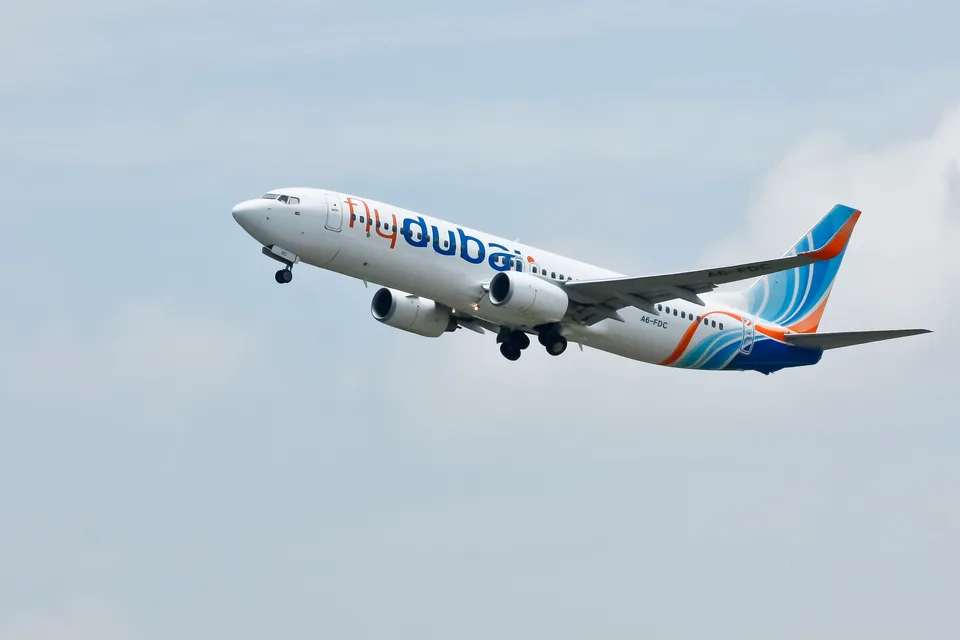
Original photograph unchanged. Responsive WebP copies resized without cropping.
Geographic context
Dubai International Airport, incident at Stand Q-05
Bagram, planned destination
Approximate airport markers for the planned Dubai to Bagram flight. The collision occurred while A6-FDC was parked at Dubai. Basemap: Natural Earth, public domain.Read supporting evidence
Two belt loaders approached the aft cargo door. One operator changed his plan towards the vacant forward door, and his machine struck the right engine. The engine shroud, acoustic panel and inlet cowl were damaged. Nobody was injured.
Read the full incident Follow what happened, from the flight to the investigation findings.
What investigators concluded
The AAIS identified possible driver distraction or unintended accelerator input, missing door-specific task allocation and a risk management system that missed uncoordinated equipment positioning.
1,211 words / about 6 minutes to read. The official report for this event is short, so this account is shorter than most and covers only what the report documents.
Two belt loaders for one aircraft
On 15 February 2015, flydubai Boeing 737-800 A6-FDC was parked on Stand Q-05 at Dubai International Airport. It was being prepared for flight FZ4359 to Bagram. The crew and passengers had yet to board. Ground handler dnata was providing ramp services under its contract with flydubai, and two mobile conveyer belts were to serve the aircraft's forward and aft cargo doors.
The morning briefing was followed by the allocation of equipment tasks. A dnata supervisor gave the task schedule to the senior ground operator, who was supervising three operators during the shift. Two were nominated to drive the belt loaders. At approximately 0515 local time, the senior operator dropped them at the equipment parking bays. Each carried out the required equipment checks using the MCB Operating Instruction and then drove his assigned machine towards the aircraft.
The operator involved in the collision had joined dnata in 2008. His training included tractors and pick-up vehicles, followed by passenger steps, hi-loaders, cargo transporters and mobile conveyer belts after promotion to airside operator grade 3. The AAIS found that he was licensed, trained and qualified for his responsibilities. The aircraft was airworthy before the collision and met the applicable certification, equipment and maintenance requirements.
The belt loader involved had come from equipment parking bay E-43. Its operator intended to approach the aft cargo door. As he drove towards it, at about five metres from the right engine cowling, he saw that his colleague had already placed the other belt at that door. The forward cargo door was still vacant, so he changed his intended destination.
According to the history in the summary, the operator stopped the machine and removed his feet from the brake pedal to turn left towards the forward door. The belt loader then moved forwards and struck the right engine. The collision damaged the engine shroud, an acoustic panel and the inlet cowl. Nobody was injured.
The damage description places the shroud damage at the six o'clock position and the acoustic panel tear at eight o'clock. A deep, long scratch marked the inlet cowl at eight o'clock. The report includes two photographs of the belt loader in contact with the engine and its position within the damaged inlet.
The collision occurred during twilight. The airport stand markings were illuminated, and the recorded weather around the occurrence included winds of about five knots. The AAIS found that weather was not a factor.
The investigation could not determine exactly why the belt loader collided with the engine. It considered two likely possibilities: distraction and loss of situational awareness after the driver saw the occupied aft door, or an unintended accelerator input when he intended to press the brake. These alternatives formed part of the AAIS probable-cause findings.
The procedures left the location of each belt loader to the individual operator. Dnata had no explicit instructions assigning specific positions and routes when different operators performed similar tasks simultaneously on the same aircraft. Its procedures also lacked a way to tell each driver which cargo compartment he was to serve. Both drivers could therefore approach the same door.
The AAIS analysis linked the unplanned change of destination with distraction and time pressure, which it considered likely to have reduced the operator's perception of distance, heading and speed. It identified the absence of a predefined task-allocation policy as a weakness that allowed the disruption to develop.
The probable causes included the missing procedure for assigning each driver to a particular cargo door. They also included the handling agent's risk management system failing to detect the possibility of uncoordinated equipment positioning. The findings extended from the driver's immediate response to the way the ground operation had been organised.
Dnata's roster involved eight-hour shifts over six consecutive working days, comprising two morning, two afternoon and two night shifts, followed by two days off. Before the change, the morning shift ran from 0600 to 1400, the afternoon from 1400 to 2200 and the night from 2200 to 0600.
From 1 February 2015, the shifts moved two hours later: 0800 to 1600, 1600 to midnight, and midnight to 0800. The belt-loader operator was on the night shift and reported for duty at midnight. The report's roster section places the incident in the last quarter of his duty period.
The Resource Planning Department had changed the roster without involving dnata's Safety Department. No risk assessment was conducted for the change. The hazard-identification and risk-assessment procedure did not require an assessment of its effects. The AAIS found that this deprived the company of useful safety information and left possible hazards unexamined.
The AAIS could not determine whether the altered roster affected the operators' circadian rhythms or whether unexpected fatigue contributed to the collision. Its findings recorded the missing assessment as a weakness in safety management.
Dubai Airports operated a safety management system that included inspections and audits of ground handling agents. Its Operations Duty Manager was assigned at least four turnaround inspections each day, and annual audits were also conducted. The airport's safety team summarised audit findings and discussed them monthly. Ground handling accidents and incidents were considered when deciding on required action.
The investigation nevertheless identified limits to this oversight. There was no regulatory reference empowering the airport to oversee all airport stakeholders, and no common conditions of use covering them in the same way as the arrangements with air operators. The service-level agreement for handling was between the airline and the handling agent, with no direct airport contribution.
Dnata used the Emirates Group safety management system. Its hazard-identification, risk-assessment and control procedure had been in place since 6 February 2015, but the hazard register was not shared with Dubai Airports. Dnata was improving collaboration with the airport on risk assessments, particularly for hazards related to airport facilities.
Existing links included incident reporting, stakeholder meetings, investigations, joint safety campaigns and joint hazard studies. The AAIS proposed a structure connecting ramp operators to the airport safety and quality system, with regulatory support for the airport's oversight role.
Before the summary was issued, dnata told the AAIS it had assessed activities and equipment operating within the Equipment Restraint Area. It introduced marshalling for all equipment positioning at aircraft, marshalling training for staff working in that area, and revised instructions showing the correct approach of belt loaders and other ground support equipment to the forward and aft holds. The AAIS accepted those actions.
Recommendation SR41/2016 called on dnata, working with Dubai Airports, to assess changes in procedures, equipment or rosters that could affect airside operators' performance. SR42/2016 asked Dubai Airports to enhance oversight of ground handling agents so that their safety and quality management systems were well established.
Two recommendations addressed the regulator. SR43/2016 called for requirements integrating the safety management systems of airport operators and service providers with the airport system recognised under the applicable aerodrome and safety management regulations. SR44/2016 called for requirements empowering airport operators to oversee the safety and quality of airside operators and service providers.
The GCAA Air Accident Investigation Sector issued its investigation summary on 12 July 2016. It classified the occurrence as an incident after the initial investigation. Because the crew and passengers had yet to board, the occurrence fell outside the Annex 13 classification described in the report; the AAIS investigated under UAE civil aviation law.
A simplified reading of the investigation findings. The sequence does not replace the full report or imply that every contributing factor is shown.
Sequence of events
Local time, UTC+4. The history gives an approximately 0515 equipment pickup and a scheduled 0528 departure; the roster section gives 0630 for the incident. The summary leaves this timing discrepancy unresolved. Expand an event to see its evidence.
Before equipment movementTwo operators assigned
The task schedule nominated two operators to drive belt loaders to the aircraft.
The AAIS found that the roster change had received no risk assessment. It could not determine whether the changed roster caused unexpected fatigue that contributed to the incident.
Dnata reported marshalling for all equipment positioning at aircraft, marshalling training for staff in the Equipment Restraint Area, and revised approach instructions for forward and aft holds. The AAIS accepted these actions.
The GCAA published an investigation summary. It contains no interview transcripts, detailed equipment test results or recorder information. The investigation covered events leading to the collision and excluded in-depth analysis of non-contributing factors.
Matching dossiers for Roster change risk assessment: No other dossier in this collection.
Read alongside
These comparisons connect specific research topics. Shared circumstances do not establish identical causes. Evidence from both investigations is provided below.
Both investigations identified weaknesses in organisational safeguards around aircraft servicing. For A6-FDC, the AAIS found missing door assignments and a risk system that missed uncoordinated equipment positioning. For British Airways 5390, the AAIB found that one engineer performed a safety-critical windscreen replacement with sole responsibility for its quality, while management and audits missed deficient working practices. A6-FDC involved a parked aircraft struck by ground equipment; the BA5390 accident involved windscreen loss in flight after maintenance.
Explore the records below for additional context. They open on the publisher's site and are not all included in our report search. Source reuse terms apply.
Published summary with the ground collision sequence, findings, dnata safety actions and recommendations SR41/2016 to SR44/2016.
Sources and transparency
GCAA investigation summary issued 12 July 2016.
Source limitations
The GCAA published an investigation summary. It contains no interview transcripts, detailed equipment test results or recorder information. The investigation covered events leading to the collision and excluded in-depth analysis of non-contributing factors.
Ground Equipment Collision with Aircraft, A6-FDC, AIFN/0001/2015
UAE GCAA Air Accident Investigation Sector Final investigation summary report, issued 12 July 2016
GCAA report copyright applies. Photographs in the report have multiple sources. Report linked as an official source. Separate licensed aircraft photograph used.
Kevin Murphy writes the incident accounts on AirlineIncidents.com, out of a long interest in aviation safety and the lessons each investigation leaves behind.
Prepared by
AirlineIncidents editorial desk
Report citation check
Independent expert review
Not completed
Citation checks compare supporting text with the indexed report pages. They do not constitute independent expert review. How these pages are prepared.
Revision history
: Published sourced incident account, timeline, photographs and investigation findings.