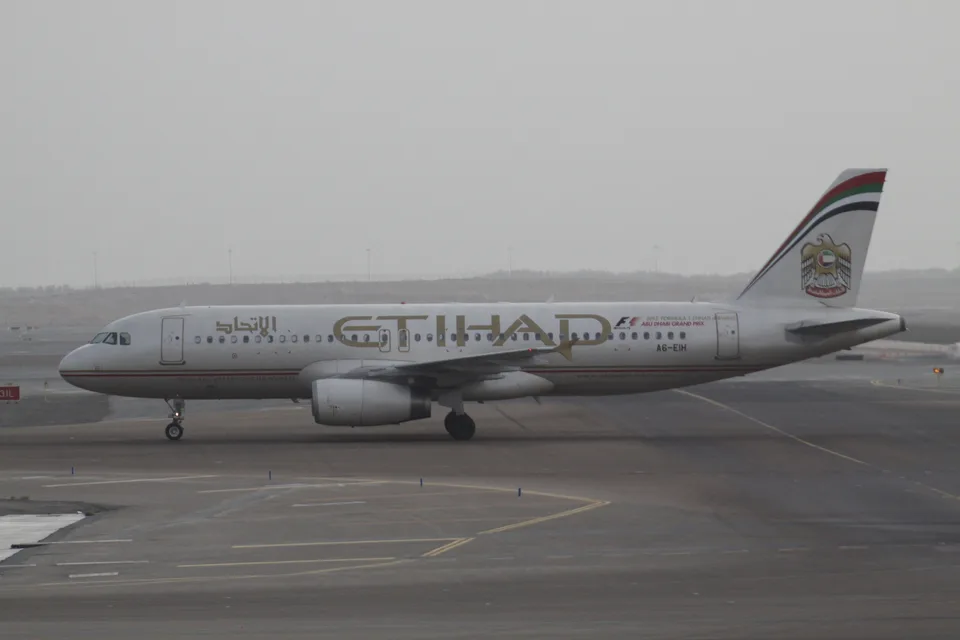
Original JPEG unchanged. Responsive WebP copies resized without cropping.
Geographic context
Karachi Jinnah International Airport, departure
Abu Dhabi International Airport, stand 406 collision
The flight arrived from Karachi and parked on stand 406 at Abu Dhabi. Markers use approximate airport positions. Basemap: Natural Earth, public domain.Read supporting evidence
After arriving from Karachi, A6-EIY was parked on stand 406 with its engines shut down. A Medical Hi Loader approached the right forward door to collect a sick passenger. Its operator pressed the accelerator while trying to brake, striking and puncturing the fuselage. The aircraft moved sideways, and some passengers descending the left forward stairs lost their balance. Disembarkation paused and resumed after the aircraft was judged safe.
Read the full incident Follow what happened, from the flight to the investigation findings.
What investigators concluded
The GCAA concluded that an organisational deficiency left an operator with insufficient experience, recent practice and confidence operating the loader independently. An unqualified worker marshalled him towards the aircraft. The operator became nervous, lost control and pressed the accelerator in an attempt to stop. The investigation recommended stronger ground handling oversight, appropriate vehicle licence categories, risk assessment and contractual safety reporting requirements.
1,018 words / about 5 minutes to read. The official report for this event is short, so this account is shorter than most and covers only what the report documents.
Arrival and disembarkation
On 25 November 2015, Etihad Airways flight ETD 222 arrived at Abu Dhabi International Airport from Karachi Jinnah International Airport. The Airbus A320-232, registered A6-EIY, carried 85 passengers and seven crew. It reached Abu Dhabi at about 0645 local time and parked on stand 406. Ground staff chocked the aircraft, the engines were shut down, and equipment moved into place for disembarkation and cargo unloading.
Passengers left through the left forward door, L1, using external stairs. A sick passenger required a Medical Hi Loader, a vehicle positioned at the right forward door, R1, to assist with leaving the aircraft. While that vehicle approached, about 50 passengers and all seven crew remained aboard. Approximately ten passengers were descending the stairs on the opposite side.
The loader operator had reported for duty at 0530 local time for a rostered shift from 0600 to 1600. He was initially assigned to a passenger bus. At about 0630, a line trainer told him that he would operate a Medical Hi Loader instead. The operator said he could not operate it alone and asked for supervision by a senior operator. The trainer told him to telephone if he encountered difficulties.
The trainer took him to stand 400, where the loader was parked, then went to stand 200 to oversee another operator's training. After completing the required equipment safety checks, the operator waited for instructions. Engineering staff subsequently directed him to A6-EIY. He reached stand 406 at about 0655, after passenger disembarkation had begun.
The operator waited for someone to marshal the loader, then asked a Passenger Service Agent staff member for help. That worker's main responsibility was assisting wheelchair passengers. He had received no airside safety, airside operations or marshalling training, although he and colleagues had performed marshalling before.
With the passenger service worker giving signals, the operator stopped the loader about 1.5 metres from the aircraft. He then continued moving slowly towards the door. As he came close, he mistakenly pressed the accelerator pedal while trying to brake. The loader accelerated suddenly and hit the fuselage below the R1 door.
The worker guiding the vehicle saw the collision developing, shouted and gave a stop signal. The operator did not respond. The worker moved away to avoid being injured. CCTV showed a violent impact and significant sideways movement of the aircraft. People inside felt the impact, and some passengers on the external stairs lost their balance. None of those passengers was injured.
Disembarkation stopped temporarily and resumed after the aircraft was deemed safe. The collision had caused a significant puncture in the fuselage skin and several dents below the door. The damage exceeded the limits in the Structure Repair Manual, so the aircraft was towed to a hangar for repair. The loader was withdrawn from service. Drug and alcohol tests on its operator were negative.
The operator had joined Etihad Airport Services as a bus driver in July 2013, following two years as a heavy vehicle driver at Sharjah Sea Port. He held a UAE general driving licence and an apron driving permit. He completed practical loader training on 3 July 2015 and was checked by the training department on 8 July. His two July checkouts included positioning the loader at an actual aircraft. The loader rating had not yet been endorsed on his apron permit.
Between his July checkout and refresher training on 24 November, he had positioned a loader at an aircraft only once, on 17 August. A senior driver marshalled him on that occasion. The refresher session immediately before the incident used neither an actual aircraft nor an aircraft mock-up. The trainer was assigned by ground operations management on the strength of his work performance, had not been nominated by the training department and had not completed the required instructor evaluation.
Investigators also compared the controls of the equipment he drove. The brake and accelerator pedals were closer together on the Cobus 3000 passenger buses than on the Medical Hi Loader. The GCAA found that this difference contributed to his pressing the wrong pedal. Its analysis linked his lack of confidence while positioning the vehicle to a loss of concentration. It found that he was working his normal rostered duty and was not suffering from tiredness or fatigue.
Interviews with four other experienced equipment operators revealed weaknesses in safety reporting. They gave verbal reports of deficiencies to managers but did not know how to submit written reports through the company system. The safety department had received no hazard reports from equipment operators. Although the company had an Integrated Safety and Quality Management System Manual, the interviewed operators said they had received no training in the safety management system and did not understand the term.
The airport company issued apron driving permits and exercised general ramp safety oversight. It checked documents and tested ramp safety rules, but lacked internal expertise in ground support equipment and did not test or validate the equipment training standards. Drivers could receive permission to operate ramp vehicles outside the categories covered by their road driving licences. The investigation identified safety, legal and insurance implications.
The GCAA concluded that the incident was primarily the result of an organisational deficiency. An operator who apparently met the company's training requirements lacked the experience, recent practice and confidence needed to work independently. While an unqualified worker marshalled him, he became nervous, lost control and pressed the accelerator in an effort to stop. The findings also identified insufficient attention to his request for a supervisor; telephone assistance failed to address his concern about inexperience.
The GCAA issued its completed investigation summary report on 31 January 2017. It recommended that Abu Dhabi International Airport oversee its ground handling agents and ensure they established safety management systems. It also called for apron permit procedures to require the correct UAE driving licence category and for handling agents to assess the risks in loading and offloading procedures.
A separate recommendation to Etihad Airways called for appropriate safety risk assessment and reporting requirements in all contracts with ground handling agents. Together, SR05/2017 through SR08/2017 addressed airport oversight, vehicle licensing, handling procedures and the airline's contractual safety requirements.
The loader punctured the fuselage, the aircraft moved sideways and passengers on the stairs lost balance. Disembarkation paused for a safety assessment.
A simplified reading of the investigation findings. The sequence does not replace the full report or imply that every contributing factor is shown.
Sequence of events
Local UAE time, UTC plus four hours, is used for the incident sequence. The report dates the occurrence to 25 November 2015. Expand an event to see its evidence.
0530 localOperator reports for duty
The operator reported half an hour before his rostered 0600 start, on his fourth consecutive morning shift.
How did the pedal layout contribute to the collision?
The brake and accelerator pedals were closer together on the Cobus passenger buses than on the Medical Hi Loader. The GCAA found that the different spacing contributed to the operator pressing the accelerator while trying to stop.
The refresher session used neither an aircraft nor an aircraft mock-up. Its trainer had not been nominated by the training department or completed the required instructor evaluation.
SR08/2017 recommended that Etihad Airways include appropriate safety risk assessment and reporting requirements in contracts with ground handling agents.
Official contributing factorTraining and recent practice
The GCAA identified inadequate experience, recent practice and confidence for independent loader operation, together with shortcomings in refresher training.
The operator requested an experienced colleague to accompany him. The line trainer offered telephone contact, and an untrained passenger service worker marshalled the vehicle.
Matching dossiers for Supervision and marshalling: No other dossier in this collection.
Contributing circumstancePedal layout and familiarity
The loader and the passenger buses had different spacing between their brake and accelerator pedals. The investigation found that this difference contributed to the wrong pedal being pressed.
Matching dossiers for Pedal layout and familiarity: No other dossier in this collection.
Read alongside
These comparisons connect specific research topics. Shared circumstances do not establish identical causes. Evidence from both investigations is provided below.
Both investigations examined an Airbus exposed to a strong ground shock. A6-EIY was parked when a loader impact moved it sideways and damaged the fuselage. G-EUPS encountered vertical shocks during takeoff, followed by severe inertial reference drift and flight guidance disconnects; the AAIB found no damage or irregularity in its inertial reference units or nose landing gear.
Explore the records below for additional context. They open on the publisher's site and are not all included in our report search. Source reuse terms apply.
Completed investigation covering the loader approach, equipment operator training, ramp oversight, findings and four safety recommendations. Official copy hosted by the UK Civil Aviation Authority.
Sources and transparency
GCAA investigation completed; summary report issued on 31 January 2017.
Source limitations
The GCAA gives approximate counts for passengers still aboard and using the stairs.
Aircraft Struck by Ground Vehicle: Etihad Airways Airbus A320-232 A6-EIY
UAE General Civil Aviation Authority, Air Accident Investigation Sector Final investigation summary report AIFN/0012/2015, issued 31 January 2017
Kevin Murphy writes the incident accounts on AirlineIncidents.com, out of a long interest in aviation safety and the lessons each investigation leaves behind.
Prepared by
AirlineIncidents editorial desk
Report citation check
Independent expert review
Not completed
Citation checks compare supporting text with the indexed report pages. They do not constitute independent expert review. How these pages are prepared.
Revision history
: GCAA investigation summary report issued on 31 January 2017.