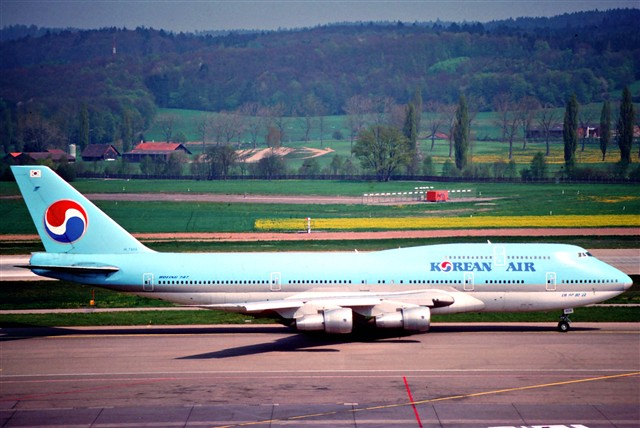
A Boeing 747 descended below the localizer approach altitudes at Guam and struck Nimitz Hill. The NTSB found failures in briefing, monitoring, training and ground altitude warnings.
Resized from the original photograph. The full image is retained in each size. Resized versions use the same licence.
Geographic context
Nimitz Hill accident site
Guam International Airport
Nimitz Hill lay southwest of runway 6L. The approach used the NIMITZ VOR/DME before the airport, with distance readings decreasing toward the beacon and increasing beyond it toward the runway. Basemap: Natural Earth, public domain.Read supporting evidence
Flight 801 descended below the 2,000- and 1,440-foot restrictions before reaching the fixes that permitted further descent. The captain selected lower autopilot altitudes too early while the crew remained unable to see the airport. A go-around began seconds before the aircraft struck Nimitz Hill.
Read the full incident Follow what happened, from the flight to the investigation findings.
What investigators concluded
The NTSB found that the captain failed to adequately brief and execute the nonprecision approach and the first officer and flight engineer failed to effectively monitor and cross-check it. Captain fatigue and inadequate Korean Air training contributed to those failures. The FAA's intentional inhibition and inadequate management of Guam's minimum safe altitude warning system also contributed.
1,505 words / about 7 minutes to read. Based on the investigation records cited below.
An overnight flight from Seoul
Korean Air flight 801 left Kimpo International Airport in Seoul on the evening of 5 August 1997 for Guam. The Boeing 747-3B5B (747-300), registered HL7468, carried 237 passengers and 17 crew members. The captain flew the aircraft, assisted by a first officer and flight engineer. The scheduled international passenger service became airborne at about 2153 Guam time, with an instrument flight rules flight plan.
HL7468 had entered Korean Air service in December 1984 and accumulated about 50,105 flight hours and 8,552 cycles. Investigators found the aircraft properly maintained and its landing weight and balance within limits. They found no evidence of a structural, engine or flight control failure before impact.
At about 0142 on 6 August, the aircraft struck Nimitz Hill southwest of Guam airport. The NTSB recorded 228 fatalities under the definition covering deaths within 30 days, and 26 seriously injured survivors, comprising 23 passengers and three flight attendants. One of those passengers died on 10 October, beyond the reporting period. Impact forces and the subsequent fire destroyed the aircraft.
The intended landing runway was 6L. Its instrument landing system glideslope had been taken out of service in July for reconstruction. A localizer still provided lateral guidance, but the crew had to control descent using the published altitude restrictions and navigational fixes. The NIMITZ VOR and its distance measuring equipment were on the approach before the airport. Distance readings counted down toward the beacon and then increased as the aircraft continued toward the runway.
The approach required at least 2,000 feet between the FLAKE intersection and the GUQQY outer marker. After GUQQY, the aircraft had to remain at or above 1,440 feet until crossing the VOR. It could then descend to the 560-foot minimum descent altitude. These were altitudes above mean sea level, with terrain rising beneath the approach.
At about 0111:51, the captain gave a short briefing. He mentioned the unavailable glideslope and the 560-foot minimum, while anticipating a visual approach. He omitted the definitions of the step-down fixes and their crossing altitudes. He also left the intended descent technique, autopilot modes and go-around decision criteria undiscussed. The NTSB found this briefing inadequate for the approach the crew would have to fly.
The crew saw Guam while descending, and the captain continued to expect visual conditions. Rain showers affected the island and its higher terrain. At about 0124:30, approach control approved a ten-mile deviation left of track for weather. The flight later requested vectors to runway 6L. Investigators concluded that the aircraft subsequently entered instrument meteorological conditions. Another shower between Nimitz Hill and the airport prevented the crew from seeing the airport, even after the aircraft likely emerged from heavier rain.
At about 0139:44, approach control cleared the flight for the approach and repeated that the glideslope was unusable. The cockpit recording nevertheless captured questions about whether it was working. The captain answered affirmatively at one point; the first officer said it was unusable. At about 0140:13, the aircraft began descending from 2,640 feet, approximately nine nautical miles from the runway threshold.
The controller transferred the flight to the tower, which cleared it to land at about 0141:01. The approach controller supplied neither a position advisory with the approach clearance nor information about a rain shower on final. He also stopped monitoring the flight after the frequency change. The NTSB found his performance substandard.
The captain used the autopilot during the approach. At about 0140:33, while the aircraft was passing through 2,400 feet, the first officer called that they were approaching 1,400 feet. The captain then ordered 1,440 feet selected. This replaced the 2,000-foot target before the aircraft reached the fix permitting further descent and before the autopilot captured the required altitude.
At about 0141:33, the captain ordered the selector changed again, this time to 560 feet. The aircraft had neither leveled at 1,440 feet nor crossed the VOR. Changing the selector removed the altitude targets that would have stopped the descent. The autopilot continued down through both intermediate restrictions.
The aircraft passed below 2,000 feet about 1.9 nautical miles before the outer marker. It passed below 1,440 feet about 2.1 DME before reaching the VOR. None of the indications marking passage over the VOR would have appeared before the collision. The NTSB concluded that the captain had lost awareness of the aircraft's position and failed to cross-check altitude against the approach chart. The first officer and flight engineer failed to challenge the premature descents.
The landing checklist continued as the aircraft descended toward the hill. At about 0141:42, its ground proximity warning system called 1,000 feet of radio altitude. At about 0142:00, it called 500 feet. These heights were measured above the ground beneath the aircraft. The published minimum descent altitude used the separate barometric reference to mean sea level.
At about 0142:14, while the aircraft was descending through roughly 840 feet above sea level, the system announced minimums. A sink rate alert followed about three seconds later. The first officer responded that the sink rate was acceptable. At about 0142:19, he called for a missed approach, then repeated the call as the crew reported the runway out of sight.
Nose-up control column movement began at about 0142:22, and thrust began increasing after the captain called for a go-around about a second later. The aircraft struck terrain at about 0142:26, at approximately 660 feet above sea level and 3.3 nautical miles from the threshold. Performance analysis indicated that a missed approach initiated at the minimums callout would likely have cleared terrain by about 450 feet. An aggressive maneuver at the first officer's initial challenge might also have cleared it.
Investigators examined the crew's repeated discussion of the glideslope. They considered intermittent indications from spurious radio signals possible, but a sustained false indication over several miles unlikely. The crew had sufficient information to know that the glideslope was unusable. The NTSB found that the captain's preoccupation with its status contributed to his loss of position awareness.
The NTSB also considered whether the captain believed the DME measured distance from the airport. That misconception could have made the aircraft appear closer to the runway. The Board treated this as a possible explanation. It found that the chart clearly defined the fixes, and the captain failed to cross-check them. Investigators could not determine precisely why the other crew members failed to monitor and challenge his actions earlier.
The accident occurred after midnight in the crew's home time zone, and the recording included the captain saying he was sleepy. The Board concluded that fatigue degraded his performance. Training also contributed: Korean Air required instructors to follow fixed simulator scenarios, while the DME approach repeatedly practiced used equipment at the airport. The syllabus supplied no scenario requiring pilots to count down to an off-airport beacon, pass it and then count up toward the missed approach point.
Guam's terminal radar minimum safe altitude warning system had been intentionally inhibited since February 1995 because controllers considered its alerts a nuisance. Low-altitude warnings were suppressed inside a 54-nautical-mile ring around the radar antenna. The remaining active area was a band only one nautical mile wide, far outside the final approach.
A postaccident simulation using the intended settings generated a visual and audible alert at about 0141:22, approximately 64 seconds before impact. The NTSB concluded that this would likely have alerted the approach controller. It found sufficient time for him to relay the warning to the tower, for the tower to warn the crew and for the crew to avoid the accident.
An FAA evaluation in 1995 recorded the inhibition, but the agency conducted no follow-up to restore full service. A further evaluation in April 1997 omitted it. The Board found the FAA's management and quality assurance inadequate and identified the inhibition as a contributing factor. It also concluded that adherence to air traffic control procedures might have prevented the accident or reduced its severity.
The first emergency response equipment reached the access road approximately 52 minutes after the crash. Notification delays, an engine's air-brake charging delay and late notification of the nearby Navy fire station contributed. A severed pipeline blocked the single access road, forcing rescuers to walk through steep, muddy ground. A winch removed the pipe at about 0334. The NTSB found that much of the response delay was preventable and that at least one passenger might have survived with earlier medical intervention.
The final report, adopted on 13 January 2000, identified the captain's inadequate briefing and execution of the nonprecision approach, together with ineffective monitoring by the first officer and flight engineer, as the probable cause. Captain fatigue and inadequate airline training contributed to those failures. The inhibited ground warning system and the FAA's management of it also contributed.
Recommendations called for full briefings of instrument approaches backing up visual arrivals at night or in possible cloud, better nonprecision approach practice, and greater use of constant descent paths with vertical guidance. The Board also sought revised Guam familiarization material emphasizing terrain and approach complexity, coordinated emergency notification procedures and regular exercises involving an accident away from the airport.
A simplified reading of the investigation findings. The sequence does not replace the full report or imply that every contributing factor is shown.
Sequence of events
Times are Guam local time, UTC+10. Altitudes are above mean sea level unless identified as radio altitude or height above ground. Expand an event to see its evidence.
5 August, about 2153Departure from Seoul
Flight 801 became airborne from Kimpo for Guam with 254 people aboard.
The NTSB found that the captain failed to adequately brief and execute the nonprecision approach and the first officer and flight engineer failed to effectively monitor and cross-check it. Captain fatigue and inadequate Korean Air training contributed to those failures. The FAA's intentional inhibition and inadequate management of Guam's minimum safe altitude warning system also contributed.
The localizer provided lateral guidance. The crew had to use DME and the VOR to identify the fixes permitting descent from 2,000 to 1,440 and then 560 feet. DME was measured from a beacon before the runway.
The NTSB's performance analysis found that a missed approach at the minimums callout, about 12 seconds before impact, would likely have cleared terrain by about 450 feet. An aggressive maneuver at the first officer's call about six seconds before impact might also have cleared it.
How did the ground warning system differ from the aircraft alerts?
The terminal minimum safe altitude warning system alerted controllers to unsafe flight paths. The aircraft's ground proximity warning system supplied radio-altitude callouts, a minimums callout and a sink rate alert. The terminal system was inhibited in the accident area.
The NTSB considered it possible that the captain believed the DME measured distance from the airport. It concluded that the approach chart clearly defined the fixes and that the captain failed to cross-check position and altitude.
The NTSB considered intermittent glideslope needle movement from spurious signals possible. It found a sustained false indication unlikely and concluded that the crew had sufficient information to treat the glideslope as unusable.
Actions and recommendations are described at the dates of the cited records. A recommendation is not proof of implementation.
Full approach briefings
Recommendation A-00-7 called for full briefings of instrument approaches backing up visual approaches at night or where instrument conditions might be encountered.
Recommendations A-00-13 through A-00-16 sought wider use of vertical guidance on nonprecision approaches, distance-versus-altitude information and evaluation of terrain depiction on approach charts.
The FAA reported that on 24 October 1999 the Guam system was reconfigured to generate simultaneous aural warnings at approach control and the tower, with visual alerts at both facilities.
Recommendations A-00-19 and A-00-20 called for an interagency task force and regular disaster exercises including an off-airport aircraft accident. In June 1999, Guam officials reported that the planned coordination agreement remained unsigned and the off-airport drill had not taken place.
The captain inadequately briefed and executed the localizer approach, and the first officer and flight engineer failed to effectively monitor and cross-check him.
These comparisons connect specific research topics. Shared circumstances do not establish identical causes. Evidence from both investigations is provided below.
Both Korean Air 801 and UPS 1354 struck terrain during nighttime localizer approaches after failures to monitor descent. At Guam, the captain selected lower targets before intermediate fixes and the terminal low-altitude warning system was inhibited. At Birmingham, an unresolved flight plan discontinuity prevented the planned profile descent, the captain selected vertical speed mode, and the crew continued below the minimum approach altitude.
Explore the records below for additional context. They open on the publisher's site and are not all included in our report search. Source reuse terms apply.
Final report examining a nighttime localizer approach, vertical speed mode, altitude monitoring and terrain impact at Birmingham.
Sources and transparency
The NTSB adopted its final report on 13 January 2000.
Source limitations
The NTSB could not determine the precise reasons for the first officer's and flight engineer's failure to monitor and challenge the captain earlier in the approach.
Controlled Flight Into Terrain, Korean Air Flight 801, Boeing 747-300, HL7468, Nimitz Hill, Guam, August 6, 1997
National Transportation Safety Board Final report NTSB/AAR-00/01, adopted 13 January 2000
Kevin Murphy writes the incident accounts on AirlineIncidents.com, out of a long interest in aviation safety and the lessons each investigation leaves behind.
Prepared by
AirlineIncidents editorial desk
Report citation check
Independent expert review
Not completed
Citation checks compare supporting text with the indexed report pages. They do not constitute independent expert review. How these pages are prepared.
Revision history
: Final report findings on approach execution, crew monitoring, training, altitude warnings and emergency response.