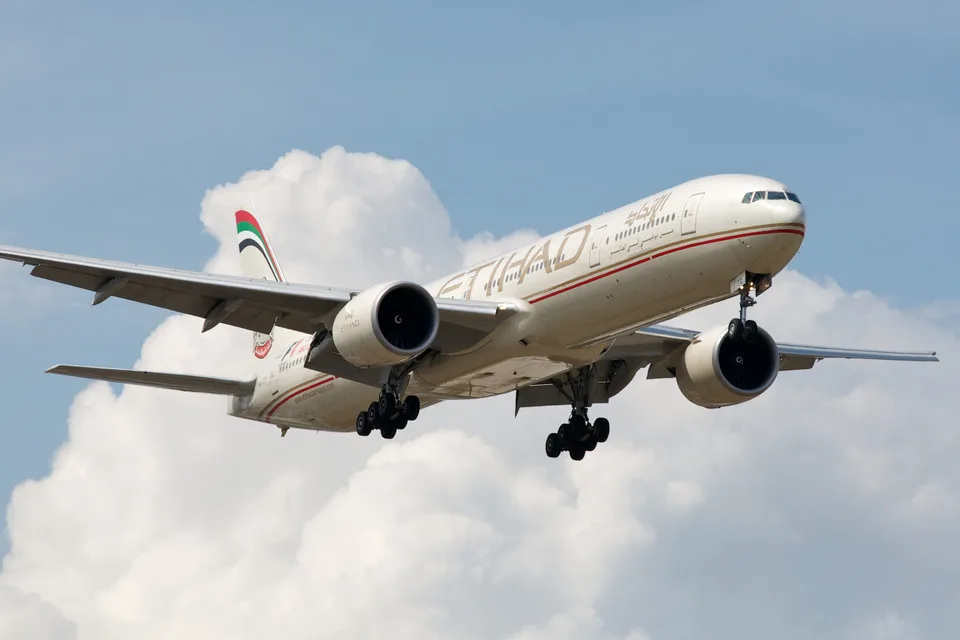
Original photograph unchanged. Responsive WebP copies resized without cropping.
Geographic context
Manila
Bay of Bengal encounter area
Abu Dhabi
The encounter marker approximates GCAA's position of 194 nautical miles south southwest of Yangon. Airport markers give geographic context. The flight made a right deviation near the weather cell and then continued to Abu Dhabi. Basemap: Natural Earth, public domain.Read supporting evidence
A6-ETC encountered severe turbulence at FL340 while turning around a cumulonimbus cell. The autopilot disconnected and the aircraft climbed about 600 feet. Passengers and cabin crew struck cabin fittings. The crew recovered the assigned altitude and continued to Abu Dhabi, where an ambulance was requested.
Read the full incident Follow what happened, from the flight to the investigation findings.
What investigators concluded
GCAA identified a combination of crew coordination, communication difficulties and late weather recognition contributing to the delayed deviation. Cabin safety findings addressed restraint use, lavatory access and crew activity during turbulence.
1,669 words / about 8 minutes to read. Based on the investigation records cited below.
A night crossing of the Bay of Bengal
On 18 October 2011, Boeing 777 A6-ETC was operating a scheduled passenger service from Manila to Abu Dhabi. Three flight crew members and twelve cabin crew members were aboard. The captain and two first officers had rested in Manila before beginning the return sector. Their planned flight duty was ten hours and thirty minutes. An analysis of their rosters using the operator's fatigue assessment software did not indicate that they would be suffering from fatigue.
The flight crossed the Bay of Bengal during darkness. Its dispatch package included a forecast chart showing embedded cumulonimbus clouds across a broad area between the Andaman Islands and the east coast of India, extending north toward Bangladesh and Myanmar. Some cloud tops were forecast to reach FL500. A satellite image supplied with the briefing showed intense convective activity in the bay. The aircraft had already made one weather deviation over the South China Sea.
At about 21:00 UTC, A6-ETC was at FL340, approximately 194 nautical miles south southwest of Yangon. The captain had left the flight deck for a comfort break. One first officer was flying from the right seat. The other first officer, who was initially in the supernumerary seat, was helping with radio communications. He was experienced on the Boeing 777 and over the Bay of Bengal, but was not qualified as a cruise relief pilot. The pilot flying had recently completed his Boeing 777 conversion and was operating his fourth unsupervised flight on the type.
The transfer from Yangon to Kolkata air traffic control became difficult. The pilots described the Yangon transmissions as garbled and hard to understand. They interpreted the response to their position report at waypoint RINDA as an instruction to contact Kolkata on high frequency radio and make another report to Yangon. The second first officer moved into the left seat to handle Yangon communications while the pilot flying tried Kolkata. The Kolkata radio transmissions also suffered from static.
Controller pilot data link communications, or CPDLC, was serviceable aboard the aircraft. The crew had not logged on to Kolkata before the flight information region boundary. The operator's supplementary procedures and the relevant airway guidance called for an earlier logon. Investigators found that clearances and weather deviation requests could have been exchanged electronically. Delaying that connection increased the burden of the difficult voice communications and was identified as a contributing safety factor.
The crew saw an isolated cumulonimbus return directly ahead on the weather radar, about twenty nautical miles away. At their speed, this represented roughly two minutes of flying. The pilot flying initially asked for a weather deviation clearance through Kolkata radio. With the cell close ahead, the crew turned before obtaining clearance. They changed from a heading of about 285 degrees to 315 degrees, moving to the right of the airway. Severe turbulence struck when the aircraft was abeam the cell at a lateral distance of about seven nautical miles.
The severe encounter lasted approximately forty five seconds. The autopilot disconnected, the aircraft climbed about six hundred feet and the stick shaker operated. The flight data recorded vertical acceleration extremes of +1.98g and -0.685g. After the encounter, the pilots reengaged the autopilot and used the mode control panel to recover the assigned flight level. The aircraft then returned toward its planned track and made no further weather deviations during the remainder of the flight.
The captain was in the cabin when the severe turbulence began. He secured himself in an empty business class seat and remained there until the turbulence subsided, then returned to the flight deck. None of the pilots was injured. In the cabin, the motion threw people against ceilings, floors and fittings. The completed injury classification was two serious injuries, affecting one passenger and one cabin crew member, and twelve minor injuries, affecting five passengers and seven cabin crew members. There were no fatalities.
Witnesses said the seat belt signs had been illuminated about ten minutes before the severe encounter, during an earlier period of light turbulence or chop. An announcement in Arabic and English instructed passengers to fasten their belts. After securing the cabin, cabin crew members had returned to galley activities. Two passengers subsequently went to lavatories near the third pair of doors. Most passengers were seated when the severe turbulence arrived.
Seven cabin crew members had been in galley areas. Some reached nearby jump seats immediately; others fell against fixtures and bulkheads before reaching seats. The report described greater loads and more severe impacts in the aft section. Crew members there hit both the galley roof and floor. No cabin service was in progress, and the carts and containers remained secured in their stowages by their locked latches.
Two crew members were in separate aft lavatories. Both had difficulty leaving while the turbulence continued and eventually reached available jump seats. An impact damaged a lavatory service unit and released an oxygen mask. Two other crew members were resting in the upper crew rest compartment above the passenger cabin. They were thrown from their bunks against the low ceiling, then fell back onto the mattresses. The report considered the mattresses to have reduced the impacts and the seriousness of their injuries.
The cabin manager had been sitting on the forward jump seat without securing its restraints. She was thrown onto the floor, then regained the seat and fastened the belt and shoulder harness. A passenger in a lavatory near door three struck the ceiling and fell to the floor. Cabin crew immobilized that injured passenger on the galley floor. Another passenger was injured against cabin fittings while returning from a lavatory to seat 38F.
In the aft passenger cabin, seated passengers struck the overhead passenger service units. Cabin crew statements described their belts as loosely fastened. Several oxygen masks dropped and service units were damaged. A passenger near door R3 was ejected from a seat and struck the door handle. The aircraft sustained internal cabin damage, while the investigation recorded no external damage. These impacts accounted for injuries even though the aircraft's flight loads remained within the manufacturer's allowable limits.
After the encounter, the captain and cabin manager contacted Medlink for medical advice. Medlink said it would inform the company and request an ambulance for the seriously injured passenger. A message reached the network operations center identifying turbulence as the source of the injury. The duty manager received it while dealing with the disruption expected from fog at Abu Dhabi and overlooked that part of the information. Medlink also telephoned the hub control center, which sent a message to the relevant departments.
Near the end of cruise, the second first officer called the hub control center to confirm that an ambulance would be ready. When asked whether the injured passenger could walk off the aircraft, he confirmed that an ambulance was needed. At Abu Dhabi, low visibility procedures were in force. The reported conditions shortly before landing included fog, visibility of three hundred meters and a cloud ceiling of one hundred feet. The crew completed an automatic landing at approximately 05:39 local time on 19 October.
The operator's emergency response plan was not activated. GCAA concluded that the injuries met the criteria for a Category B event, which should have opened the emergency response center. Instead, departments worked independently. Immediate passenger support was limited to the hospitalized passenger, and notification to the investigating authority was delayed. The aircraft turnaround supervisor could not properly assess the situation because access at the exit door was restricted. Engineering attention was focused on repairs and returning the aircraft to service.
The aircraft remained electrically powered after arrival, and the cockpit voice recorder circuit breaker was left closed. The recorder continued operating until it was removed more than two hours after landing. By then, the flight audio had been overwritten. Investigators obtained useful flight data recorder information and quick access recorder data, but the cockpit conversations during the encounter were lost. An engineer's photographs provided the only images of the damaged panels while they were still attached to the aircraft.
The voice recorder examination also revealed a recording configuration issue. The installed L3 FA2100 unit was at modification standard 5, providing thirty minutes of separate channel audio followed by combined recording within its two hour capacity. Recorders supplied through the maintenance provider's pool had mixed modification standards. GCAA called for standard 7 units and clearer requirements for two hours of separate, unmixed recording on each of the four channels.
GCAA identified crew coordination, resource management, difficult high frequency communications, the captain's absence during the boundary transfer and late weather recognition among the factors contributing to the delayed track deviation. It also identified the captain's delayed return after the severe encounter as affecting the restoration of normal crew coordination. Cabin findings concerned crew duties continuing while the belt signs were on, restraint use and inadequate monitoring of lavatory use.
The radar had remained in automatic tilt mode. Investigators found that this complied with the operating procedures, while concluding that they could not establish whether manual tilt would have given the crew a clearer and more consistent weather image. Boeing reviewed the recorded loads and confirmed that they were within allowable limits. The affected cabin panels were replaced, with the associated inspections completed.
Recommendations for weather avoidance and cabin safety
The final report called for the operator to review immediate accident notification, recorder protection and activation of its emergency response plan when passengers or crew required medical intervention. GCAA also recommended clearer regulatory wording for four separate voice recorder channels and upgrades to pooled FA2100 recorders. The recommendations linked recorder handling to prompt notification of the duty investigator.
Training recommendations covered weather radar, data link communications, weather deviation procedures, crew resource management during the captain's absence, interruptions and threat and error management in adverse weather. Cabin recommendations addressed the use of restraints and lavatories during turbulence, and procedures for several injured crew members. The operator was asked to define how reduced mobility or injuries affected cabin crew fitness to perform safety duties, particularly if the available crew fell below the minimum required for the aircraft.
Severe turbulence disconnected the autopilot and produced vertical acceleration extremes of +1.98g and -0.685g. Occupants struck ceilings and cabin fittings.
A simplified reading of the investigation findings. The sequence does not replace the full report or imply that every contributing factor is shown.
Sequence of events
UTC for the encounter. Abu Dhabi arrival times are local time, UTC plus four hours. Rounded encounter times are approximate. Expand an event to see its evidence.
Before the encounterCaptain leaves the flight deck
The captain took a comfort break while two first officers handled flight duties and the transfer between air traffic control regions.
The autopilot disconnected, the stick shaker activated and the aircraft climbed approximately six hundred feet. The pilots reengaged the autopilot and recovered the assigned flight level.
Cabin crew said some aft cabin passengers had loosely fastened belts. Those passengers struck overhead passenger service units, and several oxygen masks dropped.
Why were the cockpit voice recordings unavailable?
The aircraft remained powered and the recorder circuit breaker stayed closed. The recorder was removed more than two hours after landing, by which time the flight audio had been overwritten.
Why did GCAA recommend activating the emergency response center?
The injuries met the operator's Category B criteria. Activating the emergency response center would have coordinated passenger assistance, the investigation response and operational recovery.
GCAA could not establish whether manual tilt would have provided a clearer and more consistent weather image. Automatic tilt complied with the operating procedures.
Actions and recommendations are described at the dates of the cited records. A recommendation is not proof of implementation.
Cabin repairs and load review
The damaged cabin panels were replaced. The manufacturer reviewed the recorded loads and required no further inspections after confirming they were within allowable limits.
Recommendations 4.6 and 4.8 to 4.10 addressed multiple crew injuries, reduced mobility, cabin safety functions, seat belts and lavatory use during turbulence.
GCAA identified coordination, resource management, difficult radio communications, the captain's absence and late weather recognition among the factors delaying the turn.
Matching dossiers for Loss of cockpit audio: No other dossier in this collection.
Read alongside
These comparisons connect specific research topics. Shared circumstances do not establish identical causes. Evidence from both investigations is provided below.
Both investigations examined injuries caused when occupants were displaced during abrupt in flight motion. A6-ETC encountered severe turbulence near a cumulonimbus cell. Qantas 72 suffered pitch down commands associated with erroneous angle of attack data and a flight control processing limitation. The ATSB found substantially greater injury rates and severity among occupants who were standing or seated with their belts unfastened.
Explore the records below for additional context. They open on the publisher's site and are not all included in our report search. Source reuse terms apply.
Kevin Murphy writes the incident accounts on AirlineIncidents.com, out of a long interest in aviation safety and the lessons each investigation leaves behind.
Prepared by
AirlineIncidents editorial desk
Report citation check
Independent expert review
Not completed
Citation checks compare supporting text with the indexed report pages. They do not constitute independent expert review. How these pages are prepared.
Revision history
: GCAA final investigation completed, AAIS Case 11/2011.