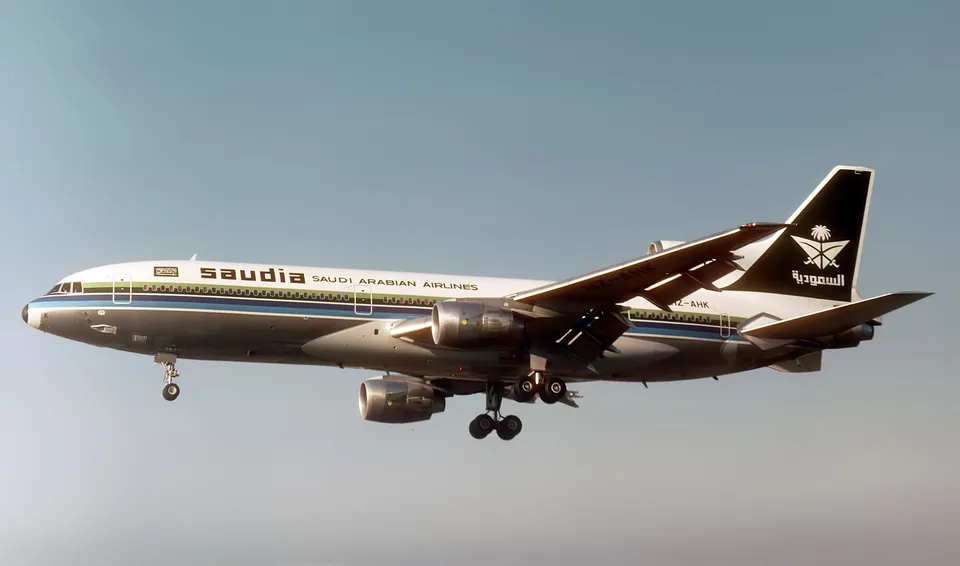
A cargo fire forced Saudia 163 back to Riyadh. The aircraft landed, taxied off the runway and burned before an evacuation began. All 301 occupants died.
Original photograph downloaded at its published resolution. Responsive WebP copies resized without cropping.
Geographic context
Riyadh departure airport
Riyadh landing and taxiway stop
Both markers use the report's airport occurrence coordinates. Flight 163 departed Riyadh toward Jeddah and returned to land on Runway 01. Basemap: Natural Earth, public domain.Read supporting evidence
Flight 163 returned to Riyadh after smoke warnings and reports of fire in the cabin. It landed on Runway 01 at 18:36:24 GMT, stopped on a taxiway about two minutes and forty seconds later, and remained there with its wing engines running until 18:42:18. Rescuers opened the first door at about 19:05.
Read the full incident Follow what happened, from the flight to the investigation findings.
What investigators concluded
The Presidency of Civil Aviation found that the fire began in cargo compartment C-3. It identified the captain's evacuation preparation, stopping decision and use of his crew, together with inadequate rescue equipment and training, as factors contributing to the fatal outcome.
The fire, the return to Riyadh and the lost evacuation
1,579 words / about 8 minutes to read. Based on the investigation records cited below.
A scheduled stop before Jeddah
Saudi Arabian Airlines Flight 163 left Karachi at 13:32 GMT on 19 August 1980 for Jeddah, with a scheduled stop at Riyadh. The first sector lasted two hours and thirty-four minutes and passed uneventfully. After landing at Riyadh at 16:06, all passengers left the aircraft with their cabin baggage for immigration and customs clearance. Checked baggage was unloaded for customs inspection as well. The aircraft was refuelled, and continuing passengers boarded again together with passengers joining the service at Riyadh.
The Lockheed L-1011, registered HZ-AHK, left its gate at 17:50 and took off at about 18:08. There were 301 people aboard: 287 passengers, including 15 infants, and 14 crew members. The crew received clearance toward Jeddah at an assigned cruising altitude of 35,000 feet. The initial climb was uneventful. The investigation subsequently found that the aircraft had been maintained under the required procedures and that its crew held the appropriate certificates.
At 18:14:54, six minutes and fifty-four seconds after takeoff, the flight crew received visual and aural warnings of smoke in aft cargo compartment C-3. Both smoke detection channels subsequently gave warnings. The crew spent four minutes and twenty-one seconds confirming the warning. About three minutes of that period went into finding the appropriate procedure. Saudia had divided its procedures among Emergency, Abnormal and Additional sections, and the crew initially searched in the Abnormal section for an item located under Emergency.
The flight engineer went into the cabin to investigate. On his return, at about 18:20:16, he reported fire behind the cockpit. At 18:20:17 the first officer told Riyadh that Flight 163 was coming back. The crew then reported a cabin fire and asked for fire vehicles. The aircraft was climbing through about 22,000 feet when the return began. Air traffic control gave it priority and clearance to descend immediately.
After a second visit to the cabin, the flight engineer reported smoke at the rear. His descriptions of the situation varied during the descent, and investigators concluded that his reassuring statements may have caused the captain to underestimate its severity. The captain concentrated on flying. The report found that assigning the first officer to fly could have reduced the captain's workload and given him time to assess the emergency and direct the other crew members.
At about 18:25 the captain reported that the No. 2 engine throttle was stuck and announced his intention to shut the engine down. A cabin attendant came forward and reported fire in the cabin. Another attendant said that she could not get beyond the second pair of doors because passengers were struggling in the aisles. The cabin crew made announcements in English, Arabic and Urdu, asking passengers to sit down and keep the aisle clear.
The attendants repeatedly sought instructions about evacuation. At 18:32:10 an attendant asked whether the captain wanted the passengers evacuated, and he told her to take her position. Another request reached him through the flight engineer at 18:35:17. Investigators found that the cabin crew fought the fire, tried to calm passengers and repeatedly kept the captain informed. They described the cabin crew's actions during the flight as commendable.
The No. 2 engine was shut down during the approach. Cargo smoke alarms continued intermittently, and the flight engineer also reported a duct overheat condition. At 18:35:57 the captain directed the cockpit crew to tell the cabin crew not to evacuate. The report could not establish whether this instruction was passed on. The aircraft continued toward Runway 01, with witnesses seeing smoke trailing from the rear on short final.
Flight 163 touched down at 18:36:24. It continued its landing roll to the far end of the runway, turned right through 180 degrees and stopped on an adjacent taxiway at 18:39:03. The main flight history describes an interval of about two minutes and forty seconds from touchdown to the stop. During the rollout, the crew asked whether fire was visible at the tail. The tower checked with the fire vehicles and initially reported that none was seen.
After the stop, the tower asked whether the crew intended to proceed to the ramp or shut down. The crew replied that they were shutting down and evacuating. Firefighters were reporting an increasing fire and seeking engine shutdown, but they had no direct radio channel to the aircraft. Communications passed through the tower. At 18:40:33, in its last radio transmission, the crew said that they were trying to evacuate.
The two wing engines continued running until 18:42:18, three minutes and fifteen seconds after the aircraft stopped. Investigators found that the air conditioning packs had already been shut down, ending the supply of ventilation air to the fuselage. They concluded that heat and combustible gases accumulated, followed by a flash fire shortly after engine shutdown that rapidly incapacitated the occupants. No evacuation began.
Rescuers attempted to enter through the forward left door. They used a ladder placed on a fire vehicle and tried the exterior emergency handle, but could not open the door. Attempts then moved to the right side. The forward right door handle was obscured by foam, and firefighters proceeded to door R2. They opened it at about 19:05, approximately twenty-six minutes after the aircraft stopped and twenty-three minutes after engine shutdown. The cabin was filled with smoke. Rescuers saw no movement and heard no human sounds. Flames spread forward shortly afterward.
All 301 people aboard died. The report attributed the deaths to smoke inhalation and the effects of fire, heat and oxygen depletion. Examined blood samples contained high carbon monoxide levels, and soot was found in the airways of those examined. The landing and rollout had subjected the occupants to no unusual impact forces. Investigators considered the accident survivable and identified the time available immediately after landing as significant.
The aircraft had sufficient braking capability for a maximum stop on the runway. The investigation estimated that a prompt stop could have saved about two minutes. Door tests and the pressure reconstruction indicated little or no pressure difference at touchdown, allowing the doors to open. Examination found no evidence that an interior emergency handle had been pulled. Investigators also found that the firefighters lacked training in L-1011 door operation and forcible entry, suitable protective clothing and necessary equipment. The report attributed these deficiencies to rescue service management.
The investigation compared the sequence of smoke alarms, cabin reports, throttle trouble and duct overheat with the damage and laboratory tests. It strongly supported an origin in C-3. Baggage and cargo probably supplied the initial fuel. Investigators examined possible origins in the cabin, beside the cargo compartment and immediately behind it. They found the sequence most consistent with a fire in C-3 penetrating its ceiling liner and spreading through the space beneath the passenger floor.
That space also carried the No. 2 engine throttle control cables. Heat tests showed that nylon rollers could soften and adhere to the cables as they cooled, increasing friction. The report linked the stuck throttle to fire damage. Other aircraft system damage, including the hydraulic pipe rupture and electrical wiring damage, was also attributed to the developing fire. Investigators found no detectable evidence of a system fault preceding it.
C-3 had been approved as a Class D cargo compartment. Its protection depended on containing a fire and restricting airflow so that oxygen depletion controlled combustion. Tests showed that a small baggage fire could penetrate the Nomex ceiling liner and gain access to further air. In a simulated compartment test, the fire varied in intensity as oxygen was consumed and replenished through the opening. Soot deposits could also cause a detector warning to stop while the fire continued. These tests explained how changing warnings and limited damage inside the compartment could accompany a fire spreading beyond it.
A specialist examined baggage and other items removed from C-3 for evidence of sabotage. The examination found no damage suggesting the detonation of an explosive device and no signs of an incendiary device in the baggage. Debris and soot samples were also sent to the Metropolitan Police Forensic Science Laboratory in London. Its examination found no products of an incendiary mixture or device. The investigation used these examinations alongside the fire tests and the recorded sequence to evaluate possible origins.
The Presidency of Civil Aviation identified the initiation of fire in C-3 as the probable cause. Its contributing factors concerned the captain's failure to prepare for immediate evacuation, his decision to taxi clear instead of stopping promptly on the runway, his use of the flight crew, and the rescue service's equipment and training. The final report was approved on 16 January 1982. It also found that the C-3 compartment and its certification requirements had failed to provide the intended fire protection.
The recommendations called for immediate responses to smoke or fire, landing as soon as possible when smoke was confirmed, stronger command and assertiveness training, and more suitable matching of crew experience. Saudia was asked to clarify emergency landing and evacuation procedures and improve baggage and cargo surveillance. The report recorded revisions to checklists and training, additional emphasis on evacuation training, and sealing of Saudia's C-3 compartments, ending their use for animal transport.
Lockheed replaced the C-3 Nomex ceiling panels with high strength glass laminate panels under a service bulletin released on 17 June 1981. The Presidency also reported improvements to firefighting equipment and training across Saudi Arabia. It asked the FAA to reconsider its response to the NTSB recommendation for reassessing the compartment's Class D certification, citing the evidence that the original containment concept had failed.
The cabin crew sought evacuation instructions during the descent. The captain continued flying and did not prepare them to evacuate immediately on landing.
Ventilation ceased before engine shutdown. The investigation concluded that a flash fire rapidly incapacitated the occupants, while rescue entry was delayed.
The captain told the cockpit crew to tell the cabin crew not to evacuate. Investigators could not determine whether that message reached the cabin crew.
The engines continued running for more than three minutes after the aircraft stopped. Investigators found no evidence of an attempt to open the doors by their emergency method and concluded that a flash fire probably incapacitated the crew before an evacuation began.
The aircraft had enough braking capability for a maximum stop on the runway. The investigation estimated that stopping promptly could have saved about two minutes for evacuation.
How was cargo compartment fire protection changed?
Lockheed replaced the Nomex ceiling panels in the L-1011 C-3 compartment with high strength glass laminate panels under Service Bulletin 093-25-377, released on 17 June 1981.
The pressurization system was found in standby mode. The investigation could not determine its control mode during the short final portion of the approach.
Actions and recommendations are described at the dates of the cited records. A recommendation is not proof of implementation.
Crew training and procedures
The Presidency recommended stronger command and assertiveness training, balanced crew experience and clearer emergency landing and evacuation procedures. The report recorded checklist revisions and a review of crew training.
Lockheed issued Service Bulletin 093-25-377 on 17 June 1981 to replace Nomex ceiling panels with high strength glass laminate panels. Saudia sealed its C-3 compartments, removing their animal transport capability.
Matching dossiers for Cargo fire containment: No other dossier in this collection.
Read alongside
These comparisons connect specific research topics. Shared circumstances do not establish identical causes. Evidence from both investigations is provided below.
Saudia 163 and Air Canada 797 both landed after an in-flight fire and suffered a rapid deterioration in cabin conditions. Air Canada 797 began evacuating as soon as it stopped, and a flash fire developed about 60 to 90 seconds after exits opened. Saudia 163 remained closed while its wing engines continued running, and the investigation placed incapacitation shortly after engine shutdown.
Explore the records below for additional context. They open on the publisher's site and are not all included in our report search. Source reuse terms apply.
Kevin Murphy writes the incident accounts on AirlineIncidents.com, out of a long interest in aviation safety and the lessons each investigation leaves behind.
Prepared by
AirlineIncidents editorial desk
Report citation check
Independent expert review
Not completed
Citation checks compare supporting text with the indexed report pages. They do not constitute independent expert review. How these pages are prepared.
Revision history
: Final investigation completed; accident report approved 16 January 1982.