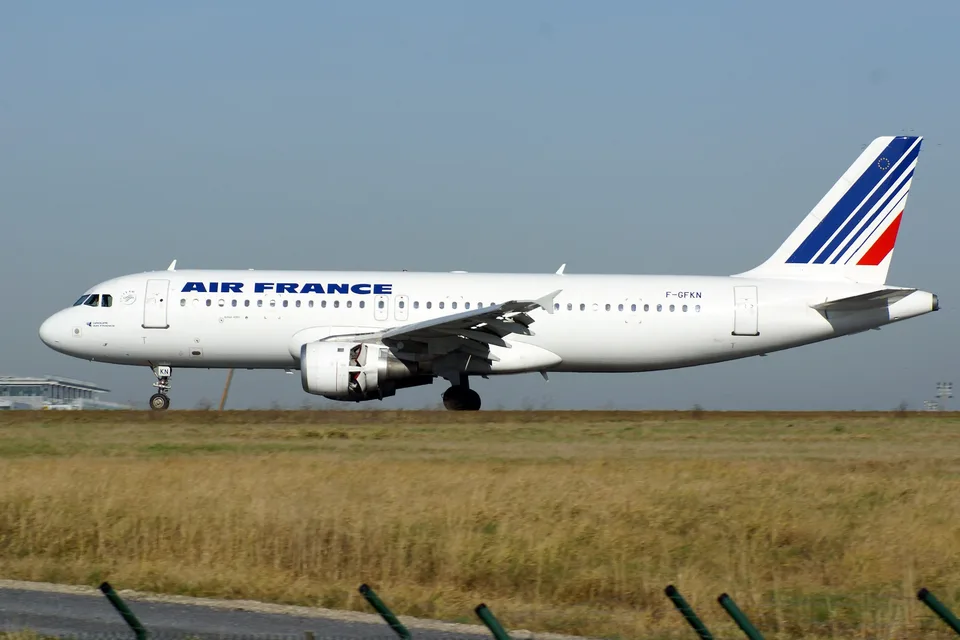
Original photograph unchanged. Responsive WebP copies resized without cropping.
Geographic context
Basel Mulhouse departure and planned return
Habsheim accident site beyond runway 34 R
The circular passenger flight departed Basel Mulhouse and was to return there after the Habsheim display. The accident position follows the wreck symbol on the report's aerodrome chart. Coordinates are approximate. Basemap: Natural Earth, public domain.Read supporting evidence
During a passenger charter flight, F-GFKC descended for a low-speed display over Habsheim. It continued below the planned 100 feet and crossed the grass runway at about 30 feet with the engines at idle. The captain selected go-around thrust about five seconds before the aircraft struck trees. The right wing broke, fuel ignited and three passengers died in the cabin fire.
Read the full incident Follow what happened, from the flight to the investigation findings.
What investigators concluded
The commission attributed the accident to the combination of a height below surrounding obstacles, very low and decreasing speed, engines at flight idle and a late go-around. Inadequate preparation, incomplete task allocation, late identification of the airfield and the crew's lack of experience in these display and go-around conditions contributed. The engines and flight controls operated in accordance with certification.
1,630 words / about 8 minutes to read. Based on the investigation records cited below.
A charter flight with a display on its route
On 26 June 1988, Air France was operating an Airbus A 320-100 for Air Charter on behalf of the Mulhouse flying club. The day's programme included a flight from Paris Charles de Gaulle to Basel Mulhouse, two circular passenger flights and the return to Paris. Each circular flight was to begin with a pass over Mulhouse-Habsheim during an air display. The sightseeing route had been changed from the Vosges to the Alps because of the weather.
F-GFKC had been delivered on 24 June and had accumulated 22 hours 30 minutes of operation. There were 130 passengers and six crew aboard the first circular flight. The two pilots were both captains and members of Air France's flying management. They held the qualifications required to operate the A320, but neither had previously performed a display flight. The aircraft's mass and centre of gravity were within limits. The commission found that errors in their calculation had no influence on the flight.
Administrative, commercial and technical preparation was divided among the regional Air France office, Air Charter and Air France's operations services. According to the airline, the technical study considered a low pass over runway 02. The packet supplied to the crew contained maps, an aerodrome chart, a proposed flight plan and messages. It gave no instructions for the runway axis or display height. The packet reached the A320 division late on the Friday before the flight, and the pilots examined it on Sunday morning.
The crew received no oral briefing from the services that prepared the flight. No reconnaissance of Habsheim was planned. The required meeting between the display's flight director and the crew did not take place. A morning briefing was held for the other participating pilots, but the A320 crew was absent. This left them without information that could have clarified the display axis, the position of the spectators and the airfield's particular features.
Habsheim had parallel paved and grass runways. None was suitable for an A320 landing. The display used grass runway 34 R, with woodland immediately beyond its northern end. The forest began about 60 metres beyond the runway and its trees averaged 12 metres in height. The commission also criticized Air France's internal instruction permitting some passes at 100 feet: its use at Habsheim conflicted with the applicable rules of the air.
During taxi at Basel Mulhouse, the captain described two passes. He would fly the first at 100 feet with landing gear extended and flaps in position 3. He intended to decelerate in level flight to the maximum angle of attack allowed by the flight-control system. The first officer would adjust thrust to maintain height and then select go-around thrust on the captain's command. The second pass would be fast, with the aircraft in clean configuration and the first officer flying.
The briefing included disabling Alpha Floor, the automatic thrust protection associated with high angle of attack. The commission observed that Alpha Floor was inactive below 100 feet in any event. It distinguished this thrust function from the angle-of-attack protection in the flight controls. That protection limited the angle of attack while the aircraft approached its aerodynamic performance limits.
The commission found important gaps in the plan. The pilots had not clearly allocated the tasks of watching outside and monitoring the instruments. They had not fixed a precise point for the go-around, and the runway length did not permit the prolonged stabilized pass the captain envisaged. Training demonstrations at minimum speed had normally begun with substantial thrust already set to sustain level flight. The Habsheim approach would leave the engines at idle.
The A320 took off at 12:41 UTC and turned right toward Habsheim. Autothrust was disconnected after takeoff. The crew used the motorway and a parallel road as visual navigation references. The descent began at 12:43:44, about 5.5 nautical miles from the airfield. The commission considered this distance too short to complete the height loss and deceleration in time for a stabilized level pass.
The engines were reduced to flight idle, and the landing gear and flaps were extended during the descent. Both pilots set and cross-checked Habsheim's QFE pressure of 984 hPa. The captain asked the first officer to confirm the airfield when the aircraft was at about 450 feet. He subsequently selected the display axis after seeing the spectators beside runway 34 R.
At 12:45:14, the first officer announced that they were reaching 100 feet, at the same time as the radio altimeter's spoken announcement. The aircraft was still descending at about 600 feet per minute. It continued through the planned height. A small right turn aligned it with runway 34 R while it descended and slowed further.
At 12:45:26 the aircraft was at about 40 feet and 132 knots, with the engines still at idle. The captain began the level-off. During the following seconds the aircraft flew close to 30 feet above the ground while its pitch and angle of attack increased. The first officer drew attention to pylons ahead; the captain gave a brief reassuring response. The nearby trees became the immediate obstacle.
Between 12:45:34 and 12:45:35, the captain moved the thrust levers rapidly into the takeoff and go-around detent, TOGA. The aircraft's speed was about 122 knots. The captain then progressively pulled the sidestick fully aft. These actions departed from the briefing, in which the first officer was to increase thrust progressively to maintain level flight and then apply maximum thrust on command.
The engines accelerated, but the aircraft had very little speed or height in reserve. Their response from idle was slowest during the first part of the acceleration. The commission described approximately four seconds from 29 percent to 67 percent N1, followed by about one second from 67 percent to 83 percent. Between 12:45:39 and 12:45:40, the rear fuselage and tail struck the treetops.
Contact with the trees added drag and prevented the aircraft from gaining height as thrust increased. Branches and leaves entered the engines and obstructed their combustion chambers, causing them to stop. The aircraft sank into the forest. Its right wing broke, throwing fuel forward. Fire developed immediately and entered the cabin as the aircraft came to rest.
Cabin crew began the evacuation through the forward and rear left doors. Fire on the right side prevented use of those doors. At the front, branches restricted the door's opening and the slide began deploying partly inside the cabin. When the door was forced farther open, the chief flight attendant and a passenger fell outside under the slide. Others helped remove branches and guide passengers out. Some jumped beside the slide and became piled together among the trees.
At the rear, the left door opened and its slide deployed correctly, but branches punctured it after the first passengers used it. Crew and passengers helped people reach the ground. The commission credited the rear flight attendant's firm, reassuring instructions and previous evacuation experience with helping this part of the evacuation proceed calmly.
Smoke and flames prevented a complete search of the cabin. The captain returned to the cockpit for a smoke hood but had to leave before he could put it on. Three passengers, a woman and two children, died in the fire. The other 127 passengers and all six crew survived. Thirty-four passengers were hospitalized, and the medical section also recorded injuries to the pilots and contusions among the cabin crew. Investigators could not determine the evacuation's duration.
The commission used flight-recorder data, cockpit sound, a spectator's video and aircraft and simulator tests to examine the final seconds. These independent sources gave consistent evidence of engine acceleration after the thrust command. The cockpit recording and flight data showed fan speeds in the low eighties at tree contact, while the video soundtrack enabled investigators to follow the rise to about 91 percent N1. The commission found that engine response met the certification requirements.
Tests also found that the flight controls behaved in accordance with certification. At high angle of attack, the protection law became active. The commission established that an earlier or faster aft sidestick input could have increased angle of attack before tree contact, but the extra drag would still have prevented clearance unless thrust had been increased earlier. It found that the low-height pitch-down feature associated with the landing flare had not activated during the pass.
Investigators examined the unusual order of the radio-altimeter callouts. A small group of trees before the runway produced a sudden change in measured radio height. This caused the 40-foot callout to take priority before the earlier 50-foot callout could be spoken. The commission also found an emergency-lighting activation error and an ineffective evacuation signal. These affected the escape conditions after the collision.
The commission attributed the collision to four conditions occurring together: a height lower than the surrounding obstacles, very low and decreasing speed, flight-idle engine settings and a late go-around. It also identified insufficient preparation, incomplete task allocation, unfamiliarity with display flying, late identification of the airfield and lack of experience of a go-around from idle in similar conditions. It considered that the aircraft's protective features could have encouraged excessive confidence.
Its recommendations called for a complete safety dossier, advance coordination with the crew, reconnaissance and simulator rehearsals where possible. Display flights were to carry only the crew necessary to conduct them. Pilot training should emphasize the performance limits that remain alongside automatic protections, and crews of equal seniority should define their responsibilities clearly.
The commission recommended more practical cabin-safety training, improved communication equipment and clear demonstrations of opening and fastening seat belts. It sought studies of head impacts against seatbacks, separate routing of recorder power cables, and emergency access arrangements suited to the local terrain. It recorded that the emergency-lighting programming error had already been corrected. The final report was published in the Journal officiel on 24 April 1990.
A simplified reading of the investigation findings. The sequence does not replace the full report or imply that every contributing factor is shown.
Sequence of events
UTC throughout. Local time in France was two hours ahead of UTC. Expand an event to see its evidence.
Before departureTwo passes briefed
The captain planned a low-speed pass at 100 feet with gear down and flaps 3, followed by a fast pass in clean configuration. The first officer was to adjust thrust during the slow pass.
Immediately after the crashEvacuation through the left doors
Cabin crew opened the forward and rear left doors. Trees obstructed the forward exit and damaged the slides. Three passengers remained in the burning cabin.
After the aircraft hit the trees, the engines ingested leaves and wood. This material obstructed the combustion chambers and caused both engines to stop. The commission found normal engine operation before the ingestion.
The commission found a design error in the emergency-lighting automatic activation program. It recorded that this error had been corrected by the time of the final report.
What preparation did the commission recommend for display flights?
It recommended a complete safety dossier specifying flight parameters and failure procedures, an advance meeting between crew and the preparation services, effective reconnaissance and, where possible, simulator rehearsals.
The commission found that an earlier or faster aft input could have produced a higher angle of attack. The added drag would still have prevented clearance unless the go-around thrust command had come earlier.
The commission gave a conditional finding: if the descent below 100 feet was unintentional, inadequate use of visual or aural height information could explain it.
Investigators could not determine the exact cause of the nearly simultaneous stoppages. They considered damage to the recorders' power cables the most probable explanation.
Actions and recommendations are described at the dates of the cited records. A recommendation is not proof of implementation.
Display-flight planning and occupants
The commission recommended a full safety dossier, crew coordination, reconnaissance and rehearsal where possible. It recommended display flights with only the personnel necessary for the flight.
Recommendations covered performance limits despite automatic protection, clear task allocation for pilots of equal seniority, practical handling of cabin-safety equipment and realistic evacuation training.
The final report recorded correction of the automatic emergency-lighting activation error. It also recommended stronger handset attachments and simpler access to passenger announcements.
The commission recommended demonstrations of seat-belt use, studies of head-impact protection in future seats, clear access for emergency vehicles and rescue equipment matched to the surrounding terrain.
These comparisons connect specific research topics. Shared circumstances do not establish identical causes. Evidence from both investigations is provided below.
Both investigations identified a late go-around after the aircraft had lost the height and speed margin needed to avoid obstacles. At Habsheim this developed during a planned display pass with idle thrust. Asiana 214 was on a visual landing approach; the NTSB identified descent mismanagement, unintended deactivation of automatic airspeed control and inadequate airspeed monitoring.
Explore the records below for additional context. They open on the publisher's site and are not all included in our report search. Source reuse terms apply.
Kevin Murphy writes the incident accounts on AirlineIncidents.com, out of a long interest in aviation safety and the lessons each investigation leaves behind.
Prepared by
AirlineIncidents editorial desk
Report citation check
Independent expert review
Not completed
Citation checks compare supporting text with the indexed report pages. They do not constitute independent expert review. How these pages are prepared.
Revision history
: Commission of Inquiry final findings and safety recommendations, published 24 April 1990.