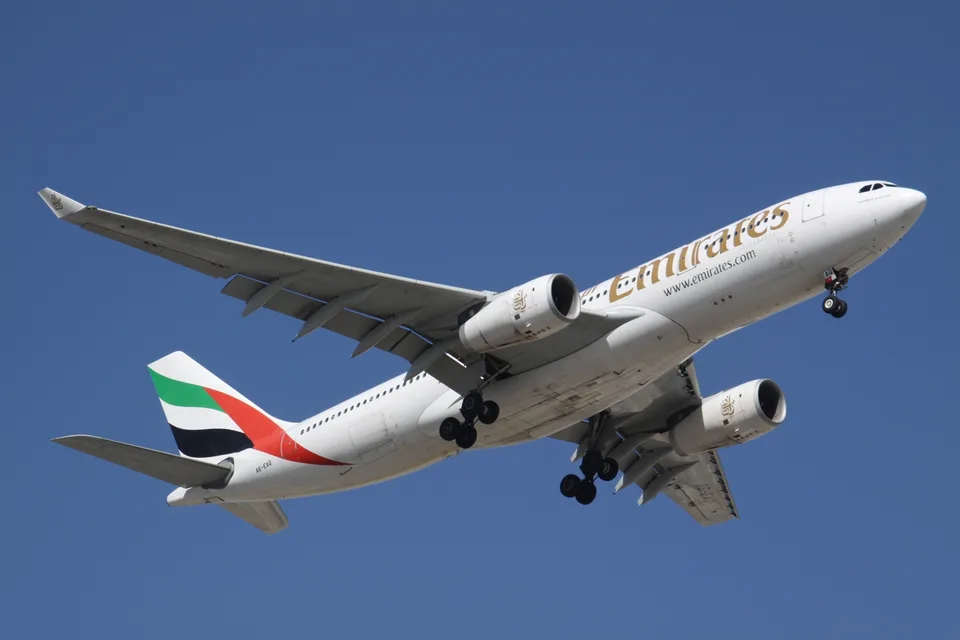
Hydraulic fluid entered the air conditioning during departure preparations at Karachi. A breathing hood then caught fire, and all 82 occupants escaped by slides.
Original photograph unchanged. Responsive WebP copies resized without cropping.
Geographic context
Karachi, departure and evacuation airport
Dubai, planned destination
The flight was scheduled from Karachi to Dubai. The evacuation occurred at the final pushback position in Karachi. Coordinates mark the airports approximately. Basemap: Natural Earth, public domain.Read supporting evidence
During preparations for Emirates EK609 at Karachi, a fractured rudder hydraulic hose released fluid into the APU intake. The air conditioning spread the resulting mist through the cockpit and cabin. A cabin crew member activated protective breathing equipment while investigating suspected smoke, and the equipment ignited. The aircraft was evacuated through its slides.
Read the full incident Follow what happened, from the flight to the investigation findings.
What investigators concluded
The AAIS traced the mist to the yellow hydraulic rudder servo hose and identified probable manufacturing defects in the PBE starter candle. Leaving the APU bleed supply open prolonged the entry of hydraulic mist into the cabin.
Hydraulic mist, a burning breathing hood and the Karachi evacuation
1,551 words / about 8 minutes to read. Based on the investigation records cited below.
Departure preparations and the first warnings
Emirates flight EK609 was preparing to depart Jinnah International Airport in Karachi for Dubai on 4 October 2014. The Airbus A330-243, registration A6-EAQ, carried 68 passengers and 14 crew. Cabin preparations were complete at 14:05 UTC. It was already after sunset in Karachi, and the cabin crew dimmed the lights for the planned night departure. The first engine was started on the stand before the aircraft began pushing back.
The previous flight from Dubai had generated an APU fault, followed by an automatic shutdown. Maintenance personnel cycled the APU switch, after which it started with normal indications. During the departure preparations, ground power was disconnected after the first engine started. Pushback began at 14:10:34, and the commander announced the second engine start shortly afterwards. This start used compressed air supplied by the APU.
At 14:12:42, a chime sounded and the copilot reported low air pressure in the yellow hydraulic reservoir. Hydraulic pressure fluctuated. At 14:13:09, a master caution accompanied a low pressure indication. The pilots discussed the yellow system and reviewed the indications. At 14:13:54 they detected a strong odor and what they perceived as smoke. The copilot suggested returning to the stand. The senior cabin crew member confirmed that the whole cabin was affected.
A pressure hose serving the yellow hydraulic rudder actuator had fractured in the vertical fin. Fluid escaped at a high rate and flowed around the aft fuselage towards the APU air intake beneath the tail. The intake had a diverter and gutters intended to keep fluids out, but these features could not exclude all the fluid from a large hydraulic leak on the ground.
Inside the APU, the leaking fluid passed through the load compressor and diffuser, where it was heated and atomized. The APU bleed supply carried the contamination into the air conditioning system. The system supplied the cockpit and cabin with the resulting fine mist. Its filters could not completely remove the contamination, and the environmental control system could neither detect the mist nor provide an early warning to the crew.
The pilots switched off the yellow hydraulic pumps and put on their oxygen masks. They checked communications through the mask microphones. In the cabin, occupants had difficulty breathing, throat discomfort and irritated eyes. The senior cabin crew member reported very thick smoke and increasingly severe conditions. Cabin crew searched for a possible fire source while communicating with the cockpit and attempting to keep the passengers seated.
The commander initially intended to have the aircraft towed back to the stand so that passengers could leave by steps. Ground personnel requested a tug, and the flight crew repeated their request for assistance. At 14:16:49, the senior cabin crew member reported that people in the cabin could not breathe. The cabin crew continued making announcements asking passengers to stay seated.
At 14:17:13, the commander told the copilot to keep the APU running while he shut down the engines. The flight crew wanted it available if both engines had to be stopped. The aircraft air supply therefore continued carrying hydraulic mist into the cabin until the APU bleed was closed. At 14:18:08, the commander said he would turn off that bleed supply to stop the circulation.
The L4 cabin crew member then called the cockpit, described the conditions as severe and said evacuation was necessary. The commander asked how far she could see. Her answer, four seat rows, gave him a more specific measure of the cabin conditions. He decided that the passengers would have to leave at the final pushback position. He still asked ground personnel whether passenger steps were immediately available.
The AAIS found that early descriptions from the cabin lacked standard terminology and sufficient detail to build a clear picture in the cockpit. It also found that the flight crew could have asked more effective questions and given greater weight to the urgency of the cabin reports. The report credited the continuing flow of information and effective crew resource management during the developing emergency.
A cabin crew member originally assigned to L1A had gone towards the rear to help investigate the suspected smoke source. She was having trouble breathing and seeing. Another crew member handed her the PBE stored near L3, already removed from its sealed package. She put the hood on and pulled its activation straps according to the procedure. The equipment immediately caught fire.
The crew member removed the burning hood and dropped it on the floor beside L3. She escaped injury from that action, which the investigation assessed as a normal human response to the hazard. Four Halon extinguishers were used in an attempt to suppress the fire. The oxygen generating equipment continued supporting combustion, and the initial extinguisher efforts were unsuccessful.
The fire remained localized around L3. It burnt the cabin crew seat, carpet and floor panels, including one heated panel. Three damaged floor panels required replacement. L3 became unavailable for evacuation. The commander ordered the cabin crew to evacuate through the slides shortly after the PBE ignited, and he subsequently requested the fire service through air traffic control.
The hood used a chemical starter candle to provide its initial oxygen supply. Tests and forensic examination found evidence of disrupted filters and energetic material in the candle outlet. The AAIS judged manufacturing defects in the candle the probable cause of an abnormally vigorous reaction on activation. Tests of other units from the suspect production lot included one that made a popping sound and another that caught fire.
The manufacturer also tested nine units under vibration and shock, temperature changes, and combined humidity and altitude conditions. All nine activated normally, including one whose pouch seal was compromised. The AAIS considered it unlikely that the installation operating conditions had contributed to the candle fire, subject to the tests representing those conditions accurately. Scans of the burnt units showed displaced starter material and residues obstructing the oxygen path. These findings directed the investigation towards the candle reaction and the escape of hot material into the hood.
The certification review found that the qualification tests addressed resistance to external flames but did not test a fire generated by the starter candle itself. Airbus relied on the equipment approval and had no additional qualification tests for its A330 installation. A later PBE version incorporated a steel mesh spark arrester in the outlet path to keep hot particles from reaching the oxygen rich hood.
Before the public evacuation announcement, some passengers had left their seats with hand baggage and gathered near L2, the door used for boarding. Cabin crew tried to direct them to other unobstructed exits, but many passengers continued towards the familiar door. Most of the 68 passengers eventually left through L2. All passenger doors except L3 were opened, and their armed slides deployed.
At 14:21:02, the commander announced evacuation over the public address system. All 82 occupants left the aircraft by slides. Seven cabin crew members and one passenger sustained minor injuries; there were no serious injuries or fatalities. The investigation described the evacuation as well managed. Crew members reported difficulty hearing the evacuation call and did not recall seeing illuminated floor path lighting. Subsequent testing found all the emergency lights operational.
Once outside, passengers stayed close to the aircraft without directions to a safe assembly point. Aircraft and vehicles continued moving nearby. The AAIS found that air traffic control had given the evacuation insufficient urgency and that the airport lacked effective procedures to protect and guide passengers after a ramp evacuation. Fire vehicles arrived within a reasonable time and were appropriately positioned. Firefighters entered through R1 by climbing its slide barefoot, a method the report found inconsistent with standard firefighting practice.
Examination of the failed pressure hose found fatigue markings in the steel braiding that reinforced its inner tube. Failure of that reinforcement preceded fracture of the tube and the hydraulic leak. Investigators found no corrosion on the failed wires. The hose had been installed during aircraft manufacture and had never been replaced. Its missing identification tag prevented verification of its production date and associated inspection records. The exact cause of the braiding fatigue remained undetermined.
The AAIS identified the continued APU bleed supply as a contributing factor because it prolonged the entry of mist while the crew sought its source. The smoke checklist included steps aimed at an aircraft in flight, and there was no dedicated checklist for an emergency involving smoke or mist on the ground. Recommendations asked Emirates and Airbus to assess changes that would distinguish the two operating situations.
The investigation also examined training and crew uniforms. Slide training used clothing chosen by the trainees, and PBE training used an already opened dummy unit. Some crew members hesitated over removing their shoes and sliding while wearing skirts. The AAIS found that the uniform had not contributed to this incident, while recommending a safety risk analysis and training that better reflected operational conditions.
In actions recorded in the final report, the GCAA ordered withdrawal of PBE units from the suspect serial number range. Emirates reported completing a fleet change to a gaseous PBE system by 31 December 2015, with associated crew training, and replacing the affected type of hydraulic hose across its A330 fleet. The final report, issued on 12 July 2016, made nine recommendations covering checklists, uniforms, training, passenger protection after evacuation and research into contaminated cabin air.
A simplified reading of the investigation findings. The sequence does not replace the full report or imply that every contributing factor is shown.
Sequence of events
Times are UTC. Karachi local time was UTC plus five hours. The aircraft remained on the ground during departure preparations. Expand an event to see its evidence.
14:05 UTCDeparture preparations completed
EK609 was preparing to leave Karachi for Dubai with 68 passengers and 14 crew.
The PBE caught fire when activated. The crew member removed it and dropped it beside L3. The commander ordered the cabin crew to use the escape slides.
The CVR was successfully downloaded and supplied clear cockpit and cabin communications. Investigators made a transcript and used it to assess crew performance. The final report includes selected exchanges in its chronology.
The identification tag was missing when the hose was removed, preventing investigators from checking its manufacturing date and post production inspection documentation.
The evidence indicated a probable production defect affecting the candle reaction. The investigation identified possible effects of material purity, pressing, mixing and the finished candle shape.
Emirates reported completing the change to a gaseous PBE system by 31 December 2015 and replacing the subject hydraulic hoses across its fleet of the same aircraft type.
Recommendations SR50/2016 and SR51/2016 addressed passengers evacuated onto the ramp. SR52/2016 and SR53/2016 called for work on health effects and improved occurrence data.
These comparisons connect specific research topics. Shared circumstances do not establish identical causes. Evidence from both investigations is provided below.
Both investigations examined how information from the cabin shaped the captain's assessment of a developing emergency. At Karachi, hydraulic mist preceded a localized PBE fire during ground preparations, and everyone escaped. Air Canada 797 suffered an in flight fire of undetermined origin. The NTSB identified underestimated fire severity and misleading progress information among its probable causes; 23 passengers died after landing.
Explore the records below for additional context. They open on the publisher's site and are not all included in our report search. Source reuse terms apply.
Kevin Murphy writes the incident accounts on AirlineIncidents.com, out of a long interest in aviation safety and the lessons each investigation leaves behind.
Prepared by
AirlineIncidents editorial desk
Report citation check
Independent expert review
Not completed
Citation checks compare supporting text with the indexed report pages. They do not constitute independent expert review. How these pages are prepared.
Revision history
: Published sourced incident account, timeline, photographs and investigation findings.