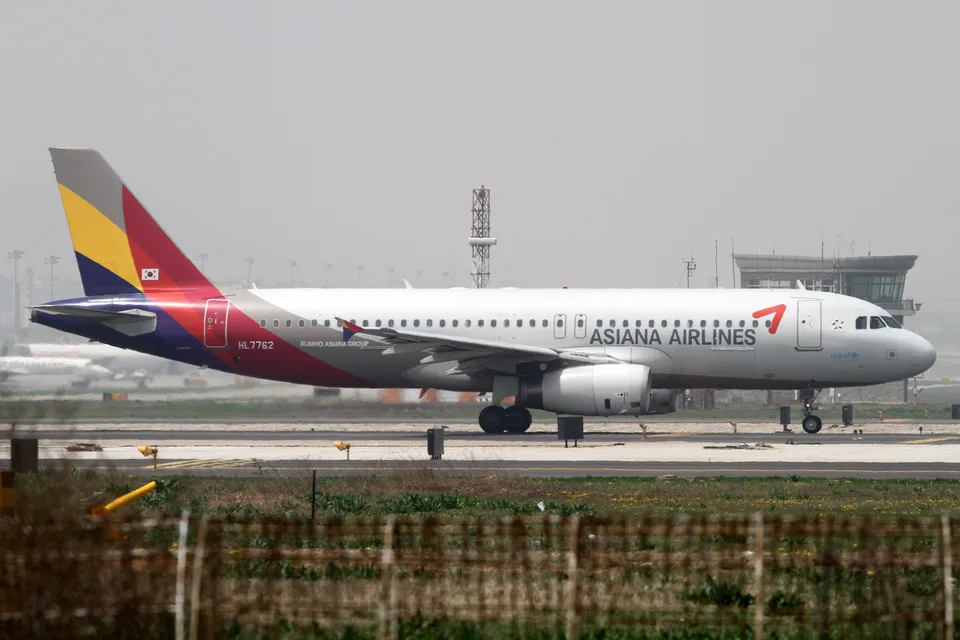
Fog obscured Hiroshima runway 28 as Asiana 162 descended below its approach path. A late go-around ended in a collision with navigation aids; all 81 aboard survived.
Original photograph unchanged. Resized copies use the same CC BY-SA 2.0 licence. Responsive WebP copies resized without cropping.
Geographic context
Localizer collision site east of runway 28
Hiroshima runway 28 threshold
The collision site is the report coordinate. The threshold marker is approximate, derived from the reported 325 m separation to the west. The A320 arrived from Incheon and approached runway 28 from the east. Basemap: Natural Earth, public domain.Read supporting evidence
Asiana 162 approached Hiroshima runway 28 in a locally worsening fogbank. The captain disconnected the autopilot and flight directors, then continued below the 1,500 ft decision altitude while the required visual references could no longer be identified continuously. The aircraft descended below the intended path. A go-around began at 20:05:11, but the A320 struck approach lighting and the localizer support structure before it could climb clear. It touched down short, crossed onto the runway and veered into the southern runway strip.
Read the full incident Follow what happened, from the flight to the investigation findings.
What investigators concluded
JTSB attributed the undershoot probably to the captain continuing the approach without the required continuous visual references and the first officer failing to call for an immediate go-around at decision altitude. It identified insufficient training in compliance with rules as a probable background factor and ineffective crew resource management as a probable factor in the first officer failing to assert the need for a go-around.
1,618 words / about 8 minutes to read. Based on the investigation records cited below.
A change of runway at Hiroshima
Asiana Airlines Flight 162 left Incheon International Airport at 18:34 on 14 April 2015 for Hiroshima. The Airbus A320-200, registration HL7762, carried 73 passengers, seven crew members and a boarding mechanic. The captain occupied the left seat and flew the aircraft; the first officer monitored from the right. The flight plan named Fukuoka as the alternate airport. The aircraft had a valid airworthiness certificate and had received the prescribed maintenance and inspections. Both pilots held valid qualifications and medical certificates.
The captain initially expected an instrument landing system approach to runway 10. During the cruise he discussed Hiroshima's high elevation and the runway slope with the first officer. At about 19:37 the crew received airport information showing an RNAV approach to runway 28 in progress, and they prepared for that runway. Hiroshima stood in mountainous terrain with sharply uneven ground beneath its final approaches. Runway 10 had a Category III instrument landing system; runway 28 had VOR and RNAV approaches. Its threshold stood 1,067 ft above sea level. The crew selected full flaps, lowered the landing gear, completed the landing checklist and set 4,100 ft as the go-around altitude before reaching the final approach fix.
The A320 passed the final approach fix at about 3,000 ft at 20:02:33. The pilots saw the runway soon afterwards. The aircraft followed the lateral RNAV course closely throughout the remaining approach. After 20:03, visibility at the runway 28 touchdown measuring point began deteriorating rapidly. The middle and far end of the runway continued to register visual ranges above 1,800 m. The crew remarked that the runway looked unusual as fog affected its eastern end.
Hiroshima Tower reported touchdown runway visual range of 1,700 m at 20:03:29, together with a light southeasterly wind. The cockpit recording contained a sound consistent with a brief radio transmission button press after the message. The pilots did not confirm the value between themselves or compare it with the RNAV approach minima. At 20:03:55 the captain selected track and flight path angle indications and disconnected the autopilot at about 2,100 ft, roughly 1,000 ft above the threshold. The flight directors were switched off shortly afterwards, while autothrust remained engaged. JTSB found it highly probable that the captain had changed to manual visual flying at that point.
At 20:04:02 the first officer made the standard call for 1,000 ft above the threshold, and the captain responded that the approach was stabilized. At that stage the aircraft had been following approximately the intended three degree descent path. At 20:04:14, around 700 ft above the threshold, the first officer commented on the obscuring cloud. Thereafter the aircraft gradually moved below the standard path and continued with a relatively high descent rate. At about 100 ft above decision altitude, the reconstructed flight path would have placed the aircraft where the visual approach slope indicator showed one white and three red lights, if those lights had been visible.
The first officer reported the runway becoming invisible at 20:04:39. At 20:04:42 the aircraft passed the 1,500 ft decision altitude, equivalent to 433 ft above the threshold. The automatic minimum call and the first officer's call were followed by the captain's decision to continue. The first officer immediately reported that he could not see the runway. The captain asked him to wait. JTSB considered it possible that the captain could see parts of the lights or runway intermittently. It found that the required visual references were insufficient for him to identify the aircraft's position continuously. The descent continued and the low path remained uncorrected.
Around 20:04:50 the A320 was about 300 ft above the threshold and had descended into the area where the approach slope lights would have shown four reds. The captain again asked the first officer to wait, then directed him to watch radio altitude. The first officer began reading the height indications. Company rules prohibited using radio altitude for a non-precision approach because it measured height over the changing terrain. The terrain in front of runway 28 included a steep cliff, so the indication could change rapidly while giving a misleading impression of height above the runway.
JTSB found it probable that the captain was primarily looking at instruments below decision altitude. He told investigators that he had divided his attention between the visual slope indicator and the instruments, with most attention on instruments. The flight path vector symbol, called the Bird in the report, showed the aircraft's current direction of motion. Its indicated descent angle could be maintained even while the aircraft remained below the correct approach trajectory. JTSB considered it possible that the captain was using this indication to aim for a three degree descent. The aircraft continued on a slightly steeper path. After 20:05:07, automatic radio altitude calls for 400, 300 and 200 ft followed in rapid succession as it crossed the cliff. At 20:05:11 the captain announced a go-around, advanced the thrust levers and pulled fully back on the sidestick.
At 20:05:14 the left main wheels struck an approach light about 360 m east of the runway 28 threshold. The aircraft then hit the localizer frame 325 m before the threshold. This steel structure supported antennas used for the instrument landing system. The A320 was travelling at 137 kt with its nose about 11 degrees above the horizon. Its descent rate had fallen to approximately 30 to 50 ft per minute, but it had reached the structure before climbing clear. Both engines, both main landing gears, the flaps, the lower fuselage and the horizontal stabilizers struck it.
Steel fragments entered both engines and the aircraft lost thrust. Steel framework wrapped around the main landing gears, severing brake hoses, electrical lines and sensor connections. The wheel brakes became inoperative; the ground spoilers and autobrake also failed to work properly. The left landing gear downlock stay broke, leaving the gear vulnerable to folding partly during the ground movement. Damage to electrical systems disabled the cabin passenger address and interphone systems. After the collision the aircraft continued through more approach lighting and touched down on the grass roughly 155 m short of the threshold, tail first, followed by the main wheels. The flight recorder registered a vertical acceleration of at least 2 g at touchdown.
The aircraft crossed the paved area before the threshold and entered runway 28 close to the centreline, carrying steel debris wound around its landing gear. The damaged left gear became partly folded. After the aircraft had travelled about 725 m beyond the threshold, the left engine cowling began scraping the runway. The resulting resistance helped turn it to the left. At about 1,160 m beyond the threshold the A320 left the runway to the south and crossed wet, muddy grass. It stopped facing southeast, about 1,480 m beyond the threshold and 140 m south of the runway centreline, close to the airport boundary fence.
Inside the cabin, flight attendants shouted instructions as overhead bins opened, baggage fell and oxygen masks dropped. After the stop, the purser went to the cockpit and was told to wait while the pilots performed the emergency evacuation checklist. She heard urgent calls from the rear and saw what appeared to be smoke. The interphone was unusable. She decided to begin an evacuation and opened the forward left door. Other attendants operated their doors and exits and directed passengers out. JTSB found their actions adequate and prompt: all 73 passengers escaped despite the failed cabin communications and the absence of an evacuation order from the captain.
The pilots continued working through the checklist after the cabin evacuation had begun. By the time the captain left the cockpit, the passengers and flight attendants had already escaped. JTSB found that the checklist took too long and that the captain consequently could not direct and support the passenger evacuation. Emergency lights and the deployed evacuation slides worked properly. All 81 people aboard survived. Twenty-six passengers and two flight attendants suffered minor injuries. The aircraft was substantially damaged, and no fire broke out.
Evacuated passengers began walking towards the terminal instead of assembling together. JTSB considered it possible that poor coordination between the crew and airport rescue personnel prevented effective guidance. The airport command desk passed on accident information but did not request emergency vehicle dispatch or establish the rescue and firefighting support organization required by the airport plan. Triage, ambulance arrangements, first aid and transport to medical facilities were substantially delayed. The investigation called for prompt requests to the relevant organizations and clearer coordination of the initial response. The runway remained closed until 07:30 on 17 April.
JTSB concluded that the captain's continued descent without the required visual references and the first officer's failure to call for a go-around at decision altitude probably caused the undershoot. It identified insufficient company education and training in compliance with rules as a probable background factor. Crew resource management probably failed to support the first officer in asserting the need for a go-around. The report also identified misunderstandings about RNAV minima and the requirement to retain flight director guidance, or combined autopilot and flight director guidance, down to decision altitude.
The report records special simulator training introduced by Asiana, additional emphasis on monitoring duties and prompt go-around responses, revised Hiroshima airport information, standardized callouts and monthly analysis of pilot check results. Japanese aviation authorities were examining runway visual range reporting rules and improving emergency response training. Hiroshima Airport held a full-scale emergency exercise in November 2015. JTSB issued two recommendations to the Korean transport ministry to supervise Asiana in reinforcing compliance with procedures and training crews to use visual references as the primary basis for flight below decision altitude, supported appropriately by instruments. The Board adopted the final report on 18 November 2016 and issued it on 24 November.
After disconnecting the autopilot and flight directors, the captain continued descending as the aircraft gradually moved below the intended three degree path.
The captain continued below decision altitude despite losing the required continuous visual references. The first officer reported the runway out of sight but made no immediate go-around call.
Engine ingestion of steel debris caused loss of thrust. Severed brake hoses and damaged gear sensors disabled braking and disrupted spoiler and autobrake operation.
A simplified reading of the investigation findings. The sequence does not replace the full report or imply that every contributing factor is shown.
Sequence of events
Japan Standard Time and Korea Standard Time, UTC+9. Recorder times were aligned with air traffic control transmissions. Expand an event to see its evidence.
18:34Departure from Incheon
The scheduled passenger service left Incheon for Hiroshima with the captain flying and the first officer monitoring.
The captain disconnected the autopilot at about 2,100 ft, approximately 1,000 ft above the runway threshold. The flight directors were switched off seconds later.
The captain announced that he could not see the runway. He advanced the thrust levers to takeoff and go-around power and pulled the sidestick fully back.
The left main wheels hit an approach light, followed by collision with the localizer frame. The aircraft subsequently touched down about 155 m short of the threshold.
The aircraft veered south off the runway. Flight attendants evacuated all 73 passengers despite failure of the cabin interphone and passenger address systems.
The final approach crossed steeply rising terrain in front of runway 28. The rapid sequence of radio altitude calls reflected the cliff beneath the aircraft. Company rules prohibited using radio altitude for a non-precision approach because the underlying terrain could mislead pilots about height above the runway.
The final report records special simulator training in visual approaches, reduced visibility and non-precision approaches. Asiana also emphasized monitoring and go-around calls, standardized callouts, revised Hiroshima information and established monthly meetings to identify pilots needing additional checks.
The tower reported touchdown runway visual range of 1,700 m, then gave no further update as it deteriorated. JTSB considered it possible that the controller expected the crew to initiate a go-around if necessary and was considering separation from departing traffic while watching outside. It found another update desirable and called for examination of reporting procedures during rapid deterioration.
JTSB considered it possible that the captain saw parts of the visual references intermittently below decision altitude. It found that he could not continuously identify the aircraft position from the required visual references.
JTSB considered it possible that the captain used the flight path vector to adjust the descent angle below decision altitude. It found it probable that instruments were his primary reference.
Actions and recommendations are described at the dates of the cited records. A recommendation is not proof of implementation.
Asiana training and monitoring
The final report records special simulator training, emphasis on monitoring and go-around calls, standardized callouts and monthly review of pilot check results to arrange additional checks where needed.
JTSB recommended that the Korean transport ministry supervise Asiana in strengthening compliance with regulations and procedures, and in training pilots to use visual references as the primary reference below decision altitude with appropriate instrument support.
Japanese authorities were examining reporting rules for rapidly changing runway visual range and revising rescue response arrangements. Hiroshima Airport conducted a full-scale emergency exercise on 25 November 2015.
These labels organise the evidence. They are not a ranking of causes. A shared label means a shared research topic, not an identical mechanism.
CauseApproach path monitoring
The aircraft descended below its intended path while the captain continued below decision altitude without continuously identifiable visual references.
The first officer reported that the runway was out of sight but did not assert an immediate go-around. JTSB found that crew resource management probably did not function appropriately.
A transient fogbank reduced touchdown runway visual range to 350 m around the accident while the other two runway measuring points remained above 1,800 m.
The crew switched off flight guidance before decision altitude and used radio altitude over uneven terrain. JTSB identified insufficient company training in rule compliance as a probable background factor.
Flight attendants successfully evacuated the passengers. JTSB found that the flight crew took too long over the evacuation checklist and that coordination with airport responders was inadequate.
These comparisons connect specific research topics. Shared circumstances do not establish identical causes. Evidence from both investigations is provided below.
Air Canada 624 and Asiana 162 both descended below their intended approach paths and collided with structures before the runway. In Halifax, the TSB found that the crew did not monitor altitude and distance or adjust the selected flight path angle, and likely delayed disconnecting the autopilot beyond minimum descent altitude. At Hiroshima, the captain disconnected the autopilot and flight directors before decision altitude, then continued manually as fog obscured the required visual references. Both investigations identified failures to recognize and correct a developing vertical path deviation.
Explore the records below for additional context. They open on the publisher's site and are not all included in our report search. Source reuse terms apply.
English translation of the Japanese final investigation report, including recorder records, approach diagrams, findings and recommendations.
Sources and transparency
JTSB adopted its final investigation report on 18 November 2016 and issued it on 24 November 2016.
Source limitations
JTSB considered it possible that the captain saw parts of the visual references intermittently below decision altitude. It found that he could not continuously identify the aircraft position from the required visual references.
Asiana Airlines HL7762, Hiroshima undershoot and collision
Japan Transport Safety Board Final report AA2016-9, adopted 18 November 2016, issued 24 November 2016
Japan Transport Safety Board report. Brief attributed extracts support original commentary; the report and its illustrations remain with the issuing authority. Source terms.
Kevin Murphy writes the incident accounts on AirlineIncidents.com, out of a long interest in aviation safety and the lessons each investigation leaves behind.
Prepared by
AirlineIncidents editorial desk
Report citation check
Independent expert review
Not completed
Citation checks compare supporting text with the indexed report pages. They do not constitute independent expert review. How these pages are prepared.
Revision history
: Published sourced incident account, timeline, photographs and investigation findings.