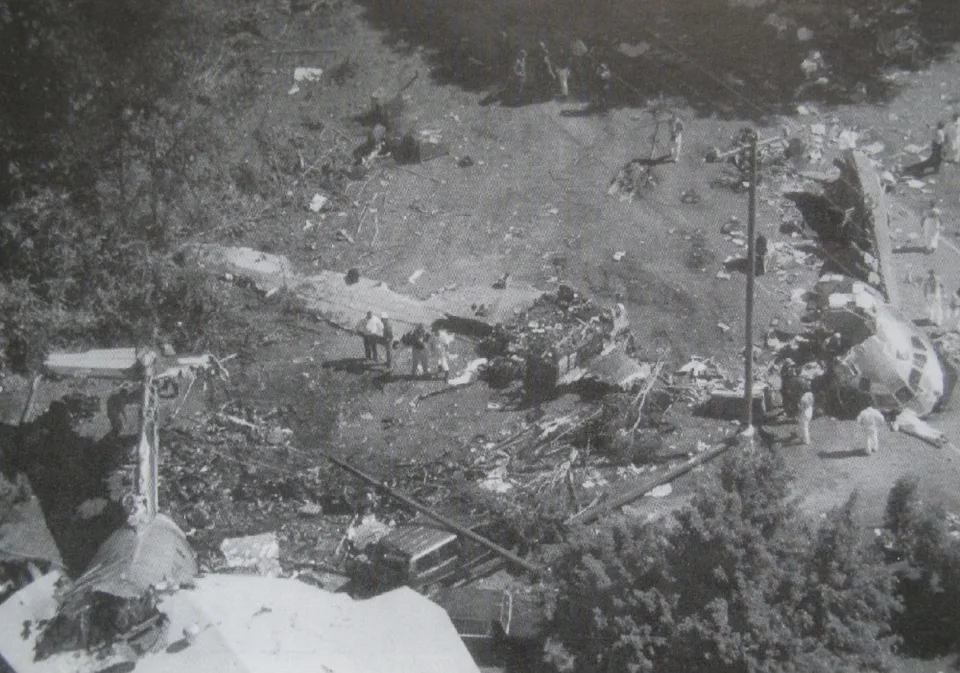
Original downloaded photograph. Responsive WebP copies resized without cropping.
Geographic context
Charlotte/Douglas International Airport, destination
Accident vicinity, report coordinate
Approximate airport and accident markers. The accident coordinate is given to the nearest minute in the report. Basemap: Natural Earth, public domain.Read supporting evidence
Flight 1016 entered severe convective weather while approaching runway 18R at Charlotte. The crew began a missed approach, encountered microburst windshear and lowered the nose as airspeed fell. The airplane struck trees and a house. The NTSB found failures in approach decisions, escape technique and the dissemination of weather information.
Read the full incident Follow what happened, from the flight to the investigation findings.
What investigators concluded
The NTSB attributed the accident to the continued approach into severe convective activity, delayed windshear recognition, inadequate escape attitude and thrust, and missing timely weather information from air traffic control. Controller procedures, supervision, operating discipline and warning system software contributed.
1,613 words / about 8 minutes to read. Based on the investigation records cited below.
A short flight back to Charlotte
USAir Flight 1016 left Columbia, South Carolina, on 2 July 1994 for Charlotte, North Carolina. The Douglas DC-9-31, N954VJ, carried 52 passengers and 5 crewmembers. The first officer was flying the airplane. This was the fourth leg of the crew's working day, which had already taken them through Charlotte before the stop in Columbia. The return flight was a scheduled passenger service under Part 121.
The crew spent about 40 minutes in Columbia and left the gate at 18:10. Dispatch information described Charlotte conditions as similar to those encountered about an hour earlier, with scattered thunderstorms in the area. Flight 1016 became airborne at 18:23 for a planned 35 minute flight. On contacting Charlotte approach control, the captain reported that the crew had received the current airport information broadcast, identified as Yankee.
As the airplane approached Charlotte, the crew saw two storm cells on their weather radar, one south of the airport and another east of it. The southern cell had a red center and yellow edges, indicating heavy and moderate precipitation. The captain requested small changes of course as the flight descended toward the airport. The controllers then vectored the airplane for runway 18R.
The approach began with the prospect of a visual landing backed up by the instrument landing system. Weather was changing while controllers positioned the airplane. The final approach controller saw a storm cell appear near the airport on the surveillance radar. He told the crew there was some rain south of the field and changed the plan to an instrument approach. At 18:38:24, he cleared Flight 1016 for the ILS approach to runway 18R.
The captain and first officer could initially see the airport. The captain discussed turning right if they had to abandon the approach and mentioned the chance of windshear. Another USAir crew, waiting to depart, reported a storm over the field and delayed departure. When Flight 1016 contacted the tower, the controller passed a smooth ride report from an earlier arrival. At the captain's request, he also obtained and relayed a smooth ride report from the airplane immediately ahead.
The weather information reaching the crew lagged behind the deterioration. A new airport information broadcast was being prepared after a special observation, but it was first transmitted at 18:43. Flight 1016 never received it. An observation at 18:40 recorded visibility of one mile in thunderstorms and heavy rainshowers. At 18:41:05, the tower transmitted a windshear alert associated with the northeast boundary sensor. The airplane continued toward the rain.
Investigators reconstructed additional weather information available inside air traffic control. At 18:40:27, the low level windshear alert system's centerfield sensor indicated an alert while Flight 1016 was about 4.5 miles from the runway. Controllers transmitted wind information as gusts. The NTSB determined that the sensor data represented windshear. Alerts also appeared at the northeast and southeast sensors, but the full pattern of alerts was never passed to the crew.
The local controller had been told that a departing crew had a storm directly overhead. He did not relay that information to Flight 1016. The NTSB found that the supervisor failed to ensure that controllers knew visibility had fallen to one mile. The tower display for runway visual range was not activated, so the crew also missed a reported value of 2,400 feet. Investigators identified inadequate procedures and a breakdown in communications within the tower.
The NTSB found that these omissions deprived the pilots of information about the storm over the airport and approach path. It also found that the pilots had sufficient cues from their own radar, observations and airspeed changes to abandon the approach earlier. The smooth ride reports and continued visual contact with the runway may have influenced their assessment of the threat.
Heavy rain reached the airplane during the final approach. The first officer remarked on an airspeed increase, and the captain noted a gain of 20 knots. At 18:42:14, the captain ordered a go-around with a turn to the right. The airplane was about 200 feet above the ground at 147 knots indicated airspeed. The first officer increased power, raised the nose and began the right turn. He then called for the flaps to be moved to 15 degrees.
The airplane initially climbed. Both engines stabilized at approximately 1.82 engine pressure ratio, below the calculated go-around target of 1.93. The pitch attitude reached 15 degrees nose up. At 18:42:22, the captain commanded the first officer to lower the nose. The flight data recorded a corresponding change in control column position. The airplane briefly reached about 350 feet above the ground as its airspeed fell below 120 knots.
The ground proximity warning sounded at about 18:42:28. The crew increased thrust and applied aft control column input, but the airplane had developed a steep descent. At 18:42:31, its pitch attitude was 5 degrees nose down and its descent rate exceeded 2,000 feet per minute. The stall warning sounded shortly before the first recorded ground impact at 18:42:35.6. Flight 1016 struck trees and a house near the airport.
Impact and the subsequent fire destroyed the airplane. Investigators identified four major wreckage sections, with sharply different damage and survival conditions. The cockpit and forward crew seats remained in a section on Wallace Neel Road. A section of the forward passenger cabin struck large trees and was destroyed. Other cabin sections suffered both impact damage and fire. The aft section came to rest in the carport of the house.
Passengers and flight attendants escaped through breaks in the fuselage. Some passengers remained trapped until rescuers freed them. One flight attendant tried to open the tailcone exit, but cabin deformation prevented it from opening fully. After seeing smoke in the tailcone, she led passengers through breaks on the left side. Another flight attendant helped an injured colleague away from the forward wreckage and then assisted passengers at the tail.
Thirty-seven passengers died. Sixteen occupants sustained serious injuries and four sustained minor injuries. All five crewmembers survived, along with fifteen passengers. The report also found that the passenger manifest listed only 50 names and omitted two infants carried on adults' laps. It recommended improved passenger accounting and renewed action on child restraints.
The wind reconstruction showed how quickly the environment changed. During the final seconds, the airplane passed from a headwind of about 35 knots to a tailwind of about 26 knots in 15 seconds. Downward air movement intensified at the same time. The thunderstorm had generated a microburst near the approach end of runway 18R. The NTSB calculated a 61 knot horizontal wind change along the airplane's path.
Performance simulations examined whether the DC-9 could have escaped. Using the modeled wind field, investigators found that maintaining the proper nose-up attitude, setting the target go-around thrust and retracting the landing gear on schedule could have produced a successful missed approach. They also found that an immediate windshear escape maneuver with maximum effective pitch and maximum thrust could have overcome the encounter. Lowering the nose was the most significant factor preventing escape in the simulations.
The captain did not recall ordering the nose down, and investigators could not determine his reason with certainty. The NTSB considered a somatogravic illusion a possible explanation. The abrupt loss of outside visual references, acceleration, pitch change and turn could have created a misleading sensation of excessive climb. The first officer followed the command without challenging it, and the captain failed to monitor the resulting airplane performance.
The installed windshear detection system gave no audible warning during the accident sequence. The NTSB could not determine why it failed to activate. Testing also identified a software feature that reduced sensitivity during flap movement to suppress nuisance warnings. The flaps were retracting during the encounter. Investigators calculated that, with that feature, a warning should have occurred only three to four seconds before impact; removing the desensitization would have allowed approximately eight to nine seconds.
The NTSB found that USAir's windshear training met industry standards and that both pilots had received it. The pilots nevertheless failed to apply the training adequately. Simulator exercises repeatedly used turbulence or airspeed fluctuations as advance cues. Entry into the Charlotte microburst had been smooth. Investigators concluded that this difference could have contributed to the crew's failure to recognize the encounter promptly.
The investigation also found weaknesses in procedural discipline. The crew had abbreviated the approach briefing, omitted required altitude callouts and engaged in nonessential conversation during a phase requiring attention to flying. USAir management and the FAA inspector knew that adherence to operating procedures was inconsistent across the airline. Corrective efforts had failed to resolve the problem. The report linked these organizational deficiencies to the crew's performance.
The NTSB adopted its final report on 4 April 1995. Its probable causes included continuing the approach into severe convective activity, delayed recognition of windshear, failure to maintain the attitude and thrust needed to escape, and the failure of air traffic control to pass timely adverse weather and windshear information. Contributing factors included controller procedures, tower supervision, ineffective corrective action on operating discipline and inadequate windshear warning software logic.
Recommendations called for prompt updates to airport weather broadcasts and for controllers to pass the highest precipitation levels shown on radar. The NTSB also asked for improved simulator scenarios, including windshear with a smooth entry, and stronger standardization among USAir check airmen. Separate recommendations addressed warning system certification and testing while flaps were moving.
The report recorded the FAA's plans to review the warning systems, revise certification guidance and require changes to the Honeywell installation. On 27 March 1995, the NTSB classified the warning system recommendations as open with an acceptable response. Further recommendations sought accurate manifests for every occupant and suitable restraints for infants and small children.
A simplified reading of the investigation findings. The sequence does not replace the full report or imply that every contributing factor is shown.
Sequence of events
Times are eastern daylight time, using the report's synchronized flight recorder and air traffic control sequence. Expand an event to see its evidence.
What windshear information failed to reach the pilots?
The centerfield sensor alerted at 18:40:27. Controllers treated its indication as gust information, and the full pattern of sensor alerts was not relayed to Flight 1016.
The NTSB simulations showed a successful escape with the proper pitch attitude and thrust. The report identified the nose reduction as the largest obstacle to recovery in those simulations.
The warning software reduced sensitivity during flap movement to suppress nuisance alerts. Investigators calculated that this feature shortened the available warning time by about five seconds.
The recorded-data wind estimates applied to the actual flightpath. Investigators used an atmospheric model to evaluate alternative flightpaths through the storm.
The successful simulated missed approach assumed timely gear retraction, target thrust and a sustained nose-up attitude. Investigators also evaluated an immediate windshear escape maneuver.
Actions and recommendations are described at the dates of the cited records. A recommendation is not proof of implementation.
Weather reports and controller coordination
The NTSB recommended prompt weather broadcast updates, direct advisories to pilots and mandatory display and transmission of radar precipitation levels.
Recommendations sought simulator scenarios with smooth windshear entry, improved recognition and escape decisions, and standardized checking of USAir operating procedures.
The NTSB called for prompt warnings during flap movement and certification testing with flaps in transition. On 27 March 1995, the recommendations remained open with an acceptable FAA response.
These comparisons connect specific research topics. Shared circumstances do not establish identical causes. Evidence from both investigations is provided below.
Both investigations found that crews continued approaches as severe thunderstorms affected the airport. USAir 1016 encountered a microburst during a missed approach and lost its escape margin. American Airlines 1420 landed at Little Rock and overran the runway; the NTSB also identified the crew's failure to ensure spoiler extension after touchdown.
Explore the records below for additional context. They open on the publisher's site and are not all included in our report search. Source reuse terms apply.
Kevin Murphy writes the incident accounts on AirlineIncidents.com, out of a long interest in aviation safety and the lessons each investigation leaves behind.
Prepared by
AirlineIncidents editorial desk
Report citation check
Independent expert review
Not completed
Citation checks compare supporting text with the indexed report pages. They do not constitute independent expert review. How these pages are prepared.
Revision history
: Final investigation completed; NTSB report adopted 4 April 1995.