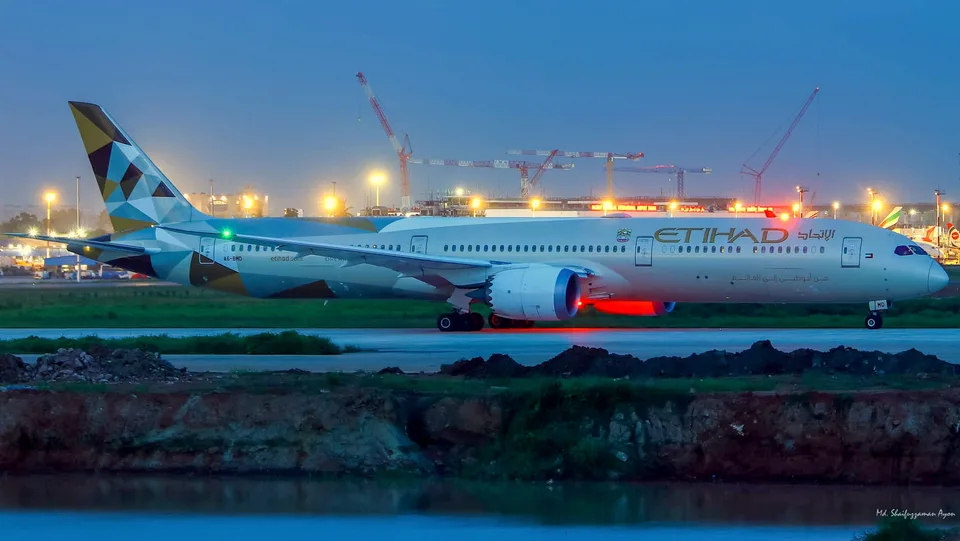
An Etihad 787 flew below the approach profile at Abu Dhabi with an incorrect altimeter setting. Four red PAPI lights prompted a go-around near 200 feet.
Original image unchanged. Responsive WebP copies resized without cropping.
Geographic context
Runway 31L approach area, Abu Dhabi
Abu Dhabi International Airport, runway 13R/31L midpoint
Approximate approach marker southeast of runway 31L. The airport marker uses the report's runway midpoint coordinates; the go-around began about 1.3 nautical miles from the threshold. Basemap: Natural Earth, public domain.Read supporting evidence
Cargo flight EY9878 approached Abu Dhabi with both pilots' altimeters set to 1009 hPa, the pressure used at Beijing. The destination ATIS had given 999 hPa. The resulting barometric approach path was about 300 feet low. The captain ordered a go-around after seeing four red PAPI lights; the lowest recorded radio altitude was 202 feet. A controller later queried the aircraft's altitude, and the crew corrected the setting before an uneventful ILS landing.
Read the full incident Follow what happened, from the flight to the investigation findings.
What investigators concluded
The AAIS determined that the incorrect local pressure setting caused the descent below the vertical profile. Contributing factors included omitted QNH preselection, fixation on descent energy management, missing QNH information from Approach Control, ineffective use of the vertical situation display, the absence of altitude-check instructions after ground warnings, and reduced forward visibility in haze.
1,597 words / about 8 minutes to read. Based on the investigation records cited below.
A cargo arrival from Beijing
Etihad Airways flight EY9878 left Beijing Capital International Airport at 0219 UTC on 6 June 2020 for Abu Dhabi. The Boeing B787-10, registered A6-BMD, carried cargo and three pilots. A copilot flew the aircraft, the captain monitored, and a second copilot occupied the jump seat. The climb and cruise passed uneventfully. The aircraft spent about two hours forty minutes at FL360 before climbing to FL380 for the later part of the flight.
Before descent, the crew prepared the arrival and briefed the approach. An Abu Dhabi ATIS message uplinked at 0902 gave a local pressure setting, or QNH, of 999 hPa and an expected RNAV Yankee approach to runway 31L. The descent procedure required the crew to preselect the destination pressure after receiving ATIS. Both operating pilots overlooked that step. The stored value remained 1009 hPa, the QNH used at Beijing. Descent from cruise began at 0937.
The aircraft followed the EMERU 2D arrival. Abu Dhabi Approach could not clear it below FL160 earlier because of the transfer agreement between Dubai and Abu Dhabi air traffic control. EY9878 leveled at FL160 at 0949:19. The crew became concerned about the height still to lose before the approach, and concentrated on managing the aircraft's energy.
At 0951:19, about three nautical miles before EMERU, Approach cleared the flight down to 7,000 feet and for the RNAV Y approach from TUGVA. The controller gave no QNH with either clearance, although the operating manual and an existing supplementary instruction required it. The controller had relied on the crew's earlier confirmation that they had received ATIS India.
At 0952:36, descending through approximately FL146, the captain changed his altimeter from standard pressure to the stored 1009 hPa. The copilot changed his setting one second later. All three pilots remained unaware that the value was wrong. The AAIS found that fixation on energy management had degraded monitoring around the change from flight levels to local altitude. The report estimated that the incorrect setting made the aircraft's true altitude about 300 feet lower than the indicated altitude.
The copilot changed from vertical navigation to flight level change mode, or FLCH, at about 13,130 feet indicated altitude. The crew deployed speedbrakes and reduced the target speed. At TUGVA, the initial approach fix, the aircraft indicated 10,920 feet against a maximum altitude of 10,000 feet. The captain and copilot continued to focus on losing height. When the controller asked whether they could lose the altitude with 23 nautical miles remaining, the crew answered that they could.
The crew returned to vertical navigation at 9,835 feet and set 470 feet, the decision altitude, much earlier than the procedure specified. They selected FLCH again near 6,570 feet. With the decision altitude selected, that mode allowed descent toward 470 feet while bypassing the altitude constraints in the flight management system. The AAIS found that the prescribed procedure for intercepting the vertical path from above required VNAV mode, which protected those constraints. The captain did not detect or challenge the combination of FLCH and the low selected altitude.
At about 2,150 feet indicated altitude, roughly 1.2 nautical miles before KUSOK, VNAV PTH became active again. This brought the aircraft onto a path calculated with the incorrect pressure setting. At KUSOK the aircraft was about 110 feet below the indicated profile; adding the pressure error placed it approximately 410 feet below the nominal profile.
Investigators compared the descent gradients achieved in the different modes. The interval in VNAV with speedbrakes deployed produced a steeper average gradient than the first interval in FLCH with speedbrakes. They concluded that changing to FLCH had been ineffective. They believed that applying full speedbrakes from EMERU while remaining in VNAV SPD would have allowed the aircraft to reach the TUGVA altitude restriction. The report also found that the arrival design met the applicable criteria in the hot atmospheric conditions of the incident flight.
The ground radar system generated a minimum safe altitude warning at 0958:27, about 8.7 nautical miles from the runway threshold. It lasted ten seconds and reflected a prediction that the high descent rate could take the aircraft below a configured minimum altitude. The Approach controller associated it with the aircraft's proximity to an area of minimum vectoring altitude and did not advise the crew to check QNH and altitude, as the procedure required.
The flight then transferred to Tower. At 1000:16, an approach path monitoring warning activated about 3.5 nautical miles from the threshold and lasted 45 seconds. The system displayed this warning as an MS label, like the earlier altitude warning. Approach did not react because the aircraft was on Tower frequency. The procedures then in force provided no instructions for Approach to notify Tower of that alert, or for Tower to advise the pilots. The Tower controller was unaware of the warning.
Cockpit checks also failed to expose the pressure error. The automatic 2,500-foot radio-altitude callout occurred when the barometric altitude indicated approximately 2,670 feet. The normal difference at Abu Dhabi with the correct QNH was less than 100 feet. For the rest of the approach, the difference ranged from about 150 to 380 feet. The AAIS found that the captain did not notice the unusual discrepancy, most probably because cockpit scanning or awareness of the difference was inadequate.
At the 1,000 feet radio-altitude callout, the barometric altitude indicated about 1,350 feet and the runway was approximately four nautical miles away. The AAIS found that the response to that callout did not effectively include the required distance-to-touchdown crosscheck. The vertical situation display offered flight path and runway cues, but the crew did not use them to assess their vertical position. Etihad's procedures lacked detailed guidance for that display crosscheck.
The aircraft was fully configured for landing as it passed KUSOK. The crew reduced speed and retracted the speedbrakes. With VNAV PTH active and the speed settling, they perceived that they had recovered the correct profile. At 1000:04 the aircraft crossed KATIG, the final approach fix, at 1,300 feet indicated altitude and about 950 feet radio altitude. Its indicated altitude matched the chart, while the incorrect pressure setting put the aircraft about 300 feet below the nominal vertical path.
Haze obscured the colours of the PAPI lights after KATIG. The reported weather indicated visibility of at least ten kilometres, but the AAIS found that forward visibility at higher altitudes was lower in both approaches. As the lights became distinct, the captain saw four reds and ordered a go-around. The copilot pressed the TO/GA switches at 1001:06, approximately 1.3 nautical miles from the threshold, at about 210 feet radio altitude. The lowest recorded radio altitude was 202 feet, when the aircraft began to climb.
The crew retracted the landing gear before moving the flaps from 25 to 20. This differed from the prescribed go-around sequence. The AAIS found no consequent risk during the remaining go-around. A later ground inspection found the PAPI system functioning correctly. The flight crew learned during investigation interviews that the go-around had begun only about 200 feet above the ground.
During the climb, Approach supplied QNH 998 hPa and asked when the crew would be ready for an ILS approach to runway 31L. The captain answered that they were ready, but did not read back the QNH. The crew left their altimeters at 1009 hPa. The aircraft leveled at an indicated 4,000 feet, while the controller's display showed approximately 3,700 feet.
The controller queried the pressure setting and altitude. At 1004:27 the crew began correcting the setting, exposing the 300-foot altitude shortfall. They climbed to the cleared 4,000 feet and leveled there at 1005:10. Approach continued with vectors for the ILS, including descent to 2,000 feet. EY9878 landed at 1017:32. During the landing roll the captain confirmed that the PAPI lights had appeared to function correctly on short final. All three pilots were uninjured, and the aircraft sustained no damage.
The AAIS determined that the incorrect QNH setting caused the aircraft to fly below the vertical profile. It identified omitted QNH preselection, fixation on energy management, omitted QNH information from Approach, ineffective use of the vertical situation display, missing instructions to the crew following ground altitude warnings, and reduced forward visibility as contributing factors. Aircraft defects, crew qualifications and fatigue were excluded as factors by the investigation.
The occurrence was reported to the AAIS about 23 hours later. The crew had not appreciated its severity, and the aircraft operated its next scheduled service. Its two-hour cockpit voice recording was overwritten. The flight data recorder held 72 hours and preserved the incident data. Investigators synchronized those data with recorded air traffic communications and used crew interviews. They could not determine why destination QNH preselection had been overlooked, or whether the required altimeter and 1,000-foot callouts had been made.
Etihad added a requirement to confirm QNH before the initial approach fix for RNP AR approaches. It issued separate Boeing and Airbus approach guides, mandatory questionnaires and training on incorrect pressure settings, monitoring, distraction and workload. The airline refined VNAV altitude-setting techniques with Boeing and incorporated the event into its October 2020 to March 2021 proficiency-check syllabus.
GAL ANS reinforced QNH issuance, reviewed controller communications and issued instructions covering MS alerts for both Approach and Tower. The final report, issued on 28 September 2021, made six recommendations. Four addressed Etihad: QNH preselection, checking the effectiveness of safety actions, detailed vertical situation display guidance and monitoring by additional pilots. One asked GAL ANS to consider incorporating its alert instructions into the operating manual. The sixth asked the GCAA to consider 25-hour cockpit voice recording for qualifying new aircraft and a programme to upgrade older aircraft.
The incorrect setting put the aircraft about 300 feet below the nominal approach path. VNAV PTH subsequently followed the profile calculated from that pressure setting.
Two ground warnings occurred. The first prompted no QNH and altitude check; the second occurred after transfer to Tower, where alert coordination procedures were absent.
A simplified reading of the investigation findings. The sequence does not replace the full report or imply that every contributing factor is shown.
Sequence of events
Times are UTC. United Arab Emirates local time was UTC plus four hours. The go-around began at 1001:06 on 6 June 2020. Expand an event to see its evidence.
0219Departure from Beijing
EY9878 took off from runway 01 at Beijing Capital with a captain and two copilots aboard.
The captain changed from standard pressure to 1009 hPa; the copilot changed his setting one second later. The correct destination value had not replaced the Beijing preset.
At KATIG the aircraft indicated 1,300 feet, with about 950 feet radio altitude. The incorrect setting placed it around 300 feet below the nominal profile.
The copilot pressed the TO/GA switches about 1.3 nautical miles from runway 31L at approximately 210 feet radio altitude. The captain had ordered a go-around after seeing four red PAPI lights.
1004:27 to 1005:10QNH corrected and altitude regained
After the controller queried the setting and altitude, the crew selected 998 hPa. The aircraft had leveled at about 3,700 feet, then climbed to the cleared 4,000 feet.
The Beijing QNH of 1009 hPa remained in the pressure altimeter preset. The crew omitted the destination QNH preselection, then selected that stored value during descent. The destination ATIS had supplied 999 hPa.
The lowest recorded radio altitude was 202 feet, when the aircraft began climbing. The go-around was initiated at about 210 feet radio altitude and 1.3 nautical miles from the runway threshold after the captain saw four red PAPI lights.
GAL ANS reviewed controller communications, reinforced QNH issuance and issued instructions for Approach and Tower to respond to MS alerts and notify each other when necessary. The AAIS recommended considering inclusion of those instructions in the operating manual.
The cockpit recording was overwritten on the next flight. Investigators could not determine why the crew omitted destination QNH preselection, or confirm the required altimeter and 1,000-foot callouts.
The AAIS could not establish the exact time of the go-around order. All three pilots reported no delay between the order and initiation, and the investigators estimated the captain saw the four red lights about 1.5 nautical miles from the threshold.
Actions and recommendations are described at the dates of the cited records. A recommendation is not proof of implementation.
Etihad procedures and training
The final report records QNH confirmation before the initial approach fix, mandatory Abu Dhabi approach guides and questionnaires, and training on pressure errors and descent management. Recommendations SR48/2021 to SR51/2021 addressed preselection, the effectiveness of these actions, vertical situation display checks and the additional pilot's monitoring role.
GAL ANS issued QNH reminders and instructions for Approach and Tower responses to MS alerts. SR52/2021 recommended considering incorporation of the two alert instructions into the air traffic services operating manual.
SR53/2021 asked the GCAA to consider 25-hour cockpit voice recording for qualifying new aircraft and a retrofit programme for older UAE aircraft above 27,000 kg maximum certificated takeoff mass.
Matching dossiers for Altimeter setting: No other dossier in this collection.
Contributing factorFlight path monitoring
The crew focused on recovering the descent profile, missed the incorrect QNH and did not use the vertical situation display cues to assess the approach.
Approach Control omitted QNH from the initial altitude and approach clearances. The crew received no instruction to check QNH and altitude following the ground warnings.
Matching dossiers for Controlled flight into terrain risk: No other dossier in this collection.
Read alongside
These comparisons connect specific research topics. Shared circumstances do not establish identical causes. Evidence from both investigations is provided below.
Both investigations identified failures to monitor vertical position during an instrument approach. At Abu Dhabi an incorrect QNH displaced the barometric path downward, and a go-around followed the captain's sighting of four red PAPI lights. At Birmingham the NTSB attributed the UPS 1354 crash to continuation of an unstabilized approach and failure to monitor altitude, leading to descent below minimum approach altitude and impact with terrain; its findings also addressed incorrect flight management computer setup. The aircraft, approach systems and failure sequences differed.
Explore the records below for additional context. They open on the publisher's site and are not all included in our report search. Source reuse terms apply.
The official investigation of UPS Flight 1354, used for the approach-monitoring comparison.
Sources and transparency
The AAIS issued Final Report AIFN/0007/2020 on 28 September 2021.
Source limitations
The incident cockpit recording was overwritten on the next flight. The AAIS reconstructed the sequence from flight data, recorded air traffic communications and crew interviews.
Descent below Vertical Profile during Approach, Etihad Airways Boeing B787-10 A6-BMD
UAE GCAA Air Accident Investigation Sector Final Report AIFN/0007/2020, issued 28 September 2021
Kevin Murphy writes the incident accounts on AirlineIncidents.com, out of a long interest in aviation safety and the lessons each investigation leaves behind.
Prepared by
AirlineIncidents editorial desk
Report citation check
Independent expert review
Not completed
Citation checks compare supporting text with the indexed report pages. They do not constitute independent expert review. How these pages are prepared.
Revision history
: The AAIS final report identifies the incorrect QNH setting as the cause and records six safety recommendations.