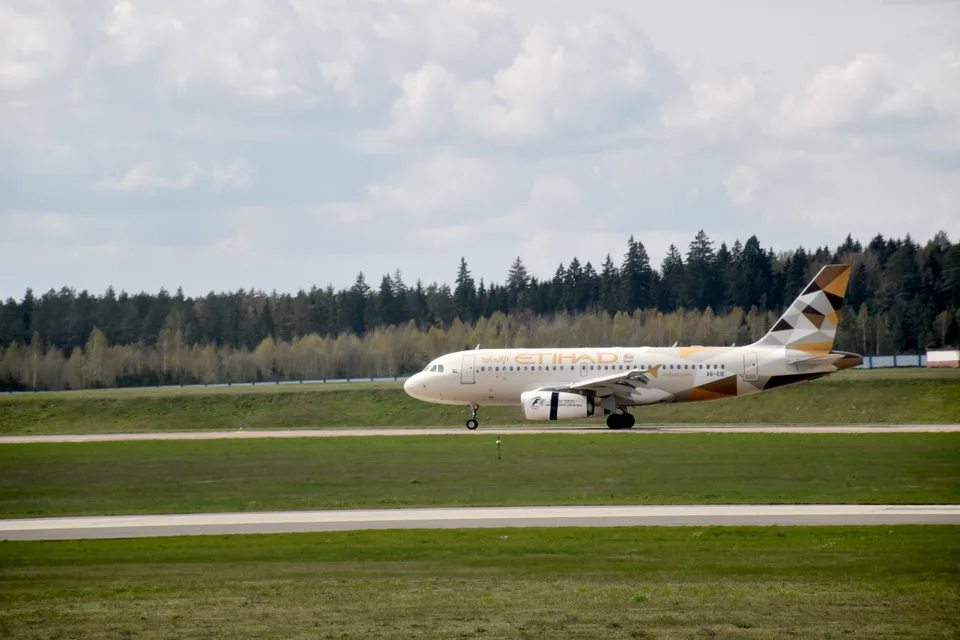
An oxygen-servicing fire injured an engineer after an Etihad A319 arrived at Abu Dhabi. The GCAA traced ignition to rapid pressurization of the filling line.
Original JPEG retained at its published dimensions. Responsive WebP copies resized without cropping.
Geographic context
Minsk International Airport, departure of ETD062
Abu Dhabi International Airport, arrival and servicing fire
ETD062 completed its flight from Minsk to Abu Dhabi. The fire occurred during oxygen servicing at Bay 402 after passengers and crew had disembarked. Markers approximate the airport locations. Basemap: Natural Earth, public domain.Read supporting evidence
After flight ETD062 arrived from Minsk, an engineer found the flight crew oxygen pressure below the daily-check dispatch requirement. During servicing, the pressure regulator transmitter failed with a bang and flash. The oxygen supply and aircraft bottle were shut off, and the aircraft was de-powered. The engineer was treated for minor skin and eye irritation.
Read the full incident Follow what happened, from the flight to the investigation findings.
What investigators concluded
The AAIS attributed the oxygen-system fire to failure of the pressure regulator transmitter through adiabatic compression. It found that opening the quick-acting toggle valve after pressurizing the servicing trolley regulator departed from the sequence in the equipment user instructions.
924 words / about 5 minutes to read. The official report for this event is short, so this account is shorter than most and covers only what the report documents.
A low oxygen indication after arrival
Etihad Airways flight ETD062 arrived at Abu Dhabi International Airport from Minsk at approximately 16:42 UTC on 18 January 2014. The Airbus A319, registered A6-EID, parked at Bay 402. The airline's line maintenance nightshift team received the aircraft. There were no incoming defects. Its scheduled work included daily and transit checks, together with maintenance actions generated by the airline's maintenance control center.
The passengers and crew disembarked before the daily check. An engineer then saw a flight crew oxygen pressure indication of 1,450 psi on the DOOR/OXY page of the electronic centralized aircraft monitoring system. The daily-check requirement set the minimum pressure for dispatch at 1,500 psi. The engineer decided to service the oxygen system before dispatch, with a technician assisting at the oxygen trolley.
During the in-place oxygen servicing, the oxygen pressure regulator transmitter exploded. A loud bang and a flash of light accompanied rapid depressurization of the aircraft oxygen bottle. The oxygen discharge caused minor facial irritation to the engineer. The technician immediately shut off the trolley supply and attended to the engineer.
A maintenance team leader at adjacent Bay 403 heard the explosion and went to A6-EID. The engineer closed the rapidly discharging crew oxygen bottle, and the aircraft was de-powered. Emergency services were called. The engineer went first to the airport medical center and then to hospital for further examination. He was later discharged with minor skin and eye irritation.
The aircraft was moved to the maintenance facility and quarantined. All oxygen components associated with the incident were removed and securely stored. The servicing trolley was also quarantined for investigation.
The oxygen cylinder, its valve body, the pressure regulating transmitter and the associated plumbing were sent to manufacturer Zodiac Aerotechnics in France. Specialist examination by WHA International indicated that the fire probably began at the transmitter filling valve. Heat initially travelled toward the cylinder valve. Oxygen flowing back from the emptying cylinder then sustained the fire at the transmitter.
A computed tomography scan showed partial melting of the cylinder valve stem and the disappearance of its outlet filter. Inside the transmitter filling valve, the O-ring, poppet, spring and screws had disappeared, together with the filter and its fixing parts. Damage was concentrated around the transmitter's CGA540 coupling. The cylinder valve stem and outlet pipe were partially melted.
The initial assessment identified an internal transmitter failure. Investigators also found that the aircraft maintenance procedures and precautions used for servicing complied with the aircraft maintenance manual. Their subsequent analysis examined the operating sequence of the ground servicing trolley.
The trolley instructions and two ignition scenarios
The Newbow Aerospace trolley carried four oxygen bottles. Its charging panel had an inlet pressure gauge, a manually loaded self-venting regulator, an outlet pressure gauge and a quick-acting toggle valve. The operating instructions called for the regulator to be fully off and the outlet gauge to read zero before connecting the hose. After opening the equipment isolation valve, the operator was to select CHARGE on the toggle valve and then turn the regulator to the required pressure.
The instructions warned that selecting CHARGE after increasing regulator pressure could cause rapid pressurization and adiabatic compression in the filling line. They also required the pressure to be increased slowly. The report explains that rapid adiabatic compression generates heat too quickly for it to escape.
Investigators considered mechanical impact ignition at the transmitter valve seat, caused by poppet chatter, and ignition through adiabatic compression. The engineer had heard no hissing during filling, and the aircraft filling gauge had shown no pressure rise. Investigators concluded that the absence of flow eliminated the poppet-chatter scenario and considered adiabatic compression the probable explanation.
In the AAIS's most probable reconstruction, the crew cylinder was open while the trolley toggle valve remained closed. After the supply hose was connected and the service bottle opened, trolley pressure was raised first to 1,500 psig and then to 1,600 psig. The aircraft filling gauge showed no increase because the toggle valve was still closed.
Opening the toggle valve then compressed the gas in the filling line rapidly from zero to 1,600 psig. The reconstructed sequence put the temperature at the transmitter filling port at about 800 degrees Celsius. Ignition at the O-ring level spread to adjacent parts and the transmitter body. Fire also travelled toward the cylinder valve and melted or burned its filter.
The AAIS identified a kindling chain involving the O-ring, thin stainless steel poppet and spring, stainless steel orifice, and aluminum transmitter body. Combustion burned through a thinner area of the body. The weakened transmitter separated from the cylinder valve, and an external fire damaged the aircraft. Closing the cylinder valve stopped its discharge. The cause finding attributed the fire to adiabatic compression after the trolley was operated outside the user instructions' sequential order.
The aircraft returned to service at 08:48 UTC on 21 January 2014. Its repairs included a new flight crew oxygen bottle, plumbing and insulation blankets, followed by satisfactory leak and functional checks. The avionics bay and surrounding structure were inspected for debris and heat damage. Burn marks on the emergency transformer rectifier unit led to its precautionary replacement. The oxygen trolley was checked, recalibrated and returned to line maintenance.
Etihad issued a quality notice introducing dedicated oxygen-servicing tool kits. New maintenance instructions made replacement of crew oxygen bottles the primary option. An oxygen-servicing and system-maintenance training program was approved, and the maintenance organization exposition was revised to include it with an approved syllabus. The GCAA completed its investigation with Summary Report AIFN/0001/2014, issued on 30 January 2017 under final-report standards. It issued no safety recommendations after the investigation.
The filling line rapidly pressurized when the toggle valve opened. The AAIS attributed ignition at the transmitter filling port to the resulting adiabatic compression.
The O-ring, steel valve components and aluminum body formed a kindling chain. The transmitter body burned through and separated from the cylinder valve.
A simplified reading of the investigation findings. The sequence does not replace the full report or imply that every contributing factor is shown.
Sequence of events
UTC, as used in the GCAA report. Arrival was at approximately 16:42 on 18 January 2014. The report gives no separate time for the fire. Expand an event to see its evidence.
18 January, approximately 16:42 UTCArrival from Minsk
Flight ETD062 arrived at Abu Dhabi. A6-EID was parked at Bay 402 and received by the nightshift maintenance team.
Emergency responseAircraft de-powered and engineer treated
Emergency services were called. The engineer was taken to the airport medical center and then hospital, and later discharged with minor skin and eye irritation.
21 January, 08:48 UTCReturn to service after repairs
Replacement of the oxygen bottle, plumbing and insulation blankets was followed by satisfactory leak and functional checks. The aircraft returned to service.
The AAIS found that opening the toggle valve after pressurizing the servicing trolley caused adiabatic compression and failure of the oxygen pressure regulator transmitter.
The operator introduced dedicated servicing tool kits, made crew oxygen bottle replacement the primary maintenance option, and approved oxygen servicing and maintenance training.
Investigators could not determine whether a fracture had already occurred at the threaded connection between the union and the pressure regulator transmitter.
These comparisons connect specific research topics. Shared circumstances do not establish identical causes. Evidence from both investigations is provided below.
Both investigations examined damage following the release of pressurized oxygen. On A6-EID, the AAIS identified a servicing fire initiated by adiabatic compression at the pressure regulator transmitter. On Qantas 30, a passenger oxygen cylinder ruptured during flight, damaged the fuselage and caused rapid depressurization. The ATSB could not physically examine the missing cylinder and limited its verifiable contributing factors to the rupture and its effects.
Explore the records below for additional context. They open on the publisher's site and are not all included in our report search. Source reuse terms apply.
Completed Summary Report AIFN/0001/2014, including component examinations, the reconstructed filling sequence and operator safety actions.
Sources and transparency
GCAA investigation completed. Summary Report AIFN/0001/2014 was issued on 30 January 2017 under final-report standards.
Source limitations
The exact position of the quick-acting toggle valve during filling was not established. The AAIS described its detailed sequence as the most probable reconstruction.
Oxygen System Fire, Etihad Airways Airbus A319 A6-EID
UAE General Civil Aviation Authority, Air Accident Investigation Sector Final investigation summary report AIFN/0001/2014, issued 30 January 2017
Kevin Murphy writes the incident accounts on AirlineIncidents.com, out of a long interest in aviation safety and the lessons each investigation leaves behind.
Prepared by
AirlineIncidents editorial desk
Report citation check
Independent expert review
Not completed
Citation checks compare supporting text with the indexed report pages. They do not constitute independent expert review. How these pages are prepared.
Revision history
: Published sourced incident account, timeline, photographs and investigation findings.