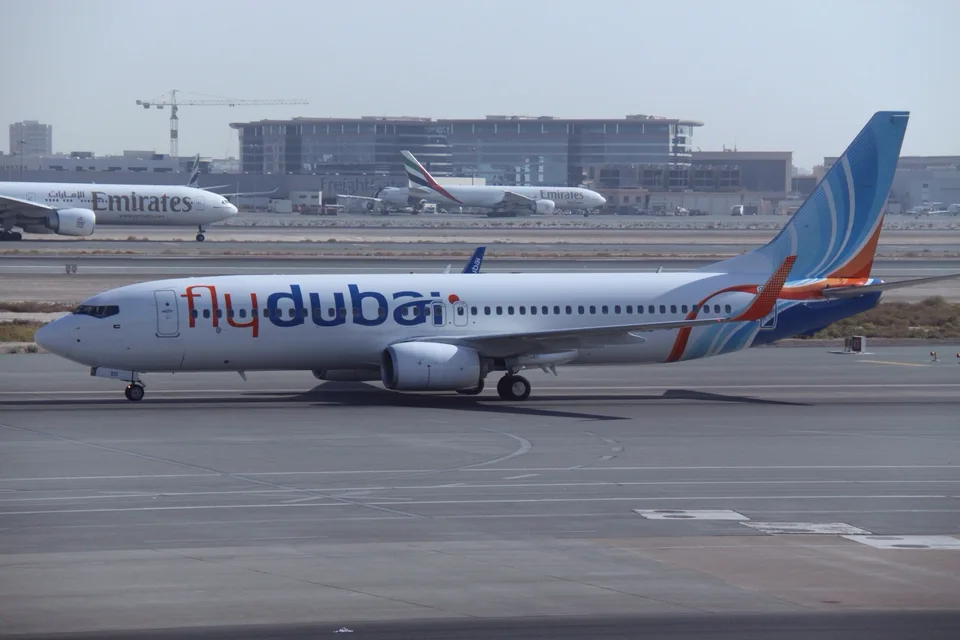
Six passenger service units containing chemical oxygen generators travelled in the cargo hold on a ferry flight from Amman to Dubai. Both pilots were uninjured.
Original photograph unchanged. Responsive WebP copies resized without cropping.
Geographic context
Queen Alia International Airport, Amman
Dubai International Airport
The aircraft returned from maintenance at Queen Alia International Airport to Dubai. Markers locate the named airports approximately. Basemap: Natural Earth, public domain.Read supporting evidence
A6-FEB returned from a C-Check and cabin seating modification carrying six removed PSU assemblies. An engineer identified their oxygen generators during inspection in Dubai. The AAIS found failures in maintenance instructions, dangerous goods identification, stores control and contractor oversight.
Read the full incident Follow what happened, from the flight to the investigation findings.
What investigators concluded
The AAIS identified missing dangerous goods labels, omitted oxygen maintenance instructions, deficiencies in the engineering order, personnel awareness failures and a parts-return contract that failed to distinguish dangerous goods.
Six oxygen generators on the return flight to Dubai
1,529 words / about 7 minutes to read. Based on the investigation records cited below.
A maintenance visit in Amman
On 6 December 2013, flydubai's Boeing 737-800 A6-FEB returned to Dubai after maintenance at JorAMCo in Amman, Jordan. It was a ferry flight with two pilots aboard. Six passenger service unit assemblies, each containing a chemical oxygen generator, travelled in its cargo hold. The aircraft arrived undamaged and neither pilot was injured. A quality assurance engineer discovered the generators while inspecting the returned parts at Dubai. The GCAA's Air Accident Investigation Sector completed its investigation with a final report dated 17 June 2015.
The maintenance visit combined a C-Check with a change to the forward cabin seating from economy to business class. Three sets of triple economy seats and their associated equipment were removed. That equipment included three passenger service units, known as PSUs, with chemical oxygen generators inside. A6-FEB was the ninth aircraft to undergo the modification during the program. Across those aircraft, twenty-seven PSU assemblies had been removed and taken to the maintenance organization's stores.
Flydubai was certificated to carry passengers, and its regulatory approval excluded the transport of dangerous goods. The report states that chemical oxygen generators were prohibited from carriage on passenger aircraft. These devices supply emergency oxygen and produce substantial heat during operation. The report gives an external canister temperature of up to 232 degrees Celsius. The incident brought together removed aircraft equipment, hazardous contents and a return-to-base shipment that passed through several departments.
The seating modification used an engineering order prepared by the supplementary type certificate holder, TIMCO. Its instructions directed the removal of the PSU assemblies and their return to the customer. The GCAA found that the order failed to give sufficient prominence to the oxygen generators and their dangerous goods implications. It omitted a direct reference to the oxygen section of the aircraft maintenance manual and did not classify the removal task as critical or require an inspection signature.
The referenced PSU maintenance instructions did lead to the oxygen instructions. The engineer who removed the units consulted the PSU instructions but did not follow that further reference. The investigation attributed this omission to familiarity with the task. The units received serviceable tags and entered the stores system without dangerous goods identification. The report found that the required treatment of the generators had been missed during removal, storage and transport.
Flydubai had technically reviewed the modification documents before sending them to JorAMCo. That review involved engineering staff and management, but it missed the weakness in the engineering order. JorAMCo checked the work pack for applicability and content while assuming that the operator had already completed the technical assessment. The GCAA identified this as another lost opportunity to discover the deficiencies in the instructions.
The removed assemblies accumulated in the general stores alongside other parts awaiting return to flydubai. Their dangerous contents were not identified by labels, and the stores had no dedicated quarantine area for dangerous goods. The maintenance organization's service engineering department and flydubai had agreed that the removed PSUs would be returned by road when the modification program ended. That arrangement was undocumented and had not been properly communicated to stores personnel.
The written maintenance contract gave a different general instruction. Components removed and left out of the aircraft were to return to flydubai aboard its ferry or commercial flights, with provision for authorized disposal of parts beyond economic repair. The contract did not distinguish ordinary parts from dangerous goods. The GCAA found that contracts affecting air safety were neither reviewed by the operator's Safety Manager for appropriate safety content nor formally assessed for risk.
On A6-FEB's departure day, the stores employee preparing the return shipment faced limited time as newly removed parts arrived. Three PSUs from A6-FEB and three from an earlier modified aircraft were included in the shipment. The associated invoice required no signed certification that the listed items met packing, labelling and regulatory requirements. The GCAA considered that such a check could have provided a final opportunity to identify the hazardous contents before loading.
A6-FEB departed directly from the maintenance ramp. The preceding eight aircraft in the modification program had returned through the passenger terminal as scheduled commercial flights. Flydubai had no documented procedure for dispatching an aircraft directly from the maintenance ramp after maintenance, and no documented process controlling parts being returned to base. The flight crew did not know dangerous goods had been loaded.
The operator assigned a Base Maintenance Liaison Engineer to oversee the maintenance visit and modifications. His job description did not extend to supervision of the loading of returned parts. He had received no dangerous goods training from flydubai, although he had received such training in previous employment. He did not observe the loading of A6-FEB and did not see its loadsheet. The report found that the operator had neither a procedure nor delegated responsibility giving its representative sufficient control over the return of aircraft parts.
After arrival in Dubai, the shipment reached the operator's pending receiving area. A quality assurance engineer opened the boxes, recognized the generators within the PSU assemblies and identified their dangerous goods status. He reported the incident internally and to the GCAA. The pilots had been unaware of anything untoward during the flight. The investigation recorded no aircraft damage, no other property or environmental damage and no injuries to the two occupants.
Flydubai's initial assessment and supplier audit had accepted JorAMCo as a maintenance provider. Neither included the stores within its scope. The operator therefore had not examined the storage and labelling of dangerous goods or the dangerous goods training of stores staff before approving the organization. The audit checklists also omitted requirements in flydubai's Safety Manual concerning the safety management systems of contracted maintenance providers.
Flydubai operated a safety management system accepted by the GCAA. JorAMCo had a quality system approved by the Jordanian regulator but lacked an accepted safety management system. The GCAA found that the maintenance organization consequently lacked a formal process to identify, evaluate and reduce risks arising from its maintenance and modification work. Its existing reporting arrangements did not clearly distinguish quality deficiencies, occupational safety matters and air safety events.
The investigation concluded that a functioning safety management system would likely have exposed the systemic weaknesses in dangerous goods control. It also found failures in the operator's compliance with its own contractor safety policy and in regulatory oversight. The GCAA had not discovered that flydubai's requirement for its maintenance contractor to have a safety management system was unmet. The Jordanian regulator had not ensured implementation of its corresponding safety management requirements.
The operator's Safety Manual required contracted engineering services to meet its safety management requirements, but the manual had not been supplied to JorAMCo. The contract itself imposed no requirement for a safety management system. At the maintenance organization, management and maintenance personnel had received no dedicated air safety or safety management training. The GCAA found that neither the contractual arrangements nor the audits brought these gaps to the operator's attention.
The GCAA had required UAE maintenance organizations to operate accepted safety management systems since January 2010. It had not required UAE operators to limit overseas maintenance contracts to organizations with an accepted system. JorAMCo had been approved to maintain UAE aircraft since 2004 and was regularly audited by the GCAA. The investigation examined how that oversight had failed to expose the unmet contractor safety requirement.
The final report identified several causes of the prohibited carriage: missing dangerous goods labels; failure to consult and follow the oxygen maintenance instructions; shortcomings in TIMCO's engineering order that neither flydubai nor JorAMCo detected; insufficient awareness of the hazardous contents among the personnel involved; and the contract clause requiring parts to return by air without distinguishing dangerous goods. The findings addressed the chain from maintenance documentation to the shipment's departure.
Contributing factors included the lack of dangerous goods markings on generator casings, the maintenance organization's inability to detect deficient stores control through its quality system, and its lack of a safety management system. Flydubai had not met the contractor requirements in its own Safety Manual. The report also identified insufficient GCAA oversight of the operator's foreign maintenance arrangements. Dangerous goods training had reached flight crew, cabin crew and ground operations staff, while flydubai's policy did not provide it to maintenance personnel.
The report records that flydubai tightened its requirements for instructions and verification on complex or critical maintenance tasks. It also introduced Safety Department involvement in approval of maintenance and other contracts affecting air safety. JorAMCo provided dangerous goods training to the relevant maintenance and stores personnel, circulated safety information and added a dangerous goods overview to continuation training. It strengthened its engineering order review and introduced a shipping declaration and customer approval policy.
The AAIS issued eleven recommendations. Five to flydubai covered contractor safety management, access to safety reporting, stronger audit checklists, recurrent dangerous goods training and wider safety duties for the liaison engineer. Two to JorAMCo addressed adherence to approved instructions and dual signatures for critical work involving generators. Three to TIMCO addressed visible dangerous goods markings, classification of relevant engineering order tasks and certifying engineer verification. The GCAA was asked to consider initial and recurrent dangerous goods training requirements for maintenance, service engineering and stores personnel, including at foreign organizations maintaining UAE aircraft.
How were the oxygen generators discovered in Dubai?
A quality assurance engineer inspected the returned PSU assemblies in flydubai's pending receiving area, recognized the oxygen generators and reported their carriage to flydubai and the GCAA.
The supplier audit omitted the maintenance organization's stores. The operator had not examined dangerous goods storage, quarantine, labelling or stores staff training before approving the contractor.
SR 25/2015 through SR 29/2015 asked flydubai to improve contractor safety requirements, reporting access, audits, training and liaison engineer duties.
Critical tasks and engineering order recommendations
SR 30/2015 through SR 34/2015 addressed maintenance instruction compliance, critical task verification and clearer identification of hazardous equipment.
These labels organise the evidence. They are not a ranking of causes. A shared label means a shared research topic, not an identical mechanism.
CauseDangerous goods
Six PSU assemblies containing chemical oxygen generators travelled in the cargo hold. The report identified missing dangerous goods labels among the causes.
These comparisons connect specific research topics. Shared circumstances do not establish identical causes. Evidence from both investigations is provided below.
Both investigations found failures in the control of chemical oxygen generators removed during maintenance. The GCAA identified deficient dangerous goods identification and contractor oversight in the A6-FEB shipment, which arrived undamaged. The NTSB found that activation of chemical oxygen generators initiated the fire on ValuJet 592 and that ValuJet failed to adequately oversee its maintenance contractor.
Explore the records below for additional context. They open on the publisher's site and are not all included in our report search. Source reuse terms apply.
Kevin Murphy writes the incident accounts on AirlineIncidents.com, out of a long interest in aviation safety and the lessons each investigation leaves behind.
Prepared by
AirlineIncidents editorial desk
Report citation check
Independent expert review
Not completed
Citation checks compare supporting text with the indexed report pages. They do not constitute independent expert review. How these pages are prepared.
Revision history
: Published sourced incident account, timeline, photographs and investigation findings.