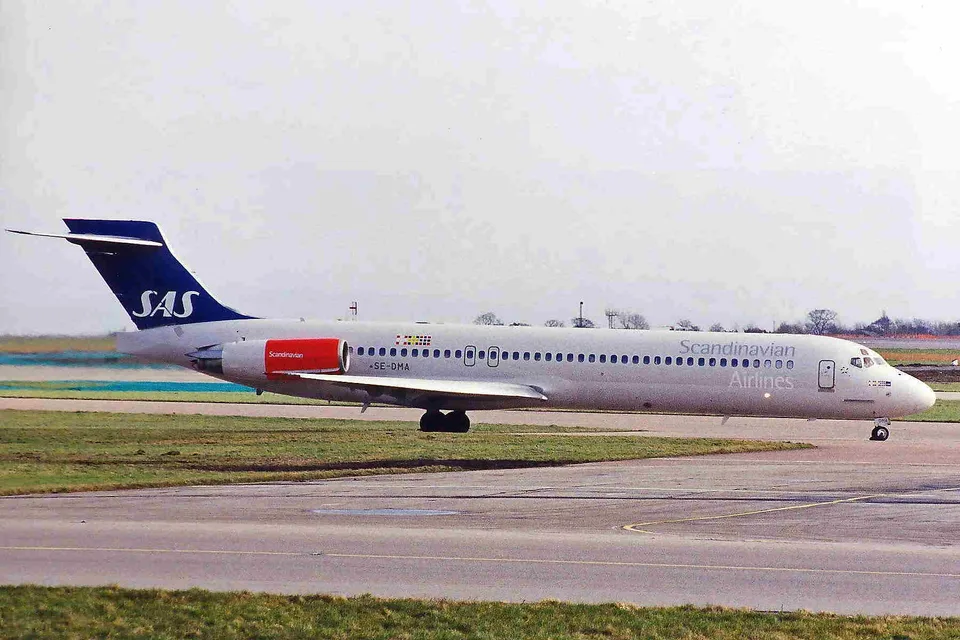
In dense fog at Milan Linate, SAS 686 struck a Cessna that had entered runway 36R. The damaged MD-87 then hit a baggage building, killing 118 people across both aircraft and the ground.
Original photograph displayed in full. Responsive WebP copies resized without cropping.
Geographic context
Milan Linate airport
Copenhagen Kastrup, intended destination
SAS 686 was scheduled from Milan Linate to Copenhagen Kastrup. The collision occurred where R6 joined runway 36R, about 1,500 metres from its threshold. The airport markers show approximate locations. Basemap: Natural Earth, public domain.Read supporting evidence
The Cessna was instructed to taxi north via R5 but followed R6 towards the active runway. Its Sierra 4 position report did not resolve the ground controller's belief that it was on R5. A further instruction to continue taxiing was followed by a runway entry as SAS 686 began its takeoff. The collision tore away the MD-87's right engine and right main landing gear. It briefly became airborne before sliding into the baggage building.
Read the full incident Follow what happened, from the flight to the investigation findings.
What investigators concluded
ANSV identified the Cessna's runway incursion as the immediate cause. The investigation also found deficient airport signs and markings, inaccurate charts, ineffective communication checks, unsuitable low visibility procedures and weak safety management. These failures combined to defeat opportunities to detect and correct the error.
1,595 words / about 8 minutes to read. Based on the investigation records cited below.
Two departures in dense fog
On 8 October 2001, Scandinavian Airlines flight 686 was preparing to leave Milan Linate for Copenhagen Kastrup. Its Boeing MD-87, registered SE-DMA, carried 104 passengers, two pilots and four cabin attendants. On the other side of the airport, Cessna 525-A D-IEVX was preparing for Paris Le Bourget with two pilots and two passengers. Fog had reduced the airport to short stretches of pavement, lights and markings visible ahead of each aircraft.
The Cessna had landed on runway 36R at 04:59:34 UTC. Its crew obtained permission to backtrack and leave the runway through taxiway R6, which led to the West apron. It later followed R6 towards the runway during its departure taxi. SAS 686 was parked on the North apron. After boarding finished, its crew requested engine start at 05:41:39 and received a takeoff slot of 06:16. The Cessna later received a 06:19 slot.
The aircraft and crews had different low visibility approvals. ANSV found the MD-87 and its crew qualified for the intended flight. The Cessna was certified for Category I approaches, and its pilots were not qualified to land in the conditions they had encountered. The report found that the applicable rules permitted them to taxi out, but their departure required visibility of at least 400 metres. Visibility remained below that limit.
Linate had two parallel runways. The main runway, 18L/36R, was 2,440 metres long; the shorter runway to its west served small general aviation aircraft. R5 connected the northern end of the West apron to the North apron across the extended runway centreline. R6 connected the southern end of the West apron directly with the main runway. A taxiway east of the runways served the North apron along the full length of the main runway. Its commonly used name, main taxiway, had no specific designation in the official documentation.
At 06:05:44, ground control instructed the Cessna to taxi north via R5 and report at the stop bar of the main runway extension. The route would take it along the West apron towards its northern end. The readback repeated Romeo 5 but left out north, the stop bar and the runway extension. The controller accepted the reply and did not request the missing elements.
The Cessna followed the painted taxi line from its stand and reached a fork. The larger turn to the left led north towards R5. The shorter turn to the right led southeast to R6. The crew took the right branch. ANSV found missing vertical signs and poor pavement markings along this part of the route. The first green centreline light on R6 was about 80 metres from the fork; the first on R5 was about 350 metres away, beyond the prevailing visibility.
The investigators considered it more probable that the crew believed they were following their clearance along R6. They had used that taxiway after landing, and its green lights could reinforce their expectation of the route. The report developed this interpretation from radio exchanges, the airport layout and the available visual cues. The Cessna carried no cockpit voice recorder or flight data recorder.
SAS 686 had already changed from ground control to the tower frequency. Its pilots could not hear the Cessna's taxi exchanges. The Cessna remained with ground control and could not hear the tower's instructions to the MD-87. Each crew therefore lacked the radio traffic that might have revealed the other aircraft's movement.
At 06:08:23, the Cessna crew reported approaching Sierra 4. S4 was a pavement marking on R6, read upside down from their direction of travel. The controller asked them to confirm their position. The reply again referred to the runway and Sierra 4. Ground control then instructed the crew to hold position, which they acknowledged at 06:08:40.
The marking was missing from the published airport information, and the controllers said they did not know it existed. The ground controller did not establish the Cessna's actual position. He continued to believe it was on R5. At 06:09:19, after checking another aircraft's position on the North apron, he told the Cessna to continue taxiing on the main apron and follow the Alpha line. Its crew read back that instruction and continued along R6.
Before reaching the runway, the Cessna passed a white STOP marking, holding position markings and an illuminated red light bar. Green centreline lights continued towards the runway. The red bars could not be switched by the ground controller, and crews were accustomed to crossing them after receiving clearance. The Cessna entered runway 36R without the required specific runway clearance.
At approximately the same time, tower cleared SAS 686 to take off. Twenty-two seconds before the collision, the reported runway visual ranges were 225 metres at the touchdown zone, 200 metres at the midpoint and 175 metres near the far end. Surface movement radar had been out of service since November 1999. Controllers had no radar picture of the Cessna progressing along the wrong taxiway.
Plans to replace the old radar dated from 1994. An objection to the proposed antenna position stalled the project in 1995. ENAC approved a revised installation in July 2000, but technical work remained suspended at the time of the accident. A notice issued three days before the collision again declared the surface radar out of service. ANSV also found that equipment intended to prevent incursions at the R6 intersection had been deactivated for several years.
The aircraft collided at 06:10:21 UTC. The MD-87 was making a normal takeoff rotation at 146 knots indicated airspeed. Its nose gear had lifted clear of the runway while its main wheels were still on the ground. The Cessna was crossing the runway near the R6 intersection, about 1,500 metres from the runway 36R threshold. The MD-87's recorded engine parameters had been normal until the collision.
The impacts broke the Cessna into three major sections and tore away the MD-87's right main landing gear and right engine. The MD-87 became airborne. Its crew advanced the throttles, but the remaining left engine suffered reduced thrust after debris ingestion. ANSV estimated that the aircraft climbed to about 35 feet and remained airborne for approximately 12 seconds before coming down on the runway.
Wreckage examination linked the severe landing gear damage to contact between the MD-87's right main wheels and the inner part of the Cessna's right wing. The landing gear strut broke above its retraction cylinder. The separated wheel assembly moved rearwards and became trapped between the MD-87's right engine and the Cessna fuselage. Collision forces then broke the engine mounts. ANSV reconstructed the engine separating from its pylon approximately one second later, after the MD-87 had become airborne.
The pilots selected reverse thrust and attempted to brake and maintain direction. The left engine's reverser deployed, but hydraulic pressure loss prevented effective manual braking. The missing right main gear left the right wingtip dragging along the ground. The aircraft slid beyond the runway end and turned sideways before striking the baggage handling building. ANSV calculated its speed at that impact as 139 knots.
The impact demolished concrete supports and brought part of the building down onto the wreckage. Fire followed. All 110 people in the MD-87 and all four in the Cessna died. Four ground staff also died, bringing the total to 118. Four other ground staff survived with injuries; the report's injury table classified one as seriously injured. ANSV found that the impact had left no prospect of rescue changing the survival outcome for the aircraft occupants.
Fog also obscured the accident from the tower. An airport office called about a series of bangs, while controllers tried to determine why SAS 686 had disappeared and was not answering. The first fire response began after a police report of a fire near the baggage building. The fire station reported receiving that call around 06:12 and sent two vehicles. Further vehicles followed as information emerged that an aircraft was involved.
The investigation found confused communication between tower, airport authorities and the fire service. Essential information about the aircraft, passengers and fuel was not passed promptly. The Cessna wreckage was located at 06:36:50, more than 26 minutes after the collision. ANSV found that the emergency plan had not been updated and followed consistently. The airport closure notice was issued at 07:53.
Earlier emergency exercises had exposed coordination problems. In August 2000, the command team assembled about 20 minutes after the exercise began, and several communication links were not activated. During the June 2001 exercise, the command post remained unmanned because the participating organizations' representatives did not attend. The review also identified a need for a mobile command post. ANSV found that shortcomings exposed by these exercises had remained uncorrected and resurfaced during the accident response.
The MD-87's flight recorder, cockpit recording, radio exchanges, wreckage and ground marks supported the reconstruction. Several recorded parameters became unreliable after the collision. Investigators therefore calculated the later speeds from usable acceleration data and distances. ANSV identified the Cessna's incursion as the immediate cause and found that airport systems had failed to catch the developing errors. Missing signs, unpublished markings, ineffective readback checks, low visibility procedures and the absence of a functioning safety management system all featured in its findings.
ANSV approved final report A/1/04 on 20 January 2004. Its recommendations addressed standard radio communication, explicit runway crossing clearances, accurate airport publications, controller training and controllable stop bars. The final report also called for functioning airport safety management systems and emergency plans that rapidly shared essential information. ENAC's response of 3 October 2002 had already acknowledged the communication recommendation and asked operators and training organizations to reinforce English usage, readbacks and runway crossing procedures.
Follow the main stages, then open the evidence beneath each step.
1
A wrong turn in fog
The Cessna followed R6 southeast after receiving an instruction to taxi north via R5. Missing signs and poor markings reduced the visual cues available to the crew.
The Cessna reported Sierra 4, a marking unknown to the controllers. Ground control continued to place the aircraft on R5 and issued a further taxi instruction.
The Cessna crossed holding markings and a red light bar, then followed green lights onto runway 36R without specific clearance. SAS 686 was accelerating for takeoff.
A simplified reading of the investigation findings. The sequence does not replace the full report or imply that every contributing factor is shown.
Sequence of events
Times are UTC. Local time at Linate was UTC plus two hours; the collision occurred at 06:10:21 UTC, or 08:10:21 local. Expand an event to see its evidence.
04:59:34Cessna arrives
D-IEVX lands on runway 36R, backtracks and leaves via R6 for the West apron.
Ground control instructs the Cessna to taxi north via R5 and report at the stop bar of the main runway extension. The readback omits north, stop bar and extension.
How long did the MD-87 remain airborne after the collision?
About 12 seconds. The MD-87 reached an estimated height of 35 feet after losing its right engine and right main landing gear. Reduced thrust from its damaged left engine could not sustain flight.
Why did Sierra 4 fail to identify the Cessna to ground control?
The S4 marking was absent from the published airport information and unknown to the controllers. The Cessna reported Sierra 4 twice, but the ground controller continued to believe it was on R5.
Why did the Cessna cross the illuminated red light bar?
The ground controller could not switch the red light bars, and pilots routinely crossed them after receiving taxi clearance. ANSV considered it more probable that the Cessna crew believed the clearance applied to the R6 path they followed. They entered the runway without the required specific clearance.
The Cessna carried no flight data recorder or cockpit voice recorder. ANSV considered it more probable that its crew believed the clearance applied to the R6 route they followed.
Damage made the MD-87's recorded airspeed unreliable after the collision. ANSV calculated later speeds from usable acceleration data and the distance travelled.
ANSV could not interview the directly involved controllers because of the parallel judicial inquiry. Its analysis used recorded communications and their declarations to the magistrate.
Actions and recommendations are described at the dates of the cited records. A recommendation is not proof of implementation.
Communication and runway crossing clearances
The July 2002 recommendations called for standard readbacks, English usage and explicit clearances naming each runway to be crossed. In October 2002, ENAC acknowledged the recommendation and asked operators and training organizations to reinforce these procedures.
ANSV recommended checks that airport visual aids and published procedures matched the physical airport. It also recommended standard taxi routes and stop bars controlled by ground controllers.
ANSV recommended recurrent controller training. The January 2004 final report called for functioning safety management systems at Italian airports and compliance with international aerodrome standards.
The final report recommended emergency plans that immediately shared aircraft type, dangerous goods, fuel and the number of people aboard. It also called for periodic exercises and communication arrangements linking the tower and fire services.
Missing signs, deficient markings and discrepancies between charts and the physical airport reduced positional awareness. The S4 marking was unknown to the controllers.
These comparisons connect specific research topics. Shared circumstances do not establish identical causes. Evidence from both investigations is provided below.
Both investigations examined a crew's mistaken understanding of airport surfaces and cues that failed to correct it. At Linate, the Cessna followed R6 and entered an active runway in fog while ground control believed it was on R5. At San Francisco in 2017, Air Canada 759 aligned with taxiway C during a night approach. The NTSB linked that misidentification to an ineffective review of the parallel runway closure information, with expectation bias and other factors contributing.
Explore the records below for additional context. They open on the publisher's site and are not all included in our report search. Source reuse terms apply.
Kevin Murphy writes the incident accounts on AirlineIncidents.com, out of a long interest in aviation safety and the lessons each investigation leaves behind.
Prepared by
AirlineIncidents editorial desk
Report citation check
Independent expert review
Not completed
Citation checks compare supporting text with the indexed report pages. They do not constitute independent expert review. How these pages are prepared.
Revision history
: ANSV final report A/1/04 approved 20 January 2004.