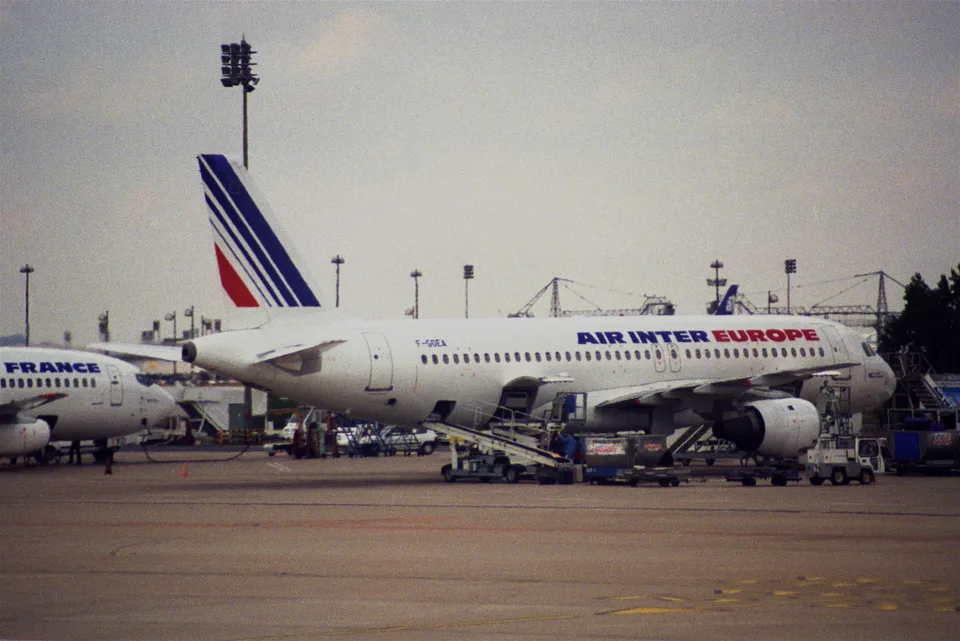
Original photograph used with its full frame. Responsive WebP copies resized without cropping.
Geographic context
La Bloss accident site
Strasbourg-Entzheim destination
The accident marker is centred within the wreckage coordinates recorded by the commission. The destination airport marker is approximate. The aircraft struck about 10.5 nautical miles from the runway 05 threshold. Basemap: Natural Earth, public domain.Read supporting evidence
Air Inter 148 struck La Bloss at 18:20:37 UTC during the VOR approach to Strasbourg runway 05. The aircraft descended at about 3,300 feet per minute while the crew concentrated on alignment and landing configuration. Eighty-seven people died and nine survived.
Read the full incident Follow what happened, from the flight to the investigation findings.
What investigators concluded
The commission identified an excessive descent left uncorrected, weak mutual monitoring, a late approach change, a peak in workload and cockpit design features that increased the possibility of mode or target entry errors. The aircraft had no ground proximity warning system.
1,625 words / about 8 minutes to read. Based on the investigation records cited below.
A short flight to Strasbourg
On 20 January 1992, Air Inter's Airbus A320-111 F-GGED departed Lyon-Satolas for Strasbourg-Entzheim with 90 passengers and six crew members. The captain was flying. The aircraft took off from runway 36 at 17:39:50 UTC and climbed to flight level 180. Autopilot 1 was engaged during the cruise. An ILS approach to Strasbourg's runway 23 had been programmed before departure.
Both pilots held the required qualifications, although their experience on the A320 was limited. The captain had 162 hours on the type and the first officer 61 hours. The aircraft held a valid certificate of airworthiness, had been maintained under the applicable regulations and remained within its weight and balance limits. It had no known fault when the flight began.
Strasbourg was using runway 05. The crew planned to fly the instrument landing system approach in the opposite direction, to runway 23, then manoeuvre visually to land on runway 05. The controller was preparing for a direct VOR approach to runway 05. The two plans remained different through the early arrival clearances.
The flight contacted Strasbourg approach at about 18:09. The controller directed it towards ANDLO and cleared it down to 5,000 feet on the local pressure setting. After the aircraft passed abeam ANDLO, the controller cleared a VOR-DME approach to runway 05. At that stage the aircraft was too high and fast to complete a direct approach.
The crew explained its intention to use the ILS to runway 23 and circle to runway 05. The controller advised that this would require a hold while three aircraft departed from runway 05. The captain then changed the plan to a VOR-DME approach. The controller offered radar vectors to shorten the full procedure and bring the aircraft back towards ANDLO. The crew accepted.
During the outbound leg, the captain briefed the new approach. Descent would begin at 11 nautical miles from STR, the Strasbourg navigation station. He correctly converted the charted descent gradient of 5.5 percent into an angle of 3.3 degrees. He also mentioned crossing heights at nine and seven nautical miles, although he did not explicitly describe them as minimum heights.
At 18:17:49, the controller instructed a left turn towards heading 090 degrees. The crew reduced speed, selected the first stage of flap and continued the turn. The controller then instructed the aircraft to establish on the 051-degree bearing to STR. The turn was too tight to place the aircraft on the final approach course at ANDLO.
The first officer pointed out the alignment problem and suggested opening the heading. The captain selected successive corrections towards 066 and 071 degrees. Final approach clearance came at 18:19:23 while the aircraft was still left of the intended course. The captain requested flap configuration 2 as the crew continued correcting the lateral position.
The commission found that these simultaneous demands produced a sudden peak in workload. The pilots were bringing the aircraft onto the approach course, preparing its landing configuration and initiating descent. Their attention became concentrated on horizontal navigation and configuration, while the vertical flight path was delegated to the automation.
At 18:19:38, about 11.2 nautical miles from STR, altitude hold disengaged and the aircraft began the transition into descent. The autothrust remained in speed mode. Investigators concluded that the active guidance reference was almost certainly heading and vertical speed, abbreviated HDG/VS. The guidance reference had remained unchanged from the turn back towards ANDLO.
Flap extension had briefly produced an upward vertical speed exceeding 500 feet per minute while descent was being commanded. Under those conditions the autopilot used increased authority to establish the selected descent. The captain requested the landing gear at 18:19:42. Ten seconds after altitude hold disengaged, the recorded vertical speed became negative.
The descent rate then increased quickly. At 18:19:56, the analogue vertical speed indication reached its lower limit of 2,000 feet per minute and turned amber, as did the numerical indication. The rate settled at approximately 3,300 feet per minute around 18:20. The published approach at nominal speed called for about 800 feet per minute.
The aircraft passed below the nominal 3.3-degree descent path at 18:20:05. It was then pitched about seven degrees nose down and accelerating. Four seconds later the captain reacted to an indicated speed of 192 knots by progressively extending the speed brakes. The engines were already at flight idle, so the autothrust could not reduce thrust further to counter the acceleration.
At 18:20:10, the first officer mentioned the required crossing height over STR. The minimum heights at nine and seven nautical miles were not called. At nine nautical miles, reached at 18:20:19, the aircraft was about 550 feet below the minimum altitude for that distance. The commission found no indication that the crew performed the altitude and distance check.
The crew continued working on alignment. The first officer described the aircraft approaching the course, and the captain selected another heading to intercept it. The commission identified a substantial failure of mutual monitoring and of checking the results of actions assigned to the automation. The instruments displayed the excessive descent, but the crew did not detect and correct the vertical deviation.
At 18:20:36, the radio altimeter called 200 feet. One second later the aircraft struck La Bloss while descending at about 190 knots. It was banked left as it intercepted the approach course, with the landing gear down and flap configuration 2 selected. The autopilot remained engaged until at least the second before impact. Investigators found no attempt to go around or take over manually.
The impact site was at an altitude of 799 metres, about 10.5 nautical miles from the runway 05 threshold and 0.8 nautical mile left of its centreline. The aircraft entered a forest on the southwestern slope. The wreckage and subsequent fire destroyed the aircraft. Five crew members and 82 passengers died. One crew member and four passengers sustained serious injuries; four other passengers had minor or no injuries.
Strasbourg approach raised the alert at 18:31. Search arrangements expanded from gathering information to a ground search across the Mont Sainte-Odile area. Helicopters encountered cloud covering the ridges, darkness and icing risk. The aircraft's emergency locator beacon had been destroyed in the impact and supplied no signal to guide the search.
Radar information became available gradually as teams reconstructed the last part of the flight. The search increasingly focused on La Bloss. A survivor reached a road and gave the wreckage location. A mobile gendarmerie group reached the aircraft at 22:35, more than four hours after the accident. The first arrivals provided aid, and all survivors had been located before 23:00.
The commission identified difficulties in coordinating the search, bringing ground resources into action and organising medical assistance. Congestion on the roads towards Mont Sainte-Odile also hindered rescue operations. Nine people ultimately survived. The findings led to recommendations addressing the search and rescue arrangements as well as the aircraft and its operation.
Fire had melted the protected flight data recorder's tape and reading mechanism, preventing recovery of its information. The cockpit voice recorder's tape survived and could be copied. Investigators also recovered the quick access recorder, an additional recorder used for maintenance and flight analysis. Its tape had been torn, stretched and burned.
Manual decoding and magneto-optical reading recovered information from damaged sections of the quick access recorder. Gaps remained during the last 25 seconds, especially the final nine. Investigators combined the recovered parameters with cockpit audio, air traffic recordings, wreckage examination and simulations to reconstruct the approach.
The simulations compared the observed aircraft response with vertical speed and flight path angle guidance. The descent rate and the changes in the autopilot's response were consistently closer to the vertical speed case. The flight controls followed the commands of an autopilot maintaining the steep descent. This evidence supported the commission's finding that HDG/VS was almost certainly active.
The commission could not determine with certainty why the excessive descent had been initiated. It considered two explanations fairly probable: confusion over the selected vertical mode, or an unintended target entry based on the number used in the approach briefing. An FCU failure affecting mode selection or transmission of the target value was assessed as very unlikely.
The flight control unit used the same selector and display window for vertical speed and flight path angle. A two-digit vertical speed display could show 33 for 3,300 feet per minute, closely resembling the 3.3-degree angle discussed in the briefing. The commission found that the control layout, separated mode and value selections, and similar displays increased the likelihood of confusion during heavy workload.
The final findings also identified weak cockpit communication, omitted calls, limited experience on the A320 and the failure to monitor the vertical path. F-GGED carried no ground proximity warning system. The commission considered that absence a lost opportunity for a final warning about the dangerous flight path.
Air Inter equipped its entire fleet with ground proximity warning systems during 1992. A French regulatory amendment dated 12 January 1993 required the equipment on turbine-powered airliners above the stated seating or weight thresholds. The commission also recommended training and operating procedures that would support an immediate and appropriate response to warnings.
Since April 1992, Air Inter had prohibited pairing two pilots classified as new to the A320. The commission called for stronger training in conventional instrument approaches and cockpit resource management. It also recommended showing the selected vertical speed or flight path angle on the primary flight display and changing the FCU target display to an unambiguous expression in normal units.
The destruction of the flight data recorder prompted further attention to recorder protection. The commission found the existing criteria for prolonged fires of moderate or low intensity inadequate. Its final report, approved unanimously on 26 November 1993, extended the safety work across cockpit design, training, warning systems, recording equipment and rescue organisation.
Radar guidance left the aircraft off the final approach course near ANDLO. The pilots corrected the lateral track while extending flap and preparing to descend.
The FCU displayed vertical speed using two digits. A value of 33 represented 3,300 feet per minute, while the flight path angle target was 3.3 degrees. The commission identified the similar formats and shared control as sources of possible confusion.
How did investigators recover the damaged recorder data?
Investigators used manual decoding and magneto-optical reading on damaged parts of the quick access recorder tape. Information remained discontinuous in the final 25 seconds, especially the last nine.
When did Air Inter install ground proximity warnings?
Air Inter equipped its entire fleet during 1992, following the ministerial decision of 24 February. The final report also records the French regulatory amendment of 12 January 1993 requiring GPWS on aircraft meeting the stated turbine, seating or weight criteria.
The commission retained mode confusion and target entry error as fairly probable explanations. It also retained an FCU failure as a very unlikely possibility.
The protected flight data recorder yielded no usable information after fire damage. The quick access recorder supplied much of the flight sequence, with gaps during the final 25 seconds.
Actions and recommendations are described at the dates of the cited records. A recommendation is not proof of implementation.
Fleet warning equipment installed in 1992
Air Inter installed GPWS throughout its fleet in 1992. The report records a French regulatory amendment dated 12 January 1993 requiring the equipment for turbine aircraft meeting the seating or weight thresholds.
Air Inter prohibited pairing two pilots considered new to the A320. The commission recommended measures to prevent pairing two pilots with little experience on the same type.
The commission recommended showing the selected VS or FPA target on the primary flight display and expressing the FCU target in unambiguous normal units.
The commission sought stronger conventional approach and cockpit resource management training. It also identified inadequate recorder protection criteria for prolonged fires.
Matching dossiers for Controlled flight into terrain: Air France 296
Contributing factorAutomation monitoring
The crew failed to detect the excessive vertical speed and omitted the approach height and distance checks while concentrating on alignment and configuration.
Matching dossiers for Automation monitoring: No other dossier in this collection.
Probable initiating mechanismMode awareness
The commission considered vertical mode confusion or an unintended target entry fairly probable. The shared FCU control and similar numerical displays increased the possibility of error.
Different approach plans remained unresolved until late in the arrival. Radar vectors then left the crew correcting alignment as it configured the aircraft and initiated descent.
Matching dossiers for Air traffic control communication: SAS 686
Read alongside
These comparisons connect specific research topics. Shared circumstances do not establish identical causes. Evidence from both investigations is provided below.
Air Canada 624 also involved an A320 descending below its planned approach profile while using automatic guidance. The TSB found that the crew did not monitor altitude and distance after selecting flight path angle. Air Inter 148 involved a much higher descent rate, almost certainly in vertical speed mode, during corrections to the final approach alignment. Both investigations identified failures to monitor the vertical flight path.
Explore the records below for additional context. They open on the publisher's site and are not all included in our report search. Source reuse terms apply.
Kevin Murphy writes the incident accounts on AirlineIncidents.com, out of a long interest in aviation safety and the lessons each investigation leaves behind.
Prepared by
AirlineIncidents editorial desk
Report citation check
Independent expert review
Not completed
Citation checks compare supporting text with the indexed report pages. They do not constitute independent expert review. How these pages are prepared.
Revision history
: Published sourced incident account, timeline, photographs and investigation findings.