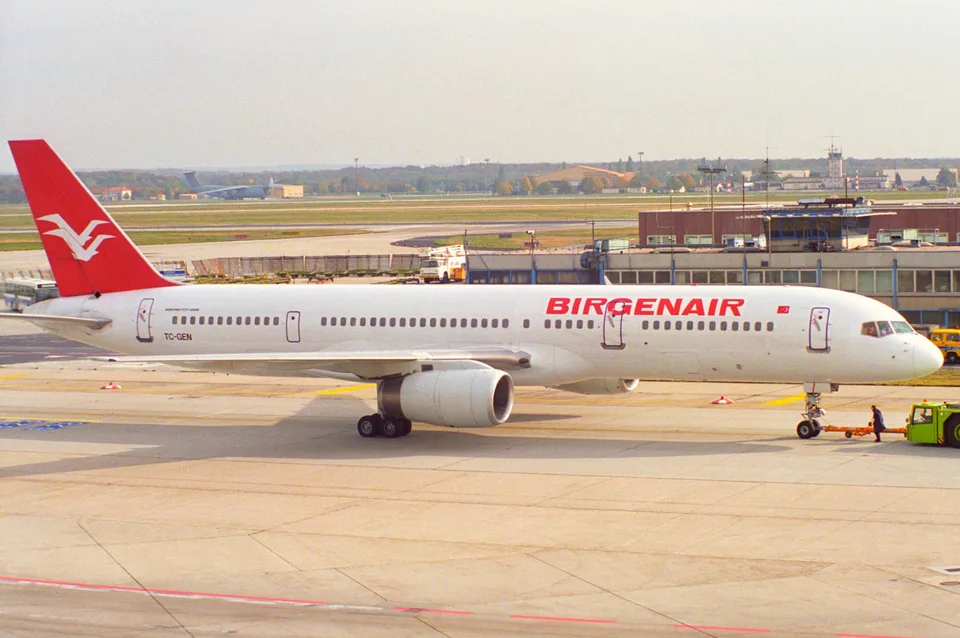
Original photograph unchanged. Derivatives retain the same licence. Responsive WebP copies resized without cropping.
Geographic context
Puerto Plata departure airport
Accident site northeast of Puerto Plata, approximate
The report places the impact 14 nautical miles northeast of Puerto Plata. The schematic marker uses that distance and direction from the report's airport coordinates; the impact position is approximate. Basemap: Natural Earth, public domain.Read supporting evidence
During takeoff from Puerto Plata, the captain reported a failed airspeed indicator and continued using the first officer's speed calls. In the climb, a blocked pitot tube caused the captain's indicated speed to rise as the aircraft slowed. An overspeed warning was followed by the stick-shaker stall warning. The crew did not carry out an effective stall recovery, and the Boeing 757 struck the Atlantic Ocean.
Read the full incident Follow what happened, from the flight to the investigation findings.
What investigators concluded
The JIAA found that the probable cause was the crew's failure to recognize the stick-shaker as a warning of an approaching aerodynamic stall and to execute the procedures needed to recover control. Erroneous rising airspeed indications and the subsequent overspeed warning caused confusion before the stall warning. Contributing factors included training, knowledge of aircraft systems and procedures, and pitot protection and return to service maintenance.
1,514 words / about 7 minutes to read. Based on the investigation records cited below.
A replacement for the planned flight
Birgenair Flight ALW-301 was a passenger charter for Alas Nacionales, bound from Puerto Plata in the Dominican Republic to Frankfurt through Gander and Berlin Schonefeld. On 6 February 1996, the aircraft assigned to carry it changed shortly before departure. A mechanical failure affected the planned Boeing 767. About two and a half hours before the flight, operations called for a replacement aircraft and crew. The Boeing 757 registered TC-GEN carried 176 passengers and 13 crew.
The replacement crew reported to the airport at about 02:15 on the report's UTC time scale. A delayed flight attendant added about an hour to the departure preparations. The investigation found the dispatch work, including weight and balance and aircraft performance calculations, appropriate and within the aircraft's limits. Three pilots were aboard, as required for the planned journey. Weather and airport services were considered suitable for the night departure over water.
TC-GEN had been on the ground in Puerto Plata for about twenty days. An engine inspection during that period required a ground run before the next departure. Investigators believed that engine and pitot covers had been absent before and after the run. The aircraft returned to service without the pitot static system verification recommended by the manufacturer after a prolonged period on the ground. The JIAA judged that this inspection might have detected the blockage and allowed it to be corrected before departure. The investigation classified the obstruction as a contributing factor in the accident.
During the takeoff roll, the first officer made the standard 80 knot call. The captain acknowledged it, then reported that his own airspeed indicator was not working. The first officer confirmed that his indication was operating. The captain asked him to provide the speed calls, and the aircraft continued accelerating. The transcript records the V1 and rotation calls, followed by a positive climb and retraction of the landing gear.
The JIAA considered the 80 knot check an opportunity to verify the engines and flight instruments. It found that the captain had underestimated the missing airspeed indication and continued contrary to established procedures. Calculations after the accident showed that stopping from 80 knots required 2,280 feet of runway. Investigators also calculated that the aircraft could have accelerated to V1 and then rejected the takeoff with runway remaining.
At 03:43:00 in the cockpit transcript, the captain said that the indication had begun operating. The crew then proceeded with climb thrust, navigation modes and flap retraction. They completed the after takeoff checklist and, at about 03:44:07, selected the center autopilot. Investigators found that the apparent return of the captain's airspeed indication reduced the significance he attached to the earlier discrepancy.
The captain's airspeed system was receiving false information from an obstructed pitot tube. Investigators compared the recorded indications with manufacturer calculations and simulator results. As the aircraft climbed, the pressure changes affecting trapped air in the system produced a rising indicated airspeed. The flight data recorder obtained its indicated airspeed from the captain's air data computer, and investigators found that those recorded values were invalid.
The aircraft had several other sources of speed information available: the first officer's airspeed indicator, the standby indicator, and ground speed displays on both pilots' electronic flight instrument screens. Ground speed was obtained from the inertial reference units. During the climb, the first officer reported an airspeed of about 200 knots and decreasing. Investigators accepted his indication as correct; displayed ground speed was then about 212 knots.
The captain's indication continued upward while the pitch attitude increased. Rudder ratio and Mach trim messages appeared, and the captain reported that something was wrong. Both operating pilots subsequently acknowledged that the alternate indicator was correct. They did not compare and use the available indications to establish a dependable reference. They also did not select the alternate air data source that could supply the captain's instruments and autopilot with the first officer's data.
At 03:45:28 the overspeed warning sounded. The captain's air data computer was indicating roughly 350 knots, while the aircraft was climbing at a nose up attitude of about 15 degrees. The crew pulled the circuit breaker for the overspeed warning, and the sound stopped. The investigation judged that reducing pitch at this stage could still have produced a complete recovery.
The recorded flight path then became more severe. In its analysis, the JIAA described the selection of vertical speed mode, disconnection of the autothrottle, reduced engine power and increased elevator deflection. At 03:45:52 the stick-shaker began. The nose up attitude reached about 18 degrees. Power was subsequently increased, but the autopilot disengaged as it reached the limit of its authority.
For almost a minute after the autopilot disengaged, the aircraft continued with a positive pitch attitude while descending and rolling from side to side. Ground speed indications fell to about 140 knots. The transcript records the first officer calling for the nose to be lowered and the relief captain referring to the attitude indicator. The crew did not carry out the stall recovery actions that the investigation found were required.
The pilots continued discussing thrust and altitude as the aircraft lost height. At 03:46:25, the first officer confirmed that the autopilot was already disconnected. Later he selected altitude hold and told the captain that he was doing so. The investigation found that altitude hold was unavailable because the autopilot was no longer engaged. The selection therefore did not arrest the descent.
In the final part of the sequence, both thrust levers were advanced, followed by a reduction of left engine power while the right engine remained at high power. The recorded pitch and bank angles varied sharply. A ground proximity warning sounded during the descent. The Boeing struck the Atlantic Ocean 14 nautical miles northeast of Puerto Plata and was destroyed. The report records 189 fatalities and no survivors.
Investigators considered the impact unsurvivable. They found no evidence of a fire in the recovered remains, and the analysis found no pre-impact evidence of fire, explosion or hostile activity. The available evidence also indicated that the aircraft structure had remained intact until it struck the water. The engines had performed within their certified characteristics.
The cockpit voice recorder and flight data recorder lay with the aircraft at a depth of about 7,200 feet. On 28 February a United States Navy team used the remotely operated vehicle CURV III to recover both units. The report says the recovery took about two hours of operation. The recorders were taken to the National Transportation Safety Board laboratories in Washington for examination.
Investigators found that the recording systems had operated normally, with a one second interruption in the flight data sequence at 03:44:16. They compared the captain's recorded indicated airspeed with the other parameters and identified the pattern associated with a blocked pitot tube. Simulator trials reproduced similar indications, including the center autopilot selection and the sequence of overspeed and stick-shaker warnings.
A reconstruction in a flight training simulator also examined recovery from a similar flight profile. Investigators judged that recovery was possible with maximum thrust and the proper stall recovery control inputs. Boeing reported that development flight testing had included an inadvertent entry into a similar condition, from which its crew recovered with normal stall recovery techniques.
The JIAA identified the failure to recognize the stick-shaker as an impending stall warning and to execute recovery procedures as the probable cause. It found that the false rising airspeed and subsequent overspeed warning had caused confusion before the stall warning. Contributing events included flight crew training, cockpit actions, procedural use and basic flying skills, together with limited understanding of the aircraft's systems and alternate air data sources.
The investigation also identified failures to protect the pitot system while the aircraft stood on the ground and to test it before return to service. It found that the crew had not used the operations manual guidance for flight with unreliable airspeed. That guidance provided pitch and thrust references for climb, cruise and landing. The crew's cockpit activity did not demonstrate use of those procedures.
Although the pilots held the required qualifications and had received training from outside providers, the JIAA found that the training had not prepared them for this event. It identified an absence of crew resource management training and a lack of continuity across the different courses. It also found shortcomings in the manual's detailed checks for combined warning messages and unreliable speed, and in the aircraft's alerting of erroneous airspeed.
The final report addressed its recommendations to ICAO. The JIAA sought revisions to Boeing 757 and 767 flight manuals explaining that simultaneous Mach speed trim and rudder ratio warnings could indicate disagreeing airspeeds. It also recommended an additional caution alert for erroneous airspeed and emergency procedures for identifying and eliminating the faulty indication.
The training recommendations covered the recognition of airspeed indicator malfunction during takeoff and simulator scenarios involving a blocked pitot tube. The JIAA called for training manuals tailored to each airline's operations, a crew resource management program for commercial operators, and revision of flight crew training requirements. Operations inspectors were to receive guidance to check that operators' manuals contained the recommended unreliable airspeed procedures.
A simplified reading of the investigation findings. The sequence does not replace the full report or imply that every contributing factor is shown.
Sequence of events
Times follow the UTC column of the report's cockpit voice recorder transcript. The accident date is 6 February 1996 on the report title. Expand an event to see its evidence.
About 2.5 hours before departureA replacement aircraft and crew
A mechanical problem with the planned Boeing 767 led operations to substitute the Boeing 757 and its crew.
03:42:23 to 03:42:36Speed disagreement during takeoff
After the 80 knot call, the captain reported that his airspeed indicator was not working. He asked the first officer to call the speeds, and the takeoff continued.
The captain reported that his indicator had begun operating. Investigators linked the rising indication to trapped air in the blocked pitot system during climb.
03:44:25 to 03:44:59System warnings and conflicting speeds
Rudder ratio and trim alerts appeared. The first officer reported about 200 knots and decreasing. Both pilots acknowledged that the alternate indicator was correct.
03:45:28 to 03:45:39Overspeed warning sounds and stops
The overspeed warning sounded while the captain's air data computer showed excessive speed. The crew silenced the warning by pulling its circuit breaker.
03:46:43 to 03:46:48Altitude hold selected during descent
The first officer selected altitude hold after the autopilot had disengaged. Investigators found that the function was unavailable with the autopilot disconnected.
Investigators found that the captain's pitot system was blocked. Pressure changes during climb made the trapped air expand and produced an increasing airspeed indication.
What did the pilots have available for unreliable airspeed?
They had the first officer's indicator, a standby indicator, ground speed displays and an alternate air data source. The operations manual also gave pitch and thrust references for flight with unreliable airspeed.
The JIAA identified failure to recognize the stick-shaker warning and to perform the required recovery as the probable cause. It also identified training, systems knowledge and maintenance factors.
The exact obstruction could not be determined because the relevant wreckage was not recovered. Investigators considered mud or debris from a small insect the probable source.
Investigators could not verify the crew's activities before reporting for the flight. The conclusions listed inadequate physical or mental rest as a possibility after the unexpected call during scheduled free time.
Section 1.1 places an impact two seconds after the 03:47:09 warning entry, while section 2.2 and the CVR transcript end the recording at 03:47:17. The title dates the accident 6 February; the body gives UTC times and equates 23:40 local with 03:40 UTC without resolving the calendar rollover.
Actions and recommendations are described at the dates of the cited records. A recommendation is not proof of implementation.
Recorder recovery
On 28 February the United States Navy recovered both flight recorders from about 7,200 feet of water using CURV III. They were sent to NTSB laboratories for examination.
The JIAA recommended a caution alert for erroneous airspeed, manual guidance on the paired trim and rudder warnings, and emergency procedures for identifying and eliminating an erroneous indication.
The JIAA recommended blocked pitot simulator scenarios, recognition of airspeed faults during takeoff, airline specific training and a crew resource management program.
These comparisons connect specific research topics. Shared circumstances do not establish identical causes. Evidence from both investigations is provided below.
Birgenair 301 and Air France 447 involved unreliable airspeed, loss of control and crews that failed to recover from a stall. Birgenair's captain had a blocked pitot system during departure from Puerto Plata. The BEA found that AF447's cruise airspeed inconsistency likely followed ice crystal obstruction of its probes, with autopilot disconnection and a change to alternate flight control law. The events occurred on different aircraft types, in different flight phases and with different automation responses.
Explore the records below for additional context. They open on the publisher's site and are not all included in our report search. Source reuse terms apply.
English ALPA translation of the Dominican final report, including the cockpit voice recorder transcript. Hosted by the FAA.
Sources and transparency
The Dominican JIAA completed its final investigation. The English edition is an ALPA translation of the main report and cockpit voice recorder transcript.
Source limitations
The English edition omits the other annexes listed in the report.
Final Aviation Accident Report: Birgenair Flight ALW-301, Puerto Plata, 6 February 1996
Junta Investigadora de Accidentes Aereos (JIAA), Dominican Republic Final report, English ALPA translation of the main body and CVR transcript; original issue date unstated
Report copyright and translation rights remain with their respective holders. Short quotations support analysis; full document reproduction is excluded. Source terms.
Kevin Murphy writes the incident accounts on AirlineIncidents.com, out of a long interest in aviation safety and the lessons each investigation leaves behind.
Prepared by
AirlineIncidents editorial desk
Report citation check
Independent expert review
Not completed
Citation checks compare supporting text with the indexed report pages. They do not constitute independent expert review. How these pages are prepared.
Revision history
: Published sourced incident account, timeline, photographs and investigation findings.