Cockpit voice recorder transcript

LEVEL 3 Final report

Based on the investigation authority's final report.

Date
Show source
Occurrence
Icing encounter and loss of control
Location
A soybean field near Roselawn, Indiana
Show source
Operator
Simmons Airlines, Incorporated, doing business as American Eagle
Show source
Aircraft
Avions de Transport Regional model 72-212 (ATR 72)
Show source
Registration
N401AM
Show source
Route
Indianapolis to Chicago O'Hare
Show source
People aboard
68: 64 passengers, 2 pilots and 2 flight attendants
Show source
Fatalities
68 aboard; 0 on the ground
Show source
Survivors
0
Show source
Topics
Loss of control, Icing, Holding in icing conditions, Icing certification and oversight

This photograph is cropped for the banner. See the full photograph, credit, licence and what it shows.

Photographs and geographic context

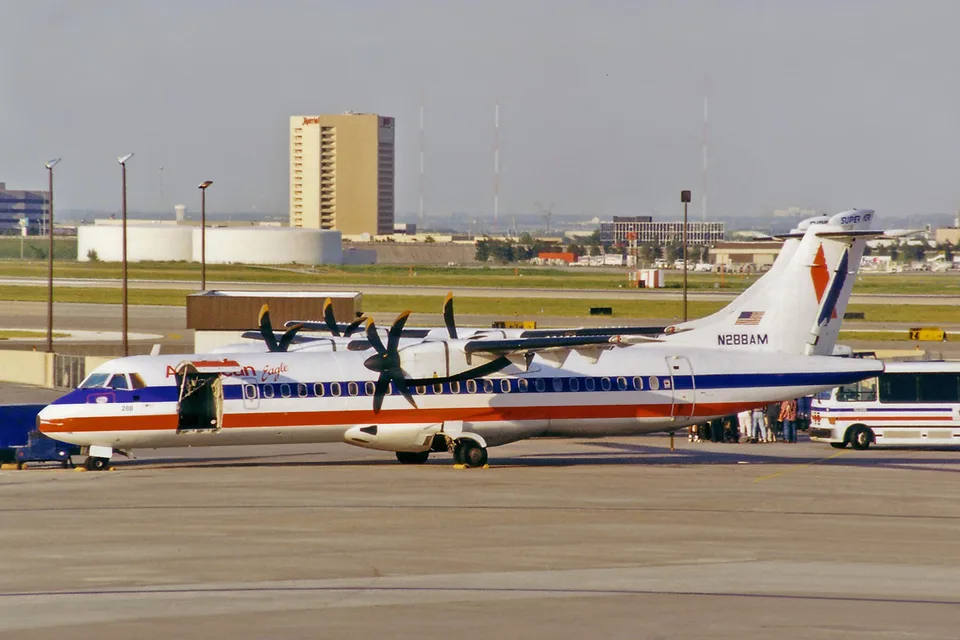
American Eagle ATR 72 N288AM on the ground at Dallas Fort Worth.

American Eagle ATR 72 N288AM at Dallas Fort Worth in September 1996.

Photo: Kev Colbran, CC BY 4.0

Image info

N288AM is another ATR 72 in American Eagle service. The accident aircraft was N401AM.

Image source

Original photograph. Responsive WebP copies resized without cropping.

Geographic context

Geographical orientation for American Eagle Flight 4184Indianapolis departure; Accident site near Roselawn; Chicago O'Hare destination. The flight departed Indianapolis for Chicago O'Hare and held at LUCIT. The accident marker uses the coordinates stated in the report. Airport markers give approximate geographic context.123NORTH UP / SCHEMATIC / NOT A RECORDED FLIGHT TRACK
  1. Indianapolis departure
  2. Accident site near Roselawn
  3. Chicago O'Hare destination
The flight departed Indianapolis for Chicago O'Hare and held at LUCIT. The accident marker uses the coordinates stated in the report. Airport markers give approximate geographic context. Basemap: Natural Earth, public domain.
Read supporting evidence

What happened

Flight 4184 spent about 39 minutes holding at 10,000 feet before the upset. During a descent clearance, flap retraction increased the angle of attack over a wing carrying ice behind the deice boots. Airflow separation near the right aileron reversed the aerodynamic forces on the control surface. The aircraft rolled, entered a steep descent and struck the ground, killing everyone aboard.

Read the full incident Follow what happened, from the flight to the investigation findings.

What investigators concluded

In its amended probable cause, the NTSB attributed the loss of control to an unexpected aileron hinge moment reversal after ice formed behind the deice boots in droplets exceeding the icing certification envelope. It identified contributing shortcomings in DGAC oversight and information sharing, FAA icing requirements and oversight, and ATR's response to earlier icing roll upsets.

Evidence behind this explanation
In-flight Icing Encounter and Loss of Control, American Eagle Flight 4184September 2002 amended contributing factors | Printed page a-3 | PDF page 7Find this passage in evidence search

The hold, the ice ridge and the loss of control

1,855 words / about 9 minutes to read. Based on the investigation records cited below.

A delayed return to Chicago

American Eagle flight 4184 was the second leg of the crew's day, returning from Indianapolis to Chicago O'Hare on 31 October 1994. Simmons Airlines operated the scheduled passenger service with N401AM, an Avions de Transport Regional model 72-212. The high-wing twin turboprop carried 64 passengers, two pilots and two flight attendants. The first officer was flying the aircraft. All 68 people aboard died when it crashed near Roselawn, Indiana.

The flight was scheduled to leave its gate at 14:10 and reach Chicago at 15:15. It left the gate at 14:14, but deteriorating weather at O'Hare led controllers to change the arrival traffic flow. Flight 4184 remained on the ground for 42 minutes before receiving its instrument flight clearance. The Indianapolis ground controller warned that the crew could expect some airborne holding. Takeoff clearance followed at 14:55:20.

Before departure, the crew received a combined flight release and weather package prepared by the company. It omitted AIRMET advisories and forecasts of light to moderate turbulence or icing along the intended route. Dispatchers could include AIRMETs at their discretion, and pilots could consult them at the departure station. Investigators could not determine whether these pilots had obtained that information separately.

The autopilot was engaged during the climb through 1,800 feet. The crew subsequently received clearance to climb to 16,000 feet. At 15:13, the aircraft began descending toward 10,000 feet, and the flight recorder showed airframe deicing operating during the descent. O'Hare's arrival controllers were preparing to hold inbound aircraft.

Sources for this section

Thirty-nine minutes in the hold

At 15:18:07, the crew received clearance to the LUCIT intersection, with instructions to hold southeast on the airway. The expected onward clearance was initially 15:30, then moved to 15:45. The captain arranged ten nautical mile holding legs and confirmed right turns. At 15:24:39, he reported entering the hold. The crew also notified the company of the delay through the aircraft's messaging system.

The first circuit was flown at about 175 knots indicated with the flaps retracted. Airframe deicing had been switched off, and propeller speed was reduced to 77 percent. During the hold, the captain commented on the aircraft's nose-high attitude in turns. At about 15:33, the crew extended the flaps to 15 degrees. The recorded angle of attack decreased as the flaps moved.

The onward clearance time was extended again, to 16:00. At 15:41:07, a caution tone sounded, followed by activation of Level III airframe deicing. Propeller speed increased to 86 percent. A pilot remarked that ice was visible at about 15:48:41, and the first officer reported ice again at 15:55:42. The pilots remained in the hold.

The NTSB's analysis found two small drag increases consistent with ice accretion, one around the time the flaps were extended and another about six minutes before the upset. It concluded that the aircraft probably encountered large supercooled droplets intermittently. Ice formed on the upper wing behind the deice boots and ahead of the ailerons. The hold lasted about 39 minutes before control was lost.

Sources for this section

Flap retraction and the first roll

At 15:56:16, the controller cleared flight 4184 to descend to 8,000 feet. He also advised that clearance onward would take about another ten minutes. The descent began at 15:56:51 from 10,000 feet. Engine power was reduced to flight idle, propeller speed remained at 86 percent and the autopilot stayed engaged in vertical speed and heading select modes.

At 15:57:21, the aircraft was descending in a right bank at 186 knots indicated when its flap overspeed warning sounded. The pilots retracted the flaps. To maintain the selected vertical speed as the flaps came up, the autopilot increased the pitch attitude. The angle of attack rose through approximately 5 degrees. Over the ice-contaminated right wing, airflow began separating near the aileron.

This altered the aerodynamic force acting around the aileron hinge. The force reversed and drove the ailerons rapidly toward a right roll. At 15:57:33, as the aircraft passed through about 9,130 feet, the recorded aileron deflection reached 13.43 degrees right wing down. The autopilot disconnected because the deflection rate exceeded its permitted control rate. The aircraft rolled rapidly to the right.

The NTSB found that the angle of attack at the onset of the aileron movement was below the stall warning threshold. As the angle of attack then decreased, the ailerons returned toward neutral and the roll stopped at about 77 degrees right bank. The pilots applied corrective control inputs, and the aircraft began rolling back toward level.

Sources for this section

A second reversal and the steep descent

During the initial recovery, nose-up elevator inputs increased the angle of attack again. At 15:57:38, the aircraft was rolling left through about 59 degrees right bank when the ailerons again deflected rapidly toward a right roll. The second hinge moment reversal initiated another rapid rotation. In the NTSB's reconstruction, the aircraft rolled approximately one and a quarter turns over the next nine seconds.

Nose-up elevator and the existing pitch trim kept the angle of attack above the value at which airflow separated near the aileron. The ailerons remained directed toward a right roll and oscillated. When the nose-up elevator input decreased, the angle of attack fell, airflow reattached and aileron control returned. By then, the aircraft was descending through approximately 6,000 feet at about 24,000 feet per minute.

The pilots attempted to pull out of the dive. Pitch reached about 73 degrees nose down before beginning to recover, while airspeed continued rising. Near 1,700 feet, further elevator input increased the aerodynamic loading. A loud crunching sound was recorded. The NTSB concluded that excessive loads separated the outer sections of both wings and the horizontal tail close to the ground.

Flight 4184 struck a wet soybean field partially inverted, with its nose down and left wing low. The report gives the accident time as about 15:59 CST and the site elevation as about 675 feet. The aircraft was destroyed, and the impact was unsurvivable.

Sources for this section

Large droplets beyond the certification envelope

The NTSB estimated that the holding area contained a mixture of supercooled cloud droplets and drizzle or rain drops. Some droplets were estimated to be as large as 2,000 microns in diameter. The ambient temperature at 10,000 feet was about minus 3 degrees Celsius, with the freezing level between 7,000 and 8,000 feet. Weather radar, upper-air observations, satellite imagery and pilot reports supported the analysis.

The ATR 72's icing certification used the conditions specified in Part 25, Appendix C. Those envelopes described droplet size, liquid water content and temperature, with a maximum mean effective droplet diameter of 50 microns. Freezing drizzle and freezing rain fell outside those limits. The accident aircraft encountered droplet sizes and water content exceeding the certification envelope.

Its pneumatic boots removed ice by repeatedly inflating and deflating chambers on the leading edges. The wing boots covered about seven percent of the upper wing chord. Ice accumulating farther aft lay beyond their working area. The ATR 72's ailerons were unpowered, connected mechanically to the cockpit control wheels, with hydraulic spoilers supplementing roll control.

In the accident conditions, the ridge of ice disturbed airflow near the right aileron as the angle of attack rose. The resulting hinge moment reversal could force the control surface and cockpit wheel to move suddenly. The crew's training had prepared them to expect ice-related speed loss and a stall warning. It had not prepared them for this abrupt aileron behavior at an angle of attack below the stall warning threshold.

Sources for this section
In-flight Icing Encounter and Loss of Control, American Eagle Flight 41841.6.7.2 ATR 72 Icing Certification Program | Printed page 30 | PDF page 48Find this passage in evidence search
In-flight Icing Encounter and Loss of Control, American Eagle Flight 41841.6.3 ATR 72 Lateral Flight Control System | Printed page 18 | PDF page 36Find this passage in evidence search

Reproducing the ice and the control response

In December 1994, ATR conducted flight tests at Edwards Air Force Base using an Air Force tanker to create an icing cloud. An instrumented Learjet measured droplet size, liquid water content and temperature. The tests examined both the established certification conditions and larger supercooled droplets at temperatures near freezing.

Within Appendix C conditions, ice accumulated in the active boot area and was shed during normal cycling. In simulated freezing drizzle outside that envelope, ice accumulated both within and behind the boots. A jagged ridge developed near the aft edge of the boot on the upper wing. It appeared with both retracted flaps and flaps set to 15 degrees.

ATR subsequently tested artificial ice shapes derived from the tanker results. With shapes associated with ice accretion at flaps 15, flight at flaps zero produced autopilot disconnection, uncommanded aileron deflection and an initial roll consistent with the accident data. Sharp edges on the artificial ice lowered the angle of attack at which reversal occurred and increased the control forces.

The NTSB found that tests with flaps extended produced a smaller drag increase than tests with flaps retracted. Together with the flight recorder evidence, this supported its conclusion that the accident ice ridge developed mainly after flap extension. The physical evidence and the test program supported a loss of lateral control caused by ice-induced airflow separation.

Sources for this section
In-flight Icing Encounter and Loss of Control, American Eagle Flight 41842.4 ATR Flight Characteristics in Icing Conditions | Printed page 168 | PDF page 186Find this passage in evidence search

The amended findings on warnings and oversight

The NTSB adopted its final report on 9 July 1996 and amended the findings and probable cause on 13 September 2002. The amended probable cause identified loss of control following an unexpected aileron hinge moment reversal after ice formed behind the deice boots during exposure to supercooled droplets outside the certification envelope. The aircraft was susceptible to that loss of control, and the crew could not recover.

The contributing factors included inadequate DGAC oversight of the ATR 42 and 72 and delayed transfer of airworthiness information to the FAA. The NTSB also identified deficiencies in FAA icing certification and operational requirements, published icing information and continuing airworthiness oversight. It cited ATR's inadequate response to continued ATR 42 icing roll upsets, which should have prompted further research and updated manuals and training.

The revised findings said ATR's earlier information had inadequately warned operators about the adverse control characteristics and recovery techniques. The 1992 All Weather Operations brochure inadequately communicated the catastrophic potential of operations in freezing rain. The crew lacked specific warning that freezing rain could produce sudden autopilot disconnection, aileron reversal and rapid roll excursions.

The report also examined cockpit discipline. In its revised finding, the NTSB said a sterile cockpit would probably have reduced distractions and could have improved awareness of the conditions. The accident manuals did not prohibit holding with flaps at 15 degrees in icing, and the crew had received no published explanation of the associated adverse ice accumulation.

Sources for this section
In-flight Icing Encounter and Loss of Control, American Eagle Flight 4184September 2002 amended contributing factors | Printed page a-3 | PDF page 7Find this passage in evidence search
In-flight Icing Encounter and Loss of Control, American Eagle Flight 4184September 2002 revised findings 24 and 25 | Printed page a-1 | PDF page 5Find this passage in evidence search
In-flight Icing Encounter and Loss of Control, American Eagle Flight 4184September 2002 revised findings 35 and 36 | Printed page a-2 | PDF page 6Find this passage in evidence search

Wider boots and safety recommendations

ATR developed extended chord deice boots for the wing outboard of the engines, including the area ahead of the ailerons. A second series of tanker tests found no ice accretion behind the new boots in simulated conditions consistent with those estimated at Roselawn. In early 1995, ATR published an icing procedures brochure covering recognition cues, aircraft configuration, lateral trim and autopilot use.

The NTSB recognized that wider boots, improved procedures, training and pilot awareness had reduced the risk. It remained concerned about aircraft controllability across the full range of naturally occurring droplet sizes, water content, temperature, configuration and exposure duration, because the tests had covered a limited set of conditions.

Its recommendations called for expanded icing certification criteria, tests addressing aileron hinge moment reversal, clearer operational limitations and better ways for crews to identify hazardous icing. It recommended that dispatchers provide pertinent AIRMETs and Center Weather Advisories, that weather broadcasts include relevant icing information, and that training address freezing drizzle, freezing rain and recovery from unusual flight events. The safety program addressed the aircraft, its operating guidance and the flow of weather and airworthiness information.

Sources for this section
In-flight Icing Encounter and Loss of Control, American Eagle Flight 41842.4 ATR Flight Characteristics in Icing Conditions | Printed page 169 | PDF page 187Find this passage in evidence search

Return to the short summary / Source status and limitations

How the sequence developed

Follow the main stages, then open the evidence beneath each step.

  1. Ice grows behind the boots

    During the hold, large supercooled droplets created a ridge on the upper wing behind the active deice boots, ahead of the ailerons.

    Read supporting evidence
  2. Flap retraction raises angle of attack

    During the descent, the flap overspeed warning prompted retraction. The autopilot increased pitch to hold the selected descent rate, raising the angle of attack.

    Read supporting evidence
  3. Aerodynamic forces reverse the aileron

    Airflow separated near the right aileron. The resulting hinge moment reversal forced a right-roll deflection beyond the autopilot's control rate.

    Read supporting evidence
  4. Repeated reversal defeats recovery

    An initial reduction in angle of attack restored aileron control briefly. Further nose-up input produced another reversal and rapid roll, followed by a steep descent and structural overload near the ground.

    Read supporting evidence

A simplified reading of the investigation findings. The sequence does not replace the full report or imply that every contributing factor is shown.

Sequence of events

Central Standard Time. Altitudes are above mean sea level unless specified. Expand an event to see its evidence.

  1. 14:55:20Takeoff clearance from Indianapolis

    After a ground delay linked to worsening weather and arrival traffic at Chicago, flight 4184 received takeoff clearance for O'Hare.

  2. 15:24:39Entering the LUCIT hold

    The crew reported entering the holding pattern at 10,000 feet. The first circuit was flown with the flaps retracted, at about 175 knots indicated.

  3. 15:33:34Flaps extended to 15 degrees

    The flight recorder showed the flaps moving to 15 degrees, reducing the angle of attack while the aircraft held.

  4. 15:41:07Airframe deicing activated

    A caution tone was followed by activation of Level III airframe deicing and an increase in propeller speed from 77 to 86 percent.

  5. 15:56:16Cleared down to 8,000 feet

    The controller instructed the flight to descend and advised that clearance onward was about ten minutes away.

  6. 15:57:21 to 15:57:33Flap warning and first uncommanded roll

    The flap overspeed warning sounded during descent. As the flaps retracted, the angle of attack rose. The ailerons then moved rapidly toward a right roll, the autopilot disconnected and the aircraft rolled to a bank of 77 degrees.

  7. 15:57:38Second aileron reversal

    During the initial recovery, the angle of attack rose through 5 degrees again. The ailerons deflected right and the aircraft began a second rapid roll.

  8. About 15:59Impact near Roselawn

    The aircraft entered a steep high-speed descent. Excessive aerodynamic loads separated the outer wing sections and horizontal tail near the ground, before impact in a soybean field.

Search the report evidence

Search extracted report prose, with original page references. Short results link to the full document.

Questions readers ask

How did flap retraction lead to the roll?

As the flaps retracted, the autopilot raised the pitch attitude to maintain the selected descent rate. The increasing angle of attack caused airflow to separate near the right aileron over the ice-contaminated wing. The resulting hinge moment reversal drove the ailerons toward a right roll, and the autopilot disconnected.

Where did ice accumulate during the icing tests?

In simulated freezing drizzle, ice accumulated both within and behind the working area of the deice boots. The boots shed ice within their active area, while a jagged ridge formed near their aft edge on the upper wing. Tests with artificial ice shapes produced behavior consistent with the accident aircraft's initial upset.

What aircraft changes followed the accident?

ATR developed wider deice boots for the wing outboard of the engines, including the area ahead of the ailerons. In a second series of tanker tests, ice did not accumulate behind those boots in conditions consistent with the estimated Roselawn environment. ATR also published new icing procedures in early 1995.

What the evidence can and cannot establish

Safety follow-up

Actions and recommendations are described at the dates of the cited records. A recommendation is not proof of implementation.

Certification recommendations

The NTSB recommended expanding icing certification criteria to cover freezing drizzle, freezing rain and mixed water and ice crystal conditions as necessary, and introducing tests for aileron hinge moment reversal.

Read supporting evidence

Weather and recovery training

Recommendations A-96-48, A-96-61 and A-96-66 called for pertinent weather advisories to reach crews, training on freezing drizzle and freezing rain, and standardized recovery training for unusual events and extreme attitudes.

Read supporting evidence

Classifications, with reasons

These labels organise the evidence. They are not a ranking of causes. A shared label means a shared research topic, not an identical mechanism.

causeIcing

Supercooled droplets exceeding the certification envelope produced ice behind the deice boots, changing airflow near the ailerons.

causeLoss of control

An aileron hinge moment reversal forced rapid uncommanded aileron movement. Repeated reversals prevented recovery from the roll and descent.

circumstanceHolding in icing conditions

Arrival delays kept the flight in the LUCIT holding pattern for about 39 minutes while it intermittently encountered icing.

riskIcing certification and oversight

The amended findings identified inadequate regulatory oversight and deficiencies in icing certification requirements and the response to earlier ATR icing events.

In-flight Icing Encounter and Loss of Control, American Eagle Flight 4184September 2002 amended contributing factors | Printed page a-2 | PDF page 6Find this passage in evidence search
In-flight Icing Encounter and Loss of Control, American Eagle Flight 4184September 2002 amended contributing factors | Printed page a-3 | PDF page 7Find this passage in evidence search

Read alongside

These comparisons connect specific research topics. Shared circumstances do not establish identical causes. Evidence from both investigations is provided below.

Colgan Air Flight 3407

Both investigations examined turboprop loss of control during operations involving icing and the interaction between control inputs and angle of attack. At Roselawn, ice behind the ATR deice boots caused an aileron hinge moment reversal. In the Colgan Air 3407 investigation, the NTSB found that the captain's aft control input after stick shaker activation caused a wing stall; ice accumulation produced only minimal performance degradation and did not affect the crew's ability to control the aircraft.

Read supporting evidence

Further investigation records

Explore the records below for additional context. They open on the publisher's site and are not all included in our report search. Source reuse terms apply.

  • NTSB final report NTSB/AAR-96/01

    NTSB / investigation record

    Volume I gives the investigation evidence, flight sequence, analysis and recommendations, with the September 2002 revisions at the front.

Cockpit voice recorder transcript

A cockpit voice recorder (CVR) transcript records speech and sounds captured in the cockpit. This transcript was produced by the National Transportation Safety Board and is reproduced from printed pages 221 to 251 of the cited NTSB report; it is a US federal government work in the public domain.

Speaker codes and notation

HOT
Crewmember hot microphone voice or sound source
RDO
Radio transmission from accident aircraft
CAM
Cockpit area microphone voice or sound source
INT
Transmissions over aircraft interphone system
CTR
Radio transmission from Chicago Center
ADF
Transmission received over aircraft’s ADF radio
PA
Transmission made over aircraft Public Address system
AEC
Radio transmission from American Eagle Chicago Operations Control
KW17
Radio transmission from KIWI flight seventeen.
-B
Sounds heard only through both pilots’ hot microphone systems
-1
Voice identified as Pilot-in-Command (PIC)
-2
Voice identified as Co-Pilot
-3
Voice identified as 1st female Flight Attendant
-4
Voice identified as 2nd female Flight Attendant
-?
Voice unidentified
*
Unintelligible word
@
Non pertinent word
#
Expletive
%
Break in continuity
( )
Questionable insertion
[ ]
Editorial insertion
....
Pause

Note 1: Times are expressed in central standard time (CST).

Note 2: Non pertinent conversation where noted refers to conversation that does not directly concern the operation, control, or condition of the aircraft, the effect of which will be considered along with other facts during the analysis of flight crew performance.

NATIONAL TRANSPORTATION SAFETY BOARD Engineering and Computer Services Division Washington, D.C. 20594 SPECIALIST’S FACTUAL REPORT OF INVESTIGATION Cockpit Voice Recorder DCA 95 MA 001 October 16, 1995 The following corrections on page #8 of the original transcript have been approved by the CVR Group: 1. Modify editorial comment at time 1542:40; CAM [sound of several clicks similar to cockpit door being opened and closed] Modify editorial comment at time 1542:46; CAM [low frequency sound decreases slightly in volume] Albert G. Reitan Transportation Safety Specialist

Cockpit voice recorder transcript, printed pages 221 to 251
TimeSpeakerText
START of RECORDING START of TRANSCRIPT
1527:59ADF-2[sound of music]
1528:00CAM-1did that transmit?
1528:02CAM-2looks like it did.
1528:06CAM-3***.
1528:07CAM-2I didn’t see the transmit thing go off because I was dis- tracted.
1528:11CAM-3wow, ***.
1528:18CAM-?** see what’s going on up here.
1528:21CAM[sound of loud music]
1528:26CAM-3is that like stereo, radio. ... you don’t have a hard job at all. ... we’re back there slugging with these people. *****.
1528:38HOT-1yeah you are.
1528:40CAM-3**.
1528:44HOT-1we do have it pretty easy. I was telling Jeff I don’t think I’d ever want to do anything else but this .
1528:51CAM-3*****.
1528:53CAM-2no, ****.
1528:54CAM-3***.
1528:55CAM-2just wanted to see your reaction. I, I like dealing people in a way it’s kinda’ neat to be able to talk to them.
1529:03CAM[miscellaneous non-pertinent conversation between captain and flight attendant continues]
1530:00CAM-3I know.
1530:00CAM-3and how late are we going to be?
1530:01CAM-1well.
1530:02CAM-3we already got two people that have already missed their flight.
1530:05CAM-1oh really.
1530:06CAM-3three fifteen is one of them.
1530:08CAM-1three fifteen, three fifteen?
1530:10CAM-3it’s all your fault.
1530:11CAM-3uh huh. we weren’t due into Chicago until three fifteen. ***.
1530:15CAM-3***.
1530:20CAM-1she’s lying then.
1530:23CAM-3you know what we deal with out here?
1530:26CAM-2** four fifteen.
1530:28CAM-1ya, you should hit her.
1530:29CAM-3yeah.
1530:30CAM-1three fifteen eastern time.
1530:34CAM- 1531:11 [miscellaneous non-pertinent conversation between pilot and flight attendant continues]
1531:11CAM-3what do you all do up here when *** when auto-piloting? just hang out?
1531:17CAM-2you still gotta tell it what to do.
1531:20CAM-1if the auto-pilot didn’t work, he’d be one busy little bee right now.
1531:23CAM-2[sound of laughter}
1531:25CAM-3so does the FO’s do a lot more work than you do?
1531:28CAM-1yep.
1531:29CAM-3[sound of laughter]
1531:30CAM-2not really.
1531:31CAM- 1533:10 [non-pertinent pilot and flight attendant conversation continues]
1533:13HOT-1man this thing gets a high deck angle in these turns.
1533:15HOT-2yeah.
1533:17HOT-1we’re just wallowing in the air right now.
1533:19HOT-2you want flaps fifteen?
1533:21HOT-1I’ll be ready for that stall procedure here pretty soon.
1533:22HOT-2[sound of chuckle]
1533:24HOT-1do you want kick ‘em in (it’ll) bring the nose down.
1533:25HOT-2sure.
1533:26CAM[sound of several clicks similar to flap handle being moved]
1533:29HOT-1guess Sandy’s going “ooo”.
1533:34CAM[wailing sound of “whooler” similar to pitch movement]
1533:36HOT-1so anyway ..
1533:37CAM-3aah.
1533:39HOT-1.. the trim, automatic trim.
1533:41CAM-3what were they telling me about, what if, ***** something about rain. they always trick the hiring people. * about rain, ** some little person that talks.
1533:56CAM[single tone similar to caution alert chime]
1533:57HOT-1rain?
1533:58HOT-2no, this one maybe?
1533:59HOT-3sounds like it said something about the rain, or.
1534:01CAM-5glide slope, whoop whoop, pull-up, whoop whoop pull-up.
1534:05HOT-1that one?
1534:07CAM-3ya, but there’s something else.
1534:09HOT-2no, like I said. it’s a rain cloud they say, well how you know? because this thing tells us. it’ll tell you, terrain, terrain.
1534:18CAM-3that’s what it says, terrain ***.
1534:19HOT-1I think it’s this thing here.
1534:20CAM-3ya.
1534:21HOT-1I don’t know ..
1534:23CAM-5too-low, terrain, too-low terrain.
1534:25CAM- 1538:47 [non-pertinent pilot and flight attendant conversation con- tinues]
1537:40CAM[wailing sound for 1.0 seconds similar to “whooler” pitch trim movement]
1538:43CTREagle flight one eight four, expect further clearance two two zero zero.
1538:47RDO-1OK, we’ll expect further two two zero zero. Eagle flight uh, one eight four.
1538:55CAM- 1542:34 [non-pertinent pilot and flight attendant conversation con- tinues]
1538:55ADF-2[sound of music similar to standard broadcast radio sta- tion continues]
1541:07CAM[single tone similar to caution alert chime]
1541:12CAM[low frequency sound starts and increases slightly in fre- quency similar to increase in propeller RPM]
1542:15CAM[wailing sound for 0.5 seconds similar to “whooler” pitch trim movement]
1542:20CAM[sound of eight clicks]
1542:38CAM-3see you all.
1542:39CAM-1alright.
1542:40CAM[sound of several click similar to cockpit door being opened and closed]
1542:41[Hereafter, all cockpit conversation and radio transmis- sions relating to flight 4184 have been transcribed in their entirety.]
1542:46CAM[low frequency sound decreases slightly in similar to de- crease is propeller RPM]
1543:16HOT-2let’s see, we got about uh, thirty six hundred pounds of fuel?
1543:19HOT-1uh huh.
1543:27
HOT-2they sent us a message see that dispatch?
1543:30HOT-1does it work?
1543:32HOT-2so they must have got that message that we were in a hold there.
1543:35HOT-1why, what happened?
1543:37HOT-2um,
1543:40HOT-1oh, you got this?
1543:42HOT-2yeah. it just came up on its own.
1543:51HOT-1so did you send ‘em uh, the new updated uh, EFC?
1543:56HOT-2yeah. I just threatened to send it. it says acknowledge it. how do you acknowledge it? this is the only way I know how.
1544:03HOT-1yeah, you just uh, send ‘em something.
1544:06HOT-2should I tell ‘em how much fuel we got?
1544:07HOT-1sure.
1544:09HOT-2**.
1544:14HOT-?*.
1544:19ADF-2[sound of music similar to standard broadcast radio sta- tion continues]
1544:25HOT-2space, f-u-e-l is that?
1544:36HOT-1**** thirty six hundred pounds **.
1545:10HOT-2crews receive dummy messages but I don’t what that ***.
1545:14HOT-1acknowledge message one two one one? they sending you another message?
1545:18HOT-2see that was in there before.
1545:20HOT-1oh OK, that’s an old one?
1545:21HOT-2yeah, I think ...
1545:27HOT-1did you send ‘em something?
1545:29HOT-2I think that’s if you send them that uh, acknowledged it’s called **.
1545:34HOT-1essential data *** .
1545:36HOT-2yeah.
1545:48ADF-2[sound of music similar to standard broadcast radio sta- tion stops] to of
1545:48PA-1well folks once again, this is the captain. you’re uh, do regret inform that, air traffic control has put us into a holding pattern up here, we’re holding for approximately twenty minutes out Chicago at this time but uh, I guess the congestion an’ traffic’s continued on uh, they need us to hold out here for some spacing. they’re saying at this point uh, on the hour before we depart the hold though that may not hold uh, we may not be here the full thirteen minutes. we’ll be sure to keep you updated. once we leave the hold we’ll let you know more if they tell us the hold is going to be a little bit longer. I do apologize for all these delays. chances are that all the flights in and out of Chicago here this afternoon are going to be delayed as well. this is not just aircraft in the air right now but this is also uh, for aircraft that were in the air earlier, aircraft on the ground and aircraft that are going to be depart- ing. so uh, once again chances are that your flight would be delayed also and you’ll still have a real good chance of making your connection. if not, they’ll uh, automatically re-book you on the next flight in Chicago.
1546:51HOT-1did you get another note?
1546:55HOT-2no. I’m just trying to figure this out. this uh, ... messages. there isn’t any company messages. but I think that’s the number you put in there you just hit this number. and, after
you write a message, you know with the free text, you do this and see to make sure if they acknowledge **.
1547:21HOT-1why did they do that?
1547:23HOT-2this a free text one to send your own stuff. that’s what I say.
1547:28HOT-1did you tell them the new, the new delay times er the EFC is zero zero?
1547:31HOT-2yeah. but I didn’t do it on that line, I did it on uh, uh, uh, the delays.
1547:39HOT-1OK they know so they know OK. what if you went like this? messages, message received, acknowledged thirty nine twenty, so ...
1547:52HOT-2I, I just typed that one in myself and I, I hit enter.
1547:56HOT-1oh, OK.
1547:57HOT-2and uh, I don’t know if that means they sent me that I’m supposed to acknowledge that and hit it or if I’m sup.. or if that’s us sending them a message for them to acknowl- edge us.
1548:05HOT-1oh, I don’t know.
1548:05HOT-?**.
1548:06HOT-?.. confused on that.
1548:09HOT-1yeah, I’ll get my little uh, ACARS book and read it.
1548:13HOT-2one guy told me that system you, send another message and you type that number in to see if they got it. if they uh, if write in there “acknowledged”, message thirty nine twenty from you.
1548:24HOT-1huh.
1548:26HOT-2I guess.
1548:33CAM[sound of click]
1548:34HOT-2that’s much nicer, flaps fifteen.
1548:36HOT-1yeah.
1548:43HOT-?I’m showing some ice now.
1548:45HOT-?**.
1548:46
HOT-1I’m sure that once they let us out of the hold and forget they’re down we’ll get the overspeed.
1548:48HOT-2[sound of chuckle]
1548:57HOT-1good, I can’t hold any more man, that big (cup) needs out right now.
1548:59HOT-2[sound of chuckle] they’re gonna be giving you dirty looks, man.
1549:02HOT-1oh man, oh yeah, I know they are. people do. it’s either that or pee on ‘em.
1549:05CAM[sound of ding dong similar to flight attendant call bell]
1549:05HOT-1[sound of clink similar to seat belt being unfastened]
1549:06HOT-2yeah, I’ll talk to her.
1549:06CAM[sound of ding dong similar to flight attendant call bell]
1549:07CAM[sound of clunk]
1549:08INT-1what’s up?
1549:08INT-4it’s just me.
1549:09INT-1huh?
1549:10INT-4I’m uh, it was just me.
1549:11INT-1oh.
1549:12INT-4I’m just wondering how much gas do we got.
1549:14INT-1how much gas we have?
1549:15INT-4yeah.
1549:16INT-1we got more than plenty of gas. we can be out here for a long time.
1549:19INT-4cool, OK. just, was worried. maybe you’d have to divert somewhere, and really make these people ...
1549:25INT-2sixty miles from Chicago.
1549:26INT-1oh, yeah.
1549:26INT-4six, sixty miles?
1549:27INT-2yeah.
1549:28INT-4yeah, but they’re still gonna hold us, huh?
1549:30INT-1‘til, about another ten minutes.
1549:32INT-4and that’s not a for sure thing, is it?
1549:34INT-1eehh ya, pretty for sure as of right now unless they decide to make it different. how’s that, for an answer?
1549:40INT-4[chuckle] same like the other one.
1549:42INT-1yeah, I know.
1549:43CAM[sound of clunk]
1549:44CAM-1talk to her bro.
1549:45INT-2OK.
1549:49INT-4bye.
1549:50INT-2hey. you there?
1550:41CAM[sound of ding dong similar to flight attendant call bell]
1550:43INT-2hello.
1550:43INT-4*, are you sure you can handle it up there?
1550:46INT-2I’ll try.
1550:47INT-4‘K uh,
1550:48INT-2why do you ...
1550:49INT-4turn it down. it needs to be cooler back here. it’s hot.
1550:51INT-2I’m uh, it’s all the way down now.
1550:53INT-4OK thanks.
1550:53INT-2it’s been,
1550:54INT-4it’s been down?
1550:55INT-2yeah, well, I’ll, I’ll chill it up up with * too.
1550:59INT-4really, well we’re sweatin’ [sound of panting]
1551:01INT-2you know why?
1551:02INT-4you wanta hear us breathe heavy? [sound of chuckle]
1551:03INT-2it’s it’s, one of the bleeds are off.
1551:06INT-4OK.
1551:07INT-2one of the for the air conditioning.
1551:08INT-4yeah.
1551:09INT-2and it’s, your side.
1551:10INT-4oh *.
1551:11INT-2it’s the one that gives you most of the air back there.
1551:13INT-4figures.
1551:14INT-2so now you got y-y-you got less than uh, half, not only that it’s your your half. [sound of chuckle]
1551:20INT-4OK.
1551:22INT-2I’ll try.
1551:22INT-4OK, well here. Orlando wants to talk to you.
1551:24INT-2Orlando does?
1551:35INT-2hello.
1551:39INT-1hey bro.
1551:39INT-2yeah.
1551:40INT-1gettin’ busy with the ladies back here.
1551:41INT-2oh.
1551:43INT-4[sound of snicker]
1551:45INT-1yeah, so if so if I don’t make it up there within the next say, fifteen or twenty minutes you know why.
1551:49INT-2OK.
1551:50INT-1OK.
1551:51INT-2I’ll uh, when we get close to touchdown I’ll give you a ring.
1551:53
INT-1there you go.
1551:54INT-2*.
1551:55INT-1no, I’ll I’ll be up right now. there’s somebody in the bath- room so ****.
1551:55CAM[wailing sound similar to “whooler” pitch trim movement for two seconds]
1551:59INT-1talk to you later.
1552:00INT-2OK.
1553:36KW17good afternoon Chicago, Kiwi Air seventeen out of twenty for eleven.
1553:42CTRKiwi Air seventeen Chicago center roger. Midway al- timeter two niner seven niner.
1553:48CAM[sound of two clicks]
1554:13CAM[sound of several clicks similar to cockpit smoke door be- ing operated]
1554:16CAM-1we have a brand new hombre.
1554:20
CAM[sound of two clicks similar to captain’s seat moving later- ally and forward]
1554:25HOT-2oh yeah.
1554:30CAM[sound of click similar to lap belt being fastened]
1554:24HOT-1[sound similar to captain’s hot microphone bumping against object]
1553:47KW17two niner seven niner, roger.
1554:38HOT-2hello.
1553:39CTRKiwi Air seventeen, expedite your descent all the way down to eleven, please.
1553:42KW17expedite to eleven, Kiwi Air seventeen.
1554:47HOT-1did you get any more messages from the cabbage patch?
1554:49HOT-2no. I sent them another message saying did you get our twenty two hundred uh, out of the hold thing through.
1554:52CAM[sound of click similar to shoulder harness being fastened]
1554:55HOT-1*.
1554:56HOT-2you know the other mode about delays and just asked them if they got that.
1555:04HOT-1[sound of sigh] **.
1555:04HOT-2enough playing with that.
1555:05HOT-1where’s the uh, where’s the connecting gates? did we throw those away?
1555:09HOT-2uh, I didn’t throw ‘em away.
1555:12HOT-1how do you how do you get connecting gates?
1555:14HOT-2i- in-range one.
1555:23HOT-1and you haven’t heard any more from this chick in, this controller chick huh?
1555:26HOT-2no, not a word. where’d it go anyway?.
1555:30HOT-1I don’t know. I must have thrown it away.
1555:32CTRKiwi Air seventeen, fly a heading zero seven zero. this is radar vectors for your descent.
1555:37KW17* Air seventeen * zero five zero.
1555:42HOT-2we still got ice.
1555:46CAM[sound similar to paper being torn from ACARS printer]
1555:47HOT-1here.
1555:58HOT-2get a message?
1555:59HOT-1you did.
1556:01HOT-2understand a definite maybe on twenty two, release time. [sound of “ha, ha”]
1556:08HOT-B[sound of beep similar to frequency change on VHF comm]
1556:11HOT-1I’ll be right back. ‘K, I’m a talk to the company.
1556:14.7CTREagle flight one eighty four, descend descend and main- tain eight thousand?
1556:15.8RDO-1Chicago, do you copy forty, one eighty four?
1556:20.1AECforty one eighty four, go ahead.
1556:21.7RDO-1- 1556:47.0 yeah, we’ve already been talking to dispatch uh, on the ACARS but so they are aware of our delay I don’t know if you guys got the word on that. we’re on a hold out here uh, we got three, thirty two hundred pounds, thirty three hundred pounds of fuel. they’re saying zero zero, for uh, EFC so in about another four or five minutes we’ll find what the new word is. but what can you tell me about um, there’s this guy concerned about his Frankfurt connection uh, do you know anything about that?
1556:24CAM-5traffic, traffic.
1556:27.8CTREagle flight one eighty four, descend and maintain eight thousand.
1556:31.6RDO-2down to eight thousand. Eagle flight one eighty four.
1556:38.3CAM[wailing sound similar to “whooler” pitch trim movement]
1556:44.9CTREagle flight one eighty four uh, should be about ten min- utes uh, till you’re cleared in.
1556:48.3AECuh, I can double check on that uh, yeah. just sent a message to dispatch to see if you were in a hold. copy thirty on the fuel and estimated out time on the hour.
and, did you have that uh, Frankfurt flight number by any chance?
1556:50.1RDO-2thank you.
1556:53.1HOT-2they say ten more minutes.
1557:01.5CTRKiwi Air seventeen, fly a heading of three six zero.
1557:02.0RDO-1um, no I sure don’t but I pulled up connecting gates out of the ACARS and is says it’s going out of K five if that helps you any at all.
1557:05.0KW17Kiwi Air seventeen, heading three six zero.
1557:07[sound of light tapping heard on first officer channel]
1557:08.8AEClet me check.
1557:16.3HOT-1are we out of the hold?
1557:17.3HOT-2uh, no, we’re just goin’ to eight thousand.
1557:19.4HOT-1OK.
1557:20.0HOT-2and uh, ten more minutes she said ....
1557:22.1CAM[sound of repeating beeps similar to overspeed warning starts and continues for 4.6 seconds]
1557:23.3HOT-2... oop.
1557:24.7CTRKiwi Air seventeen, descend and maintain six thou- sand.
1557:26.2HOT-1we, I knew we’d do that.
1557:27.4HOT-2I’s trying to keep it at one eighty.
1557:28.2KW17Kiwi Air seventeen, eleven point five for six.
1557:29.2HOT-2[ramping repetitive thud sound]
1557:28.9HOT-B[wailing sound for 1.2 seconds similar to “whooler” pitch trim movement]
1557:29.9HOT-1oh.
1557:31.2HOT-B[wailing sound for 1.7 seconds similar to “whooler” pitch trim movement]
1557:32.8HOT-2oops, #.
1557:33.0CAM[sound of three thumps followed by rattling]
1557:33.5CAM[sound of three sets of repetitive rapid triple chirps similar to auto-pilot disconnect warning lasting 1.09 seconds]
1557:33.8HOT-2#.
1557:35.2CAM[single horn similar to altitude alert signal]
1557:35.6CTR Kiwi Air seventeen, direct Chicago Heights, direct Midway.
1557:36.9HOT-?OK
1557:37.0HOT-B[intermittent heavy irregular breathing starts and contin- ues to end of recording]
1557:39.0KW17direct the Heights direct Midway, Kiwi Air seventeen.
1557:38.8[repetitive thumping sound heard on first officers channel]
1557:39.9HOT-?oh #.
1557:42.4HOT-1OK.
1557:43.7CAM[single horn similar to altitude alert signal]
1557:44.0CAM[sound of “growl” starts and continues to impact]
1557:44.2HOT-1alright man, ...
1557:45.8HOT-1OK, mellow it out.
1557:45.8CAM[sound of repeating beeps similar to overspeed warning starts and continues to impact]
1557:46.7HOT-2OK.
1557:47.1HOT-1mellow it out.
1557:47.7HOT-2OK.
1557:48.1HOT-1auto-pilot’s disengaged.
1557:49.4HOT-2OK.
1557:52.8HOT-1nice and easy.
1557: 54.9CAM-5terrain, whoop whoop.
1557:56.6HOT-2aw **.
1557:56.7
CAM[loud crunching sound]
1557:57.1END of RECORDING END of TRANSCRIPT

Sources and transparency

NTSB final report adopted 9 July 1996; findings and probable cause amended 13 September 2002.

Source limitations

Droplet sizes and liquid water content at the holding pattern were estimated from weather observations, radar data and atmospheric analysis.

In-flight Icing Encounter and Loss of Control, American Eagle Flight 4184

National Transportation Safety Board
Final report NTSB/AAR-96/01, adopted 9 July 1996; Volume I with revisions adopted 13 September 2002

Official report PDF, hosted by ntsb.gov

Open source document

340 PDF pages.

United States government investigation report. Short source passages support the investigation findings. Source terms.

NTSB AAR-10/01: Loss of control on approach, Colgan Air 3407

NTSB
Final report adopted 2 February 2010

Official report PDF, hosted by ntsb.gov

Open source document

299 PDF pages.

Private evidence cache. Only short attributed quotations in original commentary; full report and third-party illustrations are not redistributed. Source terms.

Read the extraction, classification and review methodology.

Suggest a correction to this dossier

Editorial record

Kevin Murphy writes the incident accounts on AirlineIncidents.com, out of a long interest in aviation safety and the lessons each investigation leaves behind.

Prepared by
AirlineIncidents editorial desk
Report citation check
Independent expert review
Not completed

Citation checks compare supporting text with the indexed report pages. They do not constitute independent expert review. How these pages are prepared.

Revision history

: Published sourced incident account, timeline, photographs and investigation findings.

Source-based corrections are reviewed before changes appear here. Suggest a correction to this dossier.

Cite or link to this page

Quoting this account or linking to it? Please use the page address below, and credit the investigation report it is built from.

Credit line

AirlineIncidents.com. American Eagle Flight 4184 accident account. Published 15 October 2026. https://airlineincidents.com/incidents/american-eagle-4184-1994/

HTML link

<a href="https://airlineincidents.com/incidents/american-eagle-4184-1994/">American Eagle Flight 4184 accident account (AirlineIncidents.com)</a>

Select a box to copy it. Spotted something wrong? Send a correction.