Loss of control in flight, Spatial disorientation, Inadvertent go-around activation, Monitoring and control transfer, Pilot selection and background records
Original report image with its labels; no cropping or color changes. Responsive WebP copies resized without cropping.
Geographic context
Miami departure area
Houston destination area
Approximate whole-degree markers for the departure and destination areas. The crash occurred in Trinity Bay, about 41 miles east-southeast of Houston airport. Basemap: Natural Earth, public domain.Read supporting evidence
During descent toward Houston, the Boeing 767 encountered light turbulence and its go-around mode activated inadvertently. The first officer likely experienced a false pitch-up sensation as thrust increased and applied forward control inputs. The aircraft entered a steep dive. The captain intervened late, and opposing control inputs continued until the final pull-up. All three occupants died.
Read the full incident Follow what happened, from the flight to the investigation findings.
What investigators concluded
The NTSB found the first officer's inappropriate response to inadvertent go-around activation led to spatial disorientation and nose-down inputs. The captain's ineffective monitoring and intervention, systemic pilot selection and performance measurement deficiencies, and the FAA's delayed pilot records database contributed.
1,744 words / about 8 minutes to read. Based on the investigation records cited below.
A cargo flight approaching Houston
Atlas Air flight 3591 left Miami International Airport on 23 February 2019 for George Bush Intercontinental Airport in Houston. Atlas operated the Boeing 767-375BCF, registration N1217A, as a domestic cargo flight under Part 121 for Amazon.com Services LLC. The captain, first officer and a nonrevenue pilot in a cockpit jumpseat were the three people aboard. Departure was at about 10:33 central standard time, equivalent to 11:33 in Miami. The first officer was flying and the captain was monitoring, with the autopilot and autothrottle engaged.
The aircraft had been manufactured in 1992 as a passenger airplane and converted into a freighter in 2017. Its two engines were General Electric CF6 turbofans. Atlas' maintenance records showed no unresolved discrepancies or open minimum equipment list items on the accident day. Investigators checked loading and balance information and found the aircraft within its weight and center-of-gravity limits. The cargo included no hazardous materials or dangerous goods. The departure, cruise and initial descent were uneventful.
At 12:30:37, while descending through about 17,800 feet, the captain contacted Houston approach control. The aircraft was about 73 miles southeast of the airport. At 12:34:09 the controller warned of light-to-heavy precipitation ahead and said the crew could expect vectors around it. A cold front lay between the approaching freighter and Houston, moving southeast across Trinity Bay.
At 12:36:10 the first officer handed control to the captain after beginning a comment about a problem. Both pilots acknowledged the transfer. About a minute later the first officer referred to the electronic flight instrument switch, then said his display had returned. The captain acknowledged that it was back. The NTSB concluded that the display anomaly had been resolved to both pilots' satisfaction before the accident sequence began.
While monitoring, the first officer requested a vector west of the weather. The controller explained that departing traffic would be approaching from that direction and instructed the freighter to expedite its descent to 3,000 feet so that it could pass below that traffic. The crew extended the speedbrakes. The controller assigned a left turn to a heading of 270 degrees, and the captain acknowledged before returning control to the first officer at 12:37:24.
The crew continued preparing the flight management computer for the approach and selected flaps 1, extending the slats. The aircraft was descending normally. Recorded load-factor changes began at about 12:38:25 as it entered the leading edge of the front. The NTSB assessed the turbulence as light and considered instrument meteorological conditions likely as the flight continued. The selected altitude remained 3,000 feet.
At 12:38:31, while the aircraft was about 40 miles from Houston and at approximately 6,300 feet, its go-around mode activated. Neither pilot announced a go-around or disconnected the automated systems. The NTSB found the selection unintended and unexpected. Go-around mode normally supports abandoning a landing approach and climbing away. With this aircraft's settings, it caused the automation to increase thrust and command a climb.
Over the next six seconds the thrust levers advanced and the aircraft pitched up to about four degrees. Green go-around indications appeared on the flight mode annunciators and a go-around thrust indication would have appeared on the engine display. Investigators concluded that neither pilot recognized the mode change. The captain continued handling routine radio communications while the aircraft's commanded flightpath changed.
The go-around switches were beneath the outer sides of the thrust levers, close to the speedbrake lever. Atlas' procedure called for the flying pilot to keep a hand on the speedbrake lever while the brakes were extended. Simulator observations showed that a right-seat pilot's left wrist could then lie close beneath the left go-around switch. Assuming the first officer was holding the lever as prescribed, the NTSB found that turbulence likely moved his left wrist or watch into the switch.
About five seconds after the mode change, the speedbrakes retracted through a manual lever movement. Manual forward control-column inputs followed, overcoming the autopilot's nose-up commands while leaving the automation engaged. The NTSB attributed these inputs most likely to the first officer, who remained the pilot flying and had neither reported a problem nor transferred control to the captain. The nose dropped and the aircraft accelerated into a steepening dive.
The NTSB found that the first officer likely experienced a somatogravic illusion. During forward acceleration, the forces sensed by the inner ear can create an apparent pitching-up sensation. With limited outside visual references, those sensations can conflict with the aircraft's actual attitude. Investigators concluded that the acceleration after the mode change prompted the first officer to push the control column forward. As the dive developed, the changing forces likely intensified his apparent pitch-up sensation and may also have produced a sensation of tumbling backward.
The first officer began making alarmed statements and described a stall. Recorded airspeed exceeded 250 knots during this part of the descent, and the angle of attack was well below the wing's stall angle. The stick shaker never activated. The NTSB found the aircraft was not at or near a wing-stalled condition. It concluded that the first officer was failing to scan and interpret the available instruments effectively while the false sensations absorbed his attention. The aircraft reached about 49 degrees nose down.
The captain's attention had been divided between approach setup and radio communications. At about 12:38:46 he began pulling back on his control column against the first officer's continued forward inputs. The aircraft's elevator system allowed the two sides to move independently when opposing forces overcame its override mechanism. Recorder data showed the right elevator commanding a more nose-down position than the left for about ten seconds.
The captain did not announce a positive transfer of control when he intervened. The NTSB found that this enabled the first officer to continue forcing the aircraft into the dive. It attributed the captain's degraded response to the ambiguity, stress and short duration of the emergency. Neither pilot disconnected the autopilot or autothrottle, although Atlas' procedures called for reducing automation when its operation was unwanted.
At 12:38:56 the captain asked what was happening. The aircraft was passing through about 3,000 feet. Both elevators began moving toward a nose-up position and reached their full nose-up deflection about two seconds later. The jumpseat pilot called for a pull-up. As the aircraft descended below the expected cloud base, the NTSB considered that the crew would have gained a clear external view of its attitude and trajectory. The final pull-up reduced the nose-down pitch but failed to stop the descent. The recorder ended at 12:39:03, with airspeed above 400 knots and pitch about 20 degrees nose down.
The freighter struck a shallow, muddy marsh area in Trinity Bay, roughly 41 miles east-southeast of Houston's airport. All three occupants died and the aircraft was destroyed. Only 32 seconds separated go-around mode activation from impact. Wreckage was highly fragmented across a main debris field of about 12.3 acres. Much of it lay in water up to three feet deep or beneath as much as ten feet of soft mud.
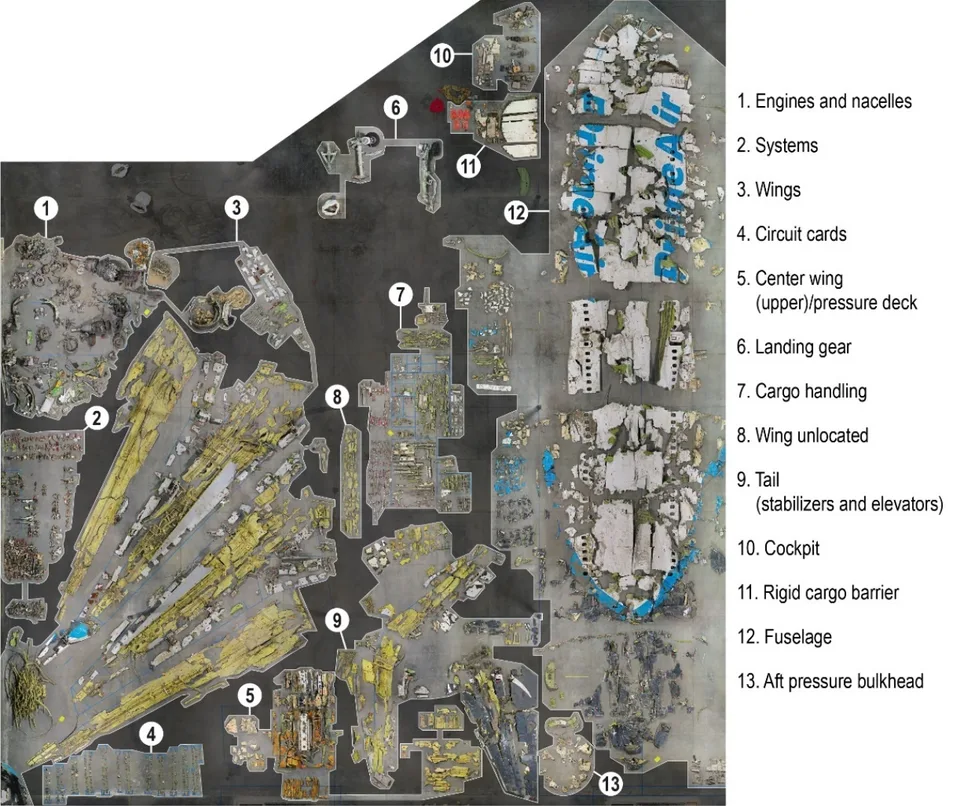
Recovery continued for nearly seven weeks using equipment suited to shallow water. More than 90 percent of the wreckage was recovered and moved to a warehouse. Investigators catalogued identified pieces and arranged them on a two-dimensional reconstruction grid. The NTSB also used aerial photographs and photogrammetry to document that layout. Examinations found damage consistent with the high-speed impact. The Board found that aircraft condition, maintenance, weight and balance, and air traffic control services were not accident factors.
Both recorder memory units were recovered separately from their chassis. Investigators downloaded two hours of cockpit audio, with quality varying between channels, and about 54 hours of flight data. The NTSB's analysis combined the recorded movements, automation status and cockpit statements with simulator observations and physical examinations. The aircraft's terrain warning system recorded no alerts during the sequence. A manufacturer simulation found that the rapidly changing radio-altitude values were rejected by internal reasonableness checks, preventing terrain alerts.
The investigation traced a recurring pattern in the first officer's training at several airlines: difficulty with unexpected events, low situational awareness, overcontrol and impulsive responses. At Atlas he failed his practical Boeing 767 type-rating examination in September 2017, received remedial training and passed four days later. He subsequently completed 53 hours of initial operating experience with a check airman and had no difficulties in later recurrent training. The NTSB found fundamental weaknesses in his flying aptitude and stress response that worsened his response to the unexpected mode change.
When applying to Atlas, the first officer omitted two previous airlines where he had left before completing initial training. He also failed to disclose an unsuccessful captain upgrade attempt at Mesa. The NTSB found that his omissions were deliberate efforts to conceal performance deficiencies. The Mesa upgrade information was present in records supplied to Atlas, but its wording described a return to first-officer duties. Neither the designated agent reviewing the records nor Atlas' human resources staff flagged it for the training director. The NTSB found Atlas' reliance on those reviews inappropriate.
The Board identified wider weaknesses in the manual pilot-records retrieval process, which depended on applicants identifying former employers. It concluded that timely implementation of the required pilot records database would have given hiring airlines relevant information about this first officer's employment and training difficulties. The probable cause centered on his inappropriate response and spatial disorientation. Contributing factors included the captain's monitoring and intervention failures, industry selection and performance measurement deficiencies, and the FAA's delayed implementation of a sufficiently robust records database.
After the accident, Atlas added a telephone screening interview to test the consistency and credibility of applicants' answers, introduced a pilot logbook review and added flight operations review of each candidate's background records. It also created a standard operating procedure dedicated to pilot hiring. The NTSB described these changes in its final report, adopted on 14 July 2020.
The Board issued six new recommendations to the FAA. They covered early involvement of flight operations experts in hiring reviews, records for all employment-related training including unfinished courses, database searches by certificate number, and a voluntary clearinghouse of deidentified selection data. It also called for an alert about accidental go-around switch activation near the speedbrake lever on Boeing 767 and 757 aircraft and a study of adapting military automatic ground collision avoidance technology to transport airplanes. The Board reiterated earlier recommendations on training records and cockpit image recorders. Images of the flight deck could have supplied evidence about switch contact, displays, individual control inputs and the pilots' attention during the final seconds.
A simplified reading of the investigation findings. The sequence does not replace the full report or imply that every contributing factor is shown.
Sequence of events
Central standard time. Flight history times are rounded to the nearest second; altitudes are mean sea level unless stated otherwise. Expand an event to see its evidence.
About 10:33Departure from Miami
The domestic cargo flight departed for Houston with three people aboard.
The NTSB found it was not at or near a wing-stalled condition. Recorded airspeed and angle of attack contradicted the first officer's stall statements, and the stick shaker never activated.
The crew reported the display had returned after the first officer used the electronic flight instrument switch. The NTSB concluded the anomaly was resolved before the accident sequence.
The manufacturer's simulation found that the rapidly changing radio-altitude values failed the system's internal reasonableness checks, preventing alerts.
The NTSB could not conclusively determine which go-around switch was pushed or how. Its likely reconstruction involved turbulence moving the first officer's wrist or watch into the left switch while he held the speedbrake lever.
The recorder evidence left uncertainty about individual control inputs, the first officer's display indications during disorientation and the captain's focus of attention.
Actions and recommendations are described at the dates of the cited records. A recommendation is not proof of implementation.
Atlas changed hiring reviews
After the accident, Atlas introduced telephone screening, logbook review, flight operations review of background records and a dedicated pilot-hiring procedure.
In July 2020 the NTSB recommended stronger technical review of applicants' records, inclusion of unfinished training in the database, certificate-number searches and a voluntary selection-data clearinghouse.
The Board reiterated A-15-7 and A-15-8 in July 2020, calling for cockpit image recorders in existing and newly manufactured aircraft within the recommendations' scope.
Matching dossiers for Pilot selection and background records: No other dossier in this collection.
Read alongside
These comparisons connect specific research topics. Shared circumstances do not establish identical causes. Evidence from both investigations is provided below.
Further investigation records
Explore the records below for additional context. They open on the publisher's site and are not all included in our report search. Source reuse terms apply.
Kevin Murphy writes the incident accounts on AirlineIncidents.com, out of a long interest in aviation safety and the lessons each investigation leaves behind.
Prepared by
AirlineIncidents editorial desk
Report citation check
Independent expert review
Not completed
Citation checks compare supporting text with the indexed report pages. They do not constitute independent expert review. How these pages are prepared.