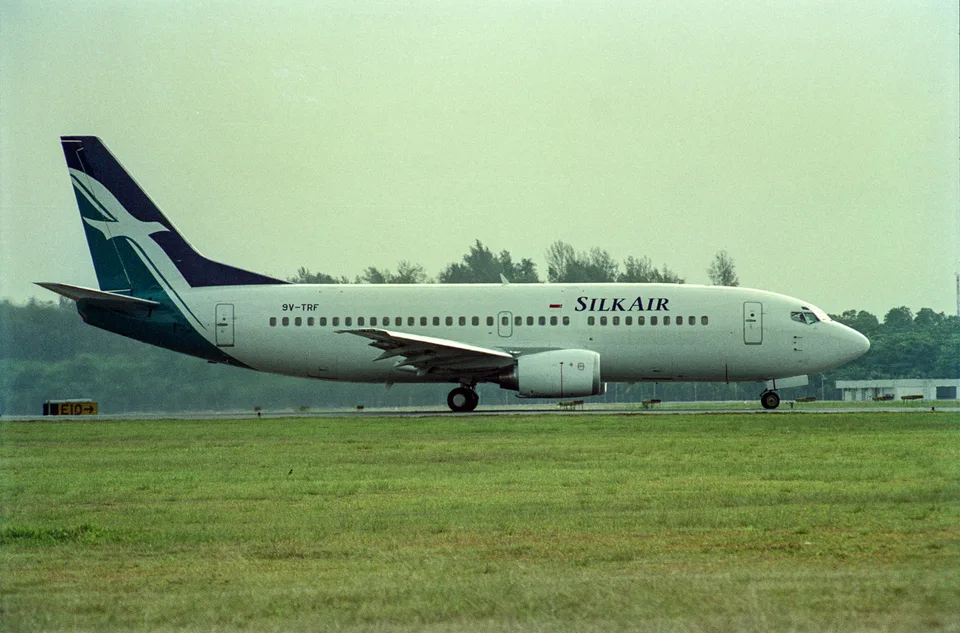
A Boeing 737 descended from 35,000 feet into the Musi River, killing all 104 aboard. Indonesia could not determine the cause; NTSB concluded that intentional pilot action explained the accident.
Original photograph unchanged. Responsive WebP copies resized without cropping.
Geographic context
Palembang reference point
PARDI reporting point
The report gives these navigation reference coordinates. MI 185 was cleared towards PARDI after reporting FL350. Impact occurred in the Musi River delta north-north-east of Palembang. Basemap: Natural Earth, public domain.Read supporting evidence
SilkAir MI 185 took off from Jakarta for Singapore and reached flight level 350. The cockpit voice recorder stopped first, followed about six minutes later by the flight data recorder. Radar then recorded a rapid descent. Parts of the tail separated in flight before impact with the Musi River. All 104 occupants died.
Read the full incident Follow what happened, from the flight to the investigation findings.
What investigators concluded
Indonesia's NTSC could not determine why the aircraft left cruise flight or why the recorders stopped. NTSB concluded that mechanical failures did not cause or contribute to the accident and that intentional pilot action explained the descent. It judged the captain the more likely source of the sustained control inputs.
SilkAir 185: the flight, recovery and disputed findings
1,561 words / about 8 minutes to read. Based on the investigation records cited below.
Jakarta to Singapore
On 19 December 1997, SilkAir flight MI 185 departed Jakarta for Singapore with 97 passengers, two pilots and five cabin crew. The Boeing 737-300, registered 9V-TRF, had flown the outward journey from Singapore normally and completed its turnaround at Soekarno-Hatta Airport. The captain was handling the aircraft when it took off from runway 25R at 08:37:13 UTC, or 15:37:13 local time. The return flight operated under instrument flight rules.
The aircraft had been registered new in Singapore in February 1997 and had accumulated 2,238.6 airframe hours. Both pilots held the required licences and medical certificates, and the investigation found that they were qualified for the flight. Its review of maintenance records identified no defect or anomaly affecting airworthiness. The aircraft climbed towards the cleared altitude of 35,000 feet while heading directly towards Palembang.
Passing flight level 245 at 08:47:23, the crew soon requested clearance directly to the PARDI reporting point. The controller initially told them to continue towards Palembang. At 08:53:17, they reported reaching flight level 350 and were cleared to PARDI, with a request to report abeam Palembang. PARDI lay near the boundary at which flights transferred from Jakarta to Singapore control.
The cockpit voice recorder stopped at 09:05:15.6 while the aircraft remained in cruise. The recording up to that point contained normal flight operations and conversations. Shortly before it ended, the captain indicated an intention to go to the passenger cabin and offered the first officer water. Investigators associated metallic sounds with a seatbelt buckle striking a metal surface. The recording contained no cockpit door opening before it stopped.
The aircraft continued communicating with Jakarta. At 09:10:18, the controller advised that MI 185 was abeam Palembang, instructed it to maintain flight level 350 and told the crew to contact Singapore at PARDI. The acknowledgment eight seconds later was the last radio transmission. Voice analysis identified the speaker as the first officer. No distress call or emergency transponder signal followed.
The last readable flight data recorder information was timed at 09:11:27.4 and showed cruise at 35,000 feet. Investigators found that a damaged portion of exposed tape represented approximately another 6.3 seconds. From its length and position they estimated that recording had continued until 09:11:33.7. Attempts at several specialist facilities failed to recover additional information from that damaged portion.
Radar recorded MI 185 at flight level 350 at 09:12:09. Eight seconds later, the next return showed the aircraft 400 feet lower. A rapid descent followed, with the last radar return at 09:12:41 indicating 19,500 feet. About a minute after that last level cruise return, the aircraft struck the Musi River delta north-north-east of Palembang. The accident occurred in daylight. NTSC found that weather and air traffic control had not contributed.
Parts of the tail separated during the descent. The aircraft was destroyed and severely fragmented by impact, with much of its wreckage penetrating the river bottom. All 104 people aboard died, and the investigation classified the accident as unsurvivable. The main wreckage lay in an area approximately 60 metres by 80 metres within a river about 700 metres wide and eight metres deep.
Recovery teams faced poor underwater visibility, strong tidal currents and debris buried in mud. Indonesian and Singapore naval divers initially searched by touch and raised pieces with ropes. After two weeks, a clam shell dredge systematically searched the riverbed down to five metres below the clay surface. Debris was washed on a barge, then taken to a hangar at Palembang Airport for cleaning, disinfection, sorting and identification.
About 73 percent of the aircraft structure and system components was recovered by weight. Many pieces were too badly damaged to provide useful evidence. Outboard portions of both horizontal stabilizers, elevator sections and rudder fragments were found on land to the east of the impact site, with some pieces several kilometres away. Investigators used their distribution, fracture surfaces and aerodynamic calculations to reconstruct the breakup.
NTSC found that the aircraft had remained structurally intact until parts of the tail separated. Examination revealed no pre-existing structural defect, in-flight fire or explosion. Recovered passenger oxygen generators had not activated, and the investigation found no indication of a rapid depressurization. Trajectory and flutter studies placed the probable tail breakup between about 5,000 and 12,000 feet, during the high speed descent.
Engine examinations indicated high rotational speed at impact and found no evidence of an uncontained engine failure. Flight and ground spoiler actuators, flap components and thrust reverser actuators were recovered in stowed or retracted positions. Examinations of the rudder, aileron and elevator power control units and the stabilizer jackscrew revealed no evidence of a malfunction before impact.
Investigators examined the main rudder power control unit in detail. They found no scratch marks on the servo valve slides or internal bores. A large force needed to remove one slide resulted from impact deformation of the valve housing. The fitted unit complied with applicable airworthiness directives and included a modification that circulated hydraulic fluid to warm the valve against thermal shock.
The last readable flight data indicated about 4.5 units of horizontal stabilizer trim. The recovered jackscrew corresponded to 2.5 units, the forward limit available through the main electric trim system with the flaps retracted. Investigators examined whether a trim runaway could account for the descent. A simulated change from 4.5 to 2.5 units took one minute and 23 seconds to descend from 35,000 to 19,500 feet. The last five radar points covered that height change in 32 seconds.
Other simulator and engineering studies tested individual primary flight control failures, including hardovers or jams of the aileron, rudder and elevator. They also examined secondary control failures, including yaw damper faults and stabilizer trim runaway. NTSC found that none of the single failures tested produced a descent history matching the radar points. The simulated aircraft could be recovered manually in those failure cases.
Manual control inputs could produce a similar flight path. Large control column inputs alone required high force, and releasing them allowed the simulated aircraft to recover through its inherent stability. Combining lateral inputs with a change to 2.5 units of stabilizer trim could also match the recorded descent. NTSC listed this combination among the possible explanations. NTSB interpreted the simulations as evidence of sustained manual inputs from the cockpit.
Divers recovered the flight data recorder on 24 December 1997. Its enclosure had partially opened, exposing the short length of tape that could not be read. The cockpit voice recorder memory module was recovered by the dredge on 8 January 1998. Its readout produced good quality recordings, and investigators verified that the available memory had been downloaded completely.
The voice recorder had functioned normally before stopping. Investigators considered power interruption, a short circuit, overload, a pulled circuit breaker and broken wiring. Other systems on its electrical bus continued supplying data to the flight data recorder for about six minutes. Tests showed that a short circuit or overload would create a distinctive recorded sound; that sound was absent from the accident recording.
The two authorities interpreted the remaining possibilities differently. NTSC concluded that cockpit noise obscured the sound of manually pulling the circuit breaker in tests, and it could not determine the reason for either recorder stoppage. NTSB judged the voice recorder shutdown consistent with intentional disconnection. It noted that the recorder circuit breaker panel was behind the captain's seat and that his movements immediately before the recording ended put him in the best position to reach it.
Indonesia's NTSC issued its final report on 14 December 2000. It concluded that the limited usable wreckage and the absence of recordings of the final descent prevented it from determining why the aircraft left cruise altitude or why the recorders stopped. It therefore left the accident cause undetermined. Its findings included the lack of evidence of pre-impact control system malfunctions and the possibility of a flight path matching combined manual control and trim inputs.
NTSB, participating for the aircraft's state of design and manufacture, submitted a chairman's letter and detailed comments on 11 December 2000. It concluded that no aircraft mechanical malfunction or failure caused or contributed to the accident, and that intentional pilot action explained it. NTSB found that recovery had been possible but had not been attempted. It cited sustained nose-down inputs, the trim setting, high engine power and the lack of evidence of speed reduction.
NTSB considered the captain more likely than the first officer to have made the inputs, while acknowledging that the pilot responsible could not be determined with certainty. Its assessment cited the captain's professional setbacks and financial difficulties and disputed the weight NTSC gave the human performance evidence. NTSC found no basis to link the captain's stock trading to his performance as a pilot.
Recommendations and the disagreement over prevention
NTSC recommended reviewing recorder design to improve continuity of recording and secure attachment of underwater locator beacons. It also called for recording the displays seen by pilots, reviewing training for high speed upsets, and examining automatic flight systems that could constrain excessive speed and descent rate. A further recommendation sought regional cooperation so states with limited investigation resources could obtain rapid assistance.
NTSB challenged the recorder shutdown and upset training recommendations in the draft report. It considered the shutdown evidence consistent with circuit breaker removal and found that both pilots already possessed the training needed to recover from an unexpected upset. Its comments linked the prevention disagreement to its conclusion that the departure from cruise was intentional.
A simplified reading of the investigation findings. The sequence does not replace the full report or imply that every contributing factor is shown.
Sequence of events
Times are UTC, based on the final report's flight data recorder time reference. Local time in South Sumatra was UTC plus seven hours. Expand an event to see its evidence.
08:37:13Departure from Jakarta
MI 185 took off from runway 25R with the captain handling the aircraft.
NTSC attributed the stoppages to loss of electrical supply but could not determine why that supply was lost. NTSB concluded that the voice recorder was probably disconnected intentionally and that pulling a circuit breaker could also explain the flight data recorder stoppage.
Why did the investigations reach different conclusions?
NTSC could not determine the cause from the available wreckage and recordings. NTSB concluded that the flight profile, trim position, recorder stoppage evidence and human performance findings supported intentional pilot action, most likely by the captain.
NTSB judged the captain more likely to have made the control inputs and acknowledged that the responsible pilot could not be identified with certainty.
Matching dossiers for Flight recorders stopped: No other dossier in this collection.
Read alongside
These comparisons connect specific research topics. Shared circumstances do not establish identical causes. Evidence from both investigations is provided below.
Both investigations examined a descent attributed to intentional pilot action by an official authority. BEA found that Germanwings 9525's co-pilot deliberately initiated a controlled descent while alone in the cockpit, with the autopilot engaged until impact. SilkAir 185 involved a rapid descent after both recorders had stopped; NTSB attributed it to intentional manual inputs, while NTSC could not determine the cause.
Explore the records below for additional context. They open on the publisher's site and are not all included in our report search. Source reuse terms apply.
Private evidence cache. Only short attributed quotations in original commentary; full report and third-party illustrations are not redistributed. Source terms.
Kevin Murphy writes the incident accounts on AirlineIncidents.com, out of a long interest in aviation safety and the lessons each investigation leaves behind.
Prepared by
AirlineIncidents editorial desk
Report citation check
Independent expert review
Not completed
Citation checks compare supporting text with the indexed report pages. They do not constitute independent expert review. How these pages are prepared.
Revision history
: Indonesia's final investigation and NTSB's separate findings address the flight sequence, recovered evidence and disputed cause.