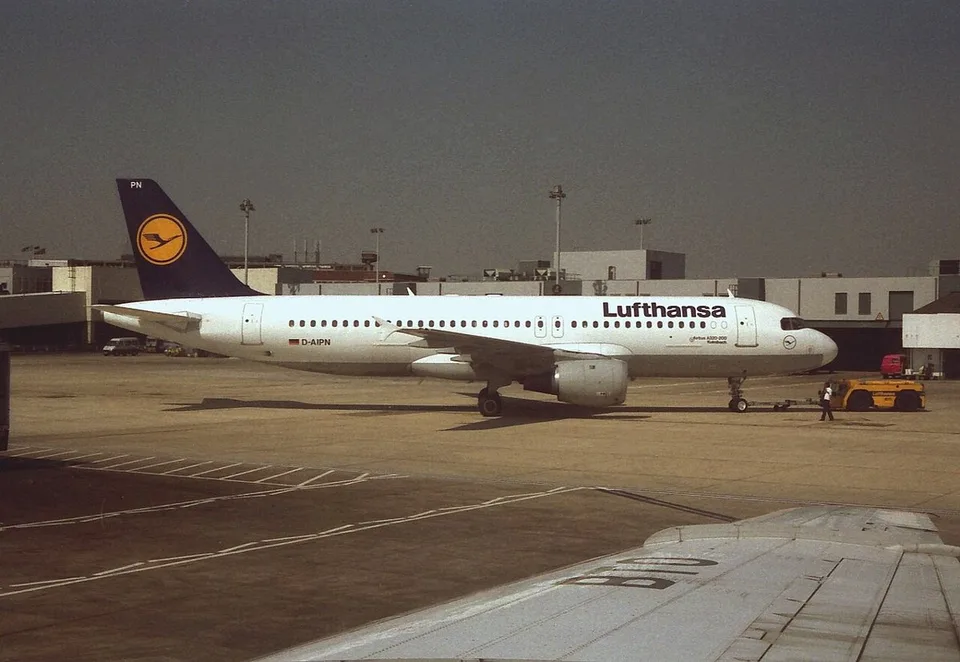
A different aircraft and operator from Germanwings 9525. This photograph illustrates the A320 type only; it shows neither D-AIPX nor the accident location.
Resized and JPEG recompressed; no content changes. Responsive WebP copies resized without cropping.
Geographic context
Barcelona departure
Dusseldorf intended destination
Approximate airport markers for the intended route, not an accident flight track or navigation chart. Basemap: Natural Earth, public domain.Read supporting evidence
After the captain left the cockpit, the co-pilot selected a low altitude and the aircraft descended on autopilot. Radio calls and requests for cockpit access went unanswered. The aircraft struck terrain in the French Alps, killing 150 people.
Read the full incident Follow what happened, from the flight to the investigation findings.
What investigators concluded
BEA attributed the collision to the co-pilot's deliberate, planned action. It found that medical self-reporting and information pathways failed to prevent an unfit pilot from flying, and that security door design prevented cockpit re-entry.
A commanded descent and failed protective barriers
1,502 words / about 7 minutes to read. Based on the investigation records cited below.
The second flight of the day
Germanwings flight 9525 was scheduled to fly from Barcelona to Dusseldorf on 24 March 2015. The Airbus A320-211, registered D-AIPX, carried 144 passengers and six crew members. Its radio callsign was GWI18G. The same crew had flown the outbound journey from Germany, landing in Barcelona at 07:57 UTC. The accident flight took off from runway 07R at 09:00. The co-pilot was pilot flying. This account uses the report's UTC convention rather than mixing the recorded times with local clock readings.
Autopilot and autothrust were engaged during the climb. The cockpit recording documented ordinary crew exchanges, including a flight attendant's visit and discussion of the departure delay. The aircraft levelled at 38,000 feet at 09:27:20. It was in contact with Marseille control and received clearance towards waypoint IRMAR. The captain acknowledged that clearance at 09:30. It was the final transmission from the flight to air traffic control. BEA's findings describe a functioning aircraft undertaking a normal scheduled operation before the deliberate descent.
The investigation also reviewed the earlier flight from Dusseldorf. It found that several selected-altitude changes towards 100 feet occurred while the co-pilot was alone in the cockpit during descent on that flight. The aircraft nonetheless landed at Barcelona. This earlier evidence was included in the final report's reconstruction, not introduced through a later secondary account. It contributed context for the investigation while leaving the accident-flight recorder sequence as the direct evidence of how the fatal descent was commanded.
At 09:30:08, the captain told the co-pilot he was leaving the cockpit and asked him to handle radio communications. The co-pilot acknowledged. Seat movements and the sounds of the cockpit door opening and closing were then recorded. By 09:30:24, the captain was out of the flight compartment. Those timings establish the sequence without adding invented dialogue beyond what the official investigation documented. They also identify when the normal two-pilot arrangement ceased to provide direct supervision within the cockpit.
At 09:30:53, the selected altitude changed in one second from 38,000 feet to 100 feet, the minimum available selection. The autopilot changed to open-descent mode and autothrust selected idle thrust. The aircraft began descending. Subsequent speed selections changed the target speed and affected the descent rate. This was a commanded flight path carried out by working aircraft systems. BEA did not describe a technical failure forcing an uncontrolled dive. Its final conclusion attributed the command and continued descent to the co-pilot's deliberate action.
The distinction between an automation command and a system malfunction is important to this account. An autopilot can accurately follow an unsafe selected target if the commanded path is itself unsafe. The flight recorders supplied evidence of mode changes, selected values and aircraft response. The investigation combined that evidence with the cockpit recording and the absence of response to others. It therefore reached a finding about intentional action through the documented sequence, rather than from a general inference that a silent pilot or a descending aircraft must indicate intent.
The controller first queried the aircraft's cleared cruise level while it was already descending through about 30,000 feet. Further calls went unanswered. During the descent, Marseille control called on multiple frequencies and the French military defence system also attempted contact. The final findings record eleven civil control calls and three military attempts without a reply. The cockpit recording contained the access-request buzzer, interphone calls and noises resembling forceful blows against the cockpit door. None resulted in the captain regaining access.
The aircraft's cockpit door had been designed to resist forcible entry by unauthorised people. That security barrier prevented entry during this event. BEA identified this consequence explicitly: security requirements made it impossible to enter the compartment before impact. A system intended to protect pilots from external intrusion was being considered in a different failure condition, with unsafe action originating inside the secured cockpit. The report does not make this a generic argument that security doors should simply be removed; it describes the barrier's effect in the investigated sequence.
The autopilot and autothrust remained engaged until the recordings ended. A recorded right-sidestick input before impact was insufficient to disengage the autopilot. Ground-proximity and other warnings sounded as the aircraft approached terrain. The collision occurred at 09:41:06 UTC in the French Alps. All 150 occupants died. This chronology gives the established result and the documented failure of re-entry attempts without embellishing the cabin scene, reconstructing unrecorded conversations or inventing the emotional experiences of people aboard.
BEA examined the co-pilot's medical certification history and information held by healthcare providers. His class-one medical certificate had been issued in 2008. A depressive episode delayed renewal in 2009, after which a waiver imposed special conditions. The medical certificate was subsequently renewed or revalidated, and the examiners were aware of the earlier history. The waiver did not require regular specific psychiatric assessments or reduce the interval between periodic examinations. The investigation considered how that certification process functioned rather than treating possession of a certificate as proof that every later change in fitness would be detected.
Between December 2014 and the accident, the report found that the co-pilot experienced a mental disorder with psychotic symptoms. He consulted healthcare providers and received medication, but did not contact an aeromedical examiner about the deterioration. No healthcare provider reported aeromedical concerns to the authorities, and no aviation or other authority was informed of his mental state. The report also found no recorded concern from pilots who had flown with him. These findings explain the information gaps relevant to aviation oversight without requiring publication of unnecessary personal medical detail.
The final cause statement connected deliberate action with a failed protective process. Medical certification, particularly self-reporting when fitness decreased between examinations, did not prevent the co-pilot from exercising his licence. The report did not claim that all mental illness predicts intentional harm or that every person seeking treatment poses a flying risk. Its safety analysis was directed at this specific deterioration, the information that did not reach decision-makers and the barriers that might allow an affected pilot to obtain help and cease flying when necessary.
BEA said several factors may have contributed to failure of the self-reporting principle. They included probable fear of losing the ability to fly professionally, potential financial consequences from insufficient loss-of-income protection, and unclear German guidance on when public safety outweighed medical confidentiality. The words probable and potential are part of the finding. They distinguish reasoned interpretation from a recorded statement of the co-pilot's thinking. An account that turns those factors into certain private motives would be stronger than the source permits.
The report treated medical confidentiality as a safety-system question rather than a simple choice between absolute secrecy and unrestricted disclosure. Healthcare providers needed clear guidance about serious threats, while pilots needed credible routes to seek treatment and support. The investigation also considered the consequences of losing flying privileges. A system that makes disclosure seem professionally or financially catastrophic may discourage it. That is the context for recommendations linking medical evaluation, financial protection, support programmes and the exchange of relevant information.
BEA did not endorse routine intensive psychological testing as an effective universal answer. Its recommendations discussion stated that most aeromedical experts considered such general screening inappropriate and not productive or cost effective. It instead described potential value in more specific evaluation for pilots with an identified history, together with additional examiner training. This distinction matters because an accident involving deliberate action can invite overly broad preventive claims. The report supports a connected, targeted response, not a promise that a single screening test could identify every future unsafe action.
The final report was published on 13 March 2016 and issued eleven safety recommendations. They addressed medical evaluation, analysis of incapacitation, consequences of loss of licence, medication and flying status, confidentiality boundaries and pilot support. BEA emphasised the interdependence between medical certification and assistance to pilots facing the risk of losing their licence. It said the recommendations should be viewed as one comprehensive package and implemented together, warning that isolated or partial implementation could fail to produce the expected benefit.
That recommendation structure reflects the accident's combination of barriers. The aircraft systems worked, the selected descent was unsafe, the cockpit door prevented re-entry and the medical information pathways had not stopped the co-pilot flying. The report therefore examined technical security requirements alongside organisational and medical safeguards. It did not present a new aircraft defect as the initiating cause. Nor did it treat recommendation recipients as automatically responsible for the accident; the report explicitly notes that a safety recommendation does not create a presumption of fault or liability.
The resulting report-based account is direct about BEA's finding of deliberate, planned action while careful about the surrounding qualifications. It preserves recorded times, selected commands, unanswered calls and the established outcome. It attributes medical-system findings to the investigation and does not generalise them into a claim about an entire group of people. The recommendations are described as they stood at publication, with no claim of current implementation. The account ends with the documented protective failures and proposed improvements, not with speculation about unrecorded final moments.
Matching dossiers for Cockpit security door: No other dossier in this collection.
Read alongside
These comparisons connect specific research topics. Shared circumstances do not establish identical causes. Evidence from both investigations is provided below.
Germanwings 9525 and Air France 447 both required careful use of recorder evidence to understand flight-deck actions. Germanwings involved an intentional descent with functioning automation; AF447 involved an unintended loss of control and findings about training and recognition. Intentional action must not be conflated with the AF447 mechanism.
Explore the records below for additional context. They open on the publisher's site and are not all included in our report search. Source reuse terms apply.
Official English translation, 13 March 2016; French original is the reference work
Sources and transparency
Checked against cached official report pages and specified official comments. No independent expert review.
Source limitations
The cause is attributed to BEA. Its medical and contributing-factor conclusions retain qualified wording. This account avoids inferred dialogue or a general claim about people with mental illness.
Final report: Germanwings Airbus A320-211 D-AIPX
BEA Official English translation, 13 March 2016; French original is the reference work
Private evidence cache. Only short attributed quotations in original commentary; full report and third-party illustrations are not redistributed. Source terms / provenance.
Final Report: Accident on 1st June 2009 to the Airbus A330-203 registered F-GZCP operated by Air France flight AF 447
Bureau d'Enquetes et d'Analyses (BEA) English final report, 5 July 2012
Limited quotations for source-based commentary. Full report and illustrations are not republished. Wider reuse requires checking BEA terms. Source terms / provenance.
Kevin Murphy writes the incident accounts on AirlineIncidents.com, out of a long interest in aviation safety and the lessons each investigation leaves behind.
Prepared by
AirlineIncidents editorial desk
Report citation check
Independent expert review
Not completed
Citation checks compare supporting text with the indexed report pages. They do not constitute independent expert review. How these pages are prepared.
Revision history
: Private landmark Wave 1 original account; final report and specified comments cited.