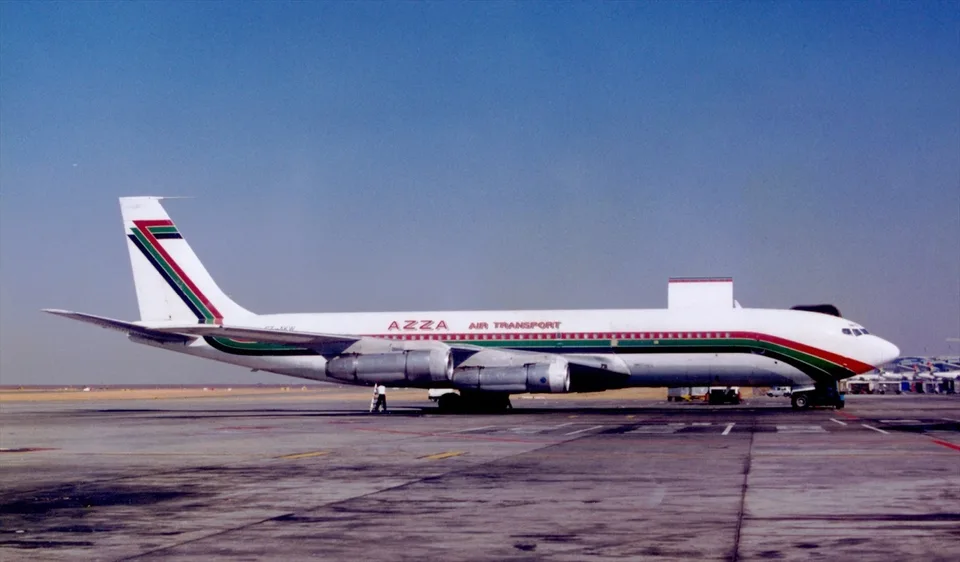
Original photograph retained at its supplied dimensions. Responsive WebP copies resized without cropping.
Geographic context
Sharjah accident area
Khartoum, planned destination
The cargo flight departed Sharjah for Khartoum and crashed about one minute after liftoff. The accident-area coordinates are rounded in the report; the Khartoum marker is an approximate airport reference. Basemap: Natural Earth, public domain.Read supporting evidence
The No. 4 engine core cowls separated shortly after takeoff. A detached hinge support severed the engine pressure-sensing line, producing a misleading low EPR indication. The crew reported an engine loss and attempted to return. The aircraft entered a steep right bank, stalled and struck the ground. All six occupants died.
Read the full incident Follow what happened, from the flight to the investigation findings.
What investigators concluded
The GCAA linked the accident to cowl separation, the disconnected EPR line, a probable inappropriate crew response to perceived power loss, a stall after the bank limit was exceeded and an unrecoverable loss of control. Chronic cowl defects, poor repairs and weaknesses in maintenance, quality and regulatory oversight contributed.
1,874 words / about 9 minutes to read. Based on the investigation records cited below.
A cargo departure for Khartoum
On 21 October 2009, Boeing 707-330C ST-AKW prepared to leave Sharjah International Airport for Khartoum as cargo flight SUD 2241. Six people were aboard: the captain, co-pilot and flight engineer, a ground engineer and two loadmasters. Azza Air Transport owned the aircraft and had wet-leased it to Sudan Airways under an agreement signed on 27 April 2009. Azza retained responsibility for the aircraft, crew, maintenance and insurance. Sudan Airways paid operational expenses, including fuel and airport charges. The GCAA names Azza Air Transport as the operator.
The co-pilot requested engine start and pushback at 11:08:45 UTC. After taxi instructions and a delay at the holding point, the tower directed the aircraft onto runway 30. At 11:27:20, the departure clearance was amended to a climb on runway track to 2,000 feet. Fourteen seconds later, the controller cleared the flight for takeoff and reported a surface wind of 320 degrees at 10 knots. The crew read back the clearance correctly. The departure took place in daylight and visual weather conditions. Investigators found no significant weather event affecting the flight.
The aircraft initially climbed normally. Approximately 15 seconds after liftoff, at about 300 feet above ground, the core cowls of the No. 4 engine separated and fell onto the departure runway. An airport surveillance camera recorded the falling object. The camera showed normal exhaust smoke during the initial climb, and the investigation found the fire damage consistent with the fire after impact.
At 11:29:19, the co-pilot told the tower that the aircraft was returning after losing No. 4 engine. The controller activated the crash alarm and advised that both runways were available. There was no further response from the crew. The aircraft turned right, banked increasingly steeply and descended into the ground about one minute after liftoff. Its right wing was approximately vertical at impact. All six occupants died, and impact forces and fire destroyed the aircraft.
Only six radar returns were available. They placed the aircraft at approximately 380 feet above ground with a ground speed of about 149 knots before the returns stopped. The surveillance camera temporarily lost sight of the aircraft; when it reappeared it was in an extreme right bank and steep dive. The ATC and video clocks differed, so investigators compared common events and calculated intervals to establish that the cowls separated before the reported engine loss.
The Boeing 707 used engine pressure ratio, or EPR, as its primary indication for setting thrust on the JT3D engines. The system compared pressure at the exhaust with pressure at the inlet. Exhaust-pressure probes fed a manifold, and a flexible line carried that pressure signal towards a transmitter in the engine pylon. The transmitter converted the pressure ratio into the electrical signal displayed on the cockpit gauge.
When the No. 4 engine cowls separated, a piece of hinge support structure tore from the pylon and struck the flexible exhaust-pressure line behind it. The line disconnected from the manifold. The transmitter consequently received ambient pressure inside the nacelle and would have driven the cockpit indication to about 1.05. Investigators concluded that the crew probably interpreted the low indication as a loss of engine power.
Examination of the recovered No. 4 EPR gauge found disturbed paint around 1.05, consistent with its pointer striking the dial during impact. Its target-setting window showed 1.78. These marks provided physical support for the misleading indication even though the aircraft's recorders supplied no usable accident-flight data.
Investigators dismantled No. 4 engine and examined its compressors, combustion chambers and turbines. Damage to the rotating components was consistent with high-speed rotation at impact. The examination found no pre-existing damage or failure that would have prevented normal engine operation. The fuel-control units also showed no internal distress attributable to a malfunction before impact, although the available evidence could not establish the engines' precise power settings.
The No. 4 core thrust reverser was partly deployed when recovered. Detailed examination traced that position to the impact sequence. The left clamshell had been forced beyond its normally stowed position and jammed. Damage to the right clamshell seal, actuator scoring and fractured drive components showed movement after impact. The GCAA concluded that the reverser had been stowed before impact. Pratt & Whitney's reconstruction, appended to the final report, described how further ground contact disengaged the locking mechanism and drove the sleeve and right clamshell towards deployment.
The investigation also examined the flight controls and airframe. It found no failure of a primary or secondary flight-control surface explaining the loss of control. The additional drag from the missing cowls was insufficient to produce a significant yawing force or other controllability difficulty.
The published engine-failure procedure assigned the flying pilot the task of maintaining directional control while the other crew members verified the engine problem and carried out checklist duties. With 14 degrees of flap, bank was limited to 15 degrees until the aircraft reached V2 plus 10 knots. A bank of 30 degrees was permitted after that speed. The GCAA found that ST-AKW increased its bank rapidly before reaching the required speed.
The investigation reconstructed a turn towards the airport during which the aircraft began losing altitude. Its analysis indicated that thrust was probably not increased at the start of the turn to compensate for the increased drag. A pilot witness described a rapid nose-up movement and an increase in engine noise as the bank steepened. Investigators could not determine whether the increase in thrust or the nose-up control input came first.
The GCAA judged that a sudden nose-up response probably produced an accelerated stall. In a banked turn, the additional lift needed to support the aircraft raises the load factor and stall speed. The right wing dropped farther, control effectiveness diminished and the aircraft entered an unrecoverable loss of control at very low altitude. The final report identified a stall after the published maximum bank angle was exceeded as one of the causes.
Boeing used the six radar returns, the impact position, weather information, loadsheet and wreckage configuration to simulate the flight. The recovered flap mechanisms indicated 14 degrees and the landing gear was retracted. A simulation with all engines operating and another with one engine out both produced greater climb performance than the radar track when moderate bank angles were used. The engine-out case retained sufficient rudder authority to balance the yawing moment.
To approximate the final radar position and impact location, the simulation applied a large right control-wheel input. This was a hypothetical input used in the reconstruction. The available radar and wreckage evidence could not reveal the actual control movements. The simulation also used an assumed airspeed of V2 minus 5 knots, while the report's calculation from the final ground speed and wind produced about 160 knots, above that assumption.
The GCAA considered it probable that the crew concentrated on the erroneous EPR indication and made its decision to return with incomplete information. The precise cockpit sequence in the final seconds remained unknown. The final causes therefore describe the crew response as probably inappropriate.
The recovered cowls showed repeated misalignment, distorted fittings, latches with weakened spring loading and numerous repairs below aviation standards. Marks beside the alignment-pin holes showed repeated difficulty engaging the halves. The hinge support carried a weld repair, a missing roller and material differing from its design specification. Investigators found fatigue striations but concluded that fatigue had not caused the support to separate.
The preceding C3 check had generated a non-routine card recording that No. 4 engine's cowl was very difficult to open and close. The recorded response described a slight twist and adjustment. The later B check, completed on 25 July 2009, recorded checking and necessary repairs without details of the damage or repair. The GCAA judged the cowl defect chronic and probably older than the C3 check. It found that successive inspections had failed to diagnose and correct it.
The Egyptian Civil Aviation Authority disputed the proposed timing in comments reproduced in Appendix C. It pointed to the B-check repair entry as indicating damage after the C check and challenged the need for an unairworthy-condition report during the earlier check. The GCAA amended its analysis after receiving those comments and retained its final findings on chronic damage, inadequate troubleshooting and reporting. The final report also found that Azza's maintenance department had received no documented request for help with the persistent cowl problem.
Both recorders were recovered and sent to the UK Air Accidents Investigation Branch. The cockpit voice recorder contained tape, but it was absent from the recording path and heads. The inner end had been tucked into the reel and the two ends did not match. Playback yielded 23 minutes 46 seconds of audio from another flight. No recording of the accident flight was available.
The flight data recorder used engraving metal foil, a type that international and Sudanese standards had required to be discontinued by 1 January 1995. Its remaining-hours indicator read zero. All foil was on the take-up spool, and examination showed that it had been reused many times. The GCAA considered it very unlikely that the recorder had been operating during the accident.
The operator's cockpit checklists contained no CVR or FDR checks. The maintenance system and the last C3 check had failed to identify the disconnected CVR tape and exhausted FDR foil. These failures deprived investigators of recorded cockpit activity and aircraft flight parameters.
The SCAA had audited the operator on 12 October 2009, nine days before the accident. Findings included an unapproved operations manual, missing quality-audit arrangements and absent annual and crew training programs and records. The audit letter required no response deadline, and no corrective actions had been submitted before the accident. Investigators found that the regulator's follow-up had failed to secure compliance.
The crew held the required licences and certificates, but training records were incomplete. Investigators could not review Azza's engine-out training policy or the crew's previous performance in such events. Skill-test forms included unusual-attitude recovery, but the GCAA considered the pilots' training and testing probably insufficient to prepare them for recovery in flight.
The final report attributed contributing factors to deficient cowl repairs, the operator's maintenance and quality systems, the maintenance organization's inspection and reporting, and SCAA oversight. It also found that UAE regulations at the time lacked adequate provisions for proactively assessing foreign aircraft airworthiness. After the accident, the GCAA established a department dedicated to foreign-operator oversight.
The GCAA issued final report 10/2009 dated 12 March 2013. Its causal sequence began with the departure of the No. 4 core cowls and the disconnection of the exhaust-pressure line. It continued through the probable inappropriate crew response to the perceived engine loss, a stall after the bank limit was exceeded and an unrecoverable loss of control.
Early recommendations SR 26/2009 and SR 27/2009 addressed recorder installations, operation and maintenance. The final report recorded that the SCAA had begun corrective action on 19 November 2009. Seven recommendations accompanied the final report. Four asked the SCAA to strengthen oversight, maintenance management, operations management and quality systems, including defect records, functional recorders and maintained crew-training programs.
Recommendation SR 05/2013 asked the Egyptian Company for Aircraft Maintenance to improve troubleshooting, corrective repairs and reporting of unairworthy conditions. The two recommendations to the UAE GCAA addressed aviation pathology examinations and a more proactive regulatory approach to foreign operators.
Follow the main stages, then open the evidence beneath each step.
1
Cowl attachment fails
The GCAA reconstructed a likely sequence in which air loads and vibration acted on improperly latched cowls. Aft latch supports failed, and the cowls pulled free of the pylon.
The aircraft banked beyond its procedural limit. A probable sudden nose-up response produced an accelerated stall and loss of control close to the ground.
A simplified reading of the investigation findings. The sequence does not replace the full report or imply that every contributing factor is shown.
Sequence of events
UTC. UAE local time was UTC plus four hours. ATC and surveillance-video clocks differed; elapsed flight times are approximate. Expand an event to see its evidence.
11:08:45Start and pushback requested
The co-pilot requested start and pushback for cargo flight SUD 2241 to Khartoum.
The GCAA final report identified the cowl and sensing-line failures, probable crew response, stall and loss of control, and issued seven final recommendations.
Separation of the engine cowls and their hinge support severed the exhaust-pressure sensing line. The EPR transmitter then received nacelle ambient pressure and would have indicated about 1.05. The GCAA found that the crew probably interpreted this as an engine failure; the engine examination showed high-speed rotation at impact.
Was there a cockpit voice recording of the accident flight?
The CVR contained no accident-flight recording. Its tape was disconnected from the recording path and heads. The recovered audio lasted 23 minutes 46 seconds and related to another flight.
Repeated alignment-pin marks, deformed fittings and latches that had lost spring loading showed persistent difficulty closing the cowls. Numerous skin repairs fell below aviation standards. The GCAA concluded that the defect was chronic and probably predated the last C3 check.
The cowl examination could not establish whether every alignment pin and latch was engaged before takeoff. The GCAA reconstructed improper latching as the most likely separation sequence.
The GCAA judged that the chronic defect probably predated the C3 check. The Egyptian authority disputed that timing and cited the later B-check repair entry.
Actions and recommendations are described at the dates of the cited records. A recommendation is not proof of implementation.
Recorder corrective action
The GCAA issued prompt recommendations SR 26/2009 and SR 27/2009 on recorder installation, operation and maintenance. The report records that the SCAA began corrective action on 19 November 2009.
The GCAA established a foreign-operator oversight department after the accident. SR 06/2013 addressed aviation pathology examinations, and SR 07/2013 sought more proactive foreign-operator safety regulation.
These comparisons connect specific research topics. Shared circumstances do not establish identical causes. Evidence from both investigations is provided below.
Both investigations examined engine-related indications followed by loss of control shortly after takeoff. At Sharjah, the GCAA found that a severed sensing line probably led the crew to perceive an engine failure; No. 4 engine was operating at impact. In TransAsia Airways 235, an uncommanded autofeather affected engine No. 2, and the crew reduced power on and shut down the operative No. 1 engine. The ASC found that the aircraft stalled during the attempted restart at an altitude from which recovery was impossible.
Explore the records below for additional context. They open on the publisher's site and are not all included in our report search. Source reuse terms apply.
Flight history, physical examinations, analysis, conclusions and safety recommendations, with Egyptian authority comments and the Pratt & Whitney reverser reconstruction in appendices.
Sources and transparency
GCAA final report 10/2009 is dated 12 March 2013.
Source limitations
Neither recorder provided usable accident-flight data. The precise engine power settings and cockpit actions could not be reconstructed.
Aircraft Crash After Takeoff: Boeing 707-330C ST-AKW, Azza Air Transport, Sharjah, 21 October 2009
UAE General Civil Aviation Authority, Air Accident Investigation Sector Final report 10/2009, dated 12 March 2013
GCAA report linked for investigation findings. Short source quotations only; report photographs and diagrams are excluded from image reuse. Source terms.
Kevin Murphy writes the incident accounts on AirlineIncidents.com, out of a long interest in aviation safety and the lessons each investigation leaves behind.
Prepared by
AirlineIncidents editorial desk
Report citation check
Independent expert review
Not completed
Citation checks compare supporting text with the indexed report pages. They do not constitute independent expert review. How these pages are prepared.
Revision history
: Final investigation report 10/2009, dated 12 March 2013.