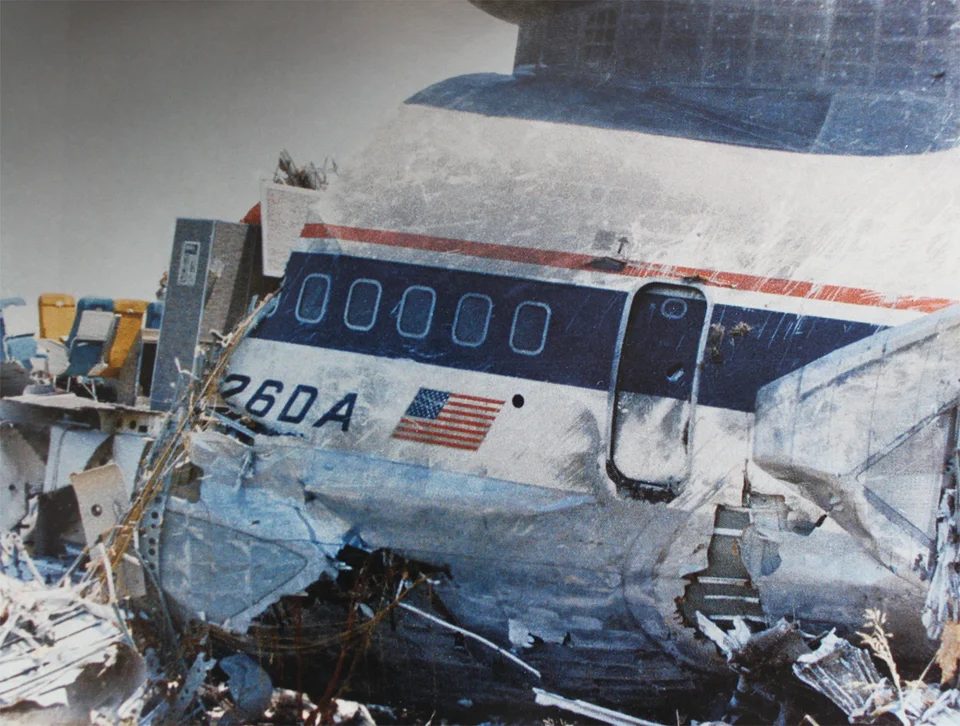
A rapidly developing thunderstorm put severe microburst wind shear across the final approach to Dallas/Fort Worth. Delta 191 struck the ground, a highway and airport water tanks.
Original photograph unchanged. Responsive WebP copies resized without cropping.
Geographic context
Fort Lauderdale departure
Dallas/Fort Worth intermediate destination
Accident north of runway 17L
Flight 191 was travelling from Fort Lauderdale to Los Angeles with a stop at Dallas/Fort Worth. The report places the accident at 32 degrees 55 minutes north, 97 degrees 01 minute west. Basemap: Natural Earth, public domain.Read supporting evidence
Flight 191 entered the rain shaft of a thunderstorm on approach to runway 17L. Increasing headwind was followed by downdrafts, airspeed losses and violent wind reversals. The crew applied high thrust and attempted a go around, but the aircraft touched down short of the runway, struck a car and airport water tanks, and broke apart.
Read the full incident Follow what happened, from the flight to the investigation findings.
What investigators concluded
The NTSB identified the decision to continue into a thunderstorm with visible lightning, inadequate guidance and training for avoiding and escaping low altitude wind shear, and the lack of definitive hazard information in real time as probable causes.
1,648 words / about 8 minutes to read. Based on the investigation records cited below.
Weather avoidance before Dallas
Delta Air Lines flight 191 left Fort Lauderdale on 2 August 1985 with 152 passengers and 11 crew members. The Lockheed L-1011-385-1, registered N726DA, was operating a scheduled passenger service to Los Angeles with a stop at Dallas/Fort Worth International Airport. Its dispatch forecast included scattered showers and thunderstorms around Dallas. The crew reviewed the supplied weather information before departure.
After the flight passed New Orleans, a line of weather along the Texas and Louisiana gulf coast intensified. The crew changed to the more northerly Blue Ridge arrival to avoid the developing weather. Arrival sequencing then required a hold of about 10 to 15 minutes at Texarkana. During the subsequent descent, the captain rejected a suggested course through a substantial weather cell and requested a route around it. Air traffic control supplied another heading, then cleared the aircraft direct to Blue Ridge.
The aircraft was within its landing weight and centre of gravity limits. Its calculated reference approach speed with landing flaps was 137 knots indicated. It had about 28,000 pounds of fuel when the approach began, including fuel for the alternate airport at San Antonio and the required reserve. The flight planning figures allowed about 20 minutes of holding near Dallas before departure for the alternate. The aircraft also carried weather radar that displayed precipitation returns.
The arrival information the crew received described calm surface wind and visual approaches in progress. Conditions changed as the flight approached Dallas. The approach controller broadcast that a rain shower lay just north of the airport and that instrument approaches were beginning. Flight 191 was sequenced behind a Learjet for runway 17L. At 18:02:35 the controller cleared it for the instrument landing system approach, directing it to join the localizer at or above 2,300 feet.
The controller successively requested lower approach speeds as the aircraft closed on the airport. A transmission at 18:03:30 described variable winds caused by the shower north of Dallas/Fort Worth. After the crew contacted the tower, flight 191 received landing clearance and a surface wind report of 090 degrees at 5 knots, gusting to 15. The before landing checks confirmed the landing gear down and the flaps at 33 degrees.
At 18:04:18 the first officer reported lightning from the cloud ahead. The captain asked where it was, and the first officer identified it directly ahead of the aircraft. The approach continued beneath that thunderstorm. The NTSB found that the lightning observation, together with the other weather information available to the crew, was sufficient to identify a thunderstorm between the aircraft and the airport. The north side of the cell was visible from the aircraft.
At 18:05:05 the aircraft was about 875 feet above the ground on the glideslope, flying at 150 knots indicated, when its headwind began to increase. The increase accelerated over the following seconds. Indicated airspeed rose to about 173 knots, and the first officer retarded the throttles. By 18:05:15 all three engines were at or close to flight idle. He also made pitch corrections as the aircraft moved through the changing airflow.
A strong downdraft followed. As heavy rain began, the captain warned the first officer to watch the airspeed and then anticipated a sudden loss. The performance analysis identified a loss of 44 knots of indicated airspeed in 10 seconds through the increasing headwind, downdraft and subsequent decreasing headwind. The captain ordered a large power increase. The NTSB found that he quickly recognized the manifestations of wind shear and knew the actions used to regain the glideslope.
At about 18:05:29, near 650 feet above the ground, the decreasing headwind reversed and airspeed rose from about 129 to 140 knots. Thrust was reduced as the airspeed increased, and the aircraft briefly stabilized on the glideslope. The NTSB concluded that the crew probably believed it had passed through the worst of the disturbance and would soon emerge from the rain. Their simulator experience had included successful passages through a headwind, downdraft and decreasing headwind sequence.
Within seconds the aircraft entered another severe disturbance, identified in the reconstruction as a vortex ring. Airspeed fell from 140 to 120 knots, the vertical wind reversed, and a lateral gust caused a rapid roll to the right. The first officer needed almost full lateral control to level the wings. Rapid changes in angle of attack most likely activated the stickshaker briefly. The NTSB concluded that a reflexive forward push on the control column drove the aircraft to a nose down attitude of about 8.5 degrees. Its descent rate briefly approached 5,000 feet per minute.
The crew applied maximum thrust before the aircraft departed rapidly below the glideslope. At 18:05:44 the ground proximity warning system sounded, and the captain called for takeoff and go around guidance. Further warnings followed. The first officer applied substantial nose up control, then relaxed the pull as the stickshaker activated again. Flight 191 made initial ground contact at 18:05:52, about 6,300 feet before the approach end of runway 17L. The shallow tyre marks showed that the descent had almost been arrested.
The aircraft became airborne again before striking a car on State Highway 114. The motorist was killed. Highway light standards were knocked down, and fire developed near the left wing root. The aircraft continued onto the airport, struck the water tanks and broke apart. The forward and middle cabin were destroyed by impact and fire. The rear fuselage and tail separated and came to rest beyond the tanks.
The NTSB found that the engines had neither failed nor malfunctioned. Examination of the thrust reverser components indicated selection of reverse thrust at or immediately after the first touchdown, followed by selection of forward thrust during the impact sequence. Investigators could not determine whether that return to forward thrust was deliberate or resulted from impact forces moving a pilot's hand. The Board found that the selection and withdrawal of reverse thrust contributed neither to the accident nor to the severity of the impact.
The storm north of the airport developed rapidly. Its radar echo intensified from level 1 to level 4 between 17:52 and 18:00. The NTSB reconstructed a microburst about 3.4 kilometres across, with at least 73 knots of horizontal wind shear. Flight 191 passed through the microburst and the vortex flow on its southern side. The reconstructed windfield contained repeated reversals of vertical airflow.
The Low Level Wind Shear Alert System measured winds through an array of surface sensors around the airport. This microburst reached the ground about 9,000 feet beyond the nearest sensor. Its divergent winds triggered an alarm after the accident. The controllers' radar could locate the precipitation cell, but it could not show the intensity of the precipitation or the speed of the air moving within the storm. Controllers therefore lacked a measurement of the severe conditions on the final approach.
The Center Weather Service Unit meteorologist was away from his station between 17:25 and 18:10. Procedures did not require another qualified person to monitor it during his absence. The NTSB found that this prevented detection of the intensifying radar echo north of Dallas/Fort Worth. Several other crews saw lightning near the airport but did not report those sightings to controllers. The investigation identified shortcomings in the collection and rapid distribution of hazardous weather information.
The report recorded 134 deaths aboard and one death on the ground under its definition of a fatal injury occurring within 30 days. Twenty-nine occupants initially survived. Twenty-seven had injuries, including 15 serious injuries and 12 minor injuries, while two passengers were uninjured. A rescue worker also sustained a minor injury. Two seriously injured passengers died more than 30 days after the accident, bringing total deaths to 137 and leaving 27 survivors.
The rear cabin had areas that remained relatively intact on its centre and right side. Fourteen passengers and two flight attendants survived in the portion between rows 40 and 46. Other survivors came from areas subjected to much heavier destruction. Most survivors in the rear cabin escaped unaided. The section was lying on its left side, and spilled fuel hampered movement and affected their eyes. The relatively undisturbed seats and furnishings, available light and absence of fire in that section helped them escape.
Airport Department of Public Safety personnel responded quickly and effectively. The NTSB credited the immediate availability of paramedics and emergency medical technicians with helping save seriously injured victims. Coordination beyond the airport was slower. Completing notifications to outside agencies took 45 minutes, a delay the Board considered excessive. It also identified weaknesses in the arrangements for passing casualty information to hospitals.
The NTSB adopted its final report on 15 August 1986. It identified three probable causes: the crew's decision to initiate and continue an approach into a cumulonimbus cloud containing visible lightning; the absence of specific guidance, procedures and training for avoiding and escaping low altitude wind shear; and the lack of definitive information about the wind shear hazard in real time. These conditions led to the encounter with severe microburst wind shear at low altitude.
Delta's avoidance procedures did not specifically address thunderstorms in the terminal area. The company also lacked defined limits on performance and control excursions that would require a missed approach during low altitude wind shear. Following the accident, Delta revised its procedures to advise readiness for a missed approach below 1,000 feet when severe turbulence or an unstable flight path occurred. The NTSB called for training that emphasized escape from severe wind shear and gaining distance from the ground.
Recommendations to the FAA addressed recorded simulator training, clearer thunderstorm avoidance policies, and warnings against using flight directors during wind shear unless their logic accommodated it. Other recommendations sought better terminal weather coordination, continuous attendance at Center Weather Service Units, and immediate distribution of rapidly developing hazardous weather information. The investigation also led to recommendations on worn flight attendant restraints, prompt notification of mutual aid agencies, hospital coordination and full scale airport emergency exercises every two years.
High thrust and nose up control almost arrested the descent. The aircraft touched down before the runway and broke apart after striking highway and airport obstacles.
A simplified reading of the investigation findings. The sequence does not replace the full report or imply that every contributing factor is shown.
Sequence of events
Times are central daylight time. The initial ground contact occurred at 18:05:52. Approach altitudes are above mean sea level unless identified as above ground level. Expand an event to see its evidence.
Before descentWeather diversion
The crew chose the more northerly Blue Ridge arrival to avoid developing weather along the gulf coast.
Why did the airport wind shear system give no warning before the crash?
The microburst reached the ground about 9,000 feet beyond the nearest Low Level Wind Shear Alert System sensor. Its divergent winds triggered the system only after the accident. Controllers could locate the rain cell on their radar but could not measure its precipitation intensity or internal air motion.
Training encouraged crews to regain the approach profile after a wind shear encounter. The NTSB called for escape from severe wind shear and maximum separation from the ground. Delta revised its procedures after the accident to include readiness for a missed approach below 1,000 feet when severe turbulence or an unstable flight path developed.
The report classified 134 deaths aboard and the death of a motorist as fatalities within 30 days. Twenty-nine occupants initially survived. Two seriously injured passengers died after 30 days, bringing total deaths to 137 and leaving 27 survivors.
The NTSB could not determine whether other pilots would have avoided ground contact in the turbulent conditions. It found that a missed approach at the first indications of microburst wind shear, between 700 and 800 feet above ground, could have assured avoidance.
Actions and recommendations are described at the dates of the cited records. A recommendation is not proof of implementation.
Delta revised its wind shear procedures
After the accident, Delta added criteria for recognizing an unstable flight path and advised readiness for a missed approach below 1,000 feet when severe turbulence or unstable control occurred.
Recommendations A-86-65 to A-86-67 sought records of simulator wind shear training, clearer thunderstorm avoidance policies, and cautions about flight directors lacking wind shear logic.
Recommendations A-86-68 and A-86-71 sought improved terminal weather broadcasts and a dedicated weather coordination position. A-86-76 and A-86-77 sought continuous weather unit attendance and immediate distribution of hazardous weather information.
The NTSB recommended guidance on replacing worn restraint webbing. It also sought prompt mutual aid notifications, timely information to hospitals, and full scale Dallas/Fort Worth emergency exercises every two years.
Matching dossiers for Wind shear: No other dossier in this collection.
CauseThunderstorm avoidance
The crew continued toward a cumulonimbus cloud after observing lightning. Delta's procedures lacked specific terminal area thunderstorm avoidance guidance.
These comparisons connect specific research topics. Shared circumstances do not establish identical causes. Evidence from both investigations is provided below.
Delta 191 and American Airlines 1420 both involved an approach continued with thunderstorms near the airport. Delta 191 encountered severe microburst wind shear and struck the ground before the runway. At Little Rock, American 1420 overran the runway after landing; the NTSB identified failure to discontinue the approach and failure to ensure spoiler extension as probable causes.
Explore the records below for additional context. They open on the publisher's site and are not all included in our report search. Source reuse terms apply.
Kevin Murphy writes the incident accounts on AirlineIncidents.com, out of a long interest in aviation safety and the lessons each investigation leaves behind.
Prepared by
AirlineIncidents editorial desk
Report citation check
Independent expert review
Not completed
Citation checks compare supporting text with the indexed report pages. They do not constitute independent expert review. How these pages are prepared.