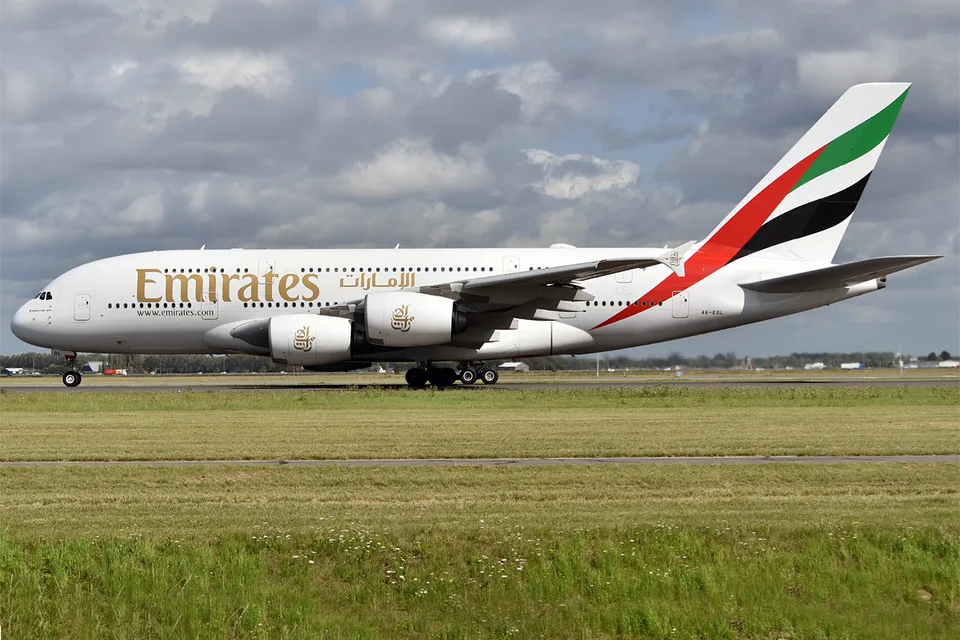
Original photograph used with its full frame. Responsive WebP copies resized without cropping.
Geographic context
Dubai International, departure and return
Paris Charles de Gaulle, intended destination
EK73 returned to Dubai after intake cowl damage during initial climb. Markers show approximate airport positions. AAIS supplies no occurrence coordinates or detailed flight track. Basemap: Natural Earth, public domain.Read supporting evidence
During initial climb from Dubai, Emirates EK73 sustained damage to the No. 1 engine air intake cowl. Cabin crew reported debris from the left outboard engine. The pilots coordinated with air traffic control and maintenance control, returned to Dubai and made an overweight landing. There were no injuries.
Read the full incident Follow what happened, from the flight to the investigation findings.
What investigators concluded
AAIS identified indications of progressive degradation of a graphite sleeve in the nacelle anti-ice feed pipe female socket. It also identified missing wear criteria, the absence of a dedicated inspection task and possible limits on inspection access. The investigation remained ongoing when the interim statement was released on 5 February 2026.
723 words / about 4 minutes to read. The official report for this event is short, so this account is shorter than most and covers only what the report documents.
Debris during the climb
Emirates EK73 departed Dubai International Airport on 6 February 2025 for Charles de Gaulle Airport in France. The scheduled passenger service was operated by Airbus A380-861 A6-EOL. During the initial climb, the air intake cowl of its No. 1 engine sustained damage. The affected engine was the left outboard engine, and cabin crew reported debris being released from its intake cowl.
The flight crew assessed the situation and coordinated with air traffic control and Emirates' Maintenance Control Center. They elected to return to Dubai. The aircraft subsequently made an overweight landing without further incident. There were no injuries. The damage identified by investigators involved the air intake cowl and associated components of the nacelle anti-ice system.
The UAE Air Accident Investigation Sector, AAIS, opened an investigation under Annex 13 to the Convention on International Civil Aviation and the applicable national legislation. France's BEA was notified as the authority for the aircraft's State of Design and State of Manufacture. The BEA appointed an accredited representative, with advisers from Airbus and Safran participating in the technical work.
Investigators examined and documented the aircraft damage. They recovered the affected intake cowl and associated nacelle anti-ice components for further examination. Their detailed component work covered the feed pipe, protection pipe, female socket and graphite sleeve. Recovered parts underwent laboratory examination and were compared with similar components removed from other Airbus A380 aircraft.
The investigation also reviewed operational information, maintenance records, the aircraft's history, minimum equipment list application and technical documentation. Both the digital flight data recorder and cockpit voice recorder were downloaded and analysed. Interviews covered flight crew, cabin crew and relevant operational personnel. Airbus, Safran, Emirates and other specialists contributed to coordination over the examinations and technical assessments.
The component examinations identified indications of a progressive degradation mechanism associated with the graphite sleeve in the nacelle anti-ice feed pipe female socket. AAIS initiated further technical assessment to establish the extent of the condition and the need for additional risk mitigation. Work on the maintenance documentation included component maintenance instructions, inspection requirements and continuing airworthiness information.
Three inspection concerns emerged. Existing maintenance documentation provided no specific graphite sleeve wear limits or acceptance criteria. There was no dedicated scheduled inspection task to monitor the sleeve's condition. Available inspection methods might also provide insufficient access to assess that condition fully while the component remained installed.
A further concern involved continued operation with the nacelle anti-ice valve locked open under minimum equipment list provisions. AAIS identified that this could increase the exposure of degraded components to continuous thermal and mechanical loading. Investigators were evaluating the operational implications of dispatch in that configuration, alongside the relationship between sleeve wear, operational exposure and the possible progression of degradation.
By the interim statement's release, technical assessment of the anti-ice components and the sleeve degradation mechanism was still in progress. AAIS was reviewing whether existing inspection methods, maintenance instructions and continuing airworthiness documentation were adequate. It was also assessing whether maintenance practices could detect graphite sleeve degradation before component functionality was lost.
Airbus, working with Safran and EASA, initiated technical assessments for mitigation measures. These included defining inspection criteria and acceptable sleeve wear limits, developing inspection instructions and updating maintenance data. The manufacturers were also assessing whether fleet inspections were needed and evaluating possible component replacement or repair solutions.
Emirates began coordinating with the manufacturers and investigators to help identify affected aircraft and facilitate required inspections or maintenance actions. AAIS continued monitoring the manufacturers' safety actions and coordinating consideration of interim measures. The investigation was also monitoring similar findings in the Airbus A380 fleet equipped with Engine Alliance GP engines, and assessing the need for wider inspection or maintenance requirements.
AAIS released its interim statement on 5 February 2026. The investigation was not complete, and findings may change as further evidence becomes available. The statement set out the flight's return, the damaged components, the indications of sleeve degradation and the safety concerns already identified. The technical assessment of the degradation mechanism and the evaluation of further protective measures were continuing.
AAIS said the completed investigation would provide the full analysis, findings, conclusions and any safety recommendations. At the interim stage, it continued to consider whether additional action was required before that work finished. The maintenance criteria, inspection instructions, possible fleet inspections and replacement or repair options were being assessed through the coordinated technical work.
The pilots coordinated with air traffic control and maintenance control, then returned to Dubai. The overweight landing ended without further incident or injuries.
Investigators identified indications of progressive graphite sleeve degradation in the nacelle anti-ice feed pipe female socket. Technical assessment of the mechanism remained ongoing.
AAIS identified gaps in wear criteria and scheduled inspection provisions. It also identified a possible increase in loading on degraded components during continued operation with the valve locked open.
A simplified reading of the investigation findings. The sequence does not replace the full report or imply that every contributing factor is shown.
Sequence of events
The statement gives the occurrence date as 6 February 2025 and supplies no clock times. Entries follow the flight sequence and subsequent investigation milestones. Expand an event to see its evidence.
Initial climb, 6 February 2025Intake cowl damaged
The No. 1 engine air intake cowl was damaged after departure from Dubai on the scheduled passenger flight to Charles de Gaulle.
Investigation before February 2026Components examined
Investigators examined the feed pipe, protection pipe, female socket and graphite sleeve, and identified indications of progressive graphite sleeve degradation.
The crew returned to Dubai after cabin crew reported debris from the left outboard intake cowl. The A380 made an overweight landing without further incident, and there were no injuries.
The maintenance documentation had no specific graphite sleeve wear limits or acceptance criteria, and no dedicated scheduled inspection task monitored its condition. Available methods could also limit access for inspection.
AAIS identified that continued operation with the nacelle anti-ice valve locked open under minimum equipment list provisions may increase degraded components' exposure to continuous thermal and mechanical loading.
AAIS completed download and analysis of the digital flight data recorder and cockpit voice recorder. The interim statement contains no cockpit voice transcript.
The investigation remained ongoing on 5 February 2026. AAIS planned to issue the complete analysis, conclusions and any recommendations when the investigation was completed.
Emirates supported identification of affected aircraft and preparation for required maintenance actions. AAIS monitored the manufacturers' progress while the investigation continued.
Matching dossiers for Minimum equipment list dispatch: No other dossier in this collection.
Read alongside
These comparisons connect specific research topics. Shared circumstances do not establish identical causes. Evidence from both investigations is provided below.
Both A380 flights returned to their departure airports after damage during climb, and both investigations examined component degradation. In EK73, AAIS identified indications of graphite sleeve degradation in the nacelle anti-ice system and continued its technical assessment. In Qantas 32, the ATSB traced a thin oil feed stub pipe wall to fatigue cracking, an oil fire and an uncontained turbine disc failure in a Rolls-Royce Trent 900 engine.
Explore the records below for additional context. They open on the publisher's site and are not all included in our report search. Source reuse terms apply.
Flight sequence, component examinations, ongoing technical work and safety actions for A6-EOL. Released 5 February 2026.
When is the Emirates EK73 final report due?
No final report has been published yet. GCAA (UAE) is leading the investigation. It has been 20 months since the accident. Under ICAO Annex 13, a final report or an interim statement is due by each anniversary of the accident. The next anniversary is 6 February 2027.
GCAA AAIS interim statement AIFN/0002/2025, released 5 February 2026. The investigation remained ongoing.
Source limitations
Technical assessment of the degradation mechanism, operational exposure and dispatch with the anti-ice valve locked open remained in progress. Complete analysis, conclusions and any safety recommendations were pending completion of the investigation.
Engine Air Intake Cowl Damage: Emirates Airbus A380-861 A6-EOL, 6 February 2025
UAE GCAA Air Accident Investigation Sector Interim statement AIFN/0002/2025, released 5 February 2026
Source: Australian Transport Safety Bureau. Commonwealth content licensed CC BY 3.0 Australia; Coat of Arms, ATSB logo and third-party photos/graphics excluded. Only limited text excerpts used. Source terms.
Kevin Murphy writes the incident accounts on AirlineIncidents.com, out of a long interest in aviation safety and the lessons each investigation leaves behind.
Prepared by
AirlineIncidents editorial desk
Report citation check
Independent expert review
Not completed
Citation checks compare supporting text with the indexed report pages. They do not constitute independent expert review. How these pages are prepared.
Revision history
: AAIS interim statement released 5 February 2026; investigation ongoing.