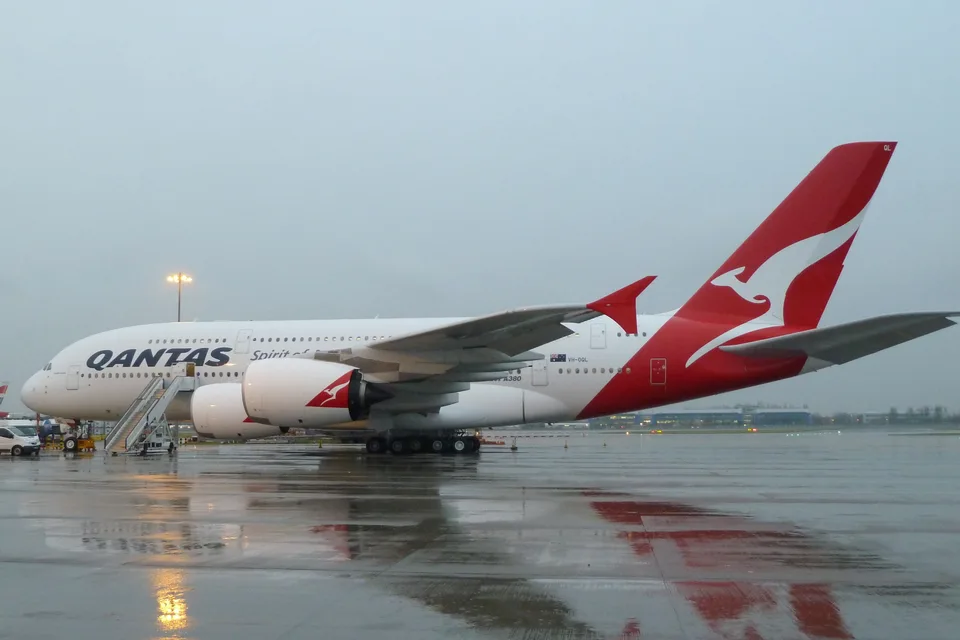
A Qantas A380 lost its No. 3 engine during the climb from Dubai. Gearbox damage interrupted the drive to the engine accessories; all 503 occupants returned safely.
Original photograph used in full. Responsive WebP copies resized without cropping.
Geographic context
Dubai International Airport: departure and return
London: planned destination
Approximate geographic markers for Dubai and London. The engine shutdown occurred during the climb from Dubai at approximately 2,000 ft. The GCAA gives no coordinates for the shutdown. Basemap: Natural Earth, public domain.Read supporting evidence
Mechanical damage in the step aside gearbox interrupted drive to the external gearbox. The fuel and oil pumps lost their drive and the engine shut down. The GCAA identified insufficient clamping at the lower support bearing joint as the primary root cause.
Read the full incident Follow what happened, from the flight to the investigation findings.
What investigators concluded
The crew declared PAN, attempted a restart, jettisoned fuel and landed at Dubai at approximately 2249 UTC. Gearbox bolt torque, assembly procedures and shaft balancing were changed during the investigation. The GCAA issued no safety recommendations.
877 words / about 4 minutes to read. The official report for this event is short, so this account is shorter than most and covers only what the report documents.
A debris warning before departure
On 27 March 2014, Qantas Airbus A380-842 VH-OQL was operating a scheduled passenger flight from Dubai to London. Its four engines were Rolls-Royce Trent 900s. There were 484 passengers and 19 crewmembers onboard, a total of 503 people. The aircraft departed Dubai International Airport at approximately 2147 UTC. Takeoff and the first part of the climb were normal.
The No. 3 engine had generated a debris advisory on the preceding flight to Dubai. Engine health monitoring recorded that message at approximately 1859 UTC. The engine continued operating without an abnormal parameter change requiring the crew's attention. During the transit at Dubai, the defect was deferred under item 79-35-01 of the onboard Minimum Equipment List. That item referred to the ENG3 OIL CHIP DETECTED message, and the aircraft was released to service.
At approximately 2,000 ft, the crew received an ENG FAIL warning for the No. 3 engine, the right inboard engine. It had shut down without command. All engine indications had been normal before the shutdown. A second chip detector debris message was recorded at approximately 2149 UTC, followed by the shutdown and engine failure warning.
The crew declared PAN and leveled the aircraft at 6,000 ft. They tried a starter assisted relight, which was unsuccessful. According to the crew statement, the engine's high pressure stage did not rotate. The commander then initiated fuel jettison for a return to Dubai. The aircraft landed uneventfully at approximately 2249 UTC, after about an hour in flight. None of the passengers or crewmembers was injured.
At the parking stand, maintenance personnel found several metal chips on the engine master chip detector. The engine showed no external damage. Its fan could windmill freely, and inspections from the front and rear found no metal in the exhaust jet pipe. The post-flight report recorded engine failure code 7100W230, which directed troubleshooting toward an engine flameout.
Manual cranking provided evidence of a disconnected drive. The external gearbox turned, but the high pressure spool did not rotate with it. The engine's fuel and oil pumps received their drive through that gearbox. Losing that drive during flight would stop the pumps and shut the engine down. An initial inspection found internal damage in the step aside gearbox, and the aircraft could not return to service after the inspection findings.
The failed engine, serial number 91137, had accumulated 12,871 hours and 1,173 cycles since new. During a June 2013 shop visit, a damaged step aside gearbox bearing support had been replaced. The engine subsequently operated for 2,224 hours and 198 cycles, all on VH-OQL. The chip detector was sent for laboratory examination after the incident, but the debris first observed on its magnet was no longer attached when it arrived.
Examination found fractured cast webs in the step aside gearbox's driven bevel bearing support, together with damage and displacement of the driven bevel gear. The internal, external and transfer gearboxes showed no primary or secondary damage during borescope inspection. Minor displacement at two transfer gearbox bearing locations was judged non-contributory.
The angled drive shaft had met the balance acceptance limits during manufacture, although its radial run-out had been accepted slightly above the upper tolerance. Testing after the incident found its balance outside the acceptance limits. A major quality investigation confirmed the imbalance and traced it to variability in the balancing process and insufficient controls to keep that process consistent.
Rolls-Royce and Avio examined a cracked lower bearing support from another engine. The crack had started at stress concentration features created by a wear step. Examination of the fracture surface showed high cycle fatigue. Analysis of the bearing joint found that the specified bolt torque supplied insufficient clamping to prevent movement during engine operation. The investigators identified that as the primary root cause. Shaft imbalance increased the movement and rate of wear; excessive radial run-out also contributed to imbalance at high speed.
The GCAA concluded that mechanical damage in the step aside gearbox caused loss of drive to the external gearbox. The engine shut down as drive to the fuel pump, oil pumps and generators was lost. Analysis showed that greater joint clamping, combined with a correctly balanced shaft within dimensional limits, would prevent movement and leave a reserve margin in the existing design.
Avio introduced higher bolt torque, revised tightening instructions and a new balancing procedure for production and overhaul. It also introduced optical measurement of shaft run-out, applied it to new and previously operated shafts, and rejected and replaced a small number with dimensional anomalies. Cleaning, inspection and assembly instructions were revised, including measures to remove residual aluminium debris from the bearing interface.
Rolls-Royce published service bulletin RB.211-72-J023 on 9 December 2014 to increase tightening torque at 20 gearbox bolt joints. Other bulletins required hardware removal, reassessment and on-wing inspections. The report recorded completed hardware removal from 13 in-service engines and completed replacement on ten engines affected by the possibility of residual aluminium debris.
The GCAA recorded 266 engine inspections: 11 had cracks, ten had loose bolts, 17 had frettage and 218 had no findings. Work continued on washer seating and dimensional tolerances at the lower bearing joint. Shafts using a three-plane balance process became available on 28 January 2016. The completed GCAA summary report was issued on 22 March 2017. It recorded no safety recommendations.
Movement generated wear at the lower bearing support. Examination of a support from another engine identified a fatigue crack starting at a wear step. Shaft imbalance accelerated movement and wear.
A simplified reading of the investigation findings. The sequence does not replace the full report or imply that every contributing factor is shown.
Sequence of events
Times are UTC. UAE local time was UTC plus four hours. Expand an event to see its evidence.
1859 UTC, preceding flightDebris advisory
Engine health monitoring recorded metal debris at the No. 3 engine chip detector. Engine parameters remained normal. The defect was deferred at Dubai under MEL item 79-35-01.
Approximately 2149 UTCEngine shuts down in the climb
A second debris message was recorded after departure. The No. 3 engine shut down without command at approximately 2,000 ft and an ENG FAIL warning appeared.
Metal chips were found on the engine detector. The external gearbox could be turned manually, but the high pressure spool did not turn with it. Inspection found damage in the step aside gearbox.
The detector contained metal chips and the engine had no external damage. Manual cranking turned the external gearbox while the high pressure spool remained stationary.
The GCAA issued no safety recommendations. Its completed summary report recorded manufacturer changes to gearbox assembly, shaft balancing and inspection.
The GCAA recorded hardware removal from 13 in-service engines and replacement on ten engines subject to the aluminium debris concern. Fleet inspections identified cracks, loose bolts and frettage.
The report recorded continued work on washer seating and incorporation of improved shafts. Three-plane balanced shafts were available from 28 January 2016.
Contributing factorManufacturing and quality control
Angled drive shaft imbalance exacerbated movement and wear. The quality investigation identified variability in balancing and insufficient process controls.
These comparisons connect specific research topics. Shared circumstances do not establish identical causes. Evidence from both investigations is provided below.
Both investigations involved Qantas A380s with Trent 900 engines and component manufacturing or assembly findings. At Dubai in 2014, gearbox damage interrupted accessory drive after inadequate bearing joint clamping. On Qantas 32 in 2010, a thin-walled oil feed pipe cracked, releasing oil that ignited and led to an uncontained turbine disc failure with structural and systems damage.
Explore the records below for additional context. They open on the publisher's site and are not all included in our report search. Source reuse terms apply.
Kevin Murphy writes the incident accounts on AirlineIncidents.com, out of a long interest in aviation safety and the lessons each investigation leaves behind.
Prepared by
AirlineIncidents editorial desk
Report citation check
Independent expert review
Not completed
Citation checks compare supporting text with the indexed report pages. They do not constitute independent expert review. How these pages are prepared.
Revision history
: GCAA completed summary report issued 22 March 2017.