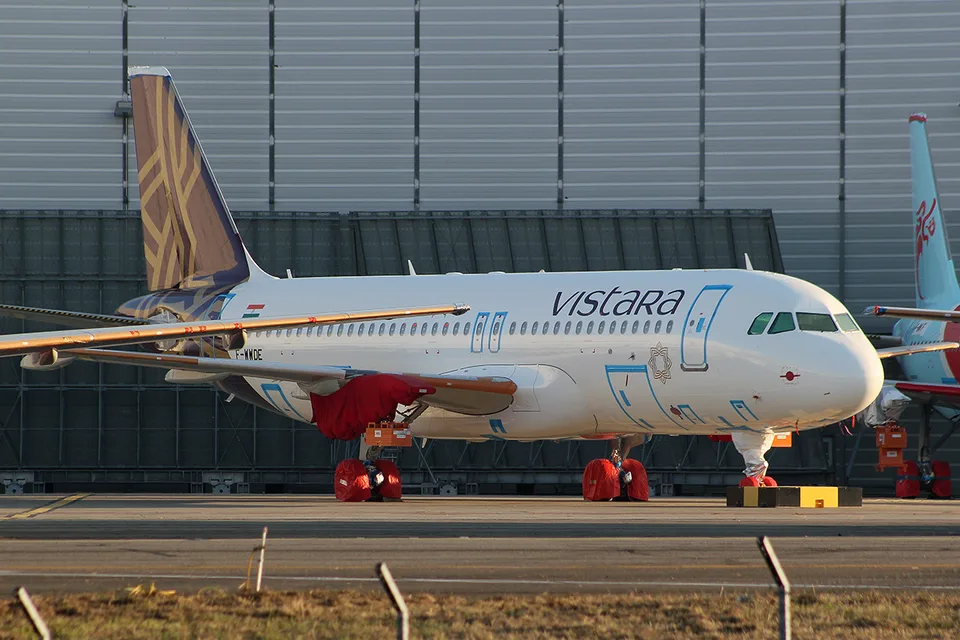
Storms disrupted the landing at Delhi and the diversion to Lucknow. Vistara 944 returned to Lucknow after a Mayday fuel call and landed with 348 kg remaining.
Original photograph unchanged. Responsive WebP copies resized without cropping.
Geographic context
Mumbai, departure
Delhi, intended destination
Lucknow, diversion and landing
Airport markers use the aerodrome reference points given in the report. Storm avoidance extended the Delhi to Lucknow diversion as much as 40 nautical miles south of the planned track. Basemap: Natural Earth, public domain.Read supporting evidence
Vistara 944 abandoned its approach at Delhi because of shifting winds over a wet runway. Storms forced a long deviation during the diversion to Lucknow, where deteriorating visibility then stopped another approach. The crew declared Mayday fuel and considered Kanpur and Prayagraj. Lucknow ATC reported improving visibility and prompted a return. The aircraft landed there at 13:18 UTC with 348 kg of fuel, below the operator's 1,150 kg final reserve.
Read the full incident Follow what happened, from the flight to the investigation findings.
What investigators concluded
The AAIB found that the captain gave insufficient consideration to the falling fuel quantity and became fixed on Lucknow despite severe weather along the diversion route. It linked the loss of situational awareness to unclear diversion guidance, inadequate operations control support, inconsistent alternate lists, insufficient weather updates and weak crew assertiveness. Its final report recommended changes to fuel planning, weather monitoring, operations control and emergency training.
1,541 words / about 8 minutes to read. Based on the investigation records cited below.
Two different alternate lists
On 15 July 2019, Vistara 944 left Mumbai for Delhi with 155 passengers and seven crew. The aircraft was VT-TNH, identified in the AAIB aircraft table as an Airbus A320 251N. The captain was the pilot flying and the first officer was the pilot monitoring. The flight plan had been generated at 06:17 UTC. Before departure, the crew received a transit briefing sheet and an operational flight plan that named different alternate airports.
The transit sheet listed Ahmedabad first and Lucknow second. The flight plan listed Lucknow first and Jaipur second. The captain accepted the documents. The flight plan included 1,001 kg of additional fuel calculated with Lucknow as the alternate. The AAIB found that the fuel carried could also cover Ahmedabad, but using Ahmedabad would leave no holding fuel over Delhi. That difference became significant as delays developed at the destination.
Vistara distinguished between a suitable alternate, where it operated or had ground handling arrangements, and an acceptable alternate close to the destination. Lucknow was the company preferred suitable alternate. Jaipur was an acceptable alternate, and Vistara had no operations or ground handling agreement there at the time. The AAIB found that these definitions and their commercial implications exerted subtle pressure on crews choosing where to divert. The aircraft departed Mumbai at 09:48 UTC.
The flight was normal until descent toward Delhi. The forecast had indicated thunderstorms and rain around the expected arrival time. While travelling toward the destination, the crew did not obtain updated weather for Ahmedabad, Udaipur or Jaipur. Operations control sent Delhi weather showing strong gusting winds and reduced visibility. Delhi ATC advised the crew to expect delay and instructed the aircraft to hold.
During the hold, the aircraft consumed the additional fuel that had made Ahmedabad available as an alternate. The AAIB found that this closed one of the safer options. The crew continued with enough fuel for Lucknow under the planned diversion calculation. The operational flight plan gave minimum diversion fuel as 2,914 kg. The pilots discussed leaving with an allowance above that figure because of weather between Delhi and the Aligarh navigation aid.
The captain told the first officer that Jaipur would not be considered. When the crew advised ATC that they had ten minutes before diversion, they recorded 3,800 kg remaining. At 11:27 UTC, Delhi radar advised that the aircraft was 40 nautical miles from touchdown and began vectors for the runway 29 instrument landing system. The crew continued toward the runway while discussing the small fuel margin that would remain after a missed approach.
Near the ground at Delhi, the winds shifted. At approximately 250 feet, the crew encountered a tailwind component above 15 knots. Runway 29 was wet, and the expected tailwind exceeded the aircraft limitation. The pilots went around at about 11:50 UTC. They advised ATC of their diversion to Lucknow and requested vectors and a further climb at 11:55 UTC.
The recorded fuel quantities were 3,396 kg after the go around and 3,077 kg at the time of diversion. Weather obstructed the direct route toward Aligarh. The aircraft changed heading to avoid the storms and eventually deviated as much as 40 nautical miles south of the intended track. Routing also had to keep clear of prohibited airspace near Agra. Delhi radar asked whether the crew wanted Jaipur and advised that it was vacant. The first officer declined, saying Lucknow was their alternate.
The AAIB found that Jaipur remained closer and had good weather. It concluded that the aircraft could have landed there without a fuel emergency if the crew had reassessed the diversion. Company operations control gave no suggestion to use Jaipur. After the route to Lucknow was entered and sequenced in the flight management system, the predicted fuel at landing was about 1,600 kg. The operator used a fixed final reserve of 1,150 kg.
The aircraft climbed to flight level 270, then received an early descent to flight level 210 because of traffic. Weather worsened during the arrival. The crew reported heavy rain and severe turbulence and temporarily maintained their level before continuing down. They asked about delay and told ATC that further delay could create a low fuel situation. ATC advised that no landing delay was expected.
An aircraft ahead abandoned its approach because of the weather. Vistara 944 continued toward the runway 27 localizer, but about 17 nautical miles from touchdown the crew received runway visual range information of 475 metres. Visibility continued to deteriorate in the thunderstorm and rain. The pilots discontinued the approach at 12:46 UTC. They initially delayed climbing so that they could make another approach promptly if the runway visual range improved.
The fuel margin continued to shrink. The crew declared minimum fuel and subsequently Mayday fuel. The flight history places the Mayday call at 12:54 UTC, when the estimated fuel at arrival had turned amber on the flight management display. The AAIB found that minimum fuel should have been declared to Delhi ATC after the diversion began. Its analysis identified an inadequate understanding of when the declaration was required.
The fuel management rules reproduced in the report required a minimum fuel call once the aircraft was committed to a particular airport and any further clearance change could bring the landing fuel below final reserve. A fuel emergency declaration was required when the predicted usable fuel at landing at the nearest airport where a safe landing could be made was below the planned final reserve.
With Lucknow below landing minima, the crew asked ATC for the closest available airport. Kanpur was proposed and the diversion was approved. Weather lay along that route, so the crew changed their intended diversion to Prayagraj. The captain told the first officer that they might have insufficient fuel to reach it. Neither Kanpur nor Prayagraj was in the aircraft navigation database, and the crew had no instrument approach charts for either airport on board.
As the aircraft headed toward Prayagraj, Lucknow ATC reported that runway visual range had improved to 600 metres. The captain remained concerned about more rain. The controller then passed a further improvement to between 800 and 1,000 metres and prompted the crew to return. At this stage, the aircraft was approximately 58 miles from Prayagraj and 37 miles from Lucknow, with 500 kg of fuel remaining.
The crew turned back and received the shortest available vectors for the runway 27 instrument approach. The captain made a manual landing at 13:18 UTC. Fuel at touchdown was 348 kg. All 162 occupants survived, and the aircraft was undamaged. The AAIB considered that continuing toward Kanpur or Prayagraj could have resulted in fuel exhaustion en route and a forced landing at night. It recommended recognition for the controller who prompted the return to Lucknow.
The AAIB found that both operating pilots were appropriately qualified and that the aircraft held valid airworthiness and release to service documents. Its probable cause centred on the captain's insufficient attention to depleting fuel and fixation on Lucknow while severe weather required further deviations from track. The report linked that loss of situational awareness to shortcomings in company guidance, dispatch support, weather monitoring and cockpit decision making.
The alternate lists on the transit sheet and flight plan had not been reconciled. The crew had not kept up with Jaipur weather while en route to Delhi and did not choose Jaipur when severe weather obstructed the route to Lucknow. The report also identified non-assertive behaviour by the pilot monitoring, who allowed the diversion to Lucknow to continue. At company level, the AAIB found that commercial preferences and ambiguous instructions influenced the choice of alternate.
Operations control had access to satellite and Doppler radar information, but its support was limited to sending weather reports. It did not advise the crew that Jaipur offered a better route and airport weather. The AAIB described practical monitoring and support as inadequate. It also found that regulatory audits had failed to identify ambiguous fuel and alternate instructions, and called for landings below minimum fuel to become a safety performance indicator.
The final report, signed on 29 October 2020, made 22 recommendations to scheduled operators, DGCA, the Airports Authority of India and the India Meteorological Department. For airlines, it proposed stronger operations control staffed with current type rated pilots, earlier diversion advice during significant weather, continuous meteorological support and active contact with aircraft in deteriorating conditions. It also called for matching alternate lists across the briefing documents and fuel planning for the more distant alternate.
Additional holding fuel was recommended when adverse destination weather was forecast. The AAIB proposed fuel planning based on recent operating experience, including congestion, ATC delay and route changes. It called for training on minimum fuel declarations, fuel emergencies and the captain's emergency authority. Another recommendation required navigation database coverage and instrument approach charts for Indian airports usable by the aircraft type in an emergency.
The recommendations to DGCA included investigating fuel emergencies proactively, defining the safety role of operations control, checking practical compliance during audits and licensing flight dispatchers. The AAIB also proposed stronger alternate weather requirements. It asked the meteorological authority to improve forecast accuracy and implement outstanding recommendations from the earlier Jaipur investigation. The report placed the prevention of another fuel emergency across the crew, airline support system, regulator and weather service.
The crew diverted with about 3.1 tonnes of fuel. Weather forced deviations reaching 40 nautical miles south of track. Delhi radar offered Jaipur, which the crew declined.
With estimated arrival fuel falling, the crew declared Mayday fuel and sought another airport. Kanpur was considered first, followed by Prayagraj because of weather along the Kanpur route.
ATC reported runway visual range improving to 600 metres and then 1,000 metres. The aircraft was about 37 miles from Lucknow with 500 kg of fuel, and the crew turned back.
Delhi radar asked whether the crew wanted Jaipur. The crew declined and continued toward Lucknow, the company preferred alternate. The AAIB found that a diversion to Jaipur would have avoided the fuel emergency.
The investigation could not find whether DGCA had proposed concrete action under the State Safety Programme or the operator had taken mitigation action under its safety management system.
Actions and recommendations are described at the dates of the cited records. A recommendation is not proof of implementation.
Earlier weather decisions by operations control
The AAIB recommended proactive diversion assistance, current type rated pilot support in operations control and continuous access to a qualified meteorological officer.
The recommendations called for matching briefing and flight plan alternates, planning fuel for the longest alternate and carrying additional holding fuel during inclement weather.
Fuel emergency training and wider airport coverage
The AAIB called for periodic training on minimum fuel and fuel emergency declarations, and navigation data and instrument charts for Indian airports usable in an emergency.
These comparisons connect specific research topics. Shared circumstances do not establish identical causes. Evidence from both investigations is provided below.
Both investigations identified failures to respond effectively to a diminishing fuel supply and weaknesses in cockpit communication. United 173 exhausted its fuel while the crew dealt with a landing gear problem; the NTSB found inadequate fuel monitoring by the captain and ineffective communication of concern by the other flight crew members. Vistara 944 encountered storms during its diversion, remained fixed on Lucknow and landed with 348 kg after ATC prompted a return. The AAIB also identified inadequate airline guidance and operations control support.
Explore the records below for additional context. They open on the publisher's site and are not all included in our report search. Source reuse terms apply.
Kevin Murphy writes the incident accounts on AirlineIncidents.com, out of a long interest in aviation safety and the lessons each investigation leaves behind.
Prepared by
AirlineIncidents editorial desk
Report citation check
Independent expert review
Not completed
Citation checks compare supporting text with the indexed report pages. They do not constitute independent expert review. How these pages are prepared.
Revision history
: AAIB final investigation completed; report signed 29 October 2020.