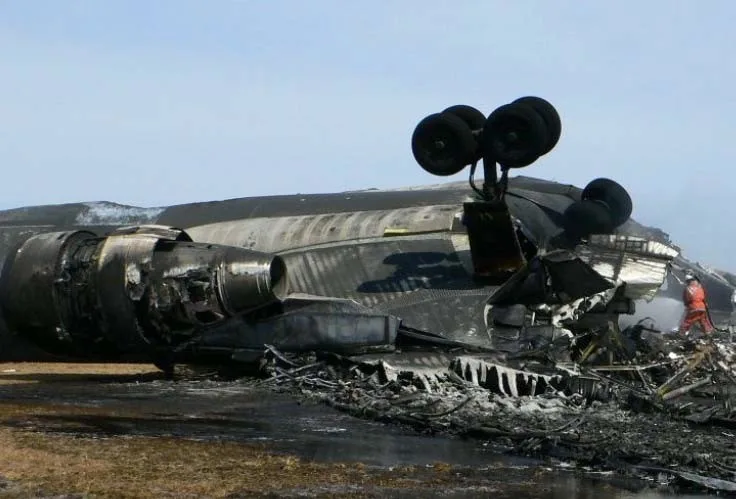
Original photograph unchanged. Responsive WebP copies resized without cropping.
Geographic context
Guangzhou Baiyun International Airport
Narita International Airport, Runway 34L area (approximate)
The cargo flight departed Guangzhou Baiyun for Narita. The inverted fuselage stopped about 60 metres west of Runway 34L's centreline, about 1,430 metres from its landing threshold. Basemap: Natural Earth, public domain.Read supporting evidence
FedEx 80 approached Runway 34L with fluctuating speed and attitude. A late flare was followed by large nose down control inputs, nose gear first impacts and a growing bounce sequence. On the third touchdown, an overload from the left main gear fractured the wing. Fuel spilled and ignited as the aircraft rolled left and stopped inverted beside the runway.
Read the full incident Follow what happened, from the flight to the investigation findings.
What investigators concluded
The JTSB found that large elevator inputs and inadequate thrust control produced porpoising. Gusty winds, a high sink rate, a late flare, difficulty judging height and attitude, and inadequate captain intervention contributed. The third touchdown exceeded the left wing structure's ultimate load. The report also identified limits in the landing gear design for predominantly vertical overloads.
1,719 words / about 8 minutes to read. Based on the investigation records cited below.
A cargo arrival in gusty winds
FedEx Flight 80 approached Narita International Airport on the morning of 23 March 2009 after flying from Guangzhou Baiyun International Airport in China. The aircraft was a McDonnell Douglas MD-11F registered N526FE, operated by Federal Express Corporation on a scheduled cargo service. Only the captain and first officer were aboard. The first officer flew from the right seat, while the captain monitored from the left seat. The aircraft had been manufactured in November 1993 as a passenger airplane and converted to a freighter in July 2006.
Northwesterly winds were gusting across the airport. At 06:41:35 the crew contacted Narita Tower, reporting that they were 13 nautical miles from Runway 34L. The controller advised that they were second in the landing sequence and passed wind information showing 28 knots, with a maximum of 40 and minimum of 20. The crew selected an approach speed of 164 knots, ten knots above the reference landing speed. They armed the automatic ground spoilers, confirmed medium autobraking and lowered the landing gear.
The tower repeatedly passed updated winds and reports from preceding aircraft. One crew described fairly strong turbulence and wind fluctuations of plus or minus 15 knots below 1,000 feet. FedEx 80 received landing clearance at 06:46:29. The JTSB found that the approach took place in rough air requiring careful control of attitude, speed and flight path. The wind change remained below the threshold for an onboard windshear warning. Investigators considered it highly probable that localized microburst windshear was absent.
With the autopilot and autothrottle engaged, calibrated airspeed fluctuated between 152 and 180 knots during the descent from 1,000 feet. Pitch and roll also varied. At the 500 foot callout, airspeed was 179 knots. Two seconds later the captain called the approach stabilized. The JTSB found that the speed excursions exceeded the company's stabilized approach criteria and that the crew continued despite deviations greater than ten knots above the selected approach speed.
At 06:48:03 the autopilot disconnected at a radio altitude of 198 feet. The autothrottle remained engaged. As the first officer took manual control, airspeed fell from 178.5 knots to about 154 knots by 92 feet. The aircraft moved below the instrument landing system glide slope. Investigators linked the speed reduction to the decreasing headwind and insufficient thrust response, including the first officer's failure to override the autothrottle actively. The cockpit recorder contained no calls or advice from the captain during this part of the approach.
By 48 feet, the pitch angle had fallen to about 1.1 degrees and the estimated sink rate was 13 feet per second. The company procedure called for a smooth flare starting at 30 feet. The first officer instead began the flare around 20 feet, pulling the control column sharply. Below 50 feet the autothrottle had entered its programmed retard mode, which reduced thrust toward idle. The first officer did not delay that reduction to control the high sink rate. The JTSB found that these conditions made the flare difficult and left substantial downward speed at touchdown.
The right main landing gear touched the runway at about 06:48:20, followed by the other main gears. Airspeed was 166 knots, and vertical acceleration recorded near the aircraft's centre of gravity reached 1.63 G. The aircraft then bounced. The JTSB considered it highly probable that the structure had sustained no damage at this first impact. The late flare had failed to reduce the sink rate sufficiently, while the rapid increase in pitch generated lift that helped the aircraft rebound.
Just before the first touchdown, the first officer had pushed the control column forward strongly. Forward input continued after touchdown, lowering the nose rapidly while the main wheels were airborne. Pitch fell from a nose up attitude to minus 1.8 degrees. At about 06:48:22 the aircraft struck the runway nose wheel first, followed by the main landing gears. Recorded vertical acceleration reached 2.21 G. Grease, a wheel cap and other nose gear components along the runway supported the finding that the nose gear was probably damaged at this stage.
The changing cockpit height complicated recognition of the bounce. A simulation showed the main wheels and centre of gravity rising about four feet after the first touchdown, while the cockpit sank about nine feet as the nose lowered. The cockpit was 31 metres ahead of the centre of gravity. The JTSB found that the first officer may have failed to recognise that the aircraft had bounced. Company procedures specified pitch and thrust changes for recovery from a low bounce and a low level go-around for a high bounce.
The nose landing gear's reaction against the runway rapidly raised the nose after the second touchdown. Pitch increased to about 6.7 degrees, lift increased and the second bounce became larger. The first officer continued large forward control inputs as the nose began falling again. The main wheels reached a height of about 16 feet. The aircraft developed porpoising, with repeated bounces and increasing oscillations in pitch. The automatic ground spoilers retracted during this sequence.
A subsequent backward control input slowed the nose down movement but came too late to restore a positive pitch attitude before the next impact. The nose gear touched down again at about 06:48:27, followed by the left, centre and right main landing gears. The aircraft was rolling left and descending at an estimated 21.5 feet per second. The recorded vertical acceleration reached 3.06 G. The JTSB estimated the vertical mechanical energy at this touchdown at about 6.8 times the certification requirement used in its comparison.
The left main gear transferred an overwhelming upward load into its wing support structure. Analysis of residual deformation in a gear component produced an estimated force of 887,000 pounds, broadly matching the manufacturer's structural analysis. The load exceeded the wing structure's ultimate strength. The left wing fractured near the landing gear attachment and the remaining right wing's lift rolled the aircraft left. The JTSB identified the third touchdown overload as the cause of the wing fracture.
Simulations examined earlier opportunities to interrupt the sequence. Starting the flare appropriately at 30 feet reduced the simulated touchdown sink rate to about two feet per second. A go-around started during the second bounce could have prevented the third touchdown. The JTSB found that the captain's advice, intervention and takeover had been inadequate. Its analysis identified the second bounce as the last opportunity for the monitoring captain to take control and carry out a recovery or go-around.
Fuel escaped from the fractured left wing. At about 06:48:29 a camera recorded fire near the rear of the left engine. Flames engulfed the aircraft as it rolled over, left the runway and slid into the grass. The fuselage stopped inverted about 60 metres west of the runway centreline and 1,430 metres from the Runway 34L threshold. The estimated fuel remaining at landing was about 28,000 litres. Strong winds intensified the fire, which consumed much of the fuselage.
The first fire engine reached the site at 06:49:28, and the first recorded water discharge began at 06:50:25. Other engines arrived and joined the firefighting. Heat and smoke prevented rescuers from entering the cockpit at 07:03. Teams cut into the rear of the cockpit from both sides of the fuselage, then entered and removed the pilots. The captain was removed at 08:00 and the first officer at 08:16. Both died. The response involved 47 vehicles and 137 personnel.
The JTSB considered it highly probable that the first officer was alive immediately after the accident, based on burns to his respiratory tract. Flames had reached the rear of the cockpit by the time water discharge began. Investigators found that early penetration of heat and smoke made rapid rescue difficult. The separating net and rubber curtain between the cargo area and flight crew compartment had largely burned away. These findings led to recommendations for measures protecting the crew compartment from heat, smoke and toxic gases.
The JTSB's probable cause finding linked the porpoising to the large nose down elevator inputs at the first touchdown and attempts to control the second bounce through elevator movement with insufficient thrust. Gusty winds, the high sink rate, the late flare and difficulty judging height and attitude contributed to the sequence. The final report was adopted on 5 April 2013 and released on 26 April. Investigators found that the aircraft had been maintained and inspected as required and had no pre-existing functional or structural degradation before the accident.
The investigation also examined the main landing gear fuse pins, designed to separate the gear under certain overload conditions and protect the fuel tanks. The MD-11 design addressed an overload dominated by rearward drag. It had not been designed for separation under a purely vertical overload. The JTSB considered it somewhat likely that gear separation under the accident's predominantly vertical load could have reduced fuel tank damage and rapid fire development. It recommended mandatory consideration of such loads in the airworthiness regulation.
The longitudinal stability augmentation system acted to curb the pitch variations, according to the JTSB's simulations. The pilot's large nose down inputs exceeded its opposing commands. The investigation could not determine why the first officer initially pushed the control column forward so strongly, why the ground spoilers retracted, the exact origin of the wing fracture or the ignition source. It also could not conclusively determine the extent to which fatigue affected the pilots' handling or judgment.
Changes to landing practice and recommended protections
FedEx revised its manuals after the accident. It removed references allowing nose down elevator input during landing, moved the flare guidance to between 40 and 30 feet, and required a go-around after a bounced landing. Revised training emphasized the relationship between power, pitch and descent rate, particularly close to the ground. Landing training was strengthened in simulator sessions and line operations. The airline also supplied crews with landing acceleration and pitch data for debriefing and reinforced go-arounds in training, checking and pilot communications.
Boeing revised the MD-11 flight crew operating manual in February 2011, emphasizing awareness of excessive descent rates during approach. The JTSB recommended that the FAA require Boeing to study landing gear support changes and improvements to handling through stability augmentation and faster ground spoiler deployment. It also called for studies of a visual display and an aural warning showing gear touchdown status. A further recommendation sought effective protection of the crew compartment against the early arrival of fire, smoke and toxic gases.
A simplified reading of the investigation findings. The sequence does not replace the full report or imply that every contributing factor is shown.
Sequence of events
Times are Japan Standard Time, UTC plus 9 hours. The report summary places the accident at about 06:49. The recorder and camera reconstruction times the three touchdowns at about 06:48:20, 06:48:22 and 06:48:27. Expand an event to see its evidence.
06:41:35Contact with Narita Tower
The crew reported 13 nautical miles to Runway 34L and received the landing sequence and gust information.
The main wheels rose about four feet while the cockpit sank about nine feet as the nose lowered. The JTSB found that the first officer may not have recognised the bounce.
Actions and recommendations are described at the dates of the cited records. A recommendation is not proof of implementation.
FedEx landing procedures and training
The final report records a revised flare height of 40 to 30 feet, a required go-around for a bounced landing, and stronger training on power, pitch and descent rate.
The JTSB recommended studies of landing gear support changes, stability augmentation improvements, reduced spoiler delay, and visual and aural gear touchdown indications.
The JTSB recommended studies of protection from heat, smoke and toxic gases, with application to in-service aircraft where effective solutions were found.
These comparisons connect specific research topics. Shared circumstances do not establish identical causes. Evidence from both investigations is provided below.
The FedEx 80 investigation identified inadequate intervention by the monitoring captain and an opportunity for a go-around during the second bounce. The Asiana 214 investigation found inadequate airspeed monitoring and delayed execution of a go-around after the crew recognised an unacceptable approach. At Narita, the accident developed through porpoising and a wing overload; at San Francisco, the crew mismanaged descent and unintentionally deactivated automatic airspeed control.
Explore the records below for additional context. They open on the publisher's site and are not all included in our report search. Source reuse terms apply.
Private evidence cache. Only short attributed quotations in original commentary; full report and third-party illustrations are not redistributed. Source terms.
Kevin Murphy writes the incident accounts on AirlineIncidents.com, out of a long interest in aviation safety and the lessons each investigation leaves behind.
Prepared by
AirlineIncidents editorial desk
Report citation check
Independent expert review
Not completed
Citation checks compare supporting text with the indexed report pages. They do not constitute independent expert review. How these pages are prepared.
Revision history
: JTSB final report AA2013-4-2, adopted 5 April 2013 and released 26 April 2013.