Original JPEG retained. Responsive WebP copies resized without cropping.
Geographic context
Dubai International Airport, departure
Approximate turbulence area in Beira FIR, Mozambique
Johannesburg Tambo International Airport, destination
Airport markers provide geographic orientation. The turbulence marker is estimated from the approximate encounter position in Figure 1 near Mount Mabu. The report gives no coordinate pair for the encounter. Basemap: Natural Earth, public domain.Read supporting evidence
At FL400 in Beira FIR, EK763 encountered about 30 seconds of moderate to severe turbulence. One passenger was lifted from her feet and fractured her right lower leg. The aircraft remained controllable and continued to Johannesburg.
Read the full incident Follow what happened, from the flight to the investigation findings.
What investigators concluded
The AAIS attributed the accident to severe vertical gust forces associated with wet turbulence cells. Incomplete use of weather radar capabilities and insufficient time to secure the cabin contributed.
1,566 words / about 8 minutes to read. Based on the investigation records cited below.
A forecast convective region
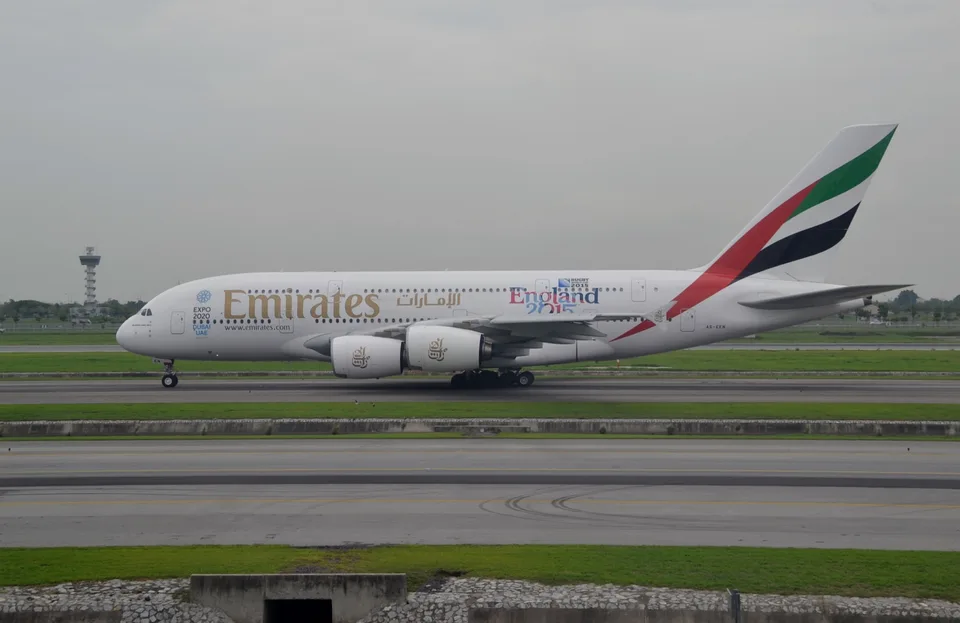
Emirates flight EK763 left Dubai International Airport at 07:20 UTC on 16 January 2020 for Johannesburg. The Airbus A380-861, registered A6-EEN, carried 500 passengers, two pilots and 24 cabin crewmembers. The commander occupied the left seat and was the pilot flying. The planned journey was about seven hours and 45 minutes. The aircraft had two passenger decks, with first and business class on the upper deck and economy on the main deck. Its maintenance records were current and investigators found no significant technical defect before the flight.
The operational flight plan forecast a large area of convective weather around the eastern side of central Africa. Isolated embedded cumulonimbus clouds were expected to reach flight level 520, or 52,000 feet. EK763 was planned to cross the Beira flight information region in Mozambique at flight level 400. The commander had flown the route before and knew that thunderstorms were common there at that time of year. Investigators found that the flight preparation and operational flight plan met the applicable regulatory requirements and best practice.
The cabin briefing described most of the flight as normal, with some turbulence expected during descent into Johannesburg. After takeoff, the seat belt sign was switched off. It was switched on three times during the first six hours. According to the commander, the daylight flight was uneventful before the encounter, and weather avoidance had not been required. The aircraft's weather radar and turbulence detection functions were active, with weather information displayed on the pilots' navigation displays.
After entering Beira FIR near waypoint OKBIM, the pilots experienced light turbulence. They described radar returns showing weather below the aircraft and away from its projected path. They maintained the planned route. They had received no pilot reports or air traffic control reports of turbulence or weather deviations in that airspace. A satellite image later supplied to investigators showed active convection, including embedded cumulonimbus clouds reaching 48,000 feet and occasional clouds reaching 52,000 feet. That image had not been available to the pilots.
Recorded data established that wet turbulence appeared on both navigation displays from 13:11:37. EK763 was then 26 nautical miles and two minutes 47 seconds from the encounter, cruising at Mach 0.86 on a heading of 206 degrees. The magenta indications continued until 13:14:43. Investigators considered it most likely that the pilots had not observed the on-path magenta cells when they first appeared. The commander recalled seeing several magenta spots, followed by insufficient time to deviate or change the radar settings.
The recorded data also showed earlier wet turbulence detections at 12:27:04, 12:32:59 and 12:33:04. At the first of these, the aircraft was about 390 nautical miles from the eventual encounter. The commander's display range was then 160 nautical miles and the copilot's was 320. About a minute before the encounter, the commander changed his display range from 80 to ten nautical miles, while the copilot changed between 80 and 40 nautical miles. The radar's magenta turbulence detection was limited to the nearer 40 nautical miles ahead even when the navigation display showed a wider area.
The radar detected turbulence through the movement of precipitation. Its turbulence function covered up to 40 nautical miles ahead and displayed wet turbulence in magenta. It could not detect clear air turbulence. Investigators found that the equipment operated as designed. They also found that the pilots had not used its full capabilities to assess the separation between their flight path and the greatest threat. Manual gain and elevation modes could help examine the weather returns more closely, while changing display range helped assess weather at different distances.
At 13:14:16, the pilots switched on the seat belt sign. The turbulence began eight seconds later. They gave the cabin crew no instructions during that interval. The cabin manager saw the sign flashing but said that he did not hear its chime. Cabin crewmembers were still performing their normal duties. Some passengers were away from their seats and a few were in the lavatories. Cabin service was minimal, with no serving trolleys in the passenger cabins.
At the onset of the turbulence, the copilot announced that the cabin crew should take their seats. The cabin manager also made an announcement during the encounter for people to sit down and fasten their seat belts. By then the cabin had not been secured. Investigators found that eight seconds had left insufficient time to stop work, secure equipment and ensure that passengers and crew were restrained.
The seat belt system flashed the signs for five seconds when selected on, then illuminated them continuously, accompanied by a single low tone chime. Emirates had discontinued the automatic cabin-wide seat belt announcement in 2008 to reduce disturbances, particularly in first and business class. Its revised procedures required a spoken announcement and physical checks in economy, and individual checks in the premium cabins. The investigation identified the need for timely communication about the expected turbulence and the cabin services that could continue.
The encounter began at 13:14:24 and lasted about 30 seconds. The commander described entering cloud, losing visibility and hearing a sound like rain. The reconstructed wind data showed an initial updraft of about 4,900 feet per minute combined with a headwind gust of ten knots. Vertical load factors varied rapidly between positive 1.75 g and positive 0.17 g. The aircraft climbed as much as 300 feet and descended as much as 180 feet relative to its earlier altitude, while roll remained within two degrees to either side.
Airspeed rose towards the maximum operating Mach number of 0.89. The aircraft automatically deployed its spoilers and reduced thrust through the autothrust system. The highest recorded speed was Mach 0.884. At 13:14:39 the pilots changed the selected Mach to 0.76 and moved the speed brake lever to half its maximum deflection. The autopilot and autothrust remained engaged throughout. Investigators found that the pilots correctly applied the overspeed prevention procedure, the aircraft remained controllable and its operational limits were not exceeded. The recorded loads required no additional aircraft inspection.
In the upper deck aft business class galley, cabin crewmembers described severe shaking and repeated lifting from their feet. They braced themselves and at times could not move. One crewmember struck her head against a cart she was holding, cushioning the impact with her hand. On the main deck, the cabin manager was lifted from the crew workstation and struck his head on the ceiling. Neither he nor the other cabin crewmembers reported an injury, and they resumed their duties.
A business class passenger was walking to the lavatory near the upper deck aft lounge and U3R door. The turbulence lifted her off her feet and she fell to the floor, fracturing her right lower leg. Cabin crewmembers and a doctor travelling on board applied bandages and splints. Another passenger struck her jaw while in a lavatory but reported no injury. The final injury table recorded one serious passenger injury, no minor injuries and no fatalities among the 526 people on board. Investigators found that the aircraft movements were more pronounced in the aft cabins.
The pilots contacted Emirates' ground medical team to assess the injured passenger. Her injury was considered non-life threatening. With the aircraft's systems unaffected, the commander continued to Johannesburg, where she received further medical attention. The remaining one hour and 46 minutes of flight was uneventful. The aircraft sustained no damage.
Investigators analysed the flight data recorder and quick access recorder, including the seat belt switch position and the aircraft's response. The cockpit voice recorder had retained only the last two hours of flight, so the encounter audio had been overwritten. The flight recorders also lacked the green, yellow and red radar returns. Airbus could therefore reconstruct the magenta turbulence indications but could not establish the exact vertical and lateral separation between the aircraft's trajectory and the radar's area of greatest threat.
The AAIS final report, issued on 20 November 2020, identified severe vertical gust forces in an area of wet turbulence cells as the cause of the accident. These forces moved unsecured passengers and crewmembers violently. The two contributing factors were the incomplete use of the weather radar's capabilities to assess the distance to the threat, and insufficient time to secure the cabin after the seat belt sign was switched on. The AAIS also examined nearby aircraft traffic and concluded that the changes in attitude and altitude were most likely associated with the convective weather; it rejected wake turbulence as the explanation.
An Airbus A350 had crossed the area about 11 to 12 minutes earlier. Its exact flight level there was uncertain because it was climbing between FL390 and FL410. The AAIS considered the typical persistence and descent of wake vortices, together with EK763's limited roll movement. It concluded that vortices from that aircraft would have decayed before EK763 arrived.
The investigation addressed radar training, access to updated weather through electronic flight bags, communication between pilots and cabin crew, automatic passenger announcements and the audibility of the seat belt chime. Emirates told investigators that work on real time weather and turbulence information depended on establishing onboard connectivity. It also described a radar differences course and learning material following Airbus manual changes. The airline reported revised seat belt announcements in 14 languages from February 2020 and an increase in the A380 seat belt chime volume from 19 September 2019. The AAIS issued no new safety recommendations in this report because recommendations in its earlier investigation AIFN/0009/2019 addressed similar findings.
Both navigation displays showed magenta wet turbulence from 13:11:37. Investigators found that the full radar capabilities were not used to assess the threat distance.
The autopilot and autothrust remained engaged. Automatic system responses and the pilots' speed reduction kept the aircraft inside its operating limits.
A simplified reading of the investigation findings. The sequence does not replace the full report or imply that every contributing factor is shown.
Sequence of events
Times are UTC. The report places the start of the encounter at 13:14:24. Mozambique local time was UTC plus two hours. Expand an event to see its evidence.
07:20Departure from Dubai
EK763 departed for Johannesburg with 526 people on board.
She was walking to an upper deck lavatory when turbulence lifted her off her feet. She fell near the aft lounge and fractured her right lower leg. Cabin crewmembers and an onboard doctor applied bandages and splints.
Recorded data showed wet turbulence on both navigation displays from 13:11:37, two minutes 47 seconds and 26 nautical miles before the encounter. Investigators considered it most likely that the pilots had not observed the on-path magenta cells from their onset. The seat belt sign came on eight seconds before the turbulence.
Was the cockpit recording available to investigators?
The cockpit voice recorder retained the final two hours of the flight. The turbulence recording had been overwritten and was unavailable to investigators.
The flight recorders captured enough data to reconstruct magenta turbulence indications. Green, yellow and red radar returns were unavailable, leaving the precise separation from the greatest threat unresolved.
The commander could not recall when the magenta area appeared. Investigators considered it most likely that the pilots had missed the onset of the on-path indications.
Emirates reported ongoing work to provide real time weather and turbulence information once onboard connectivity was established. It also described a radar differences course and learning material reflecting Airbus manual changes.
Emirates reported adding 14 languages to the revised seat belt announcement from February 2020. It reported increasing the A380 seat belt chime volume from 19 September 2019.
The AAIS issued no new safety recommendations because its investigation AIFN/0009/2019, issued on 12 August 2020, had addressed similar findings with relevant recommendations.
These comparisons connect specific research topics. Shared circumstances do not establish identical causes. Evidence from both investigations is provided below.
Both accidents caused injury when sudden vertical aircraft movement threw unsecured occupants from their seats or feet. EK763 encountered convective wet turbulence. Qantas 72 experienced commanded pitch-downs after erroneous angle of attack data interacted with a flight control software limitation. The ATSB found substantially greater injury rates and severity among occupants who were standing or seated with their belts unfastened.
Explore the records below for additional context. They open on the publisher's site and are not all included in our report search. Source reuse terms apply.
Kevin Murphy writes the incident accounts on AirlineIncidents.com, out of a long interest in aviation safety and the lessons each investigation leaves behind.
Prepared by
AirlineIncidents editorial desk
Report citation check
Independent expert review
Not completed
Citation checks compare supporting text with the indexed report pages. They do not constitute independent expert review. How these pages are prepared.
Revision history
: GCAA final findings, cabin events and safety actions documented with report page references.