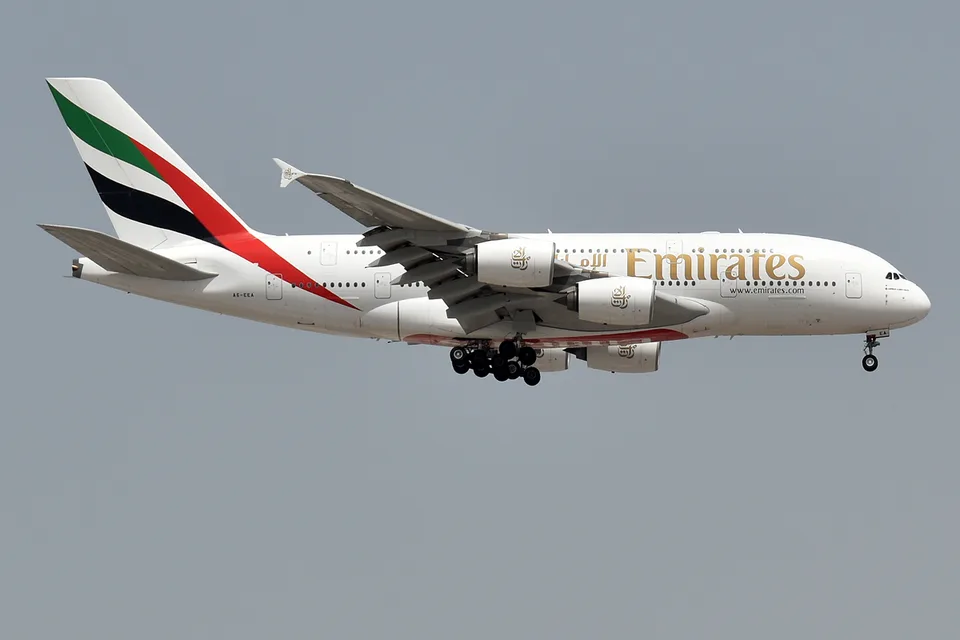
Turbulence during descent to Dubai injured ten cabin crewmembers. One suffered a fractured ankle while completing pre-landing duties in high heel shoes.
Original photograph used in full. Responsive WebP copies resized without cropping.
Geographic context
Jeddah, departure airport
United Arab Emirates, approximate descent area
Dubai, destination airport
Markers show the Jeddah to Dubai route and the broad UAE descent area. Before the encounter, the crew reported inbound to BUBIN and received a remaining track distance of 108 nautical miles from ATC. Basemap: Natural Earth, public domain.Read supporting evidence
During descent, the crew saw a small cloud that produced no weather radar returns. ATC refused a deviation because of an airspace conflict, and the aircraft continued through the cloud. Three to four seconds of turbulence produced sudden vertical acceleration while cabin crew were securing the cabin. One crewmember lost her balance and fractured her right ankle. Nine others reported minor injuries.
Read the full incident Follow what happened, from the flight to the investigation findings.
What investigators concluded
AAIS identified unanticipated turbulence during descent and the absence of a warning to cabin crew as causes. The seriously injured crewmember's required high heel footwear provided insufficient support and contributed to her fall and ankle injury. AAIS recommended revising Emirates' assessment of the footwear risk.
A short turbulence encounter during descent to Dubai
1,168 words / about 6 minutes to read. The official report for this event is short, so this account is shorter than most and covers only what the report documents.
Cabin preparation on flight EK806
On 13 September 2015, Emirates Airbus A380-800 A6-EEA was operating flight EK806 from King Abdulaziz International Airport at Jeddah to Dubai International Airport. The aircraft carried 159 passengers, 24 cabin crewmembers and three flight crewmembers, a total of 186 people. The serious injury occurred during descent towards Dubai, while the cabin crew were completing their preparations for landing.
About twenty minutes before landing, the cabin crew were securing the cabin in accordance with Emirates standard operating procedures. Cabin service had finished. The seat belt sign was switched on as the aircraft descended through FL300 so that the preparations could be completed in time. Cabin crew continued the work of securing the cabin and galley.
The crewmember who would sustain the serious injury had changed from flat sole footwear to high heel shoes before carrying out her pre-landing duties. This followed the operator's procedure. The uniform rules required standard court shoes with high or medium heels during boarding, disembarkation and before the pre-landing duties. She was wearing shoes with heels approximately 7.5 centimetres, or three inches, high.
Inbound to waypoint BUBIN at FL180 in the descent, the flight crew established two-way communication with Dubai air traffic control. They asked how many track miles remained to Dubai. ATC gave the distance as 108 nautical miles. The weather radar was operating in AUTO mode and displayed no returns.
The crew described a thin layer of scattered clouds. After descending through that layer, they saw a small isolated cloud ahead. The commander, who was the pilot monitoring, estimated that it was less than one mile in diameter. Because the cloud was close, he instructed the co-pilot to begin a right turn and requested a weather deviation from ATC.
The co-pilot selected heading mode, commanded a right turn and selected a reduction in speed to 300 knots. ATC denied the weather deviation because of an airspace conflict. The co-pilot then re-engaged navigation mode. After replying to ATC, the commander looked up and saw that navigation mode had been restored.
The cloud was now straight ahead at short distance. The commander considered that avoiding it would require a drastic manoeuvre. Taking account of its visual appearance and the lack of radar returns, he judged that continuing through it was the safest course. The flight crew did not advise the cabin crew manager of the potential weather encounter.
The aircraft entered the cloud and encountered localized turbulence lasting three to four seconds. Cabin crew were still securing the cabin and galley. The injured crewmember was standing at the upper right door 1 position while completing pre-landing tasks. The sudden vertical acceleration caused her to lose her balance and fall.
After the encounter, the commander checked the status of the passenger cabin. The senior cabin crewmember told him that a cabin crewmember had been injured. In accordance with Emirates procedures, she was removed from duty and placed in a passenger seat for the rest of the flight. The aircraft landed normally.
Medical examination confirmed a fracture to her right ankle. She was admitted to hospital and remained there for about one week. Nine other cabin crewmembers reported minor injuries. The report's injury table records no injuries to the 159 passengers or the three flight crewmembers, and no fatalities. Fourteen cabin crewmembers were uninjured.
The autopilot remained engaged throughout the turbulence encounter, and all aircraft parameters stayed within the aircraft's limitations. There was no aircraft damage or fire. AAIS found that the commander had not declared an emergency or advised Dubai ATC of cabin crew injuries requiring assistance on the ground. From the controller's perspective, the landing appeared uneventful.
Investigators successfully downloaded the recorded data, with all parameters captured, and analyzed the flight data recorder in the AAIS laboratory. The vertical acceleration trace ranged between +2.2g and +0.07g during the encounter. A minor speed fluctuation accompanied those changes. The recorded aircraft parameters remained within operating limitations.
Emirates' turbulence procedures required flight crew to tell cabin crew how much time was available to secure the cabin, the expected level of turbulence and its likely duration. The purser was responsible for ensuring that passengers and, when required, cabin crewmembers were secured, and for advising the flight crew. Expected areas of turbulence were also to be discussed during the pre-flight briefing.
AAIS found that the time available during this encounter prevented the flight and cabin crews from complying with the operator's turbulence coordination procedure. The seat belt sign was already on, but the cabin crew were still completing their landing preparations when the aircraft entered the cloud.
The investigation examined the relationship between the required footwear and the ankle injury. In-service feedback showed that changing from low heel shoes to medium or high heels before touchdown was accepted practice. It saved time during door opening and passenger disembarkation, and complied with Emirates procedures.
For service in flight, the operator offered lower footwear options, including a wedge style with a heel of about 4.5 centimetres and flat styles with heels of about 3.5 and 2.5 centimetres. The injured crewmember had changed to the higher court shoes required before pre-landing duties. AAIS found that those shoes did not provide stable support in the turbulent conditions.
The investigation attributed her loss of balance to the unexpected vertical force combined with the lack of support from the footwear. The shoes provided insufficient support for her to remain balanced during the encounter, leading to the fall and fractured ankle. AAIS listed the footwear as a contributing factor in the accident.
Emirates had considered further risk evaluation unnecessary when A380 cabin crew uniform footwear changed in 2007 and 2009. Its departmental safety risk register, reviewed in August 2015, included turbulence hazards in which the seat belt sign was on while cabin crew movement remained authorized. It classified the residual severity as hazardous and the probability as remote, producing a tolerable risk.
A May 2016 assessment of female cabin crew uniform footwear classified the risk from high heel shoes during critical phases of flight as minor in severity and remote in probability. Investigators compared that assessment with the earlier register and the consequences of this accident. They considered the earlier hazardous severity classification more accurate.
In its final conclusions, AAIS identified two causes: the aircraft encountered unanticipated turbulence during descent, producing sudden vertical acceleration, and the cabin crew were not advised of the potential turbulence. It also found that the flight and cabin crewmembers were qualified, the aircraft was airworthy, and the required footwear procedure had been followed. The serious ankle injury raised the occurrence classification from incident to accident.
Emirates completed the footwear safety risk assessment in May 2016 and shared it with the GCAA. A review in November 2016 incorporated information from the operator's operational experience. Both actions were recorded in the final report.
AAIS issued Final Report AIFN/0009/2015 on 19 October 2017. Recommendation SR51/2017 called for Emirates to revise the safety risk assessment because it had underestimated the severity of the footwear risk. The investigation considered that severity should have been classified as hazardous.
The weather radar showed no returns. ATC refused the requested deviation because of an airspace conflict, and the aircraft continued through the cloud.
The co-pilot selected heading mode for a right turn and commanded a speed reduction to 300 knots. ATC refused the deviation because of an airspace conflict, and navigation mode was re-engaged.
Three to four secondsTurbulence injures cabin crew
The aircraft entered the cloud while cabin crew were completing pre-landing duties. Vertical acceleration ranged from +2.2g to +0.07g. One standing crewmember fell and fractured her ankle.
After the encounterInjured crewmember removed from duty
The senior cabin crewmember reported an injury to the commander. The crewmember at upper right door 1 was seated in a passenger seat for the remainder of the flight.
Landing and medical examinationNormal landing, ankle fracture confirmed
The aircraft landed normally and was undamaged. Medical examination confirmed the right ankle fracture; the crewmember spent about one week in hospital.
ATC refused the requested right deviation because of an airspace conflict. With the cloud close ahead, the commander judged that avoidance would require a drastic manoeuvre and chose to continue through it, considering its appearance and the absence of weather radar returns.
How did footwear contribute to the fractured ankle?
The cabin crewmember had changed into high heel shoes for pre-landing duties under Emirates procedures. AAIS found that the shoes provided insufficient support during the sudden vertical acceleration, leading to a loss of balance, a fall and a serious ankle injury.
What did AAIS recommend about the footwear risk assessment?
Recommendation SR51/2017 called for Emirates to revise its safety risk assessment. AAIS found that the May 2016 assessment underestimated the severity of the footwear risk by classifying it as minor; the investigation considered hazardous the appropriate severity.
The flight crew reported no weather radar returns during descent. They saw the isolated cloud after descending through a thin layer of scattered clouds.
The factual section dates the reviewed turbulence risk register to August 2015. The analysis also refers to May 2015 when comparing it with the May 2016 assessment.
The final report recommended revising the footwear safety risk assessment. AAIS considered the appropriate severity hazardous and found that the minor classification underestimated the risk.
The cabin crew were not advised of the potential turbulence. AAIS found that the time available prevented compliance with the turbulence coordination procedure.
Matching dossiers for Safety risk assessment: No other dossier in this collection.
Read alongside
These comparisons connect specific research topics. Shared circumstances do not establish identical causes. Evidence from both investigations is provided below.
Both A6-EEA and Etihad A6-EIF involved cabin hazards during descent. A6-EEA encountered sudden vertical acceleration, and a standing cabin crewmember fractured her ankle. On A6-EIF, a cabin pressure controller processed corrupt landing field elevation data, causing slow depressurization and prompting an emergency descent and manual deployment of passenger oxygen masks.
Explore the records below for additional context. They open on the publisher's site and are not all included in our report search. Source reuse terms apply.
Kevin Murphy writes the incident accounts on AirlineIncidents.com, out of a long interest in aviation safety and the lessons each investigation leaves behind.
Prepared by
AirlineIncidents editorial desk
Report citation check
Independent expert review
Not completed
Citation checks compare supporting text with the indexed report pages. They do not constitute independent expert review. How these pages are prepared.
Revision history
: GCAA AAIS completed the investigation and issued its final report on 19 October 2017.