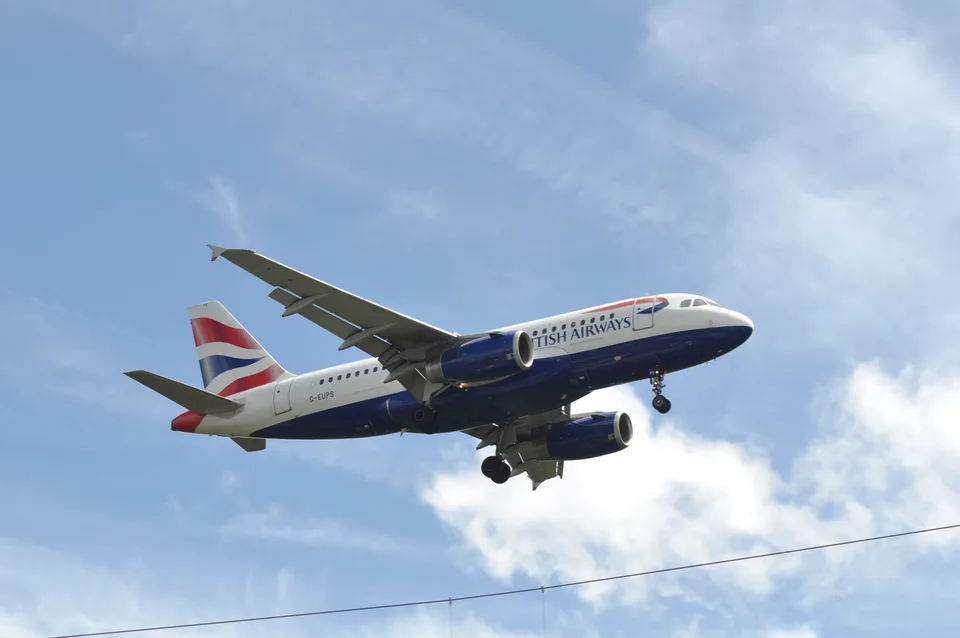
The incident aircraft, photographed on 10 July 2016 according to Commons metadata. It shows British Airways markings; the AAIB report does not name the operator. The photograph does not show the 2025 incident.
G-EUPS lost reliable position information and automatic flight functions after departure from Edinburgh. The crew used radio navigation and radar vectors, went around at Heathrow when checklist actions were incomplete, and landed safely.
Read the full incident Follow what happened, from the flight to the investigation findings.
What investigators concluded
AAIB attributed the failures to severe inertial drift after vertical nose landing gear shock loading outside the reference units' certification requirements.
1,571 words / about 8 minutes to read. Based on the investigation records cited below.
A bang before rotation
On 30 October 2025, Airbus A319-131 G-EUPS departed Edinburgh for London Heathrow with 132 passengers and six crew. It was a scheduled commercial air transport flight. The commander had 12,127 flying hours, including 6,623 on the aircraft type. The co-pilot was flying and the commander was monitoring. The AAIB recorded the occurrence time as 19:18 UTC. Its investigation subsequently drew on the pilots' report, both flight recorders and enquiries into the aircraft and the departure runway.
The taxi and initial takeoff roll appeared normal in the recorded information. As the aircraft accelerated on Edinburgh's Runway 06, the cockpit recording captured rhythmic pulses consistent with a nosewheel passing over centreline lights. Around a groundspeed of 118 knots, one pulse grew louder. The nose landing gear's recorded ground-or-air indication began oscillating at about the same time. A second loud impulse followed roughly a second later, immediately before the aircraft reached rotation speed. Both pilots heard a bang from the nosewheel.
The co-pilot applied aft control input and the aircraft lifted off. The accelerometer near the aircraft's centre of gravity showed no unusual takeoff acceleration. Investigators explained that acceleration near the forward fuselage, where the nose landing gear sits, might not be apparent at that central sensor. The cockpit audio and landing gear indication supplied evidence of a disturbance that the central accelerometer did not reveal. It was followed by a delayed sequence of flight-deck indications and automation failures as the aircraft climbed away from Edinburgh.
About nine minutes after takeoff, while climbing through flight level 220, the pilots saw a GPS PRIMARY annunciation on the left navigation display. A status message showed reduced automatic landing capability, with CAT 3 DUAL unavailable. They checked the position monitor page. Inertial reference system 2 showed dashes instead of a numerical deviation. Systems 1 and 3 each showed five nautical miles of deviation, increasing by about a tenth of a mile per second until the displayed value reached 28 nautical miles.
Autopilot 2, engaged after takeoff, disconnected. The flying pilot selected autopilot 1, but it disconnected a few seconds later, together with autothrust. There were initially no electronic centralised aircraft monitor alerts or overhead-panel fault lights. The pilots now had to fly manually while assessing unreliable position information and the availability of several aircraft systems. They declared PAN to air traffic control and levelled at flight level 320. They requested a radar heading to help them continue with an external position reference.
Scottish Control advised that the aircraft was now outside reduced vertical separation approval, which requires equipment including an autopilot able to hold altitude. The controller requested transponder code 7700 and a descent to flight level 290. The code was later cancelled after transfer to London Control. On the aircraft status display, both autopilots, autothrust and CAT 2 landing capability were listed as unavailable. The pilots consulted the flight crew operating manual and quick reference handbook, but none of the checklists exactly matched the indications they were seeing.
The crew considered the quick reference checklist for disagreement between flight management and GPS position. The flight management positions agreed with the combined GPS and inertial position, while other information showed discrepancies. A GPS waypoint check failed to establish a reliable position: air traffic control advised the pilots that the position was incorrect. They were able to confirm where they were using VOR radio navigation. The left and right navigation displays nevertheless showed a five-nautical-mile difference between their positions.
The pilots selected ROSE VOR on the displays and continued towards Heathrow using radar vectors. The approach to navigation combined a radio aid they could check with controller-supplied headings. During descent the status display returned to normal, and autopilot and autothrust became available again. The crew re-engaged autopilot 2 and autothrust. They discussed keeping the available automation for as long as practical, while planning to disconnect it on final approach to avoid a sudden workload increase if it failed again. They also briefed a go-around.
At 4,200 feet, after clearance to intercept the localiser, autopilot and autothrust disconnected again. The pilots continued the approach manually. At about 1,500 feet above mean sea level, a rudder travel limiter alert appeared. The required checklist actions could not be completed by 1,000 feet, so the crew went around as briefed. After levelling off, the alert cleared. The second approach was uneventful and the aircraft landed safely. While parking, further inertial reference fault alerts appeared. All six crew and 132 passengers were uninjured.
Three reference units and several dependent systems
Investigators recovered the flight data recorder and cockpit voice recorder after landing. The cockpit recording covered the whole flight, starting during preparation for departure. That recording allowed the takeoff sounds to be assessed alongside the pilots' subsequent response and the recorded system behaviour. The flight data showed the nose landing gear indication switching rapidly between ground and air. As its shock absorber extends, the gear passes through a small range in which the indication can change. The recorded switching supported the assessment that vertical loads were extending the leg during the takeoff roll.
G-EUPS carried three identical Northrop Grumman air data inertial reference units, mounted on a rack immediately behind and above the nose landing gear bay. Each contained an air data section and an inertial reference section, which could operate independently. Air data functions supplied parameters including pressure altitude and airspeed. Inertial functions supplied attitude, heading, ground speed, aircraft position and other movement data. Those outputs fed flight management, guidance and augmentation computers, linking several operational functions to the same set of reference units.
The installed units belonged to part-number series PN 465020-030x-0316/318. Their air data sections also supplied Mach, angle of attack, temperature and overspeed warnings. The inertial sections provided flight path vector, track, accelerations and angular rates. Flight guidance used the processed data for the flight director as well as automatic flight functions. The flight augmentation computer supported rudder trim and yaw damper functions. On the overhead panel, the pilots could select NAV, ATT or OFF modes and see indications of failures.
The computers compared the inertial outputs and disregarded a reference when its error exceeded the permitted threshold. The rudder travel limiter became unavailable with only one valid reference, or when all three were rejected. Investigators found that severe inertial drift supplied erroneous parameters to the flight management, guidance and augmentation systems. That explained the repeated loss of autopilot and autothrust, the positional problems and the rudder travel limiter's unavailability. Post-flight testing found no persistent fault in the reference units. Maintenance inspections of the nose landing gear were also satisfactory.
The AAIB concluded that vertical shock loading travelled from the nose landing gear through the airframe and into the avionics rack. The aircraft had passed over runway centreline lights and another surface irregularity immediately before rotation. The recorded landing gear indications showed that its leg extended far enough to switch the ground-or-air signal repeatedly. Investigators could not establish whether a single load or several closely spaced loads produced a force likely to be outside the reference units' operating qualification requirements. The exact source of the shock was not determined.
Edinburgh's operations team inspected the runway that day in the calculated area of the second sound impulse. Several repair patches lay along the runway, including patches on or near the centreline before the rotation point. One patch had developed an abnormal surface condition and was replaced. It was offset from the centreline, however, and the nosewheels were unlikely to have passed over the degraded area. The inspection did not identify a single irregularity capable of explaining the shock load experienced by G-EUPS.
The AAIB had investigated a similar 2021 occurrence involving another A319 from the same operator at Edinburgh. An uneven repair patch was thought to have contributed to that event and was subsequently replaced. That investigation identified five other similar events involving the same reference-unit series. The manufacturer reported seven further similar occurrences across the worldwide fleet since 2021. The affected reference-unit series had not been fitted to newly built aircraft since 2015. Its sensitivity to sufficiently large vertical shock loading was an issue already known to the manufacturer.
Earlier safety work focused on nose landing gear servicing. It included a maintenance manual amendment and development of a liquid and nitrogen charging tool. At publication, the tool had not completed qualification for operator use, although service introduction was expected during 2026. A manufacturer technical notice issued in April 2020 described severe inertial drift and how maintenance teams should investigate occurrences. The operator followed that notice when troubleshooting G-EUPS. Tests and inspections found the reference units serviceable and the landing gear in satisfactory condition.
The report says no further manufacturer action had been taken because the shocks were considered outside the reference units' certification requirements and the landing gear had been serviced in accordance with the maintenance manual. Edinburgh's planned runway resurfacing began in November 2025 and finished in April 2026. The AAIB concluded that full resurfacing would minimise the probability of surface irregularities affecting other aircraft.
The final report was published on 8 October 2026. It attributes the systems failures to severe inertial reference drift after nose landing gear shock loading, while retaining uncertainty about the precise surface input. The pilots' use of radio navigation, radar vectors, manual flight and a briefed go-around brought the aircraft to a safe landing at its intended destination. The AAIB classifies the event as a serious incident. It records no injuries and says the flight crew successfully managed the events.
Was a particular runway defect proved responsible?
The inspection did not identify a single irregularity capable of explaining the shock load. The nosewheels were unlikely to have crossed the degraded patch identified.
At the time of publication the nose landing gear servicing tool had not completed qualification for operator use; service entry was expected during 2026.
Matching dossiers for Runway surface: No other dossier in this collection.
Read alongside
These comparisons connect specific research topics. Shared circumstances do not establish identical causes. Evidence from both investigations is provided below.
Both investigations describe unreliable sensor information followed by loss of automatic flight functions. AF447 involved inconsistent airspeed after likely pitot icing and a stall; G-EUPS involved inertial drift after takeoff shock loading and a safe landing.
Explore the records below for additional context. They open on the publisher's site and are not all included in our report search. Source reuse terms apply.
Kevin Murphy writes the incident accounts on AirlineIncidents.com, out of a long interest in aviation safety and the lessons each investigation leaves behind.
Prepared by
AirlineIncidents editorial desk
Report citation check
Independent expert review
Not completed
Citation checks compare supporting text with the indexed report pages. They do not constitute independent expert review. How these pages are prepared.
Revision history
: Published sourced incident account, timeline, photographs and investigation findings.
.jpg)