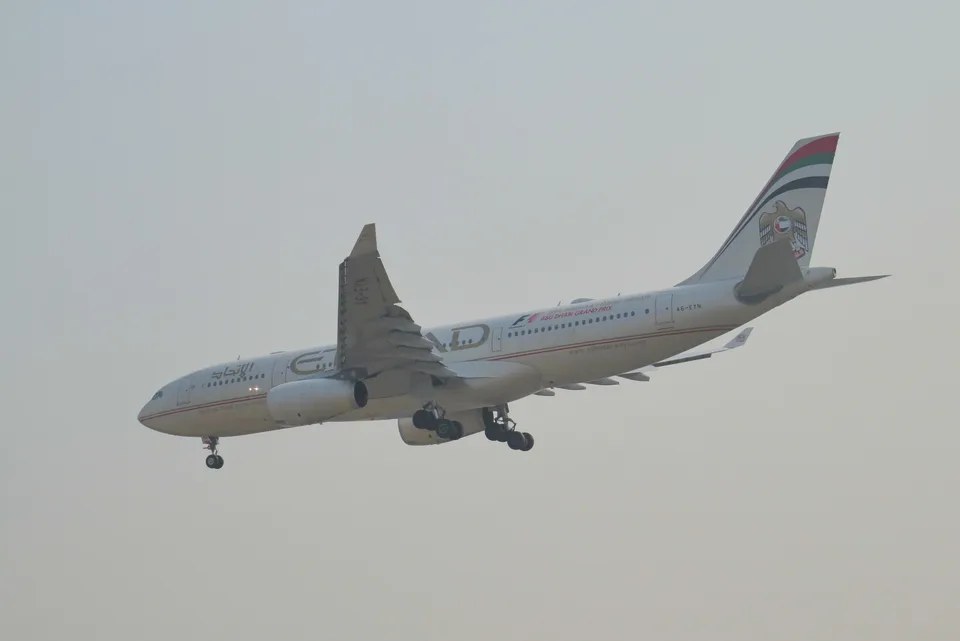
The copilot fainted at FL380 during a Dublin flight. The GCAA final report examined the return to Abu Dhabi, medical evidence and inconsistent procedures.
Original photograph unchanged. Responsive WebP copies resized without cropping.
Geographic context
Abu Dhabi, departure and return
Iranian airspace, approximate incapacitation area
Dublin, intended destination
Approximate geographic markers. Figure 1 places the incapacitation off the Iranian coast near Bushehr. The aircraft returned to Abu Dhabi. Basemap: Natural Earth, public domain.Read supporting evidence
Fifty-eight minutes after departure from Abu Dhabi for Dublin, the monitoring copilot became unconscious. Cabin crew gave oxygen and a passenger doctor attended him. The commander returned to Abu Dhabi with an off-duty company captain helping with communications and checklists.
Read the full incident Follow what happened, from the flight to the investigation findings.
What investigators concluded
The A330 landed safely with all 212 occupants. The AAIS identified inconsistent incapacitation procedures and issued seven recommendations covering manuals, cockpit assistance, medical advice, testing and safety data.
1,529 words / about 7 minutes to read. Based on the investigation records cited below.
The early departure for Dublin
Etihad Airways flight ETD045 left Abu Dhabi International Airport at 0238 local time on 29 June 2015 for Dublin, Ireland. The Airbus A330-243, registered A6-EYN, carried 201 passengers, two flight crew and nine cabin crew. The commander occupied the left seat and was flying the aircraft. The departure was uneventful, and the aircraft reached its cruising level of FL380 at 0310. The flight then continued into Iranian airspace.
The copilot had last flown on 17 June. He had reported sick on 20 and 21 June with flu and nasal congestion, and the Dublin service was his first flight in 12 days. He told investigators that he had used a nasal spray bought over the counter to clear the congestion, stopping its use 24 hours before the flight. He considered himself medically fit and said that he was well rested.
Both pilots held valid Class 1 medical certificates. The investigation found them licensed, qualified and adequately rested for the flight. The copilot was still experiencing nasal congestion when the aircraft departed. The operator had guidance on medication in its Operations Manual Part A, and its medical centre offered consultations following illness to assess whether crew were fit to fly.
About 58 minutes after takeoff, at approximately 0336, the copilot asked the commander for tissues so that he could clear his nose. He blew his nose forcefully and saw blood mixed with mucus. This happened several more times. He told the commander that he was feeling unwell, experienced a strange sensation and tingling in his fingers and body, and partially reclined his seat.
He then fainted, falling backwards into the seat with his eyes open. The commander called his name and shook him, receiving no response. He moved the seat farther back and reclined it further to prevent the copilot from obstructing the flight controls. The commander was already the pilot flying; the copilot had been carrying out the monitoring role.
An emergency passenger announcement summoned the cabin manager to the cockpit. With another crew member helping, the cabin manager applied wet towels and administered oxygen. The copilot revived after about a minute, although he was initially only partly conscious. The commander declared PAN-PAN to Tehran air traffic control, explained the incapacitation and said that he would return to Abu Dhabi. He directed the cabin manager to help the copilot leave the flight deck.
Medical help in the cabin and assistance in the cockpit
A doctor travelling as a passenger attended the copilot and checked his vital signs. His blood pressure was low. The doctor suggested that forcefully blowing his nose might have contributed to the low pressure. The copilot said that he felt normal again after about 20 minutes. He moved into a business class seat beside the doctor and remained in the cabin for the rest of the flight.
The cabin manager told the commander that a company Boeing 777 captain was also on board as a passenger. The commander asked this pilot to help with radio communications and checklist completion. His identity was checked before he entered the cockpit, and he occupied the copilot seat. The commander briefed the cabin manager, and the passengers were told that the aircraft would return to its departure airport.
The recorded timeline places the start of the right turn back toward Abu Dhabi at 0343. Abu Dhabi air traffic control gave the aircraft priority clearance. The commander continued the return while the off-duty captain helped with communications and checklists and the doctor watched over the copilot in the cabin.
At 0451 the aircraft was established on the instrument landing system for runway 13L. It landed at 0454, 78 minutes after the incapacitation and two hours and 16 minutes after takeoff. The timeline gives a landing weight of 193,624 kilograms. The aircraft data table lists a maximum landing weight of 187,000 kilograms. The report describes the overweight landing as uneventful.
The aircraft was undamaged, and the passengers and crew disembarked normally. There were no deaths. Apart from the copilot incapacitation, no injuries were reported. Paramedics met the aircraft at its parking stand and performed medical checks, including an electrocardiogram. The results were considered normal. The copilot went to the airport doctor and was released after his condition was judged satisfactory.
No drug or alcohol blood test was performed after arrival. Later that day the copilot consulted the operator's aeromedical department. The company doctor requested further testing, including blood tests, an electrocardiogram and a cardiologist consultation. Investigators were told that the subsequent examinations produced no findings related to his condition. After being declared medically fit and obtaining GCAA consent, he resumed flying approximately a month after the incident.
The investigation compared the instructions available to the commander. Operations Manual Part A told crews to arrange a landing as soon as possible following an incapacitation. The flight crew training manual called for landing as soon as practicable after considering the relevant factors. The flight crew operating manual contained no instruction about landing in its incapacitation procedure. The commander had consulted that operating manual.
The manuals also differed over declaring an emergency. Operations Manual Part A made an emergency declaration conditional on it being required. The training manual instructed crews to declare an emergency to air traffic control. The operating manual said nothing about making such a declaration. The AAIS identified these differences as inconsistencies in the guidance available to crews responding to an abnormal situation.
The commander chose Abu Dhabi, 400 nautical miles away. Kuwait International, at 105 nautical miles, was the closest available airport. The AAIS assessed most of his actions as consistent with the operator's standard procedures, but found that he should have landed as soon as possible. It also found that he should have sought help from a cabin crew member instead of admitting the off-duty Boeing 777 captain, who was not qualified on the A330. The commander had considered the captain's assistance a better option than using cabin crew. The investigation called for the operator to standardize its procedures and align the manuals.
The AAIS could not determine why the copilot fainted. Investigators were informed that the post-incident medical tests had identified no medical condition, but the medical records themselves were not made available to the investigation. The report listed possible contributors: flying with nasal congestion, possible effects of the nasal spray, the timing of the flight within his biological cycle, the effects of a pressurized aircraft, and his response to seeing blood.
The copilot described an earlier fainting episode during a medical examination before he joined Etihad. It happened when blood was drawn and was preceded by a similar tingling sensation. He had sought medical advice and been told that the condition was vasovagal. He could not remember when it had occurred and said that no treatment had been advised.
Investigators considered the symptoms during the Dublin flight similar to a vasovagal attack, while stating that this assessment had not been medically substantiated. They referred to the sight of blood, the tingling sensation, fainting and low blood pressure. They also considered the recent flu, medication, early morning duty and congestion during pressurized flight. Although they found that he was rested, they examined the possible influence of his circadian cycle. They recommended continued monitoring and assistance for the pilot.
The UAE medical rules quoted in the report required licence holders to stop exercising their privileges when illness or medication could impair safe performance. They also required aeromedical advice after significant illness. The investigation examined those duties alongside the operator's policy on seeking advice about medicines.
The investigation reviewed 40 pilot incapacitations reported to the GCAA between 2010 and 2015. All involved commercial pilots, and all the flights continued safely. Thirty-four events involved a cockpit crew of two. The authority's available data left important gaps: investigators could not identify the medical reason for 37 events or establish whether an individual pilot had suffered repeated incapacitations.
Using departure figures for 2012 to 2015, the AAIS calculated an average of roughly one reported incapacitation per 61,000 departures. It sought better medical information and analysis so that the authority could understand the risks and improve prevention. The report also called for pilots to be encouraged to disclose medical concerns openly while protecting their employment and job security. Etihad's existing medical programme included guidance during induction, medication awareness communications and consultations after illness.
The AAIS issued its final report on 10 November 2016 with three recommendations to Etihad and four to the GCAA. Recommendation SR64/2016 asked Etihad to make its reference and training manuals consistent for abnormal situations, including incapacitation. SR65/2016 called for a review of who could assist the operating pilots after an incapacitation. SR66/2016 asked the airline to reinforce medical consultation about medication and other health concerns and to promote those consultations without retribution.
For the GCAA, SR67/2016 sought cooperation with the ministries responsible for medical licensing so pharmacies and clinics could receive aviation safety information about medicines. SR68/2016 called for a study of medication use among UAE pilots, the associated flying risks and less impairing alternatives where available. SR69/2016 requested clear rules for drug and alcohol blood testing after accidents and incidents. SR70/2016 called for a review of the incapacitation statistics, including the concentration of reported events among pilots aged 30 to 50.
A simplified reading of the investigation findings. The sequence does not replace the full report or imply that every contributing factor is shown.
Sequence of events
Times are local, UTC+4, as used in the GCAA report. The incapacitation at about 0336 on 29 June was at about 2336 UTC on 28 June. Expand an event to see its evidence.
0238Departure from Abu Dhabi
ETD045 departed for Dublin with 212 people on board.
After incapacitationUrgency declared and assistance arranged
The commander declared PAN-PAN to Tehran ATC. The copilot moved into the cabin and a company Boeing 777 captain helped with communications and checklists.
Cabin crew gave him wet towels and oxygen. A passenger doctor checked him in the cabin, found low blood pressure, and stayed beside him for the return.
Kuwait International was 105 nautical miles away, compared with 400 nautical miles to Abu Dhabi. The AAIS found that the commander should have landed as soon as possible.
Recommendation SR64/2016 called for Etihad to align the reference and training manuals so crews received consistent guidance for abnormal situations, including pilot incapacitation.
SR67/2016 through SR69/2016 sought pharmacy and clinic safety information, research into pilots medication use, and clear drug and alcohol blood testing rules after accidents and incidents.
Matching dossiers for Possible medical contributors: No other dossier in this collection.
Read alongside
These comparisons connect specific research topics. Shared circumstances do not establish identical causes. Evidence from both investigations is provided below.
Both flights required the remaining operating pilot to manage the aircraft while cabin crew assisted an incapacitated colleague. On British Airways 5390, a windscreen failed and the commander was partly expelled through the opening; cabin crew held him while the copilot landed at Southampton. On ETD045, the copilot fainted, received oxygen and moved to the cabin for medical care.
Explore the records below for additional context. They open on the publisher's site and are not all included in our report search. Source reuse terms apply.
Flight history, medical evidence, operational analysis and seven safety recommendations, issued 10 November 2016.
Sources and transparency
The GCAA AAIS issued final report AIFN/0006/2015 on 10 November 2016.
Source limitations
The medical records of the copilot were unavailable to the AAIS. Post-incident medical findings were conveyed to investigators by the copilot and operator.
Pilot Incapacitation: Etihad Airways Airbus A330-243 A6-EYN
UAE GCAA Air Accident Investigation Sector Final report AIFN/0006/2015, issued 10 November 2016
Copyright remains with the rights holders. Limited quotations support commentary and citation. Full report and third-party illustrations remain available from the GCAA.
Kevin Murphy writes the incident accounts on AirlineIncidents.com, out of a long interest in aviation safety and the lessons each investigation leaves behind.
Prepared by
AirlineIncidents editorial desk
Report citation check
Independent expert review
Not completed
Citation checks compare supporting text with the indexed report pages. They do not constitute independent expert review. How these pages are prepared.
Revision history
: Published sourced incident account, timeline, photographs and investigation findings.