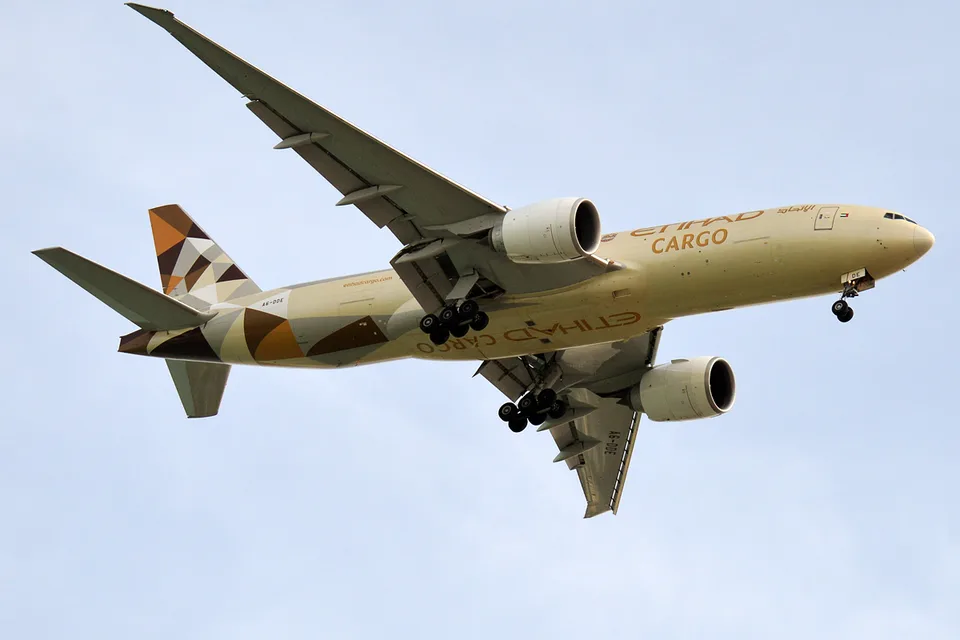
The captain of Etihad cargo flight ETD 927 collapsed in the galley. The copilot diverted to Kuwait while the other crew performed CPR. The captain died.
Original photograph saved unchanged. Responsive WebP copies resized without cropping.
Geographic context
Abu Dhabi International Airport
Incapacitation over international waters in Bahrain airspace
Kuwait International Airport, diversion
Amsterdam Schiphol, planned destination
ETD 927 departed Abu Dhabi for Amsterdam and diverted to Kuwait. The incapacitation marker is an approximate geographic estimate from Figure 1; the report supplies no coordinates for the collapse. Basemap: Natural Earth, public domain.Read supporting evidence
At flight level 320, the captain handed control to the copilot and went to the galley, where he collapsed. The copilot declared MAYDAY and diverted to Kuwait. CPR continued through the landing and after paramedics boarded, but the captain died.
Read the full incident Follow what happened, from the flight to the investigation findings.
What investigators concluded
The GCAA attributed the captain's incapacitation and death to cardiopulmonary system collapse caused by coronary artery stenosis. High cholesterol had caused coronary artery disease. Etihad changed freighter incapacitation procedures and CPR training, and the GCAA revised lipid management guidance.
The captain's collapse and the diversion to Kuwait
1,197 words / about 6 minutes to read. The official report for this event is short, so this account is shorter than most and covers only what the report documents.
A cargo flight from Abu Dhabi
Etihad Airways flight ETD 927 left Abu Dhabi International Airport for Amsterdam Schiphol on 27 September 2017. The Boeing freighter, registered A6-DDE, carried four people: the captain, the copilot, a loadmaster and a corporate security officer. Departure was at 0302 UTC, and the captain initially flew from the left seat. Takeoff and departure were uneventful, and communication between the pilots followed the operator's standards.
Both pilots were licensed and qualified, and both held valid Class 1 medical certificates. They had each flown four hours during the preceding seven days, and investigators found them adequately rested for the flight. The captain had renewed his medical certificate the day before departure. The aircraft was certified, equipped and maintained in accordance with UAE requirements. Weather and navigation aids were assessed as having no bearing on the incident.
About 42 minutes after takeoff, the aircraft was cruising at flight level 320, approximately 32,000 feet. The captain handed control to the copilot, left his seat and went to the galley. As he pulled out a meal tray, he lost consciousness and collapsed in front of the security officer. The security officer immediately began cardiopulmonary resuscitation, or CPR. The loadmaster kept the copilot informed from outside the flight deck.
The loadmaster's first warning reached the copilot approximately six minutes after the captain had left the cockpit. Figure 1 places the captain's departure from the cockpit at 0344:28 UTC and the loadmaster's report of his collapse at 0350:51. At 0351:58, the copilot declared MAYDAY and contacted Kuwait air traffic control for a left turn. The report's synopsis records that Bahrain air traffic control was advised of the diversion.
The copilot chose Kuwait International Airport, which the investigation identified as the nearest available airport. After receiving clearance from Kuwait air traffic control, he began the diversion while continuing to operate from the right seat. He requested an ambulance for arrival at 0352:54. At 0355:17, the loadmaster reported that the captain remained unresponsive and that CPR was continuing.
An overweight landing and resuscitation on the runway
The aircraft still carried enough fuel for an overweight landing after its short flight. The security officer and loadmaster continued CPR as the copilot brought the freighter into Kuwait. Touchdown was at 0414:13 UTC, according to the flight path figure. The landing was uneventful, and the copilot stopped the aircraft on the runway so that paramedics could board.
The paramedics continued resuscitation for approximately 15 minutes before declaring the captain dead. The copilot, loadmaster and security officer disembarked normally. The aircraft was undamaged. An inspection required after an overweight landing found no defects, and the aircraft returned to service. Investigators assessed the copilot's immediate diversion and the security officer's sustained resuscitation efforts as giving the captain the best opportunity to survive. His medical condition was severe, and the resuscitation attempts were unsuccessful.
An autopsy at the Kuwait City Coroner's Office identified a collapse of the cardiopulmonary system caused by narrowing of a coronary artery. The GCAA's Air Accident Investigation Sector concluded that this caused the captain's incapacitation and subsequent death. It found that his high cholesterol had caused coronary artery disease and contributed to the arterial narrowing.
The captain's medical records showed high blood lipid levels in October 2015. The operator's medical center advised changes to diet and exercise and arranged checks at three month intervals. His lipid levels improved in January 2016 but remained above the reference level. A further improvement in April was followed by the issue of a medical certificate valid for a year. High levels at the annual examination in October 2016 prompted another period of regular checks. By March 2017, the levels had fallen and the follow-up condition was removed.
Section 1.5.2 records a further medical examination on 26 September 2017. Lipid levels had decreased again, although they remained outside the reference range. Blood pressure, pulse and body mass index were normal, as was the electrocardiogram. The captain was 51, did not smoke, exercised regularly and followed a healthy diet. His calculated risk of atherosclerotic cardiovascular disease over ten years had fallen from 6.6 percent in 2015 to 3.2 percent at the latest check.
The calculation used for the medical assessment considered both modifiable and nonmodifiable risk factors. The GCAA guidance described a ten year risk below 10 percent as permitting certification once modifiable factors had been discussed and a management strategy recorded. Investigators concluded that the medical examiner could not have predicted the captain's imminent incapacitation.
Investigators found vitamins, aspirin, painkillers and statin tablets among the captain's belongings. His medical records contained no declaration of the use of these supplements and medications. Etihad's procedures and the applicable regulations required pilots to tell the aeromedical examiner about medication they were taking. Statin use was permitted under medical supervision.
The operator had already circulated medication guidance to pilots and cabin crew in 2015. Its medical center also provided information during induction and circulated material on medication use and fitness to fly. The investigation found that the captain's undeclared medication had likely helped reduce his lipid levels, while the treatment had proceeded outside the aeromedical examiner's management.
Declaring statin use could have given the examiner additional information about the reduction in the captain's calculated cardiovascular risk and allowed an assessment of the treatment. The GCAA could not determine whether the self-medicated statin use contributed to his incapacitation.
Etihad's manuals described obvious and subtle pilot incapacitation and required an emergency declaration and an early landing. The procedures were written for passenger aircraft and depended on assistance from a cabin manager. The operations manual did not address two-pilot freighter operations. The incapacitation drill in the safety and emergency procedures manual also applied to passenger aircraft.
The security officer had to draw on earlier training when he began CPR. Etihad did not provide loadmasters and corporate security officers with regular first aid training, and UAE regulations did not require it. Investigators observed that many freighter flights carry only two pilots. When additional crew are carried, appropriate training and equipment can enable them to help during a medical emergency while the remaining pilot flies.
A6-DDE carried no automated external defibrillator, or AED. Such equipment was standard on passenger flights. The investigation could not determine whether an AED would have saved the captain's life. The aircraft's cockpit voice and flight data recorders were removed and taken to the AAIS recorder laboratory, where their data was downloaded successfully. Ground equipment had also recorded communications between the pilots and air traffic control.
After the incident, Etihad added practical CPR exercises and pilot incapacitation material to initial and annual recurrent loadmaster training. Aviation health training for loadmasters and security officers was aligned with the cabin crew syllabus, apart from AED training, because B777 freighters did not carry those devices. Inflight security officers were required to attend practical CPR training and assessment.
Etihad also updated its operations manual and standard operating procedures for freighter pilot incapacitation, including the loadmaster's role. The GCAA distributed a fitness to fly brochure to UAE pilots and aeromedical centers, held a workshop for approved medical examiners on lipid management, and amended its lipid management guidance. The AAIS judged these actions adequate and issued no additional safety recommendations. Its final serious incident investigation report was issued on 25 February 2019.
A simplified reading of the investigation findings. The sequence does not replace the full report or imply that every contributing factor is shown.
Sequence of events
All flight times are UTC. Figure 1 supplies the timed emergency sequence; the narrative also gives approximate elapsed times. Expand an event to see its evidence.
0302 UTCDeparture from Abu Dhabi
ETD 927 departed for Amsterdam with the captain flying from the left seat.
The GCAA identified Kuwait International Airport as the nearest available airport. The copilot received clearance and initiated the diversion from the right seat.
What first aid training gap did the investigation find?
Etihad did not provide loadmasters or corporate security officers with regular first aid training. The security officer relied on his earlier training when he began CPR. Etihad subsequently introduced practical CPR training for these roles.
What had the captain's latest medical examination shown?
The examination recorded normal blood pressure, pulse, body mass index and ECG. His blood lipid level remained above the reference range, and his calculated ten year cardiovascular risk was 3.2 percent.
The cover, occurrence brief and synopsis give 27 September 2017. Section 1.1 gives 2018. Section 1.5.2 dates the last medical examination to 26 September 2017; the analysis refers to October 2017.
Table 1 records zero fatal injuries and four uninjured occupants. The sentence immediately above it states that the captain became incapacitated and died. Section 1.13 identifies the medical cause of death, and section 1.15 identifies the three people who disembarked.
Actions and recommendations are described at the dates of the cited records. A recommendation is not proof of implementation.
Freighter emergency procedures and training
Etihad added CPR exercises and incapacitation material to loadmaster training, required practical CPR training for inflight security officers, and revised freighter procedures to describe the loadmaster's role.
The GCAA distributed a fitness to fly brochure, organized a lipid management workshop for approved examiners and amended its lipid management guidance.
The captain had passed a medical examination the day before the flight. The GCAA found that the examiner could not predict the imminent incapacitation.
Matching dossiers for Medical certification: No other dossier in this collection.
Safety findingCrew emergency training
The freighter incapacitation procedures and regular first aid training omitted the loadmaster and corporate security officer roles addressed after the incident.
Matching dossiers for Crew emergency training: No other dossier in this collection.
Read alongside
These comparisons connect specific research topics. Shared circumstances do not establish identical causes. Evidence from both investigations is provided below.
Both flights required the copilot to land while other crew assisted the captain. On Etihad ETD 927, the captain suffered cardiac arrest and died after the diversion to Kuwait. On British Airways 5390, a windscreen separated and the captain was partially pulled outside; cabin crew restrained him while the copilot landed at Southampton.
Explore the records below for additional context. They open on the publisher's site and are not all included in our report search. Source reuse terms apply.
Kevin Murphy writes the incident accounts on AirlineIncidents.com, out of a long interest in aviation safety and the lessons each investigation leaves behind.
Prepared by
AirlineIncidents editorial desk
Report citation check
Independent expert review
Not completed
Citation checks compare supporting text with the indexed report pages. They do not constitute independent expert review. How these pages are prepared.
Revision history
: Final investigation completed. GCAA AAIS report AIFN/0011/2017 issued 25 February 2019.