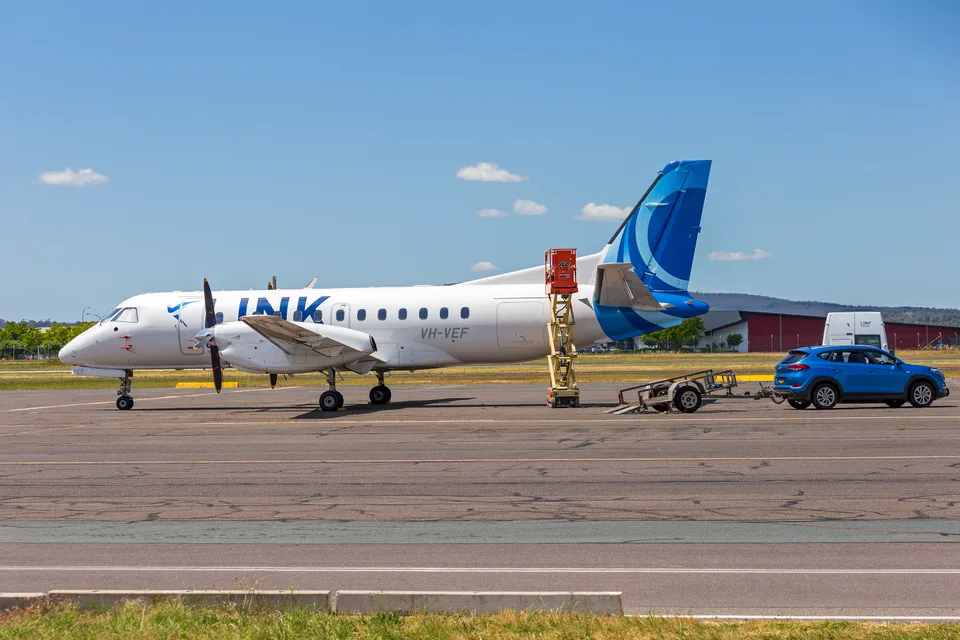
Original photograph unchanged. Responsive WebP copies resized without cropping.
Geographic context
Orange Airport, departure
Melbourne Airport, destination and occurrence
Airport markers show the departure and destination. Melbourne coordinates are those listed in the ATSB report. The Orange marker is rounded to the airport area. Basemap: Natural Earth, public domain.Read supporting evidence
After a passenger flight from Orange, VH-VEF landed at Melbourne and taxied to its bay. A post-flight inspection found a deflated left inboard main tyre and a missing section of its inner wheel rim. The fragment was recovered on the bay lead-in. A precautionary inspection found a crack in the other wheel on that gear leg.
Read the full incident Follow what happened, from the flight to the investigation findings.
What investigators concluded
The ATSB found that fatigue cracking fractured the wheel at the bead seat. Both affected wheels had an earlier design with known susceptibility to cracking in that region. Link Airways removed its eight remaining susceptible wheels from service.
1,537 words / about 7 minutes to read. Based on the investigation records cited below.
Arrival and the post-flight discovery
On 1 April 2026, Link Airways Saab 340B VH-VEF flew from Orange, New South Wales, to Melbourne Airport in Victoria on a passenger transport service. It landed at 18:41 local time. The flight crew noticed nothing unusual during the landing or the taxi to the parking bay. The first indication of damage came during the routine post-flight inspection, when the left inboard main landing gear tyre was found deflated. A section of the inner wheel rim had fractured and was missing. The aircraft sustained no other damage.
The Saab had two wheels on each main landing gear leg and another pair on the nose gear. VH-VEF, serial number 340B-457, had been manufactured in Sweden in 1998 and first registered in Australia in 2018. Its operator was VEE H Aviation, trading as Link Airways. The service was a scheduled domestic commercial air transport flight. The ATSB recorded no injuries to crew or passengers. The numbers of people on board were unknown.
At about 19:01, one of the flight crew contacted air traffic control. A section of the wheel rim was missing, and the crew member reported that it might have come away during landing. Airside safety officers began checking the runway for foreign object debris. Another officer retraced the taxi route between the runway and the parking bay. During the search, another aircraft diverted from Melbourne after its crew considered it unsafe to land.
The runway inspection found no debris. At approximately 19:08, the missing rim section was discovered on the lead-in to VH-VEF's parking bay. The pilot compared the recovered piece with the damaged wheel and confirmed that it accounted for the only missing section. That information was passed to air traffic control, and the runway inspection ended. The ATSB placed the fracture and separation during taxi on the approach to the parking position.
Link Airways removed the other wheel on the same landing gear leg for a precautionary non-destructive inspection. A hairline crack was found in the inboard bead seat area, close to the location of the fracture on the first wheel. The wheel component maintenance manual required examination of the mating wheel after a wheel assembly operated with a flat or damaged tyre. With one tyre deflated, the adjacent wheel could have carried approximately twice its usual load.
Both affected wheels had been received in overhauled condition from a supplier in the United States. Neither had previously been installed on the operator's aircraft. They were fitted to the same landing gear leg at the same time and each had completed 143 landings. Their inner subassemblies both carried part number 5009237. The fractured inner subassembly had an April 1989 serial number; the cracked one had an August 1990 serial number.
The earlier design and its inspection requirements
The wheels were manufactured by the Aircraft Braking Systems Corporation, subsequently Meggitt Aircraft Braking Systems. Their design had a known susceptibility to cracking around the bead seat of the inner wheel subassembly. Following earlier wheel failures worldwide, the manufacturer issued service bulletin SF340-32-24 in April 1994. It specified inspection techniques and intervals for finding cracks in that region, including eddy-current inspections at tyre changes and during overhaul.
A revised wheel design followed in December 1995. It reduced stresses in the bead seat area. Service bulletin SF340-32-41 allowed the earlier assemblies, with serial numbers OCT95-1606 and earlier, to remain in use until stocks were depleted if the required maintenance and inspection standards were maintained. Tyre changes occurred after a variable number of flight cycles, nominally about 300. The 143 landings accumulated by the two occurrence wheels were about half the typical interval between tyre changes and their associated inspections.
The susceptible inboard wheel forging could occur across different assembly and subassembly part-number suffixes. In the defect reports, only two entries specifically identified subassemblies 5009237 or 5009237-1. Other entries named a later revision, a different wheel part or the parent assembly.
The operator returned both wheels to VSE Aviation, the organisation that had carried out their most recent overhaul. The ATSB examined images supplied by the operator. Features on the fracture surface were consistent with fatigue cracking, and the location and manner of fracture resembled those in two earlier ATSB investigations. VSE Aviation advised that it could not identify the cause of the in-service fracture.
VSE Aviation also tested its inspection process using the second, cracked wheel. It anonymously reintroduced that wheel into the non-destructive inspection system, where the crack was reportedly detected. The ATSB considered this result to give some confidence in the inspection process. Eddy-current inspection is suitable for detecting small flaws, but inspection errors and other variables can reduce the probability of detection. The successful repeat inspection left open the possibility of a crack having escaped detection on another occasion.
At the ATSB's request, VSE Aviation provided records for the 5010488-series wheels it overhauled between April 2022 and April 2026. The list contained 676 assemblies. Twenty-six, approximately four per cent, had inboard subassembly serial numbers from October 1995 or earlier. None had been rejected because of bead seat crack indications. One had been rejected for unrelated cracking in the lock ring groove.
The ATSB also searched the Australian Civil Aviation Safety Authority defect database for Saab 340 main wheel cracking over the preceding two decades. It found 30 reports, including three in-service fractures, one bead seat failure during teardown and inspection, and 26 reports of cracked wheels. Twenty-two reports dated from April 2022 to April 2026. Five of the cracked-wheel reports identified the inboard rim or bead seat. Other reports concerned different areas or gave less specific locations. Two wheels had cracks found visually, including one that had already passed non-destructive inspection.
The ATSB had investigated two earlier Saab 340B wheel fractures. In February 2009, damage to a left outboard main wheel was discovered after a flight to Sydney. The wheel had lost approximately half its inner rim circumference through fatigue cracking at the bead seat radius. Landing and taxi had felt normal to the crew. Investigators considered it probable that a small crack had escaped detection at the previous inspection, only 40 flight cycles earlier. The susceptible design was already being phased out, with increased inspections for wheels remaining in service.
In August 2019, the first officer of another Saab found a deflated left outboard main tyre and a missing wheel section after arriving at Port Lincoln. The fragment was recovered at the departure airport, Adelaide, on the runway strip. The crew had experienced no handling problems during takeoff, landing or taxi. Fatigue cracking had started in the bead seat and progressed around a short part of the circumference before final fracture. That wheel had completed 97 flight cycles since maintenance, and investigators again considered an undetected pre-existing crack likely.
The decade between those two fractures helped the ATSB assess the inspection regime as generally adequate to find wheel cracks before failure. By the Melbourne occurrence, the susceptible design had been used for more than three decades. The ATSB reasoned that a design which failed between inspections under normal conditions alone would probably have generated substantially more failures. This supported its examination of additional factors in the 143-cycle interval after overhaul.
Possible explanations for the short service interval
The ATSB found that fatigue cracking caused the fractured rim to separate between routine inspections. The relatively small number of landings since overhaul prompted examination of additional factors. One possibility was an incipient crack that had existed at overhaul and remained undetected. Such a crack would have had more time and loading cycles in which to grow to a critical size. The presence of cracks in two separate wheels also required consideration of their shared loading history.
Another possible explanation was an abnormal load on the landing gear leg. The operator had no reports of a hard landing in VH-VEF or of potholes or runway damage at airports used since the wheels were fitted. The ATSB nevertheless considered a firm landing below the hard landing threshold possible. An event of that kind might have gone unnoticed or unreported and could have combined with the susceptible wheel design to initiate and grow cracks.
The nature of the crack in the second wheel remained undetermined. It could have resulted from the extra loading imposed after the mating tyre deflated. The ATSB could not conclusively determine the additional factors that contributed to the fracture and cracking.
The final report identified two contributing factors: fatigue cracking in the bead seat area caused the wheel fracture, and both affected wheels were of a design already known to be susceptible to cracking there. The ATSB assessed the ongoing safety risk from continued use of these wheels as low. Susceptible subassemblies appeared to represent a small proportion of the wheels still in service, and the three wheel fractures investigated in Australia had produced no significant adverse safety outcomes.
Link Airways advised that it had eight additional wheels of the susceptible design in service when the incident occurred. Although their continued use was permitted, it removed them from service to reduce the remaining risk. The ATSB's safety message urged operators to assess the residual risk when a manufacturer allows continued use of a susceptible component under increased inspections. Where practicable, operators should take further steps to reduce or eliminate that risk. The ATSB released its final report on 14 October 2026.
A simplified reading of the investigation findings. The sequence does not replace the full report or imply that every contributing factor is shown.
Sequence of events
The occurrence narrative gives landing at 18:41 local time. General details lists 18:45 Australian Eastern Standard Time. Search and recovery times follow the occurrence narrative and are approximate. Expand an event to see its evidence.
18:41 localLanding at Melbourne
VH-VEF arrived after a passenger flight from Orange. The crew noticed nothing abnormal during landing or taxi.
A crew member reported the missing rim section. Airside staff inspected the runway and retraced the taxi route. Another aircraft diverted during the search.
The rim section was found on the bay lead-in. The pilot matched it to the wheel and confirmed that it was the only missing part. The runway search ended.
The December 1995 service bulletin allowed the earlier wheel assemblies to remain in use until stocks were depleted, provided the required maintenance and inspection standards were maintained.
The ATSB could not conclusively determine which additional factors contributed to the wheel fracture and cracking. Its analysis considered an undetected crack at overhaul and abnormal loading.
The second wheel was returned to the overhauler. The ATSB did not determine the nature of its crack and considered extra loading after the mating tyre deflated as a possible explanation.
The ATSB urged operators to assess whether residual risk from susceptible components remained tolerable and to reduce or eliminate it where practicable.
The fracture occurred between scheduled inspections. The ATSB considered an undetected crack and abnormal loading as possible explanations for the short interval after overhaul.
These comparisons connect specific research topics. Shared circumstances do not establish identical causes. Evidence from both investigations is provided below.
Both investigations examined fatigue damage and the ability of inspections to detect it. At Melbourne, fatigue fractured a main wheel rim during taxi, and a known susceptibility in the wheel design contributed. In Aloha Airlines 243, the NTSB found that the maintenance programme failed to detect disbonding and fatigue damage in a fuselage lap joint, leading to an in-flight structural failure and decompression. The affected structures, loading and consequences differed.
Explore the records below for additional context. They open on the publisher's site and are not all included in our report search. Source reuse terms apply.
Commonwealth of Australia 2026. Report text licensed under Creative Commons Attribution 4.0 International. Third-party photographs and graphics have separate rights. Source terms.
NTSB AAR-89/03: Aloha Airlines flight 243, N73711
National Transportation Safety Board Final report adopted 14 June 1989.
Kevin Murphy writes the incident accounts on AirlineIncidents.com, out of a long interest in aviation safety and the lessons each investigation leaves behind.
Prepared by
AirlineIncidents editorial desk
Report citation check
Independent expert review
Not completed
Citation checks compare supporting text with the indexed report pages. They do not constitute independent expert review. How these pages are prepared.
Revision history
: Published sourced incident account, timeline, photographs and investigation findings.
Quoting this account or linking to it? Please use the page address below, and credit the investigation report it is built from.
Credit line
AirlineIncidents.com. Link Airways Saab 340 VH-VEF accident account. Published 15 October 2026. https://airlineincidents.com/incidents/vh-vef-melbourne-2026/
HTML link
<a href="https://airlineincidents.com/incidents/vh-vef-melbourne-2026/">Link Airways Saab 340 VH-VEF accident account (AirlineIncidents.com)</a>
Select a box to copy it. Spotted something wrong? Send a correction.