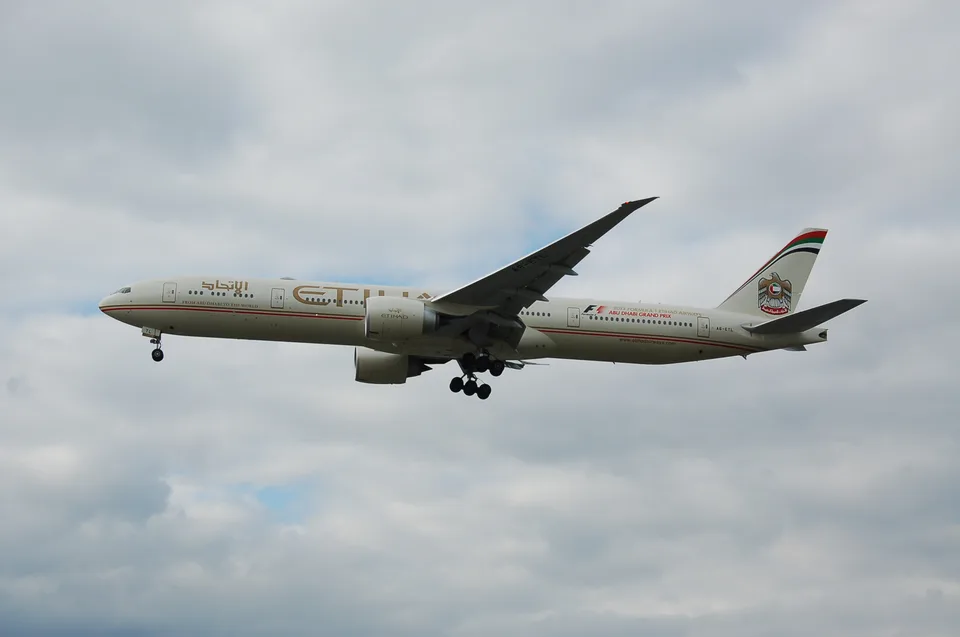
A nose tire shed its tread as Etihad flight EY450 rotated at Abu Dhabi. Debris disabled the left engine, and the Boeing 777 returned for an overweight landing.
Original photograph kept at its full dimensions. Responsive WebP copies resized without cropping.
Geographic context
Abu Dhabi International Airport, departure and return
Sydney Kingsford Smith Airport, planned destination
EY450 was scheduled from Abu Dhabi to Sydney and returned to Abu Dhabi after the engine failure. Airport markers show approximate locations. Basemap: Natural Earth, public domain.Read supporting evidence
During rotation on runway 13R, the left nose wheel tire shed its tread. Fragments damaged the fuselage and were ingested by the left engine, which shut down automatically. The crew continued on the right engine and returned to runway 13L. All 352 occupants disembarked without injury.
Read the full incident Follow what happened, from the flight to the investigation findings.
What investigators concluded
AAIS found that foreign-object damage caused the nose tire tread to separate. Ingested tire debris caused the left engine to fail. Investigators identified a risk of debris entering both engines and issued six safety recommendations.
1,513 words / about 7 minutes to read. Based on the investigation records cited below.
A heavy departure for Sydney
Etihad Airways flight EY450 was preparing to leave Abu Dhabi International Airport for Sydney on 27 September 2016. The Boeing 777-3FXER, registered A6-ETL, carried 335 passengers, two operating pilots, two augmenting pilots and 13 cabin crew. The commander was flying from the left seat, the copilot was monitoring from the right seat, and the two additional pilots occupied the cockpit observer seats.
The aircraft had been delivered to Etihad in December 2012. Its maintenance records showed no significant defects. A daily tire inspection on the morning of the flight found no visible damage, and the recorded nose tire pressures were 226 psi on the left and 227 psi on the right. The cockpit tire pressure display had given no low pressure indication. The left nose tire had been installed on 29 August and had accumulated 49 cycles since that installation.
At 11:20 local time, a conventional tug and towbar pushed the aircraft back from stand 308. It taxied towards runway 13R. The weather was clear, with a temperature of 36 C, and investigators subsequently found that weather played no part in the incident. The calculated takeoff weight was 347,807 kg. The crew had calculated a decision speed of 174 kt and a rotation speed of 181 kt.
The takeoff roll began at 11:30:36. As the aircraft accelerated towards rotation speed, the pilots felt vibration in the cockpit. Fifty-four seconds after the roll began, a loud bang occurred during rotation. The flight history records an indicated airspeed of 196 kt at that point. The left engine failure message appeared on the engine indicating and crew alerting system, accompanied by a high exhaust gas temperature.
The flight data recorder captured a sharp change in the left engine parameters. Its indicated vibration rose from below one unit to five units, while its N1 rotational speed fell from 102.4 to below 31.8. At 11:31:32, the engine shut down automatically. The aircraft had used 2,920 meters of runway at rotation, leaving 1,180 meters available.
The crew continued the takeoff on the right engine, trimmed the aircraft and engaged the autopilot at about 400 feet above the ground. The indicated airspeed fell to 172 kt as the aircraft climbed through a radio altitude of 369 feet. The landing gear lever was selected up at 539 feet and 182 kt. At 11:32:58, the pilots completed the engine failure checklist.
The commander discussed the failure with the copilot and the augmenting pilots. He declared a MAYDAY at 11:34:51. Abu Dhabi air traffic control acknowledged the emergency, alerted the airport rescue and firefighting services, and sent the runway safety team to inspect runway 13R. The inspection found tire debris, and the controller passed that information to the pilots.
The crew recognized that the nose landing gear had sustained a problem, but its condition was uncertain. ATC offered a pass by the control tower so that the gear could be inspected visually. The commander declined and continued the climb. After further configuration changes, the aircraft climbed to 4,000 feet.
The crew prepared for a single engine overweight landing on runway 13L. They selected an approach speed of 201 kt, corresponding to VREF20 plus five knots, and autobrake setting four. The detailed flight history records touchdown at 12:05:14, at an indicated airspeed of 192 kt and about 1,280 meters beyond the threshold. The landing weight was calculated as 341,481 kg, compared with a maximum landing weight of 251,290 kg. The aircraft traveled another 2,590 meters before stopping, with 230 meters of runway left.
Rescue and firefighting personnel attended the aircraft immediately after landing and told the commander that they could see no fire. The passengers and crew left the aircraft using two sets of passenger stairs placed at doors R1 and R2. All 352 occupants survived without injury. The injury table also records no injuries to anyone outside the aircraft.
The overweight landing and prolonged rollout generated high brake temperatures. Thermal fuses in the main landing gear melted, and all the main gear tires deflated. The deflated tires kept the aircraft stationary on the runway. Both nose tires retained their pressure, including the left tire that had lost its tread. Investigators found no damage to the main gear wheel hubs.
More than 90 percent of the outer tread layer of the left nose tire had separated and broken up. Fragments had damaged the lower fuselage behind the nose gear bay, the nose gear steering cable, and the left engine inlet and fan blades. The engine also sustained compressor and hot section damage. Debris struck the inboard fan cowling of the right engine. That cowling remained undamaged, and the right engine ingested no tire debris.
The cockpit voice recorder and digital flight data recorder were removed from the aircraft and delivered to the AAIS recorder laboratory in Abu Dhabi. Both were successfully downloaded and read out. Investigators converted the flight data into synchronized plots and tabulated values, then superimposed the cockpit voice transcript on the plots. The final report includes a takeoff profile showing engine speed, exhaust gas temperature, vibration, landing gear indications, pitch, airspeed and radio height during the failure.
The tire manufacturer examined both nose tires. Investigators recovered about 80 percent of the detached tread for examination. On the damaged tire, all the tread ribs, the cut protector and some casing belt cords had detached. The inner liner, both sidewalls and both bead areas were in normal condition.
The examination divided the damaged tread into three areas, labeled A, B and C. Striation marks appeared at the tire shoulder, and the crown showed a characteristic sharp cut. The recovered pieces also bore chevrons, discolored rubber and skid marks. These features helped the manufacturer reconstruct the sequence of tread damage and contact with the runway.
A shearography inspection checked the casing for internal anomalies. It found no anomaly in the crown where the rubber had detached. Two small pockets of trapped air in the inboard bead area were unrelated to the separation. Examination of the crown and associated debris linked the damage to contact with a sharp foreign object. Investigators could not determine when or where the original damage occurred; it could have happened during an earlier flight at another airport.
The left nose tire had undergone three retreads, the maximum allowed by the operator's policy. AAIS found no anomalies in the manufacturing or retreading processes and concluded that the retread count did not contribute to the incident. The separation followed external damage to the tire. The most recent workshop inspection, on 12 July 2016, had found nothing abnormal. The tire manufacturer reported that this was its first experience of Boeing 777 nose gear tire debris being ingested by an engine and damaging it.
The analysis considered a foreign-object encounter or a cut from a towbarless tug as possible origins of the initial damage. The incident flight had used a conventional tug and towbar. A detailed search of the aircraft's taxi route, the runway and surrounding areas recovered no candidate object. The report attributed the tread shedding to foreign-object damage and the engine failure to ingestion of the released tire material.
Fragments traveled in several directions when the tread separated. Their impact on the right engine cowling showed that the remaining engine was also exposed to debris. AAIS identified significant potential for ingestion by that engine, which would have created a more hazardous situation. Its findings recorded that the aircraft manufacturer had not performed a risk analysis of nose wheel tire debris entering one or both engines and causing damage or failure. Investigators assessed the crew's handling from the vibration and engine failure through the return landing, and found that they followed the operator's procedures.
At Abu Dhabi, debris detection relied on inspections and observations by airport personnel. The airport had no automated foreign-object detection system. CCTV coverage was incomplete across aircraft parking areas, taxiways and runways. The sweeping vehicles lacked magnets, reducing their effectiveness at collecting potentially sharp metallic debris. The aerodrome manual assigned airside departments and service providers responsibility for keeping operating areas clear of stones, loose objects and debris. Inspection records were maintained, ramp workers collected debris into dedicated bins at aircraft stands, and the airport carried out visual inspections of runways, taxiways and ramps.
Investigators also found sharp edges on some aircraft stand guidance lights. Subsequent work identified towbarless tugs damaging lights while disengaging from aircraft. Tug operators received training to avoid disengaging near the lights. Airport staff also received foreign-object awareness training, and posters and dedicated debris bins supported the airport's collection program.
AAIS issued its final report on 9 October 2018 with six safety recommendations. Four were addressed to the GCAA: ensure regular inspections and audits of ground lights; ensure measures to prevent tug damage to lights; have aerodrome operators assess the need for automated debris detection; and supervise a study of requiring magnetic runway and taxiway sweepers. A fifth recommendation asked Abu Dhabi International Airport to install automatic foreign-object detection. The sixth asked the FAA to evaluate requiring Boeing to assess the risk of nose tire debris entering both engines after a tire failure or tread separation.
Rescue crews found no fire. Everyone disembarked through the right forward doors using stairs. Hot brakes caused the main landing gear tires to deflate.
Examination found that a sharp foreign object had damaged the tire crown. The tread later separated, and debris entered the left engine and caused it to fail.
The overweight landing produced high brake temperatures. The main landing gear thermal fuses melted and the tires deflated. Both nose tires kept their pressure.
AAIS successfully downloaded the cockpit voice recorder and prepared an audio transcript. The published final report summarizes the recorder examination.
Actions and recommendations are described at the dates of the cited records. A recommendation is not proof of implementation.
Ground light inspections and tug operations
AAIS reported training for tug operators following the discovery that disengaging tugs damaged ground lights. Recommendations SR18/2018 and SR19/2018 addressed inspection of light fittings and prevention of tug damage.
Recommendations SR20/2018 to SR22/2018 addressed assessments of automated detection, a study of magnetic sweepers, and installation of automatic detection at Abu Dhabi.
Matching dossiers for Risk to both engines: No other dossier in this collection.
Read alongside
These comparisons connect specific research topics. Shared circumstances do not establish identical causes. Evidence from both investigations is provided below.
Both investigations traced severe aircraft damage to tire debris after foreign-object contact. On A6-ETL, shed nose tire tread entered the left engine and the crew returned on the right engine. For Air France 4590, the BEA found that a tire ran over a part lost by an earlier aircraft; tire debris then caused a fuel tank rupture, followed by a fuel fire and loss of thrust.
Explore the records below for additional context. They open on the publisher's site and are not all included in our report search. Source reuse terms apply.
Private evidence cache. Only short attributed quotations in original commentary; full report and third-party illustrations are not redistributed. Source terms.
Kevin Murphy writes the incident accounts on AirlineIncidents.com, out of a long interest in aviation safety and the lessons each investigation leaves behind.
Prepared by
AirlineIncidents editorial desk
Report citation check
Independent expert review
Not completed
Citation checks compare supporting text with the indexed report pages. They do not constitute independent expert review. How these pages are prepared.