Cockpit voice recorder transcript

LEVEL 3 Final report

Based on the investigation authority's final report.

Date
Show source
Occurrence
Loss of control on approach
Location
Near Aliquippa, Pennsylvania, about 6 miles northwest of Pittsburgh International Airport
Show source
Operator
USAir
Show source
Aircraft
Boeing 737-3B7 (737-300)
Show source
Registration
N513AU
Show source
Route
Chicago O'Hare to Pittsburgh International
Show source
People aboard
132: 127 passengers and 5 crew
Show source
Fatalities
132: all 127 passengers and 5 crew; 0 on the ground
Show source
Survivors
0
Show source
Topics
Loss of control in flight, Training and procedures, Wake turbulence, Flight control malfunction, Flight control system design, Flight recorder evidence

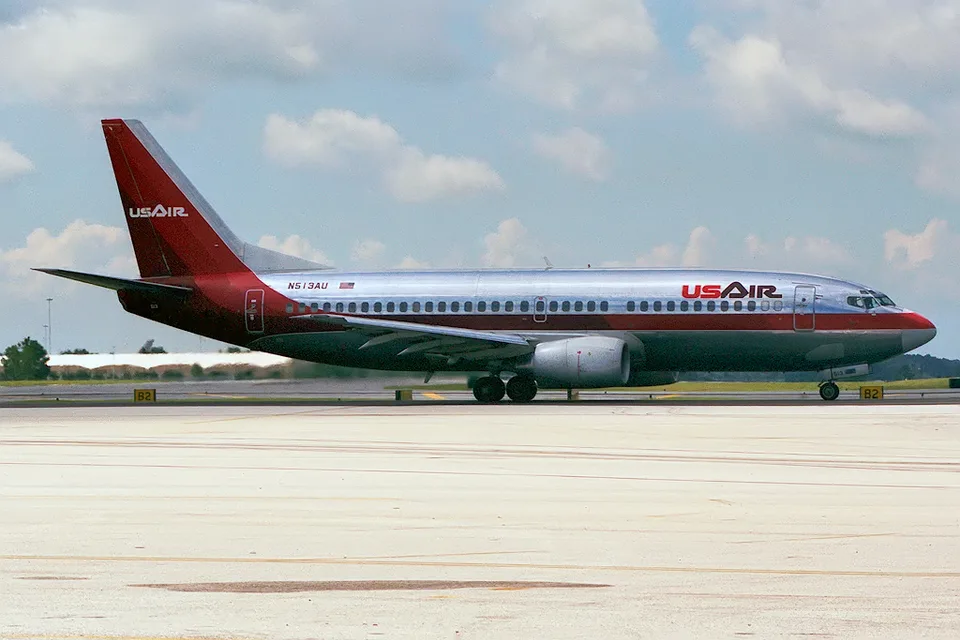
This photograph is cropped for the banner. See the full photograph, credit, licence and what it shows.

Photographs and geographic context

USAir Boeing 737 N513AU taxiing at Orlando in 1991.

N513AU at Orlando International Airport in June 1991.

Photo: Paul Denton, Creative Commons Attribution 4.0 International

Image info

The accident aircraft, photographed on 1 June 1991, more than three years before Flight 427.

Image source

The downloaded JPEG is used in its published framing. Responsive WebP copies resized without cropping.

Geographic context

Geographical orientation for USAir 427Chicago O'Hare departure; Accident site near Aliquippa; Pittsburgh International destination. The report places the accident at 40 degrees 36 minutes 14.14 seconds north, 80 degrees 18 minutes 36.95 seconds west, about 6 miles northwest of the destination airport. Airport markers are approximate.123NORTH UP / SCHEMATIC / NOT A RECORDED FLIGHT TRACK
  1. Chicago O'Hare departure
  2. Accident site near Aliquippa
  3. Pittsburgh International destination
The report places the accident at 40 degrees 36 minutes 14.14 seconds north, 80 degrees 18 minutes 36.95 seconds west, about 6 miles northwest of the destination airport. Airport markers are approximate. Basemap: Natural Earth, public domain.
Read supporting evidence

What happened

USAir flight 427 was approaching Pittsburgh at 6,000 feet and about 190 knots when it encountered the wake of a preceding Boeing 727. Its rudder then moved rapidly to the left aerodynamic limit. The airplane rolled left, descended and stalled. It struck a wooded hillside near Aliquippa at about 19:03:23, killing all 132 occupants.

Read the full incident Follow what happened, from the flight to the investigation findings.

What investigators concluded

The NTSB determined that loss of control followed movement of the rudder to its aerodynamic blowdown limit. It found that the rudder most likely moved opposite to the pilots' command because the main power control unit's secondary valve slide jammed off center and its primary slide overtravelled. The crew recognized the upset promptly and attempted recovery.

Evidence behind this explanation

What happened to USAir flight 427

1,577 words / about 8 minutes to read. Based on the investigation records cited below.

An arrival from Chicago

USAir flight 427 left Chicago O'Hare for Pittsburgh on 8 September 1994 with 127 passengers and five crew members. The Boeing 737-3B7, N513AU, became airborne at about 18:10 eastern daylight time. The first officer was flying with the automatic flight system engaged, while the captain handled radio communications and monitoring duties. Earlier that day, the same pilots had flown the airplane from Jacksonville to Charlotte and then to Chicago. Pittsburgh was the next destination in their three day trip sequence.

The approach developed in clear weather. Pittsburgh controllers were sequencing the 737 behind Delta flight 1083, a Boeing 727 arriving from the northwest. Flight 427 received successive descent and speed instructions, eventually reaching an assigned altitude of 6,000 feet and an assigned speed of 190 knots. The pilots completed their preliminary landing checklist and briefed the approach. The first officer made an arrival announcement to the cabin, and the captain confirmed that the intended runway was 28R.

At 19:02:22, approach control instructed Flight 427 to turn left onto a heading of 100 degrees and pointed out a departing Jetstream. The crew acknowledged the instruction. About half a minute later, the 737 was rolling out of its left turn, still at 6,000 feet and close to 190 knots. The first officer reported seeing the other aircraft.

Sources for this section

A wake encounter becomes a severe upset

At about 19:02:57, the cockpit voice recorder captured three thumps within a second, followed by short exclamations from the pilots. Over the next two seconds, the left bank increased from slightly less than 8 degrees to slightly more than 20 degrees. Airspeed briefly rose to about 193 knots before settling close to 191. Flight tests and reconstruction later showed that the aircraft had entered the descending wake vortices of the preceding 727.

The first response briefly arrested the roll. Between about 19:02:59 and 19:03:00, the bank reduced to about 15 degrees left. The heading, however, began changing left more quickly and passed through the assigned 100 degrees. Just after 19:03:00 the airplane rolled rapidly left again. By 19:03:01, its heading had passed through about 89 degrees and continued changing at at least 5 degrees per second. The NTSB concluded that the rudder had moved rapidly to the left and reached its aerodynamic blowdown limit.

The investigation found that controllers had maintained the required separation. The two arriving airplanes had remained at least 4.1 miles apart while at the same altitude. Wake encounter tests produced strong rolling motions, but the NTSB found that the wake alone could not explain the sustained heading change after 19:03:00.

Sources for this section

The final seconds

Just before 19:03:03, the recorded left bank reached about 43 degrees and the aircraft began descending from 6,000 feet. The control column moved aft and the airspeed began falling below 190 knots. The cockpit recording captured the autopilot disconnect warning. During the following seconds, the left roll increased, the column moved farther aft and the aircraft lost altitude.

The stall warning stickshaker began at 19:03:08.1. By then, the NTSB analysis placed the airplane at about 70 degrees of left bank and more than 20 degrees nose down. Approximately three seconds later, with the control column at its full aft position, the bank had passed 90 degrees and the nose was more than 50 degrees below the horizon. The captain transmitted an emergency declaration at about 19:03:15.

The cockpit recording stopped at 19:03:22.8. At about 19:03:23 the airplane struck a wooded hillside near Aliquippa, approximately 6 miles northwest of Pittsburgh International Airport. Impact forces and a subsequent fire destroyed the aircraft. All 132 occupants died. Emergency responders arrived within minutes, but the impact had destroyed the occupiable cabin space. The NTSB classified the accident as unsurvivable.

Sources for this section

Reconstructing a movement the recorder did not measure

Both recorders were recovered from the wreckage. The cockpit recording lasted 30 minutes 56 seconds and was of excellent quality. The flight data recorder yielded usable data despite impact damage. It recorded 13 parameters, including heading, airspeed, altitude, aircraft attitude and control column position. It recorded no flight control surface positions, and it could not identify which pilot had applied a particular control input.

The sampling rates also differed. Heading, altitude and airspeed were recorded once each second. Roll attitude and control column position were recorded twice a second, while vertical acceleration was recorded eight times a second. The cockpit audio supplied a continuous record of speech and sounds. Investigators used those different records together to establish the timing and character of the upset.

Investigators combined the recorded aircraft motion with flight tests, computer simulations, component examinations and analysis of the pilots' speech and effort sounds. A simulation involving rudder reversal after a right pedal input closely matched the recorded heading until the stall began. Boeing also developed a simulation in which a pilot applied and held left rudder. The NTSB compared both possibilities with the cockpit evidence and human performance analysis.

The Board found that the first officer probably made the initial control response. It considered simultaneous opposing inputs by the two pilots unlikely during the critical left yaw and roll. Its analysis rejected sustained full left pedal input by the crew as an explanation consistent with the human performance evidence. The combined evidence supported a reversal within the rudder system.

Sources for this section

How the rudder could reverse

The 737-300 used a single rudder panel driven by a main hydraulic power control unit. Inside that unit, a servo valve directed fluid to move the actuator. Its primary and secondary slides fitted concentrically within a housing. The primary slide normally moved first; the secondary slide supplied additional flow when needed for a rapid command. Both slides had some travel beyond their normal operating range.

Testing demonstrated a reversal mechanism. With the secondary slide jammed to the housing away from neutral, a sufficiently rapid opposing input could drive the primary slide beyond its normal range. Fluid would then be routed to move the rudder opposite to the input. The rudder could travel to its aerodynamic limit, where aerodynamic force balanced the available actuator force. That limit depended on the aircraft's flight condition.

Extreme thermal tests caused the accident valve's secondary slide to jam and produced indications of momentary reversal. Its internal clearances were tighter than those of a new production valve tested alongside it, and the NTSB considered it more susceptible to jamming. Those tests also demonstrated that a jam and reversal could leave no physical marks. The recovered valve remained capable of passing functional tests after testing. The Board identified secondary slide jamming with primary slide overtravel as the most likely reversal mechanism in Flight 427.

Sources for this section

A shrinking margin for recovery

A fully deflected rudder produced yaw and roll that the ailerons and spoilers could oppose only under some combinations of airspeed, configuration and vertical load. Investigators called the boundary crossover airspeed. By about 19:03:02, the aircraft's speed and rising vertical load had put it below that boundary. Regaining roll control then required increasing airspeed, reducing vertical load, or both.

The aft column movement was consistent with a pilot trying to arrest the nose down motion and maintain assigned altitude. It also increased vertical load and reduced the margin for countering the rudder. The crew had received no prior warning or training about rudder reversal and this relationship between load, speed and roll control. The NTSB concluded that the pilots recognized the initial upset promptly and immediately attempted recovery, but could not be expected to diagnose the fault and devise the necessary technique within the available seconds.

Simulator subjects sometimes recovered or stabilized the roll by promptly holding full right control wheel and applying enough forward column pressure to reduce load and preserve airspeed. They knew what would happen and had been coached in the response. Attempts to maintain altitude made recovery less likely. The NTSB found that knowledge, procedures and training would improve the prospects of recovery.

Sources for this section

Design changes and the final recommendations

The NTSB adopted its final report on 24 March 1999. It identified loss of control following movement of the rudder to its blowdown limit as the probable cause. The investigation also examined the wider architecture of the rudder system. The Board found that a jam in one valve slide could affect the other and that the design failed to provide reliable redundancy. Manual intervention to select a backup could take more time than an aircraft close to the ground allowed.

By the time of the report, Boeing had redesigned the servo valve and introduced hydraulic pressure reduction or limiting changes. The NTSB expected completion of those changes to prevent the identified reversal mechanism, while remaining concerned about other possible rudder malfunctions. Recommendation A-99-20 called for a reliably redundant rudder actuation system on existing and future 737s. A-99-21 sought an engineering test and evaluation board to examine potential failures in the complete system.

The final recommendations also addressed procedures, simulator accuracy, airspeed margins and recording. The Board sought complete initial and recurrent practice of the uncommanded yaw or roll and jammed or restricted rudder procedures. It recommended updating simulators with crossover airspeed flight test data and reviewing maneuvering speeds. Further recommendations sought additional recorded system parameters and pilot input forces, which would help investigators distinguish a pilot command from a control system malfunction.

A July 1998 survey showed the training gaps behind those recommendations. Three of twelve United States 737 operators contacted by the NTSB provided no simulator training in the new procedures. Only half demonstrated crossover airspeed, and only a third required that demonstration in the flaps 1 configuration. Flight tests also showed that the simulator package represented crossover airspeed inadequately. The Board called for both improved simulation and opportunities for pilots to practise the complete procedures.

Sources for this section

Return to the short summary / Source status and limitations

How the sequence developed

Follow the main stages, then open the evidence beneath each step.

  1. Wake encounter

    The aircraft encountered the preceding 727's wake while rolling out of a left turn at about 190 knots and 6,000 feet.

    Read supporting evidence
  2. Rudder reversal

    The NTSB found a reversal most likely followed a secondary valve slide jam away from neutral and primary slide overtravel.

    Read supporting evidence
  3. Roll control overwhelmed

    As airspeed decreased and vertical load increased, the roll controls could no longer counter the fully deflected rudder.

    Read supporting evidence
  4. Stall and descent

    The aircraft reached extreme left bank and nose down attitudes. Stall warning began at 19:03:08 and continued until the recording ended.

    Read supporting evidence

A simplified reading of the investigation findings. The sequence does not replace the full report or imply that every contributing factor is shown.

Sequence of events

Eastern daylight time, UTC minus four hours. Approximate times follow the NTSB flight history and analysis. Expand an event to see its evidence.

  1. About 18:10Departure from Chicago

    Flight 427 took off from Chicago with 127 passengers, two pilots and three flight attendants.

  2. 18:58:33Descent toward Pittsburgh
  3. 19:02:22Left turn assigned

    The controller assigned a heading of 100 degrees and called traffic. The crew acknowledged the turn.

  4. About 19:02:57Wake encounter and initial roll

    The cockpit recorder captured thumps as the airplane began banking more steeply left. Its indicated speed remained near 190 knots.

  5. About 19:03:00Rudder reaches its left limit

    The NTSB reconstruction placed the rapid left rudder deflection at about this time, followed shortly by its left aerodynamic blowdown limit.

  6. About 19:03:02Recovery authority diminishes

    Airspeed and vertical load placed the aircraft below crossover airspeed. The autopilot was disengaged as the upset continued.

  7. 19:03:08Stall warning

    The stickshaker began and continued through the end of the recording.

  8. About 19:03:15Emergency transmission

    The captain declared an emergency while the aircraft continued its steep descent.

  9. About 19:03:23Impact near Aliquippa

    The airplane struck wooded terrain about 6 miles northwest of Pittsburgh International Airport.

Search the report evidence

Search extracted report prose, with original page references. Short results link to the full document.

Questions readers ask

What made the accident servo valve susceptible to jamming?

Measurements showed smaller clearances between its secondary slide and housing than in a new production valve. The NTSB considered those tighter clearances likely to increase susceptibility to a jam.

Why did successful simulator recoveries require special preparation?

Test subjects expected the upset and were coached to hold full right control wheel, reduce vertical load and maintain airspeed above crossover. The accident crew had no prior training for that combination of failures and aircraft response.

Could centered rudder pedals show that a reversal had ended?

The NTSB found that linkage compliance could allow the pedals to return to neutral while the rudder remained at its aerodynamic limit. It recommended changing procedures that used centered pedals to judge recovery.

What the evidence can and cannot establish

Unmeasured control movements

The recorder omitted rudder and aileron input positions and flight control surface positions. Investigators reconstructed them using recorded aircraft motion, testing and cockpit evidence.

Read supporting evidence

Thermal test conditions

The valve jammed during extreme temperature differential tests. The NTSB identified tight clearances, thermal effects, particles in hydraulic fluid and unknown factors as possible contributors to a jam.

Read supporting evidence

Safety follow-up

Actions and recommendations are described at the dates of the cited records. A recommendation is not proof of implementation.

Revised procedures and realistic training

The report records procedures introduced following AD 96-26-07 and calls for complete initial and recurrent simulator practice. It also recommends removing centered pedals as a recovery criterion and updating crossover airspeed simulation.

Read supporting evidence

Classifications, with reasons

These labels organise the evidence. They are not a ranking of causes. A shared label means a shared research topic, not an identical mechanism.

Probable causeFlight control malfunction

The NTSB found that the rudder most likely reversed following a servo valve secondary slide jam and primary slide overtravel.

CircumstanceWake turbulence

Flight 427 encountered the preceding Boeing 727's wake. The NTSB found that the wake alone could not produce the continued heading change after 19:03:00.

Aerodynamic sequenceLoss of control in flight

By about 19:03:02, the combination of airspeed and vertical load left the roll controls unable to counter the fully deflected rudder.

Safety findingFlight control system design

The NTSB found that the dual concentric servo valve failed to provide reliable redundancy and called for a reliably redundant rudder actuation system.

Safety findingTraining and procedures

The crew had received no training for the rudder reversal and crossover airspeed problem. The NTSB recommended initial and recurrent simulator practice in the complete recovery procedures.

Investigation limitationFlight recorder evidence

The flight data recorder recorded 13 parameters but omitted flight control surface positions. The NTSB sought additional parameters and pilot input force measurements.

Read alongside

These comparisons connect specific research topics. Shared circumstances do not establish identical causes. Evidence from both investigations is provided below.

American Airlines Flight 587

Both investigations examined rudder response during an upset following wake turbulence. In USAir 427, the NTSB found a likely valve jam and reversal. In American Airlines 587, it found that unnecessary and excessive rudder pedal inputs created loads beyond ultimate design and separated the vertical stabilizer; rudder system characteristics and maneuvering training contributed.

Read supporting evidence

Further investigation records

Explore the records below for additional context. They open on the publisher's site and are not all included in our report search. Source reuse terms apply.

  • NTSB final report NTSB/AAR-99/01

    NTSB / investigation record

    The corrected final investigation report includes the flight history, valve examinations, flight tests, simulations, findings and safety recommendations.

Cockpit voice recorder transcript

A cockpit voice recorder (CVR) transcript records speech and sounds captured in the cockpit. This transcript was produced by the National Transportation Safety Board and is reproduced from printed pages 300 to 327 of the cited NTSB report; it is a US federal government work in the public domain.

Speaker codes and notation

RDO
Radio transmission from accident aircraft
CAM
Voice or sound source recorded through cockpit area microphone
HOT
Voice or sound source recorded through cockpit hot microphone
PA
Voice or sound source recorded through public address system
JSAP
Voice or sound source recorded through jumpseat audio panel
-1
Voice identified as captain
-2
Voice identified as first officer
-3
Voice identified as female flight attendant
-4
Voice identified as male flight attendant
CTR-?
Radio transmission from unidentified Center controller
CLE1
Radio transmission from 1st Cleveland Center controller
CLE2
Radio transmission from 2nd Cleveland Center controller
CLE3
Radio transmission from 3rd Cleveland Center controller
CLE4
Radio transmission from 4th Cleveland Center controller
ATIS
Radio transmission from Pittsburgh automatic terminal information service
APR1
Radio transmission from 1st Pittsburgh approach controller
APR2
Radio transmission from 2nd Pittsburgh approach controller
US1417
Radio transmission from USAir flight 1417
US1499
Radio transmission from USAir flight 1499
US1874
Radio transmission from USAir flight 1874
US1462
Radio transmission from USAir flight 1462
US1674
Radio transmission from USAir flight 1674
DL1083
Radio transmission from Delta flight 1083
US374
Radio transmission from USAir flight 374
285LM
Radio transmission from aircraft 285 LM
US309
Radio transmission from USAir flight 309
*
Unintelligible word
@
Nonpertinent word
#
Expletive
%
Break in continuity
( )
Questionable insertion
[ ]
Editorial insertion
....
Pause

Note: The CVR transcript reflects the final 30 minutes 56 seconds of the accident flight. Times are expressed in eastern daylight time, based on a 24-hour clock.

Cockpit voice recorder transcript, printed pages 300 to 327
TimeSpeakerText
START of RECORDING START of TRANSCRIPT
1832:29CTR-?... contact Chicago's Cleveland center one two six point niner seven.
1832:33RDO-1twenty six ninety seven, USAir four twenty seven, good day.
1833:08RDO-1center USAir four twenty seven at two nine oh.
1833:14CLE2USAir four twenty seven, Cleveland center roger.
1833:32CLE2USAir four twenty seven, cleared direct to uh, Akron, rest of route unchanged give me the best forward airspeed in-trail spacing.
1833:37RDO-1direct Akron, best forward, you got it, four twenty seven USAir.
1835:04HOT-1[sound similar to person yawning]
1837:46CAM[interruption in CVR audio similar to passing of CVR tape splice]
1838:00RDO-1blocked.
1840:38CLE2USAir four twenty seven, contact Cleveland center one one niner point eight seven.
1840:43RDO-1nineteen eighty seven, USAir four twenty seven, good day.
1840:50RDO-1Cleveland, USAir four twenty seven at two niner zero.
1840:54CLE3USAir four twenty seven Cleveland center roger and what is the indicated airspeed now?
1840:57RDO-1uh, we're indicating uh, 'bout uh, three hundred uh, assigned.
1843:23CLE3USAir fourteen seventeen, contact Cleveland center one three three point three seven.
1843:27US1417three three three seven, USAir's uh, fourteen seventeen. good day.
1843:32HOT-1had a four and a seven in it.
1843:34HOT-2ha ha ha.
1843:37HOT-1do you wanta let 'em up for a while?
1843:42CAM[sound of single chime similar to seat belt switch being moved]
1845:31CLE3USAir four twenty seven, descend and maintain flight level two four zero.
1845:35RDO-1out of two nine oh for two four oh, USAir four twenty seven.
1845:55HOT-2ah you piece of #.
1845:56HOT-1what?
1845:58HOT-2I said, aw c'mon, you piece of #, this damn thing is so # slow.
1846:07HOT-2there it is.
1847:23CLE3USAir four twenty seven contact Cleveland center one two eight point one five.
1847:27RDO-1twenty eight fifteen, USAir four twenty seven. good
day.
1847:35RDO-1center, USAir four twenty seven descending two four oh.
1847:38CLE4USAir four twenty seven Cleveland center roger.
1850:11DL1083and center, Delta ten eighty three's with you leaving seventeen five going down to one one thousand.
1850:15CLE4Delta ten eighty three Cleveland center, roger. cross CUTTA at one zero thousand. Pit altimeter three zero one one.
1850:18CAM[aural tone similar to altitude alert]
1850:21DL1083CUTTA at ten thousand, Delta ten eighty three.
1850:56CLE4USAir four twenty seven cross CUTTA at and maintain one zero thousand Pit altimeter three zero one one.
1851:01RDO-1CUTTA at ten, thirty eleven, USAir four twenty seven.
1851:08HOT-2ten, CUTTA.
1851:11HOT-1it's true.
1851:18HOT-1I'm off.
1851:18HOT-2alright.
1851:22ATIS..Pittsburgh tower arrival information Yankee. two one five two Zulu weather. two five thousand scattered. visibility one five. temperature seven five. dew point five one. wind, two seven zero at one zero. altimeter three zero one zero. multiple approaches ILS runway three two and ILS runway two eight right in use. notams, runway two eight right middle marker decommissioned. south entrance Air Force Reserve ramp closed. Morgantown vortac out of service. advise on initial contact you have information Yankee.
1851:54HOT-1three two and two eight right.
1851:57HOT-2three two and two eight right?
1851:58HOT-1yep.
1851:59HOT-?*.
1852:18HOT-2oh why did it *?
1853:15
CAM[sound similar to cockpit door being opened and closed]
1853:26CAM-3um, they didn't give us connecting flight information or anything. do you know what gate we're coming in on?
1853:29CAM-1not yet.
1853:30CAM-3any idea *.
1853:31CAM-1no.
1853:32CAM-3doya' know what I'm thinkin' about? pretzels.
1853:34HOT-1pretzels.
1853:37CAM-3you guys need drinks here?
1853:38CAM-1uh, I could use a glass of somethin', whatever's open. water uh, water, a juice..
1853:44CAM-2I'll splita yeah. a water, a juice, whatever's back there I'll split one with 'im.
1853:48CAM-3OKedoky.
1853:51CAM-3do you want me to make you my special fruity juice cocktail? (you wanna try it?)
1853:56CAM-1how fruity is it?
1853:57CAM-3(try it?)
1853:58HOT-2alright, I'll be a guinea pig.
1854:02CAM[sound similar to cockpit door being closed]
1854:07HOT-1[sound similar to person taking a deep breath]
1854:19CLE4Delta ten eighty three, reduce speed to two ten. contact Pit approach one two one point two five.
1854:24DL1083twenty one twenty five, good day.
1854:27CLE4USAir four twenty seven cross CUTTA one zero thousand two five zero knots now.
1854:30RDO-1ten two fifty over CUTTA, USAir four twenty seven.
1854:36HOT-2this thing's gonna scream and holler. I can't do that.
1854:42HOT-1thirty eleven.
1854:43HOT-2thirty eleven set.
1854:44HOT-1you can't make it?
1854:45HOT-2it's gonna say it can't.
1854:49HOT-2because its .... it it uh, it'll do it. I'll make it do it.
1854:53CAM[sound of unidentified click]
1854:55HOT-2see, it's callin' me names like it did you.
1856:16CLE4USAir four twenty seven reduce speed to two one zero now that's at the request of Pit approach I'll take the speed first.
1856:22RDO-1OK speed back to two ten USAir four twenty seven. uh, we'll do our best to make the restriction.
1856:27CLE4don't have to now. just uh, speed first uh, pd to ten.
1856:31RDO-1you got it.
1856:32CLE4USAir four twenty seven, contact Pit approach one two one point two five.
1856:36RDO-1twenty one twenty five, USAir four twenty seven, good day.
1856:43HOT-1two ten, he said.
1856:45HOT-2two ten? oh, I heard two fifty, #.
1856:49HOT-1I may have misunderstood him.
1856:52RDO-1approach, USAir four twenty seven is descending to ten.
1856:55APRShuttle twenty nine zero eight, turn right heading zero niner zero. contact approach one two three point niner five.
1857:05APRUSAir fourteen ninety nine, turn left heading one zero zero. contact approach one two four point one five.
1857:07CAM[sound similar to cockpit door being opened]
1857:08
CAM-3here it is.
1857:09HOT-1alright.
1857:09HOT-2alright. thank you, thank you.
1857:10CAM-3(now ** be fooled) if you don't like, I didn't taste 'em so I don't know if they came out right.
1857:11US1499one hundred degrees and twenty four fifteen, US fourteen ninety nine.
1857:14APRUSAir eighteen seventy four, descend and maintain six thousand.
1857:14HOT-1that's good [simultaneous with previous ATC transmission]
1857:15CAM-3*.
1857:16HOT-2that is good ..
1857:17CAM-3it's good.
1857:17HOT-2..that is different. be real, be real good with some dark
rum in it.
1857:20CAM-3yeah right. (can I get you something else?)
1857:23APRUSAir four twenty seven, Pittsburgh approach. heading one six zero vector ILS runway two eight right final approach course. speed two one zero.
1857:26HOT-2what kind of speed? OK.
1857:29RDO-1we're, comin' back to two ten and uh, one sixty heading down to ten, USAir four twenty seven, and uh, we have Yankee.
1857:40HOT-1what runway did he say? OK.
1857:43APRUSAir fourteen sixty two, Pittsburgh approach heading zero four zero vector ILS three two final approach course.
1857:43HOT-2***.
1857:45HOT-1it tastes like a **
1857:46HOT-2good.
1857:47HOT-1there's little grapefruit in it.
1857:49CAM-3no. [sound of laughter]
1857:54APRUSAir sixteen seventy four turn left heading one zero zero. contact approach one two four point one five.
1857:54HOT-2** cranberry.
1857:55CAM-3yeah. you saw that from the color.
1858:00US1674twenty four fifteen and a hundred on the heading US sixteen seventy four.
1858:02CAM-1how else is in it?
1858:03CAM-2uh, sprite?
1858:03APRDelta ten eighty three, descend and maintain six thousand.
1858:04CAM-3diet sprite.
1858:06CAM-2huh.
1858:07DL1083six thousand, ten eighty three.
1858:08CAM-3and I guess you could do it with sprite. prob'ly be a little better if you do.
1858:10CAM-1yeah, there's more?
1858:11CAM-3one more.
1858:13CAM-2ah.
1858:13HOT-2oh jay?
1858:14APRUSAir three seventy four, turn right heading one one zero.
1858:14CAM-3you got it.
1858:17HOT-2huh.
1858:17CAM-3cranberry orange and diet sprite.
1858:17CAM-2really nice.
1858:18CAM-3it's different. could ya keep comin' out aaah, whataya' got different and ..
1858:20CAM-1I always mix the cranberry and the grapefruit, I like that.
1858:21APRUSAir eighteen seventy four, reduce speed please to one niner zero then continue the descent to maintain six thousand.
1858:24CAM[sound of aural tone similar to altitude alert]
1858:25CAM-3** OK, back to work.
1858:26CAM-2OK.
1858:29CAM[sound similar to cockpit door opening and closing]
1858:29HOT-2I suspect we're gonna get the right side.
1858:33APRUSAir four twenty seven, descend and maintain six thousand.
1858:36RDO-1cleared to six, USAir four twenty seven.
1858:36HOT-1[intermittent static sound (heard on captain's channel only) lasting for three seconds]
1858:48CAM[sound of click similar to approach plate clip being snapped]
1858:50HOT-2oh my wife would like that [non-pertinent comment]
1858:56HOT-1cranberry orange and sprite.
1858:57APRUSAir sixteen seventy four, contact approach one two four point one five.
1858:58HOT-2yeah.
1859:04HOT-2I guess we ought to do a preliminary Pete.
1859:06HOT-1altimeters and flight instruments thirty eleven?
1859:08HOT-2my side.
1859:11HOT-1aah, where are we .... landing data is ...
1859:12285LM Pit, two eight five Lima Mike is thirteen for uhh, ten with
Allegheny's Hotel.
1859:14HOT-2posted on my side for a hundred and nine.
1859:15APRNovember two eight five Lima Mike, Pittsburgh approach. direct Montour vector ILS runway two eight final approach course.
1859:16HOT-1thirty three, forty three an two hundred.
1859:21285LM Montour on the vectors, Lima Mike...
1859:22HOT-1shoulder harness?
1859:24APRUSAir fourteen sixty two, descend and maintain six thousand.
1859:25HOT-2on.
1859:28CAM[sound of clicks similar to shoulder harness being fastened]
1859:28HOT-1approach brief?
1859:30APRUSAir three seventy four, contact approach one two
three point niner five, good day.
1859:31HOT-2plan two eight right. two seventy nine inbound, one eleven seven.
1859:36HOT-2[sound similar to deep inhale and exhale]
1859:41APRUSAir three zero nine, Pittsburgh approach, heading zero five zero vector ILS runway three two final approach course.
1859:54HOT-1ah, don't do this to me.
1859:56HOT-2[sound of chuckle] froze up did it?
1900:08APRDelta ten eighty three, turn left heading one three zero. reduce speed to one niner zero.
1900:12HOT-1[intermittent static sound (heard on captain's channel only) for seventeen seconds]
1900:12HOT-1I hate it when you don't hear the other transmissions.
1900:13DL1083one thirty one ninety speed, Delta ten eighty three.
1900:14
HOT-2[chuckle] yeah.
1900:15APRUSAir four twenty seven turn left heading one four zero, reduce speed to one niner zero.
1900:20RDO-1OK, one four zero heading and one ninety on the speed, USAir four twenty seven.
1900:24CAM[sound of three clicks similar to flap handle being moved]
1900:26CAM[sound of single chime similar to seat belt chime]
1900:26HOT-2oops, I didn't kiss 'em 'bye.
1900:28CAM[clicking sound similar to trim wheel turning at auto-pilot trim speed]
1900:31HOT-2what was the temperature, 'member?
1900:33APRfive Lima Mike contact Pittsburgh departure one two four point seven five.
1900:34HOT-1seventy five.
1900:35HOT-2seventy five?
1900:37CAM[clicking sound similar to trim wheel turning at auto-pilot trim speed]
1900:40285LM twenty four seventy five, Lima Mike.
1900:43PA-4... seatbelts and remain seated for the duration of the flight.
1900:44PA-2folks, from the flight deck we should be on the ground in 'bout ten more minutes. uh, sunny skies, little hazy. temperature, temperature's ah, seventy five degrees. wind's out of the west around ten miles per hour. certainly 'preciate you choosing USAir for your travel needs this evening, hope you've enjoyed the flight. hope you come back and travel with us again. this time we'd like to ask our flight attendants please prepare the cabin for arrival. ask you to check the security of your seatbelts. thank you.
1900:46APRDelta ten eighty three, turn left heading one zero zero.
1900:48DL1083one zero zero, ten eighty three.
1901:04RDO-1did you say two eight left for USAir four twenty seven?
1901:06CAM[chime similar to seatbelt chime]
1901:06APRuh, USAir four twenty seven, it'll be two eight right.
1901:08RDO-1two eight right, thank you.
1901:10HOT-1two eight right.
1901:11HOT-2right, two eight right. that's what we planned on. autobrakes on one for it.
1901:18APRDelta ten eighty three contact approach one two four point one five.
1901:22DL1083twenty four fifteen, good day.
1901:26APRUSAir fourteen sixty two at six thousand, reduce speed to one niner zero.
1901:35HOT-1I can't ***.
1901:36APRUSAir three zero niner, descend and maintain six thousand then reduce speed to one niner zero.
1901:42HOT-2Bravo thirty nine .... that's not too bad that's ...
1901:47APRUSAir eighteen seventy four turn right heading one zero zero. contact approach one two three point niner five.
1901:48HOT-2.. 'bout half way.
1901:50CAM[aural tone similar to altitude alert]
1901:51HOT-2(then) ... (works)
1901:56HOT-1seven for six.
1901:57APRUSAir fourteen sixty two turn right heading zero eight zero.
1901:58HOT-2seven for six.
1902:06HOT-1boy, they always slow you up so bad here.
1902:08HOT-2that sun is gonna be just like it was takin' off in Cleveland yesterday too. I'm just gonna close my eyes. [sound of laughter] you holler when it looks like we're close. [sound of laughter]
1902:24HOT-1[sound of chuckle] OK.
1902:24APRUSAir four twenty seven, turn left heading one zero zero. traffic will be one to two o'clock, six miles, northbound Jetstream, climbing out of thirty three for five thousand.
1902:32.0RDO-1we're looking for the traffic, turning to one zero zero, USAir four twenty seven.
1902:32.9CAM[sound similar to aircraft engines increasing in RPM to a steady value]
1902:34.8CAM[clicking sound similar to trim wheel turning at auto-pilot trim speed]
1902:54.3HOT-2oh ya, I see zuh Jetstream.
1902:57.0HOT-1[sound similar to three thumps]
1902:57.3HOT-1sheeez.
1902:57.5HOT-2zuh.
1902:58.0CAM[sound of thump]
1902:58.5HOT-1[sound similar to person inhaling/exhaling quickly one time]
1902:58.6CAM[sound of "clickety click"]
1902:59.1CAM[sound of thump of less magnitude than the first thump]
1902:59.3HOT-1whoa.
1902:59.5CAM[sound of "clickety click"]
1903:00.3HOT-2[sound similar to pilot soft grunting
1903:00.7CAM[sound of unknown click]
1903:01.1HOT-1hang on.
1903:01.1CAM[sound similar to aircraft engines increasing in RPM]
1903:01.5HOT-2[sound similar to pilot loud grunting]
1903:01.9HOT-1hang on.
1903:02.1CAM[sound of click and wailing horn similar to auto-pilot disconnect]
1903:03.6HOT-1hang on.
1903:04.4HOT-2oh #.
1903:05.2HOT-1hang on.
1903:07.5CAM[sound of increasing amplitude similar to onset of stall buffet]
1903:07.9CAM[vibrating sound similar to aircraft stick shaker starts and continues to end of recording]
1903:08.0HOT-1what the hell is this?
1903:08.3CAM[sound of aural tone similar to altitude alert]
1903:09.4JSAPtraffic traffic
1903:09.4CAMtraffic traffic
1903:09.6HOT-1what the ...
1903:09.9HOT-2oh...
1903:10.6HOT-1oh God.. oh God.
1903:13.3APRUSAir....
1903:15.0RDO-1four twenty seven emergency.
1903:17.4HOT-2#.
1903:18.1HOT-1pull
1903:18.5HOT-2oh #.
1903:19.1HOT-1pull
1903:19.7HOT-1(pull)
1903:20.8HOT-2God.
1903:21.1HOT-1[sound of screaming]
1903:22.5HOT-2no.
1903:22.8END of RECORDING END of TRANSCRIPT

Sources and transparency

Checked against NTSB/AAR-99/01, including its corrected edition. Independent expert review has not been completed.

Source limitations

The NTSB could not identify the physical combination that initiated the servo valve jam under normal airline operating conditions.

Uncontrolled Descent and Collision With Terrain, USAir Flight 427, Boeing 737-300, N513AU, Near Aliquippa, Pennsylvania, September 8, 1994

National Transportation Safety Board
Final report NTSB/AAR-99/01, adopted 24 March 1999; corrected edition includes changes dated 4 November 1999 and 16 February 2000.

Official report PDF, hosted by ntsb.gov

Open source document

370 PDF pages.

United States Government work. NTSB material is in the public domain except material identified as copyrighted. Source terms.

In-Flight Separation of Vertical Stabilizer, American Airlines Flight 587

National Transportation Safety Board
NTSB/AAR-04/04, adopted 26 October 2004

Official report PDF, hosted by ntsb.gov

Open source document

212 PDF pages.

United States federal government work; public domain in the United States. Third-party material carries any separately stated rights.

Read the extraction, classification and review methodology.

Suggest a correction to this dossier

Editorial record

Kevin Murphy writes the incident accounts on AirlineIncidents.com, out of a long interest in aviation safety and the lessons each investigation leaves behind.

Prepared by
AirlineIncidents editorial desk
Report citation check
Independent expert review
Not completed

Citation checks compare supporting text with the indexed report pages. They do not constitute independent expert review. How these pages are prepared.

Revision history

: NTSB final report findings, flight sequence and safety recommendations checked against the corrected report.

Source-based corrections are reviewed before changes appear here. Suggest a correction to this dossier.

Cite or link to this page

Quoting this account or linking to it? Please use the page address below, and credit the investigation report it is built from.

Credit line

AirlineIncidents.com. USAir Flight 427 accident account. Published 14 October 2026. https://airlineincidents.com/incidents/usair-427-1994/

HTML link

<a href="https://airlineincidents.com/incidents/usair-427-1994/">USAir Flight 427 accident account (AirlineIncidents.com)</a>

Select a box to copy it. Spotted something wrong? Send a correction.