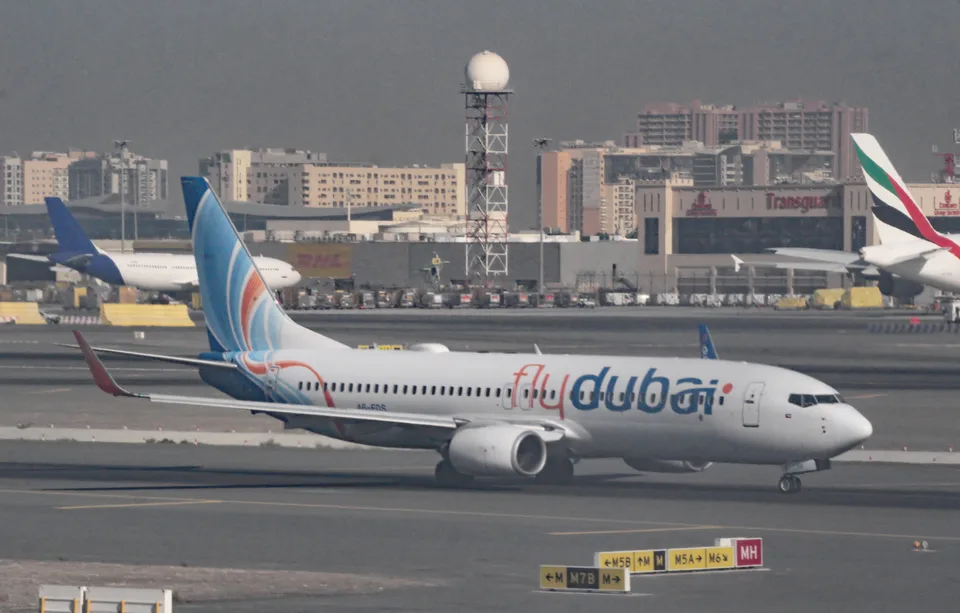
A peeled tyre tread struck hydraulic lines during gear retraction. The crew held at 4,000 feet, extended the remaining retracted gear manually and returned to Dubai.
Centre tread rib loss, Probable intermittent antiskid valve operation, Frangible fitting remained closed, System A lines and components damaged, Checklists and return to Dubai
Original photograph. Responsive WebP copies resized without cropping.
Geographic context
Dubai International Airport, departure runway 12R
Dubai International Airport, return runway 12L
FZ081 departed runway 12R, held at GINLA at 4,000 feet and returned to runway 12L at Dubai International Airport. Basemap: Natural Earth, public domain.Read supporting evidence
Flight FZ081 lost hydraulic system A shortly after takeoff from Dubai. The rotating tread of the left outboard main tyre damaged lines and components inside the wheel well. The crew completed the failure checklists, returned to runway 12L and landed safely. All 35 people on board were uninjured.
Read the full incident Follow what happened, from the flight to the investigation findings.
What investigators concluded
AAIS attributed the hydraulic loss to the rotating damaged tyre inside the left wheel well. It identified probable intermittent operation of the left alternate antiskid valve and the failure of the peeled tread to operate the frangible fitting as contributing factors.
Tyre tread damage and the loss of hydraulic system A
1,743 words / about 8 minutes to read. Based on the investigation records cited below.
Departure from Dubai
On 8 August 2017, flydubai Flight FZ081 left Dubai International Airport for Bahrain with 29 passengers and six crew. The aircraft was A6-FDS, a Boeing B737-8KN. The commander was flying and the co-pilot was monitoring. The flight pushed back from stand E23 at about 06:46 UTC and taxied for departure from runway 12R. The crew selected flaps 1, calculated a rotation speed of 134 knots and set an initial altitude of 4,000 feet for the standard instrument departure. The takeoff weight was approximately 54.6 tonnes.
The aircraft began its takeoff at about 07:15:30. The nose gear lifted at 07:16:20, followed approximately three and a half seconds later by both main landing gears. After the positive climb call, the commander called for gear retraction. At 07:16:29, the gear indications showed that the lever had moved to UP. Retraction began a second later. Pressure supplied for braking the main wheels rose from about 30 to 490 psi.
At 07:16:33, the recorded quantity of fluid in hydraulic system A began falling from 95.5 percent. Low pressure appeared at its electric pump at 07:16:35 and at its engine-driven pump and flight controls a second later. The aircraft was climbing through about 250 feet radio altitude when the system failed. At 07:16:37, the standby hydraulic system automatically pressurised to approximately 3,000 psi. The crew continued the climb towards 4,000 feet.
The right main gear reached its up and locked position. The left main gear and nose gear stopped before reaching their uplocks, then returned to the down and locked position at about 07:16:48 and 07:16:49 respectively. Their red warning lights remained illuminated because their positions disagreed with the gear lever, which was still set to UP. The right main gear remained retracted.
At 07:17:18, the co-pilot told Dubai Departure that the aircraft had a hydraulic problem and requested a convenient holding area. Departure approved maintaining 4,000 feet and subsequently directed the aircraft to GINLA. Autopilot A engaged for about five seconds during the climb. Investigators attributed that brief engagement to residual hydraulic pressure. The crew then selected autopilot B, which engaged at 07:18:29.
The pilots began the non-normal checklist for loss of hydraulic system A. They selected the system A flight control switch to standby rudder, switched both system A pumps off and selected alternate nose wheel steering. They reviewed the consequences for spoilers, brakes, landing gear and reverse thrust, and planned manual gear extension. Radio calls interrupted the checklist, which the pilots resumed and completed after each communication.
The commander requested holding to give both pilots time to understand the failure, make decisions and brief the required actions. He transferred control to the co-pilot while speaking to the cabin crew and the airline network control centre. The cabin crew were told that the aircraft would return to Dubai. AAIS found that both pilots followed the operating procedures, completed the necessary checklists and maintained sufficient situational awareness.
By 07:33:16, the crew were ready for an approach to runway 12L and requested radar vectors. The commander warned Departure that hydraulic fluid might reach the runway. At 07:34:56, the controller asked whether the crew were declaring an emergency. The co-pilot declared one on the commander's decision. The aircraft was handed to Approach and subsequently cleared to descend to 2,000 feet.
The descent preparation included autobrake setting 2, flaps 30 landing data and a reference speed of 132 knots. The pilots reviewed the manual extension procedure before carrying it out. At 07:42:19, the co-pilot resumed that checklist, opened the floor access door and pulled the right gear handle first. The right gear uplock released at 07:42:37. He then pulled the nose and left handles. Three green lights confirmed that all landing gears were down. The gear lever was moved to DN, and at 07:43:24 the gear warnings disappeared.
The aircraft captured the instrument landing system for runway 12L and the crew completed the landing checklist. The commander disconnected the autopilot and autothrottle at 07:47:15. A6-FDS landed at 07:48:03, left the runway through taxiway N8 and taxied to stand E23 using alternate nose wheel steering. The engines were shut down at 07:57:47. All 35 occupants were uninjured.
The normal wheel brakes and autobrakes operated on hydraulic system B. Four flight spoilers remained available, while the four ground spoilers and four other flight spoilers were inoperative. The commander chose to use neither thrust reverser because the slower standby operation of the left reverser could produce asymmetric thrust. AAIS compared the landing with a previous flight in a similar configuration and conditions, adjusting for the weight difference. Its measured landing distance was approximately 48 percent greater, reflecting the hydraulic failure and the decision to use no reverse thrust.
Inspection after landing found that the centre tread rib of the No. 1 tyre, the outboard tyre on the left main landing gear, had peeled away completely. The tyre remained inflated. There was hydraulic fluid scattered inside the left main wheel well. Damage included hydraulic lines and components, landing gear parts, the auxiliary power unit fuel drain line and nearby structure. Components associated with both the engine-driven and electric hydraulic pumps were affected, allowing all the system A fluid to escape.
The Boeing 737 normally brakes its main wheels during retraction so that they stop spinning before entering the wheel wells. Gear retract pressure operates the alternate brake system for this purpose. The antiskid function is inhibited for 12.5 seconds after the lever moves to UP, preventing it from releasing the retraction braking pressure. With a normally functioning system, the main wheel assemblies should stop within approximately one second of the gear-up selection.
A second protection is a frangible fitting at the outer side of each main wheel well opening. A loose tread on a spinning wheel is intended to remove its lever, opening the fitting and removing retraction pressure from that gear actuator. The affected gear then stops retracting and moves down. A flow limiter and volume fuse control the resulting hydraulic flow and stop the loss of fluid.
In this incident, the peeled tread did not remove the fitting's lever. The left gear continued into the wheel well, where the rotating tread struck hydraulic lines and components. The fitting remained closed, so the associated protective flow sequence was never triggered. Retraction stopped when system A lost pressure. The right main gear had already reached its uplock.
After the damaged components had been replaced, an operational test showed that the left gear retraction brakes applied pressure normally. Further components were nevertheless sent to their vendors. The left alternate antiskid valve was found faulty in the shop. AAIS considered that it had most probably operated intermittently, allowing the left wheels to enter the wheel well while still rotating. The recorded rise in brake pressure showed that the metering valve had supplied pressure during retraction.
Maintenance records showed an earlier problem on 25 July 2017. A walk-around inspection found black rubber traces inside the left main wheel well. A detailed inspection found no damage, but the left retraction brakes failed to stop wheel rotation. The airline raised a deferred defect and released the aircraft under the applicable minimum equipment list. A separate deferred defect covered cleaning the wheel well.
On 1 August, the brake-metering valve was replaced and its installation test was satisfactory. The retraction braking defect was closed. The cleaning defect remained open for the incident flight, with no applicable time limit for its correction. AAIS considered that a clean wheel well could help reveal whether retraction braking was functioning, and called for sufficiently frequent technical washing and documented references for maintenance deferrals.
The investigation found that A6-FDS was airworthy when dispatched and had been maintained in accordance with UAE civil aviation requirements. Its hydraulic redundancy operated as designed after system A failed: system B and the standby system supplied essential functions. Normal wheel braking remained available, and alternate steering allowed the aircraft to taxi after landing.
Michelin examined the damaged tyre and reviewed its manufacturing and retreading records, finding them consistent with its specifications. The complete centre tread rib was missing, exposing the top belt ply. In one area that ply was abraded or torn away. A cut or damaged area in an inner tread groove had tear lines extending from it, identifying a possible starting point for the tread loss.
The missing tread pieces were never recovered. Michelin could not determine the root cause of the separation. AAIS considered that foreign object debris or a rough ground surface could have produced the cut, but could not determine where, when or how it occurred. Runway inspections before and after the incident found no foreign object debris. The investigation considered that a cut could have occurred on an earlier flight and escaped detection.
The tyre had been retreaded twice. Its recorded second retread was on 24 February 2017, and it was fitted to A6-FDS on 26 July. It had completed 66 cycles when removed after the incident. AAIS found no evidence of internal separation before the flight, and no significant lateral acceleration during takeoff that could have imposed a substantial additional side load. After the incident, two aircraft tyres were within their pressure limits and four were above the maximum.
AAIS issued its final report on 17 September 2018. It identified the rotation of the damaged No. 1 tyre inside the left wheel well, and the resulting damage to hydraulic system A, as the cause. The contributing factors were the intermittent operation of the left alternate antiskid valve, which most probably allowed the wheels to continue spinning, and the failure of the peeled tread to operate the frangible fitting. Investigators could not determine why the fitting failed to open.
The report recorded that flydubai had required its contracted retreading agencies to apply the manufacturer's reliability-based inspection requirements, including shearography, and the associated acceptance criteria. AAIS issued two recommendations to the airline. SR09/2018 called for retreaded tyres to be included in its reliability programme and for robust on-wing pressure monitoring. SR10/2018 addressed wheel well washing and a policy requiring a documented reference for deferred corrective maintenance.
SR11/2018 asked the GCAA to ensure that operators' monitoring of nose and main wheel tyre pressures maintained the required integrity of retreaded tyres throughout their operating range. SR12/2018 asked Boeing to assess the risk associated with protecting wheel well components, including how the frangible fitting functions when a damaged tyre retracts. The report also found that the holding area and radar vectors had created no significant air traffic control workload issue.
System B and standby hydraulics supplied essential functions. Manual extension released the right gear uplock and alternate steering supported taxiing.
A simplified reading of the investigation findings. The sequence does not replace the full report or imply that every contributing factor is shown.
Sequence of events
UTC, four hours behind UAE local time. Times follow the synchronised flight data and cockpit voice recorder chronology in Appendix 2. Expand an event to see its evidence.
07:15:30Takeoff begins
FZ081 starts its takeoff from runway 12R for Bahrain.
Why did the damaged tyre enter the wheel well while spinning?
AAIS considered that intermittent or degraded operation of the left alternate antiskid valve produced incomplete gear retraction braking. The peeled tread then damaged hydraulic system A inside the wheel well.
AAIS calculated an increase of approximately 48 percent compared with a previous flight in a similar configuration and conditions, with a weight adjustment. The increase reflected the hydraulic failure and the use of no reverse thrust.
AAIS recommended retreaded tyre reliability monitoring, stronger tyre pressure checks, wheel well cleaning and documented maintenance deferrals. Boeing was asked to assess the protection of wheel well components when a damaged tyre retracts.
Actions and recommendations are described at the dates of the cited records. A recommendation is not proof of implementation.
Retreading inspections
The report records that flydubai required contracted retreading agencies to apply reliability-based inspection requirements, including shearography, and the manufacturer's acceptance criteria.
AAIS recommended retreaded tyre reliability monitoring, robust tyre pressure checks, frequent wheel well washing and documented references for deferred corrective maintenance.
These comparisons connect specific research topics. Shared circumstances do not establish identical causes. Evidence from both investigations is provided below.
Both investigations traced damage beyond the tyre itself. On A6-FDS, rotating peeled tread struck hydraulic lines inside the wheel well and the aircraft returned safely using its remaining hydraulic systems. For Air France 4590, the BEA found that a tyre ran over a metal strip; the tyre impact transmitted energy through the wing tank structure, released fuel and led to a major fire and engine thrust losses.
Explore the records below for additional context. They open on the publisher's site and are not all included in our report search. Source reuse terms apply.
Kevin Murphy writes the incident accounts on AirlineIncidents.com, out of a long interest in aviation safety and the lessons each investigation leaves behind.
Prepared by
AirlineIncidents editorial desk
Report citation check
Independent expert review
Not completed
Citation checks compare supporting text with the indexed report pages. They do not constitute independent expert review. How these pages are prepared.
Revision history
: GCAA AAIS issued Final Report AIFN/0008/2017 on 17 September 2018.